Aqueous zinc‑iodine (Zn‑I2) batteries are promising for large‑scale energy storage, yet their practical deployment is severely restricted by polyiodide shuttle behavior and the poor intrinsic conductivity of iodine active species. In this work, nitrogen‑doped carbon (C‑Z‑K) with a three‑dimensional interconnected wrinkled lamellar hierarchical porous framework is synthesized via high‑temperature calcination of dual precursors zeolitic imidazolate framework-8 (ZIF-8)‑gel and potassium citrate. When utilized as an iodine host for Zn‑I2 batteries, the optimized material achieves an initial specific capacity of 132.9 mAh g−1 and maintains 97.3% capacity retention after 800 continuous cycles versus the 50th cycle capacity. The hierarchically micro‑mesoporous structure coupled with nitrogen heteroatom doping works synergistically to suppress the harmful polyiodide shuttle effect, reinforce physical‑chemical confinement toward iodine species, and accelerate electronic and ionic transport. Electrochemical characterizations confirm favorable charge‑transfer kinetics, superior long‑term cyclability, and competitive rate performance. This study provides an instructive approach to construct metal-organic framework (MOF)‑derived porous carbon hosts for high‑performance aqueous Zn‑I2 battery systems.
Citation: Xianhe Meng, Qi Shen, Aobo Yue, Tao Chen, Zonghua Wang. Nitrogen-doped carbon with three-dimensional interconnected wrinkled lamellar hierarchical porous framework for high-performance aqueous Zn-I2 batteries[J]. AIMS Materials Science, 2026, 13(5): 967-975. doi: 10.3934/matersci.2026045
Aqueous zinc‑iodine (Zn‑I2) batteries are promising for large‑scale energy storage, yet their practical deployment is severely restricted by polyiodide shuttle behavior and the poor intrinsic conductivity of iodine active species. In this work, nitrogen‑doped carbon (C‑Z‑K) with a three‑dimensional interconnected wrinkled lamellar hierarchical porous framework is synthesized via high‑temperature calcination of dual precursors zeolitic imidazolate framework-8 (ZIF-8)‑gel and potassium citrate. When utilized as an iodine host for Zn‑I2 batteries, the optimized material achieves an initial specific capacity of 132.9 mAh g−1 and maintains 97.3% capacity retention after 800 continuous cycles versus the 50th cycle capacity. The hierarchically micro‑mesoporous structure coupled with nitrogen heteroatom doping works synergistically to suppress the harmful polyiodide shuttle effect, reinforce physical‑chemical confinement toward iodine species, and accelerate electronic and ionic transport. Electrochemical characterizations confirm favorable charge‑transfer kinetics, superior long‑term cyclability, and competitive rate performance. This study provides an instructive approach to construct metal-organic framework (MOF)‑derived porous carbon hosts for high‑performance aqueous Zn‑I2 battery systems.

| [1] |
Ran Y, Dong F, Sun S, et al. (2026) Aqueous zinc-based batteries: Active materials, device design, and future perspectives. Adv Energy Mater 16: 2406139. https://doi.org/10.1002/aenm.202406139 doi: 10.1002/aenm.202406139
|
| [2] |
Huang F, Xu W, He Y, et al. (2025) Electrolyte design toward high-performance zinc-iodine batteries: Progress, challenges, and prospects. Battery Energy 4: e70036. https://doi.org/10.1002/bte2.20250017 doi: 10.1002/bte2.20250017
|
| [3] |
Qi D, Jiang H, Chen X, et al. (2025) Design strategies, challenges, and prospects of nanomaterials for aqueous Zn-iodine batteries. ACS Nano 19: 24592–24620. https://doi.org/10.1021/acsnano.5c06585 doi: 10.1021/acsnano.5c06585
|
| [4] |
Wang L, Ji P, Li N, et al. (2025) Advancements and challenges in aqueous zinc-iodine batteries: Strategies for enhanced performance and stability. Electrochem Energy Rev 8: 34. https://doi.org/10.1007/s41918-025-00274-9 doi: 10.1007/s41918-025-00274-9
|
| [5] |
Bai Z, Wang G, Liu H, et al. (2024) Advancements in aqueous zinc-iodine batteries: A review. Chem Sci 15: 3071–3092. https://doi.org/10.1039/d3sc06150g doi: 10.1039/d3sc06150g
|
| [6] |
Chen S, Zeng S, Ao Z, et al. (2025) α-Trehalose: A multifunctional electrolyte additive for advanced aqueous Zn-I2 batteries under high Zn depth of discharge. Electr Act 514: 145515. https://doi.org/10.1016/j.electacta.2024.145515 doi: 10.1016/j.electacta.2024.145515
|
| [7] |
Qian Y, Chang G, Huang C, et al. (2025) Three-pronged approach enhances porous carbon spheres for high-performance aqueous zinc-iodine batteries. ACS SCE 13: 12057–12066. https://doi.org/10.1021/acssuschemeng.5c03672.s001 doi: 10.1021/acssuschemeng.5c03672.s001
|
| [8] |
Wu Y, Qian Y, Huang C, et al. (2023) Hierarchical porous soft carbon host for the cathode of an aqueous zinc-iodine battery with ultra-long cycle life. Electr Act 460: 142593. https://doi.org/10.1016/j.electacta.2023.142593 doi: 10.1016/j.electacta.2023.142593
|
| [9] |
Yan L, Liu T, Zeng X, et al. (2022) Multifunctional porous carbon strategy assisting high-performance aqueous zinc-iodine battery. Carbon 187: 145–152. https://doi.org/10.1016/j.carbon.2021.11.007 doi: 10.1016/j.carbon.2021.11.007
|
| [10] |
Zeng S, Chen S, Ao Z, et al. (2025) Dual-mechanism anchoring of iodine species by pitch-derived porous carbon for enhanced zinc-iodine battery performance. Small 21: 2501695. https://doi.org/10.1002/smll.202501695 doi: 10.1002/smll.202501695
|
| [11] |
Guo H, Luo H, Zhu F, et al. (2026) Mechanical-thermal decoupling engineering unlocks ultra-stable dry thick iodine cathodes for Ah-level zinc-based pouch batteries. Adv Mater 38: e73037. https://doi.org/10.1002/adma.73037 doi: 10.1002/adma.73037
|
| [12] |
Su X, Li S, Chen Z, et al. (2026) Steering Zn(ClO4)2 electrolyte: Trifunctional polycationic artificial interphase for wide-temperature Ah-level Zn-I2 pouch cells. Energy Storage Mater 85: 104900. https://doi.org/10.1016/j.ensm.2026.104900 doi: 10.1016/j.ensm.2026.104900
|
| [13] |
Mourdikoudis S, Dutta S, Kamal S, et al. (2025) State-of-the-art, insights, and perspectives for MOFs-nanocomposites and MOF-derived (nano)materials. Adv Mater 37: 2415399. https://doi.org/10.1002/adma.202415399 doi: 10.1002/adma.202415399
|
| [14] |
Liu Y, Wu X, Bando Y (2025) Toward highly durable aqueous zinc ion batteries: A review of MOFs/MOF-derived cathode materials. Inorg Chem Front 12: 3959–3980. https://doi.org/10.1039/D5QI00555H doi: 10.1039/D5QI00555H
|
| [15] |
Mohtaram MS, Abolghasemi A, Sayahi S, et al. (2026) MOF-derived nanomaterials: Transformative innovations for renewable energy and environmental sustainability. Coordin Chem Rev 546: 217083. https://doi.org/10.1016/j.ccr.2025.217083 doi: 10.1016/j.ccr.2025.217083
|
| [16] |
Chai L, Li R, Sun Y, et al. (2025) MOF-derived carbon-based materials for energy-related applications. Adv Mater 37: 2413658. https://doi.org/10.1002/adma.202413658 doi: 10.1002/adma.202413658
|
| [17] |
Liu Q, Wang S, Lang J, et al. (2025) Atomic synergy catalysis enables high-performing aqueous zinc-iodine batteries. Nano Lett 25: 6661–6669. https://doi.org/10.1021/acs.nanolett.5c00279 doi: 10.1021/acs.nanolett.5c00279
|
| [18] |
Miensah ED, Chen J, Gu A, et al. (2021) Ultrahigh capture of radioiodine with zinc oxide-decorated, nitrogen-doped hierarchical nanoporous carbon derived from sonicated ZIF-8-precursor. J Mater Sci 56: 9106–9121. https://doi.org/10.1007/s10853-021-05887-1 doi: 10.1007/s10853-021-05887-1
|
| [19] |
Yang Q, Qiao Y, Tong R, et al. (2026) Multi-site co-doped hierarchical porous carbon for efficient Iodine conversion and uniform zinc deposition in zinc-iodine batteries. Small Methods 10: e02240. https://doi.org/10.1002/smtd.202502240 doi: 10.1002/smtd.202502240
|
| [20] |
Tang L, Gao J, Shen T, et al. (2025) N, O co-doped porous carbon host with interconnected reaction microenvironments for long-life zinc-iodine batteries. Chem Eng J 517: 164383. https://doi.org/10.1016/j.cej.2025.164383 doi: 10.1016/j.cej.2025.164383
|
| [21] |
Zheng R, Guo Y, Hu J, et al. (2026) N-doped hierarchical porous carbon nanofibers as efficient hosts for stabling iodine redox kinetics. J Energy Storage 152: 120520. https://doi.org/10.1016/j.est.2026.120520 doi: 10.1016/j.est.2026.120520
|
| [22] |
Xu X, Huo R, Tang Z, et al. (2026) Synergistic anion-mediated conversion and single-atom catalysis enable fast and reversible iodine redox kinetics. ACS Electrochem 2: 1572–1582. https://doi.org/10.1021/acselectrochem.6c00132 doi: 10.1021/acselectrochem.6c00132
|
| [23] |
Sun J, Ma H, Wang D (2023) Heavily heteroatoms doped carbons with tunable microstructure as the iodine hosts for rechargeable zinc-iodine aqueous batteries. J Alloys Compd 947: 169696. https://doi.org/10.1016/j.jallcom.2023.169696 doi: 10.1016/j.jallcom.2023.169696
|
| [24] |
Sun J, Wang Z, Zhang J, et al. (2024) Shuttle-free zinc-iodine batteries enabled by a cobalt single atom anchored on N-doped porous carbon host with ultra-high specific surface area. J Energy Storage 90: 111716. https://doi.org/10.1016/j.est.2024.111716 doi: 10.1016/j.est.2024.111716
|
| [25] |
Wang D, Kong X, Wang Z, et al. (2025) Dual-functional Fe3O4-decorated porous carbon nanosheets for kinetics-enhanced aqueous zinc-iodine batteries. Green Carbon 3: 382–392. https://doi.org/10.1016/j.greenca.2025.06.005 doi: 10.1016/j.greenca.2025.06.005
|
| [26] |
Chaudhari A, Tan J (2017) A mechano-responsive supramolecular metal-organic framework (supraMOF) gel material rich in ZIF-8 nanoplates. Chem Commun 53: 8502–8505. https://doi.org/10.1039/c7cc03478d doi: 10.1039/c7cc03478d
|
| [27] |
Feng X, Liu C, Ren K, et al. (2025) In-situ synthesis of ZIF-8 gel network in mixed matrix membranes for enhanced CO2/N2 separations. Chem Eng Sci 311: 121610. https://doi.org/10.1016/j.ces.2025.121610 doi: 10.1016/j.ces.2025.121610
|
| [28] |
He Y, Liu M, Chen S, et al. (2022) Shapeable carbon fiber networks with hierarchical porous structure for high-performance Zn-I2 batteries. Sci China Chem 65: 391–398. https://doi.org/10.1007/s11426-021-1177-1 doi: 10.1007/s11426-021-1177-1
|
 matersci-13-05-045-Supplementary.zip |
 |
Figures(3)

Xianhe Meng, Qi Shen, Aobo Yue, Tao Chen, Zonghua Wang. Nitrogen-doped carbon with three-dimensional interconnected wrinkled lamellar hierarchical porous framework for high-performance aqueous Zn-I2 batteries[J]. AIMS Materials Science, 2026, 13(5): 967-975. doi: 10.3934/matersci.2026045

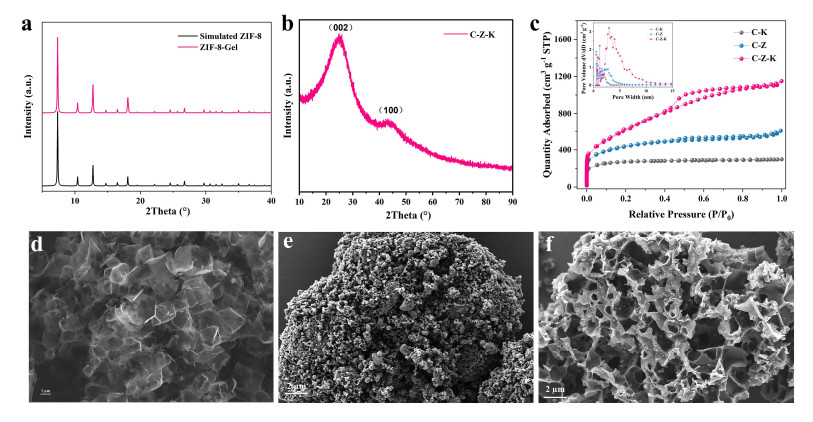
(a) XRD patterns of simulated ZIF-8, ZIF-8-gel. (b) The XRD pattern of C-Z-K. (c) Isothermal adsorption curves of C-K, C-Z and C-Z-K (insert curve is the pore size distribution). (d–f) The SEM images of C-K, C-Z and C-Z-K, respectively.
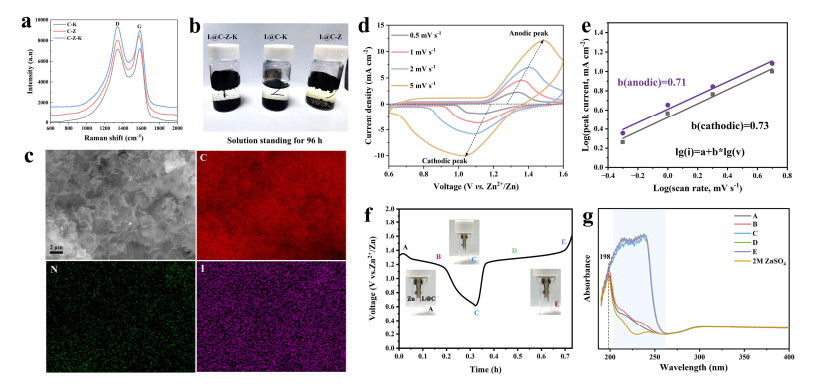
(a) The Raman spectra of C-K, C-Z and C-Z-K. (b) Photos of I2@C after standing in 2M ZnSO4 for 96 h. (c) The SEM and EDS images of I2@C-Z-K. (d) CV curves of I2@C-Z-K at different sweep speeds. (e) Dependence of the anodic and cathodic peak currents on the scan rate. (f) Different states in the first cycle for in-situ UV-vis at 1 C charge discharge rate. (g) In-situ UV-vis spectra of Zn-I2 cuvette battery.
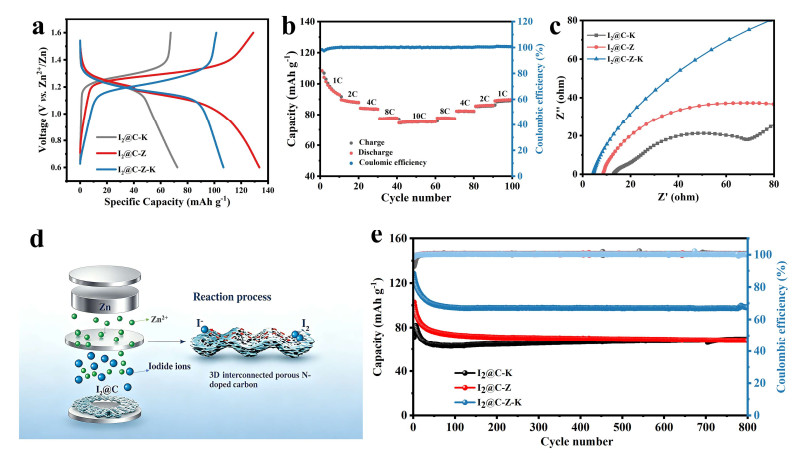
(a) The initial charge-discharge curve of electrode materials at 1 C. (b) Rate performance under different rate charge discharge current of Zn-I2 battery with I2@C-Z-K. (c) The Nyquist plots of Zn/C-I2 batteries after 10 cycles. (d) Schematic illustration of Zn/C-I2 battery. (e) Prolonged cyclic performance of Zn/C-I2 batteries at 2 C.




 DownLoad: