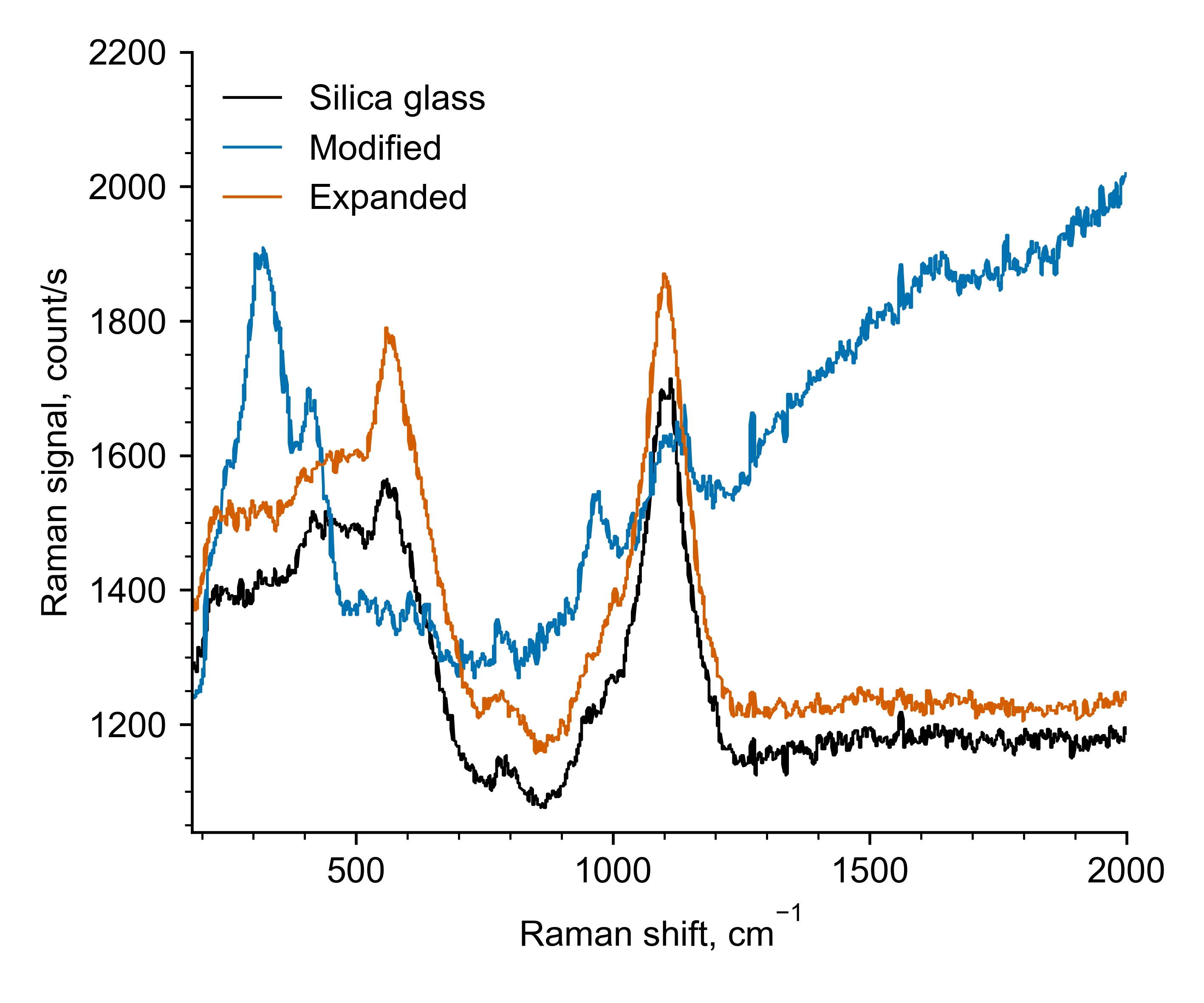
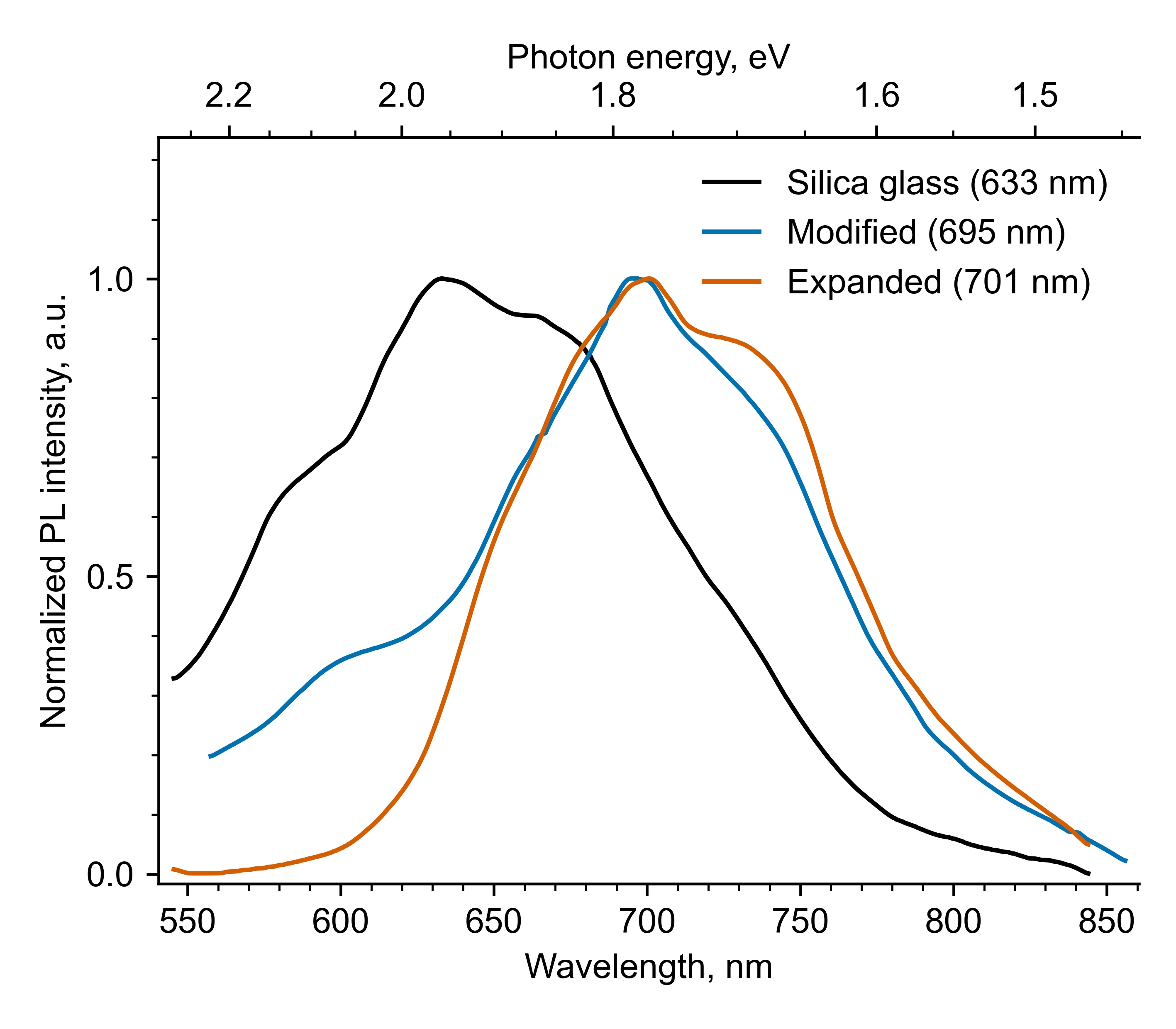
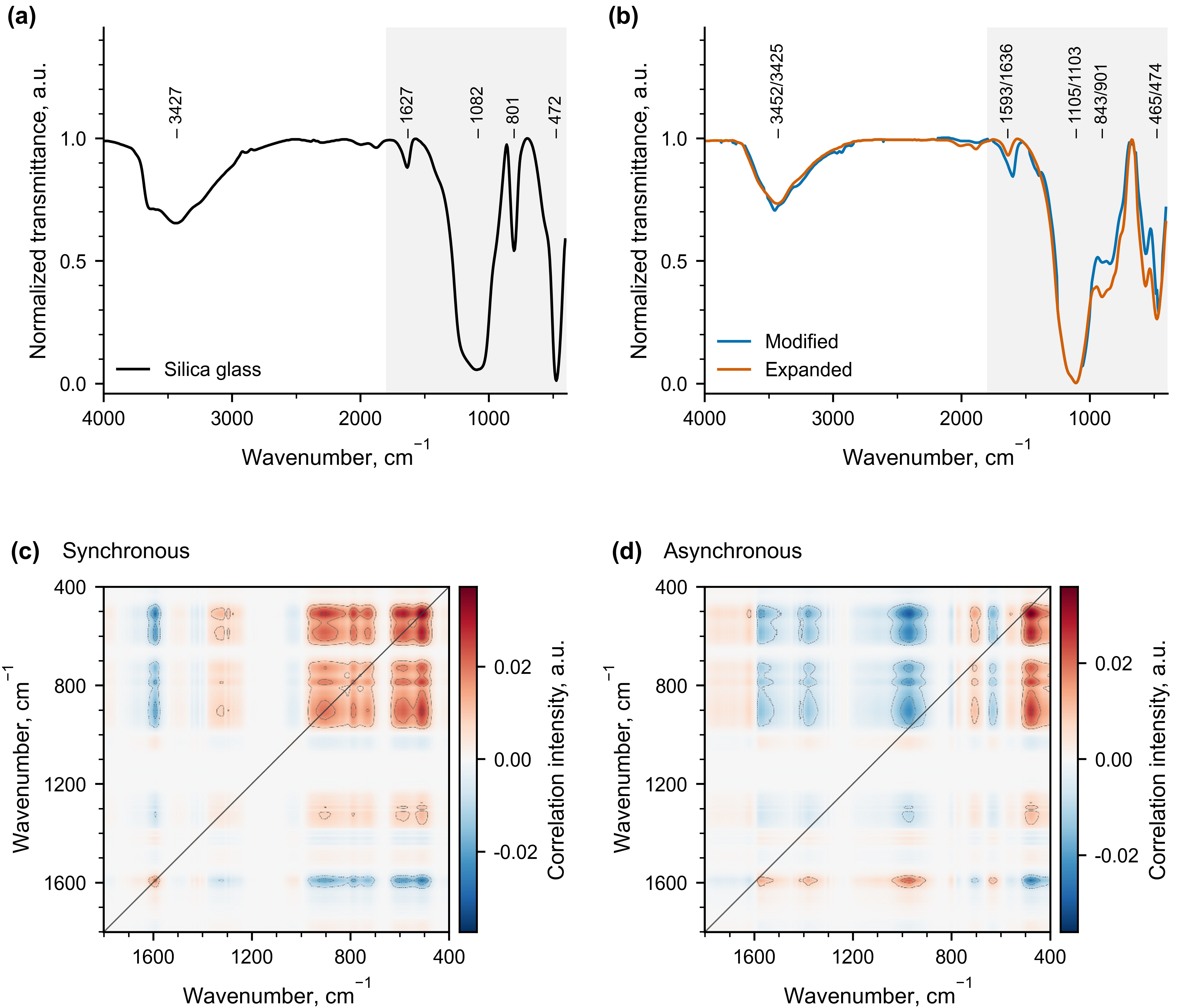
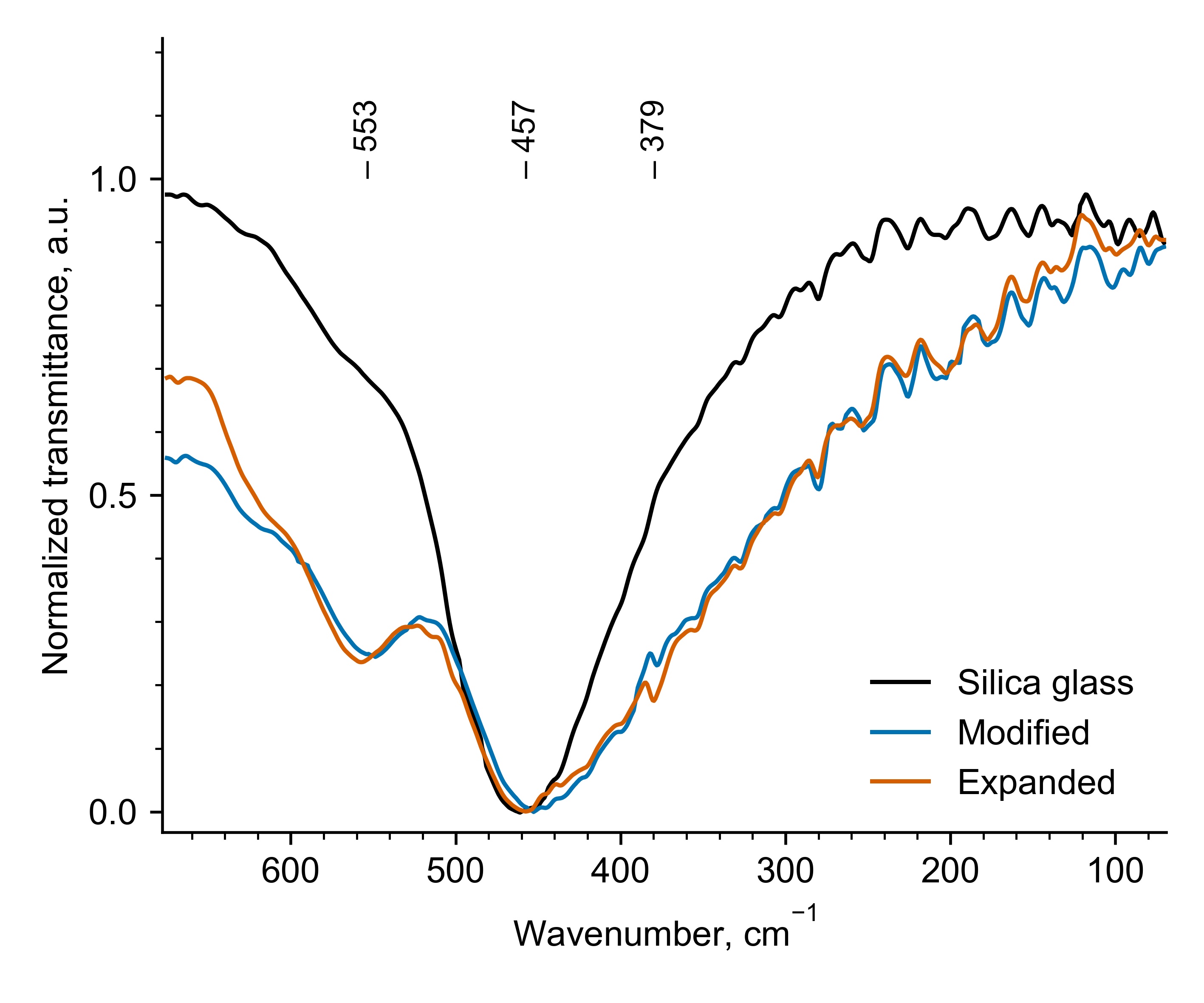
Hollow glass-crystalline fly ash microspheres, commonly known as cenospheres, represent a promising material platform for developing composite membranes intended for gas mixture separation. In this work, the first comprehensive structural characterization of cenosphere-based microspherical membranes (CBMMs) was performed using scanning electron microscopy–energy-dispersive X-ray spectrometry (SEM-EDS), magic-angle spinning nuclear magnetic resonance (MAS NMR), Raman spectroscopy, photoluminescence spectroscopy, and Fourier transform infrared spectroscopy (FTIR). The cenosphere shells exhibited a fragmentary structure, pronounced chemical heterogeneity, and silicon-rich zones devoid of modifier elements. The glassy phase of the cenospheres, which contained approximately 10 mol% modifier ions, demonstrated a density of 2.2 g/cm3, equivalent to that of pure silica glass, which contains no modifiers. This observed equivalence indicates an expanded glass network, resulting from the removal of modifier ions during the crystallization of defective phases within the glass-crystalline aluminosilicate shell. Furthermore, the close agreement between computational simulations and experimental FTIR spectra revealed the presence of strained structural sites and confirmed the formation of nanocavities attributable to the elimination of these modifier ions. To investigate the influence of the extended glass structure on the diffusion properties of silicate materials, the gas transport properties of the CBMMs were evaluated for pure gases (He, Ne) and for the He/Ne (80/20) mixture. Single‑gas permeation measurements revealed excellent performance, characterized by high helium permeability and a He/Ne ideal selectivity of 220–342 at 280 ℃. Furthermore, single‑stage membrane separation proved capable of enriching the helium feed from 80 to 99 vol%.
Citation: Elena V. Fomenko, Timur Yu. Ivanenko, Sergey V. Kukhtetskiy, Nikolay P. Shestakov, Alexander S. Krylov, Leonid A. Solovyov, Tatiana A. Vereshchagina. Glass-phase microstructure and He/Ne separation performance of cenosphere-based microspherical membranes[J]. AIMS Materials Science, 2026, 13(5): 913-938. doi: 10.3934/matersci.2026043
Hollow glass-crystalline fly ash microspheres, commonly known as cenospheres, represent a promising material platform for developing composite membranes intended for gas mixture separation. In this work, the first comprehensive structural characterization of cenosphere-based microspherical membranes (CBMMs) was performed using scanning electron microscopy–energy-dispersive X-ray spectrometry (SEM-EDS), magic-angle spinning nuclear magnetic resonance (MAS NMR), Raman spectroscopy, photoluminescence spectroscopy, and Fourier transform infrared spectroscopy (FTIR). The cenosphere shells exhibited a fragmentary structure, pronounced chemical heterogeneity, and silicon-rich zones devoid of modifier elements. The glassy phase of the cenospheres, which contained approximately 10 mol% modifier ions, demonstrated a density of 2.2 g/cm3, equivalent to that of pure silica glass, which contains no modifiers. This observed equivalence indicates an expanded glass network, resulting from the removal of modifier ions during the crystallization of defective phases within the glass-crystalline aluminosilicate shell. Furthermore, the close agreement between computational simulations and experimental FTIR spectra revealed the presence of strained structural sites and confirmed the formation of nanocavities attributable to the elimination of these modifier ions. To investigate the influence of the extended glass structure on the diffusion properties of silicate materials, the gas transport properties of the CBMMs were evaluated for pure gases (He, Ne) and for the He/Ne (80/20) mixture. Single‑gas permeation measurements revealed excellent performance, characterized by high helium permeability and a He/Ne ideal selectivity of 220–342 at 280 ℃. Furthermore, single‑stage membrane separation proved capable of enriching the helium feed from 80 to 99 vol%.

| [1] | Kerry FG (2007) Industrial Gas Handbook: Gas Separation and Purification, 1st Eds., Boca Raton: CRC Press.https://doi.org/10.1201/9781420008265 |
| [2] |
Rufford TE, Chan KI, Huang SH, et al. (2014) A review of conventional and emerging process technologies for the recovery of helium from natural gas. Adsorpt Sci Technol 32: 49-72.https://doi.org/10.1260/0263-6174.32.1.49 doi: 10.1260/0263-6174.32.1.49

|
| [3] |
Kim D, Gundersen T (2015) Helium extraction from LNG end-flash. Chem Eng Trans 45: 595-600.https://doi.org/10.3303/CET1545100 doi: 10.3303/CET1545100
|
| [4] |
Jahromi PE, Fatemi S, Vatani A, et al. (2018) Purification of helium from a cryogenic natural gas nitrogen rejection unit by pressure swing adsorption. Sep Purif Technol 193: 91-102.https://doi.org/10.1016/j.seppur.2017.11.002 doi: 10.1016/j.seppur.2017.11.002
|
| [5] |
Jin D, Xiao G, Lu Z, et al. (2026) Industrial advances in helium recovery and purification technologies: A review. Sep Purif Technol 380: 135136.https://doi.org/10.1016/j.seppur.2025.135136 doi: 10.1016/j.seppur.2025.135136
|
| [6] |
Scholes CA, Ghosh UK (2017) Review of membranes for helium separation and purification. Membranes 7: 9.https://doi.org/10.3390/membranes7010009 doi: 10.3390/membranes7010009
|
| [7] |
Soleimany A, Hosseini SS, Gallucci F (2017) Recent progress in developments of membrane materials and modification techniques for high performance helium separation and recovery: A review. Chem Eng Process Process Intensif 122: 296-318.https://doi.org/10.1016/j.cep.2017.06.001 doi: 10.1016/j.cep.2017.06.001
|
| [8] |
Scholes CA (2018) Helium recovery through inorganic membranes incorporated with a nitrogen rejection unit. Ind Eng Chem Res 57: 3792-3799.https://doi.org/10.1021/acs.iecr.8b00314 doi: 10.1021/acs.iecr.8b00314
|
| [9] |
Fomenko EV, Anshits NN, Solovyov LA, et al. (2013) Compositions and morphology of fly ash cenospheres produced from the combustion of Kuznetsk coal. Energy Fuels 27: 5440-5448.https://doi.org/10.1021/ef400754c doi: 10.1021/ef400754c
|
| [10] |
Fomenko EV, Rogovenko ES, Solovyov LA, et al. (2014) Gas permeation properties of hollow glass-crystalline microspheres. RSC Adv 4: 9997-10000.https://doi.org/10.1039/C3RA47909A doi: 10.1039/C3RA47909A
|
| [11] |
Fomenko EV, Rogovenko ES, Anshits NN, et al. (2023) Characterization of silicate glass/mullite composites based on coal fly ash cenospheres as effective gas separation membranes. Materials 16: 6913. https://doi.org/10.3390/ma16216913 doi: 10.3390/ma16216913
|
| [12] |
Kukhtetskiy SV, Fomenko EV, Anshits AG (2023) Anomalous diffusion of helium and neon in low-density silica glass. Membranes 13: 754.https://doi.org/10.3390/membranes13090754 doi: 10.3390/membranes13090754
|
| [13] | GOST 5382-2019 (2019) Cements and Materials for Cement Production. Chemical Analysis Methods. Moscow: Publishing House of Standards (in Russian).https://docs.cntd.ru/document/1200168999 |
| [14] | Günther H (2013) NMR Spectroscopy: Basic Principles, Concepts and Applications in Chemistry, 3 Eds., Weinheim: Wiley-VCH. |
| [15] |
Noda I (2018) Two-trace two-dimensional (2T2D) correlation spectroscopy—A method for extracting useful information from a pair of spectra. J Mol Struct 1160: 471-478.https://doi.org/10.1016/j.molstruc.2018.01.091 doi: 10.1016/j.molstruc.2018.01.091
|
| [16] |
Noda I (2020) Closer examination of two-trace two-dimensional (2T2D) correlation spectroscopy. J Mol Struct 1213: 128194.https://doi.org/10.1016/j.molstruc.2020.128194 doi: 10.1016/j.molstruc.2020.128194
|
| [17] |
Neese F (2025) Software update: The ORCA program system—Version 6.0. WIREs Comput Mol Sci 15: e80019.https://doi.org/10.1002/wcms.70019 doi: 10.1002/wcms.70019
|
| [18] |
Lin YS, Li GD, Mao SP, et al. (2013) Long-range corrected hybrid density functionals with improved dispersion corrections. J Chem Theory Comput 9: 263-272.https://doi.org/10.1021/ct300715s doi: 10.1021/ct300715s
|
| [19] |
Chai JD, Head-Gordon M (2008) Long-range corrected hybrid density functionals with damped atom-atom dispersion corrections. Phys Chem Chem Phys 10: 6615-6620.https://doi.org/10.1039/b810189b doi: 10.1039/b810189b
|
| [20] |
Grimme S, Antony J, Ehrlich S, et al. (2010) A consistent and accurate ab initio parametrization of density functional dispersion correction (DFT-D) for the 94 elements H-Pu. J Chem Phys 132: 154104.https://doi.org/10.1063/1.3382344 doi: 10.1063/1.3382344
|
| [21] |
Weigend F, Ahlrichs R (2005) Balanced basis sets of split valence, triple zeta valence and quadruple zeta valence quality for H to Rn: Design and assessment of accuracy. Phys Chem Chem Phys 7: 3297-3305.https://doi.org/10.1039/b508541a doi: 10.1039/b508541a
|
| [22] |
Neese F, Wennmohs F, Hansen A, et al. (2009) Efficient, approximate and parallel Hartree-Fock and hybrid DFT calculations. A 'chain-of-spheres' algorithm for the Hartree-Fock exchange. Chem Phys 356: 98-109.https://doi.org/10.1016/j.chemphys.2008.10.036 doi: 10.1016/j.chemphys.2008.10.036
|
| [23] |
Xiang Y, Du J, Smedskjaer MM, et al. (2013) Structure and properties of sodium aluminosilicate glasses from molecular dynamics simulations. J Chem Phys 139: 044507.https://doi.org/10.1063/1.4816378 doi: 10.1063/1.4816378
|
| [24] |
Yang J, Zavabeti A, Yu Z, et al. (2025) High purity helium and hydrogen production from natural hydrogen reservoir and natural gas. Sep Purif Technol 375: 133812.https://doi.org/10.1016/j.seppur.2025.133812 doi: 10.1016/j.seppur.2025.133812
|
| [25] | McNaught AD, Wilkinson A (1997) IUPAC. Compendium of Chemical Terminology (the "Gold Book"), 2 Eds., Oxford: Blackwell Scientific Publications.https://doi.org/10.1351/goldbook |
| [26] | Mulder M (1996) Basic Principles of Membrane Technology, 2 Eds., Dordrecht: Kluwer Academic Publishers.https://doi.org/10.1007/978-94-009-1766-8 |
| [27] |
Malfait WJ, Halter WE, Verel R (2008) 29Si NMR spectroscopy of silica glass: T1 relaxation and constraints on the Si-O-Si bond angle distribution. Chem Geol 256: 269-277.https://doi.org/10.1016/j.chemgeo.2008.06.048 doi: 10.1016/j.chemgeo.2008.06.048
|
| [28] |
Graetsch H, Mosset A, Gies H (1990) XRD and 29Si MAS-NMR study on some non-crystalline silica minerals. J Non-Cryst Solids 119: 173-180.https://doi.org/10.1016/0022-3093(90)90840-I doi: 10.1016/0022-3093(90)90840-I
|
| [29] |
Dupree R, Holland D, McMillan PW, et al. (1984) The structure of soda-silica glasses: A MAS NMR study. J Non-Cryst Solids 68: 399-410.https://doi.org/10.1016/0022-3093(84)90020-6 doi: 10.1016/0022-3093(84)90020-6
|
| [30] |
Jaymes I, Douy A, Massiot D, et al. (1996) Evolution of the Si environment in mullite solid solution by 29Si MAS-NMR spectroscopy. J Non-Cryst Solids 204: 125-134.https://doi.org/10.1016/S0022-3093(96)00414-0 doi: 10.1016/S0022-3093(96)00414-0
|
| [31] |
Gomes S, François M (2000) Characterization of mullite in silicoaluminous fly ash by XRD, TEM, and 29Si MAS NMR. Cem Concr Res 30: 175-181.https://doi.org/10.1016/S0008-8846(99)00226-4 doi: 10.1016/S0008-8846(99)00226-4
|
| [32] |
Sobornova VV, Khodov IA (2026) Quantitative 29Si NMR spectroscopy of ordered mesoporous silicas: revisiting Q3/Q4 ratios and surface hydroxylation in SBA-15 and MCM-41. Phys Chem Chem Phys 28: 3540-3549.https://doi.org/10.1039/D5CP03966E doi: 10.1039/D5CP03966E
|
| [33] |
Foley I, Farooqui SA, Kleinberg RL (1996) Effect of paramagnetic ions on NMR relaxation of fluids at solid surfaces. J Magn Reson Ser A 123: 95-104.https://doi.org/10.1006/jmra.1996.0218 doi: 10.1006/jmra.1996.0218
|
| [34] |
Chen X, Feng W, Zhang G, et al. (2019) Raman spectra of quartz and Pb4+-doped SiO2 crystals at different temperature and pressure. Crystals 9: 569.https://doi.org/10.3390/cryst9110569 doi: 10.3390/cryst9110569
|
| [35] |
Boizot B, Agnello S, Reynard B, et al. (2003) Raman spectroscopy study of β-irradiated silica glass. J Non-Cryst Solids 325: 22-28.https://doi.org/10.1016/S0022-3093(03)00334-X doi: 10.1016/S0022-3093(03)00334-X
|
| [36] |
Galeener FL (1982) Planar rings in glasses. Solid State Commun 44: 1037-1040.https://doi.org/10.1016/0038-1098(82)90329-5 doi: 10.1016/0038-1098(82)90329-5
|
| [37] |
Darziyeva TA, Alekperov ES, Jabarov SH, et al. (2021) Vibrational properties of nanoparticles iron oxide by Raman spectroscopy. Mod Phys Lett B 35: 2150125.https://doi.org/10.1142/S0217984921501256 doi: 10.1142/S0217984921501256
|
| [38] |
Zoppi A, Lofrumento C, Castellucci EM, et al. (2008) Al-for-Fe substitution in hematite: The effect of low Al concentrations in the Raman spectrum of Fe2O3. J Raman Spectrosc 39: 40-46.https://doi.org/10.1002/jrs.1811 doi: 10.1002/jrs.1811
|
| [39] |
Bost N, Duraipandian S, Guimbretière G, et al. (2016) Raman spectra of synthetic and natural mullite. Vib Spectrosc 82: 50-52.https://doi.org/10.1016/j.vibspec.2015.11.003 doi: 10.1016/j.vibspec.2015.11.003
|
| [40] |
Bates JB (1972) Raman spectra of α and β cristobalite. J Chem Phys 57: 4042-4047.https://doi.org/10.1063/1.1678878 doi: 10.1063/1.1678878
|
| [41] |
Trukhin A, Smits K, Chikvaidze G, et al. (2011) Luminescence of silicon dioxide—Silica glass, α-quartz and stishovite. Cent Eur J Phys 9: 1106-1113.https://doi.org/10.2478/s11534-011-0016-5 doi: 10.2478/s11534-011-0016-5
|
| [42] |
Pathak N, Gupta SK, Sanyal K, et al. (2014) Photoluminescence and EPR studies on Fe3+ doped ZnAl2O4: An evidence for local site swapping of Fe3+ and formation of inverse and normal phase. Dalton Trans 43: 9313-9323.https://doi.org/10.1039/C4DT00741G doi: 10.1039/C4DT00741G
|
| [43] | Cannas M (2002) Luminescence properties of point defects in silica. arXiv.https://doi.org/10.48550/arXiv.cond-mat/0203284 |
| [44] |
Patel N, Mariazzi S, Toniutti L, et al. (2007) Structural evolution of nanoporous silica thin films studied by positron annihilation spectroscopy and Fourier transform infrared spectroscopy. J Phys App Phys 40: 5266. https://doi.org/10.1088/0022-3727/40/17/038 doi: 10.1088/0022-3727/40/17/038
|
| [45] |
Kalampounias AG, Yannopoulos SN, Papatheodorou GN (2006) Temperature-induced structural changes in glassy, supercooled, and molten silica from 77 to 2150 K. J Chem Phys 124: 014504.https://doi.org/10.1063/1.2136878 doi: 10.1063/1.2136878
|
| [46] |
Ando MF, Benzine O, Pan Z, et al. (2018) Boson peak, heterogeneity and intermediate-range order in binary SiO2-Al2O3 glasses. Sci Rep 8: 5394.https://doi.org/10.1038/s41598-018-23574-1 doi: 10.1038/s41598-018-23574-1
|
| [47] |
Morrow BA, Cody IA (1976) Infrared studies of reactions on oxide surfaces. 6. Active sites on dehydroxylated silica for the chemisorption of ammonia and water. J Phys Chem 80: 1998-2004.https://doi.org/10.1021/j100559a010 doi: 10.1021/j100559a010
|
| [48] |
Ceresoli D, Bernasconi M, Iarlori S, et al. (2000) Two-membered silicon rings on the dehydroxylated surface of silica. Phys Rev Lett 84: 3887-3890.https://doi.org/10.1103/PhysRevLett.84.3887 doi: 10.1103/PhysRevLett.84.3887
|
| [49] |
Brinker CJ, Brow RK, Tallant DR, et al. (1990) Surface structure and chemistry of high surface area silica gels. J Non-Cryst Solids 120: 26-33.https://doi.org/10.1016/0022-3093(90)90187-Q doi: 10.1016/0022-3093(90)90187-Q
|
| [50] |
D'Souza AS, Pantano CG (2002) Hydroxylation and dehydroxylation behavior of silica glass fracture surfaces. J Am Ceram Soc 85: 1499-1504.https://doi.org/10.1111/j.1151-2916.2002.tb00303.x doi: 10.1111/j.1151-2916.2002.tb00303.x
|
| [51] |
Zachariasen WH (1932) The atomic arrangement in glass. J Am Chem Soc 54: 3841-3851.https://doi.org/10.1021/ja01349a006 doi: 10.1021/ja01349a006
|
| [52] |
Altemose VO (1961) Helium diffusion through glass. J Appl Phys 32: 1309-1316.https://doi.org/10.1063/1.1736226 doi: 10.1063/1.1736226
|
| [53] |
Leiby CC, Chen CL (1960) Diffusion coefficients, solubilities, and permeabilities for He, Ne, H2, and N2 in Vycor glass. J Appl Phys 31: 268-274.https://doi.org/10.1063/1.1735556 doi: 10.1063/1.1735556
|
| [54] |
T'Sai LS, Hogness TR (1932) The diffusion of gases through fused quartz. J Phys Chem 36: 2595-2600.https://doi.org/10.1021/j150340a007 doi: 10.1021/j150340a007
|
| [55] |
Norton FJ (1953) Helium diffusion through glass. J Am Ceram Soc 36: 90-96.https://doi.org/10.1111/j.1151-2916.1953.tb12843.x doi: 10.1111/j.1151-2916.1953.tb12843.x
|
| [56] |
Borjigin H, Stevens KA, Liu R (2015) Synthesis and characterization of polybenzimidazoles derived from tetraaminodiphenylsulfone for high temperature gas separation membranes. Polymer 71: 135-142.https://doi.org/10.1016/j.polymer.2015.06.021 doi: 10.1016/j.polymer.2015.06.021
|
| [57] |
Zhao Z, Ma X, Li Z, et al. (2011) Synthesis, characterization and gas transport properties of MOF-5 membranes. J Membr Sci 382: 82-90.https://doi.org/10.1016/j.memsci.2011.07.048 doi: 10.1016/j.memsci.2011.07.048
|
| [58] |
Au LTY, Yeung KL (2001) An investigation of the relationship between microstructure and permeation properties of ZSM-5 membranes. J Membr Sci 194: 33-55.https://doi.org/10.1016/S0376-7388(01)00489-6 doi: 10.1016/S0376-7388(01)00489-6
|
 matersci-13-05-043-Supplementary.zip |
 |
Figures(11) / Tables(7)

Elena V. Fomenko, Timur Yu. Ivanenko, Sergey V. Kukhtetskiy, Nikolay P. Shestakov, Alexander S. Krylov, Leonid A. Solovyov, Tatiana A. Vereshchagina. Glass-phase microstructure and He/Ne separation performance of cenosphere-based microspherical membranes[J]. AIMS Materials Science, 2026, 13(5): 913-938. doi: 10.3934/matersci.2026043





 DownLoad: