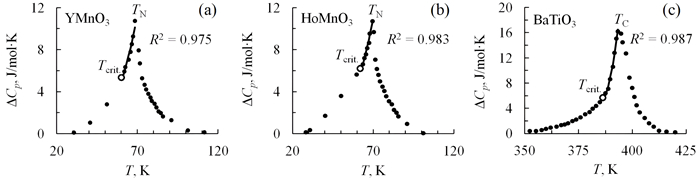
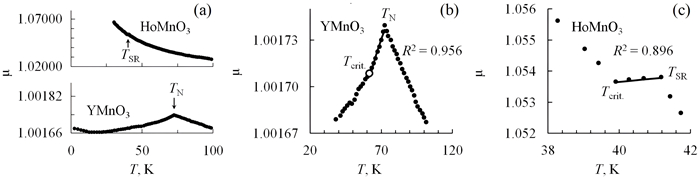
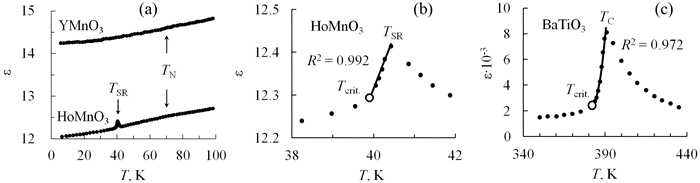
Ferroelectric materials and multiferroics are two classes of functional materials that exhibit unique electrical and magnetic properties that can be altered by external fields. Ferroelectrics are actively used as sensors, actuators, and energy storage devices, while multiferroics hold promise for future use in new types of memory and spintronic devices. Investigating the thermal excitation of the electron and spin subsystems of these materials is of theoretical and practical interest. Based on this, in this study, the vicinity of phase transitions exhibiting significant spin-phonon and electron-phonon interactions was analyzed for the ferroelectric BaTiO3 and the multiferroics YMnO3 and HoMnO3: a second-order transition from the antiferromagnetic state to the paramagnetic state at the temperature for YMnO3 and HoMnO3; a first-order magnetostructural spin-reorientation transition for HoMnO3; and a first-order ferroelectric phase transition of the displacement type at the Curie temperature for BaTiO3. From the temperature dependences of the permittivity, magnetic permeability, and heat capacity, the activation energies of these quantities in the neighborhood of the phase transitions were obtained. It is suggested that the obtained activation energy values for magnetic and dielectric permeability can serve as parameters for estimating the excitation processes of the spin and electronic subsystems, respectively; this constitutes the novelty of this study.
Citation: Danil V. Kuzenko, Aleksey V. Bezus. The excitation energy spectrum of the electron and spin subsystems of ferroelectrics and multiferroics, determined from ferroelectric and magnetic phase transitions[J]. AIMS Materials Science, 2026, 13(5): 897-912. doi: 10.3934/matersci.2026042
Ferroelectric materials and multiferroics are two classes of functional materials that exhibit unique electrical and magnetic properties that can be altered by external fields. Ferroelectrics are actively used as sensors, actuators, and energy storage devices, while multiferroics hold promise for future use in new types of memory and spintronic devices. Investigating the thermal excitation of the electron and spin subsystems of these materials is of theoretical and practical interest. Based on this, in this study, the vicinity of phase transitions exhibiting significant spin-phonon and electron-phonon interactions was analyzed for the ferroelectric BaTiO3 and the multiferroics YMnO3 and HoMnO3: a second-order transition from the antiferromagnetic state to the paramagnetic state at the temperature for YMnO3 and HoMnO3; a first-order magnetostructural spin-reorientation transition for HoMnO3; and a first-order ferroelectric phase transition of the displacement type at the Curie temperature for BaTiO3. From the temperature dependences of the permittivity, magnetic permeability, and heat capacity, the activation energies of these quantities in the neighborhood of the phase transitions were obtained. It is suggested that the obtained activation energy values for magnetic and dielectric permeability can serve as parameters for estimating the excitation processes of the spin and electronic subsystems, respectively; this constitutes the novelty of this study.

| [1] |
Weston L, Cui XY, Ringer SP, et al. (2016) Multiferroic crossover in perovskite oxides. Phys Rev B 93: 165210. https://doi.org/10.1103/PhysRevB.93.165210 doi: 10.1103/PhysRevB.93.165210

|
| [2] |
Bersuker IB (2012) Pseudo Jahn-Teller origin of perovskite multiferroics, magnetic-ferroelectric crossover, and magnetoelectric effects: The d0-d10 problem. Phys Rev Lett 108: 137202. https://doi.org/10.1103/PhysRevLett.108.137202 doi: 10.1103/PhysRevLett.108.137202
|
| [3] |
Bansal D, Niedziela JL, Sinclair R, et al. (2018) Momentum-resolved observations of the phonon instability driving geometric improper ferroelectricity in yttrium manganite. Nat Commun 9: 15. https://doi.org/10.1038/s41467-017-02309-2 doi: 10.1038/s41467-017-02309-2
|
| [4] |
Yamauchi K, Picozzi S (2009) Magnetically induced ferroelectricity in TbMnO3: Inverse Goodenough–Kanamori interaction. J Phys Condens Matter 21: 064203. https://doi.org/10.1088/0953-8984/21/6/064203 doi: 10.1088/0953-8984/21/6/064203
|
| [5] |
Van Aken BB, Palstra TTM, Filippetti A, et al. (2004) The origin of ferroelectricity in magnetoelectric YMnO3. Nat Mater 3: 164–170. https://doi.org/10.1038/nmat1080 doi: 10.1038/nmat1080
|
| [6] |
Sakai H, Fujioka J, Fukuda T, et al. (2011) Displacement-type ferroelectricity with off-center magnetic ions in perovskite Sr1−xBaxMnO3. Phys Rev Lett 107: 137601. https://doi.org/10.1103/PhysRevLett.107.137601 doi: 10.1103/PhysRevLett.107.137601
|
| [7] |
Delaire O, Stone MB, Ma J, et al. (2012) Anharmonic phonons and magnons in BiFeO3. Phys Rev B 85: 064405. https://doi.org/10.1103/PhysRevB.85.064405 doi: 10.1103/PhysRevB.85.064405
|
| [8] |
Poojitha B, Rubi K, Sarkar S, et al. (2019) Effect of phonon anharmonicity on ferroelectricity in Eu𝑥Ba1−𝑥TiO3. Phys Rev Mater 3: 024412. https://doi.org/10.1103/PhysRevMaterials.3.024412 doi: 10.1103/PhysRevMaterials.3.024412
|
| [9] |
Povzner AA, Volkov AG, Nogovitsyna TA (2024) Skyrmions and fluctuations of spin spirals in strongly correlated Fe1–хCoxSi with a noncentrosymmetric cubic structure. J Surf Investig 18: 944–949. https://doi.org/10.1134/S102745102470068X doi: 10.1134/S102745102470068X
|
| [10] |
Yakunina EM, Kravtsov EA, Khaydukov YN, et al. (2021) Structure and magnetism in multilayer Fe/MgO/Cr/MgO/Fe nanosystems. J Surf Investig 15: 793–798. https://doi.org/10.1134/S1027451021040406 doi: 10.1134/S1027451021040406
|
| [11] |
Asanov IP, Fedorenko AD, Vasilchenko DB, et al. (2023) Spin-orbit interactions in osmium complexes. J Surf Investig 17: 630–640. https://doi.org/10.1134/S1027451023030217 doi: 10.1134/S1027451023030217
|
| [12] |
Bauer GEW, Tang P, Iguchi R, et al. (2022) Magnonics vs. ferronics. J Magn Magn Mater 541: 168468. https://doi.org/10.1016/j.jmmm.2021.168468 doi: 10.1016/j.jmmm.2021.168468
|
| [13] |
Zhou XH, Cai C, Tang P, et al. (2023) Surface ferron excitations in ferroelectrics and their directional routing. Chin Phys Lett 40: 087103. https://doi.org/10.1088/0256-307X/40/8/087103 doi: 10.1088/0256-307X/40/8/087103
|
| [14] |
Wooten BL, Iguchi R, Tang P, et al. (2023) Electric field–dependent phonon spectrum and heat conduction in ferroelectrics. Sci Adv 9: eadd7194. https://doi.org/10.1126/sciadv.add7194 doi: 10.1126/sciadv.add7194
|
| [15] | Nagaev EL (1992) Ferrons and the giant Zeeman effect in amorphous semiconductors. Phys Solid State 34: 1882–1888 (in Russian). https://journals.ioffe.ru/articles/22471 |
| [16] |
Vazhenin VA, Rumyantsev E, Artemov MY, et al. (1998) Mechanisms of EPR line broadening in Pb5Ge3O11 near a structural transition. Phys Solid State 40: 293–298. https://doi.org/10.1134/1.1130296 doi: 10.1134/1.1130296
|
| [17] |
Glinchuk MD, Kondakova IV (1998) EPR and NMR line shapes in disordered ferroelectric crystals. Phys Solid State 40: 311–317. https://doi.org/10.1134/1.1130300 doi: 10.1134/1.1130300
|
| [18] |
Kallaev SN, Bakmaev AG, Omarov ZM, et al. (2022) Thermophysical properties of multiferroics Bi1−xTmxFeO3. Phys Solid State 64: 298–301. https://doi.org/10.21883/PSS.2022.02.52979.221 doi: 10.21883/PSS.2022.02.52979.221
|
| [19] |
Mitarov RG, Kallaev SN, Omarov ZM (2022) Heat capacity of nanostructured SmFeO3. Phys Solid State 64: 591–593. https://doi.org/10.21883/PSS.2022.05.53522.272 doi: 10.21883/PSS.2022.05.53522.272
|
| [20] |
Kallaev SN, Bakmaev AG, Omarov ZM (2023) Thermophysical properties and phase transitions of ferroelectric PbFe0.5Nb0.5O3 at high temperatures. Phys Solid State 65: 506–508. https://doi.org/10.21883/PSS.2023.03.55596.562 doi: 10.21883/PSS.2023.03.55596.562
|
| [21] |
Derets NK, Mikhailin NYu, Smirnova TA, et al. (2024) Study of the temperature behavior of the heat capacity of a relaxor ferroelectric PbNi1/3Nb2/3O3. Phys Solid State 66: 1649–1652. https://doi.org/10.61011/PSS.2024.10.59625.222 doi: 10.61011/PSS.2024.10.59625.222
|
| [22] |
Ovsyannikov GA, Constantinian KY, Ulev GD, et al. (2024) Manganite heterostructures SrIrO3/La0.7Sr0.3MnO3 and Pt/La0.7Sr0.3MnO3 for generation and registration of spin current. J Surf Investig 18: 210–216. https://doi.org/10.1134/S1027451024010336 doi: 10.1134/S1027451024010336
|
| [23] |
Jankowska-Sumara I, Kądziołka-Gaweł M, Podgórna M, et al. (2020) Complex structure and Mössbauer effect observed in the course of phase transitions in PbZr0.72Sn0.28O3 single crystal. J Chem Phys 153: 224202. https://doi.org/10.1063/5.0032957 doi: 10.1063/5.0032957
|
| [24] |
Gokhfeld YS, Kazak NV, Bel'skaya NA, et al. (2023) Structural disorder, specific heat, and magnetic transitions in Cu2FeBO5. J Exp Theor Phys 137: 494–505. https://doi.org/10.1134/S1063776123100175 doi: 10.1134/S1063776123100175
|
| [25] |
Shaykhutdinov KA, Skorobogatov S, Knyazev YV, et al. (2024) Controlling the temperature of the spin-reorientation transition in HoFe1−xMnxO3 orthoferrite single crystals. J Exp Theor Phys 165: 693–706. https://doi.org/10.31857/S004445102405е080 doi: 10.31857/S004445102405е080
|
| [26] |
Googlev KA, Kozakov AT, Kochur AG, et al. (2025) Crystal and electronic structure of the composite compound Bi1−xLaxFe1−yMnyO3+σ according to X-ray diffraction and X-ray electron spectroscopy. Phys Solid State 67: 285–290. https://doi.org/10.61011/PSS.2025.02.60679.348 doi: 10.61011/PSS.2025.02.60679.348
|
| [27] |
Khan AR, Bhardwaj S, Kumar S (2025) Influence of Fe3+ and Co2+ co-doping on the electrical, magnetodielectric, and multiferroic properties of lead-free Ba0.7Sr0.3TiO3 ceramics. J Magn Magn Mater 624: 173030. https://doi.org/10.1016/j.jmmm.2025.173030 doi: 10.1016/j.jmmm.2025.173030
|
| [28] |
Motseyko AV, Pushkarev AV, Olekhnovich NM, et al. (2025) Magnetic phase transitions in (1−x)BiFeO3–xPbFe1/2Sb1/2O3 solid solutions studied by the Monte Carlo method. Comput Mater Sci 253: 113860. https://doi.org/10.1016/j.commatsci.2025.113860 doi: 10.1016/j.commatsci.2025.113860
|
| [29] |
Evarestov RA, Novikov SS (2025) Non-empirical calculations of properties of KNbO3 and RbNbO3 crystals. Phys Solid State 67: 259–267. https://doi.org/10.61011/PSS.2025.02.60674.32-25 doi: 10.61011/PSS.2025.02.60674.32-25
|
| [30] |
Picozzi S, Yamauchi K, Sergienko IA, et al. (2008) Microscopic mechanisms for improper ferroelectricity in multiferroic perovskites: A theoretical review. J Phys Condens Matter 20: 434208. https://doi.org/10.1088/0953-8984/20/43/434208 doi: 10.1088/0953-8984/20/43/434208
|
| [31] |
Zhukov VP, Chulkov EV (2022) Electronic band structure and thermoelectric properties of SrTiO3, BaTiO3 and CaTiO3: ab initio approach. Phys Solid State 64: 1855–1863. https://doi.org/10.21883/PSS.2022.12.54377.383 doi: 10.21883/PSS.2022.12.54377.383
|
| [32] |
Tomczyk M, Vilarinho PM, Moreira A, et al. (2011) High temperature dielectric properties of YMnO3 ceramics. J Appl Phys 110: 064116. https://doi.org/10.1063/1.3629996 doi: 10.1063/1.3629996
|
| [33] |
Warren WL, Vanheusden K, Dimos D, et al. (1996) Oxygen vacancy motion in perovskite oxides. J Am Ceram Soc 79: 536–538. https://doi.org/10.1111/J.1151-2916.1996.TB08162.X doi: 10.1111/J.1151-2916.1996.TB08162.X
|
| [34] |
Sundarakannan B, Kakimoto K, Ohsato H (2003) Frequency and temperature dependent dielectric and conductivity behavior of KNbO3 ceramics. J Appl Phys 94: 5182–5187. https://doi.org/10.1063/1.1610260 doi: 10.1063/1.1610260
|
| [35] |
Kuzenko DV (2024) Activation analysis of the temperature dependence of the dielectric constant of ferroelectrics. Bull Russ Acad Sci Phys 88: 715–720. https://doi.org/10.1134/S1062873824706470 doi: 10.1134/S1062873824706470
|
| [36] |
Fan C, Zhao ZY, Song JD, et al. (2014) Single crystal growth of the hexagonal manganites RMnO3 (R = rare earth) by the optical floating-zone method. J Cryst Growth 388: 54–60. https://doi.org/10.1016/j.jcrysgro.2013.11.028 doi: 10.1016/j.jcrysgro.2013.11.028
|
| [37] |
Kuzenko DV (2021) Critical temperature below the Curie temperature of ferroelectric ceramics PZT. J Adv Dielectr 11: 2150006. https://doi.org/10.1142/S2010135X21500065 doi: 10.1142/S2010135X21500065
|
| [38] |
Kuzenko DV (2024) Determination of the activation energy of defects in ferroelectrics by the method of temperature activation–relaxation of the dielectric permittivity. J Surf Investig 18: 530–535. https://doi.org/10.1134/S1027451024700058 doi: 10.1134/S1027451024700058
|
| [39] |
Belov KP, Zvezdin AK, Kadomtseva AM, et al. (1976) Spin-reorientation transitions in rare-earth magnets. Sov Phys Usp 19: 574–596. https://doi.org/10.1070/PU1976v019n07ABEH005274 doi: 10.1070/PU1976v019n07ABEH005274
|
| [40] |
Bussmann A, Bilz H, Roenspiess R, et al. (1980) Oxygen. polarizability in ferroelectric phase transitions. Ferroelectrics 25: 343–346. https://doi.org/10.1080/00150198008207016 doi: 10.1080/00150198008207016
|
| [41] |
Kuzenko DV (2025) Construction of the interatomic potential of the ferroelectric barium titanate based on the temperature dependence of the heat capacity near the phase transition. Phys Solid State 67: 502–509. https://doi.org/10.61011/PSS.2025.03.60881.54-25 doi: 10.61011/PSS.2025.03.60881.54-25
|
| [42] | Smolensky GA (1985) The Physics of Ferroelectric Phenomena, Leningrad: Izdatel'stvo Nauka (in Russian). |
| [43] | Mushnikov NV (2017) Magnetism and Magnetic Phase Transitions, Ekaterinburg: Publishing house of the Ural. University (in Russian). |
| [44] |
Murtazaev AK, Abdulvagidov SB, Aliev AM, et al. (2001) Heat capacity of a Cr2O3 antiferromagnet near the critical temperature. Phys Solid State 43: 1103–1107. https://doi.org/10.1134/1.1378152 doi: 10.1134/1.1378152
|
| [45] |
Brown PJ, Chatterji T (2006) Neutron diffraction and polarimetric study of the magnetic and crystal structures of HoMnO3 and YMnO3. J Phys Condens Matter 18: 10085–10096. https://doi.org/10.1088/0953-8984/18/44/008 doi: 10.1088/0953-8984/18/44/008
|
| [46] |
Fiebig M, Lottermoser Th, Pisarev RV (2003) Spin-rotation phenomena and magnetic phase diagrams of hexagonal RMnO3. J Appl Phys 93: 8194–8196. https://doi.org/10.1063/1.1544513 doi: 10.1063/1.1544513
|
| [47] |
Bersuker IB (2001) Vibronic (pseudo Jahn-Teller) theory of ferroelectricity: Novel aspects and applications. Ferroelectrics 536: 1–59. https://doi.org/10.1080/00150193.2018.1528919 doi: 10.1080/00150193.2018.1528919
|
Figures(5) / Tables(2)

Danil V. Kuzenko, Aleksey V. Bezus. The excitation energy spectrum of the electron and spin subsystems of ferroelectrics and multiferroics, determined from ferroelectric and magnetic phase transitions[J]. AIMS Materials Science, 2026, 13(5): 897-912. doi: 10.3934/matersci.2026042





 DownLoad: