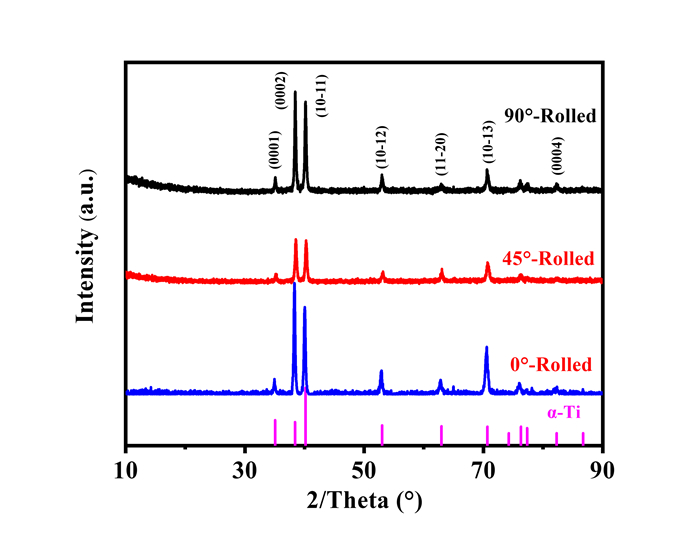
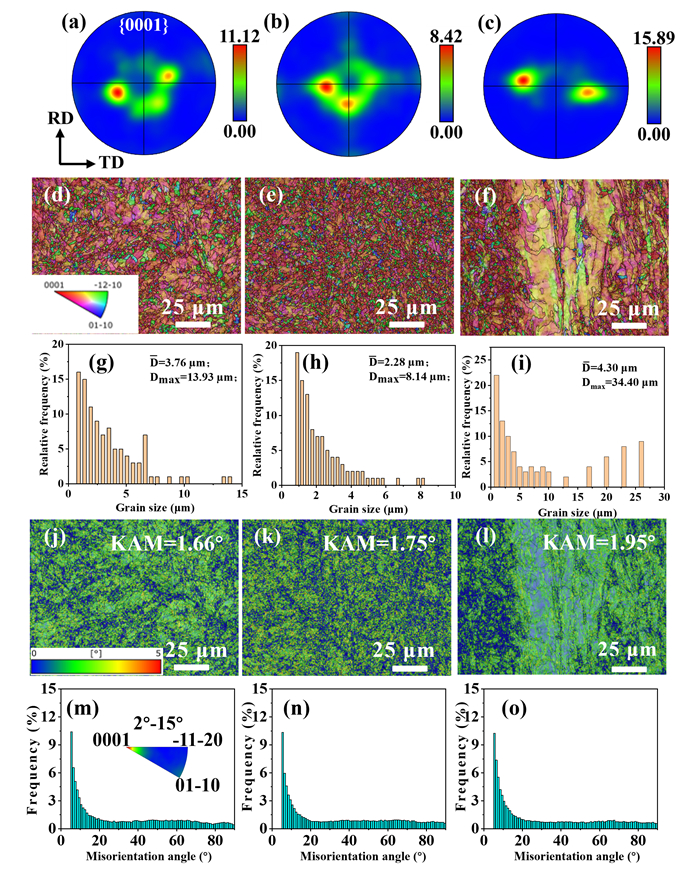
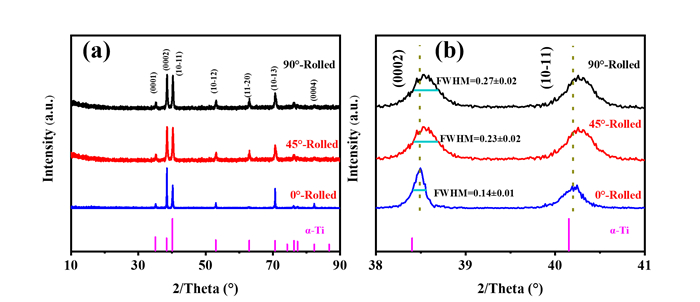
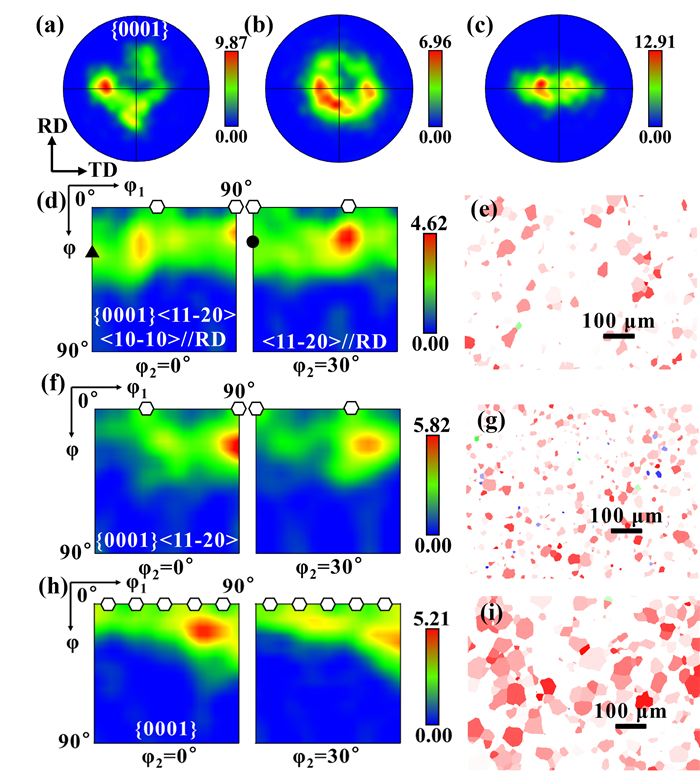
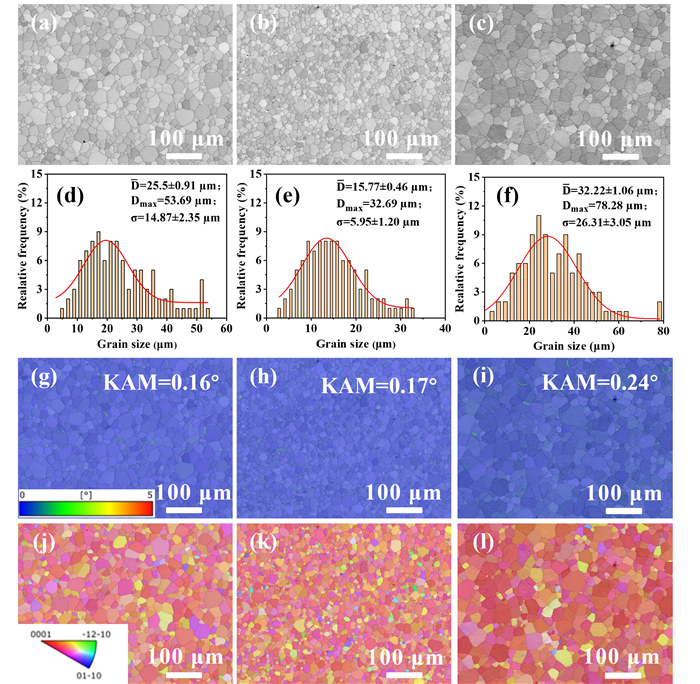
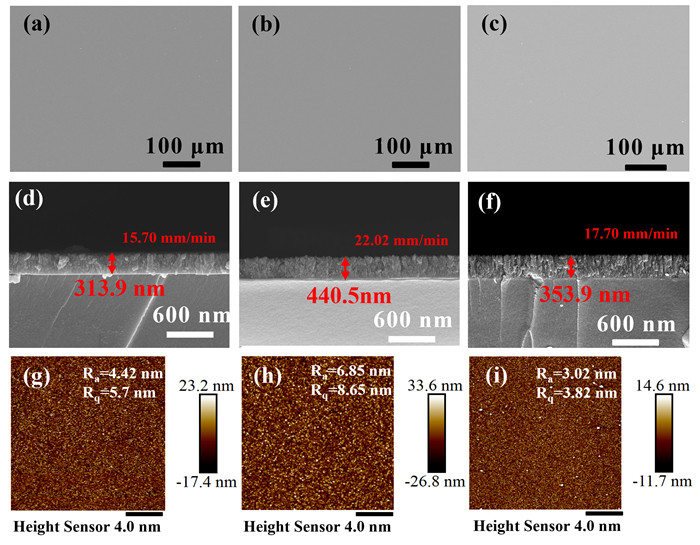
High-purity titanium (Ti) sputtering targets are essential for the fabrication of advanced Ti-based thin films with excellent electrical conductivity, adhesion, and diffusion barrier properties. Moreover, the important role of Ti films as functional layers in integrated circuits makes Ti targets indispensable sputtering materials in advanced manufacturing. The grain size and {0001} basal texture of Ti targets are crucial factors determining sputtering performance and film quality. In this study, high-purity Ti ingots (99.9994 wt.%) were processed via multi-directional rolling at 0°, 45°, and 90° combined with annealing. The sample rolled at 45° achieved the finest grains with an average grain size of 15.77 μm, which is much lower than the 30 μm standard for commercial titanium targets. Additionally, the rolling strategy effectively regulated the {0001} basal texture, with the <0001>// fraction decreasing from 42.7% (unidirectional rolling) to 16.7% (90° cross-rolling). In addition, this work revealed the correlations among target grain size, {0001} texture evolution, and deposited-film properties. Notably, the 45°-rolled annealed target achieved the maximum film deposition rate of 22.02 nm/min, exceeding the value of 17.70 nm/min for the unidirectionally rolled target. The findings provide valuable guidance for the preparation and performance optimization of high-purity Ti sputtering targets.
Citation: Kewen Zhao, Longzhen Zhang, Zhipeng Song, Hongjun Yuan, Wei Zhang, Juanjuan Wang, Junbao Guo, Chengyu Hu, Gequan Hu, Xiaochao Wu, Qingkui Li, Jilin He. Effect of multidirectional rolling on texture evolution and sputtering film deposition in Ti targets[J]. AIMS Materials Science, 2026, 13(5): 882-896. doi: 10.3934/matersci.2026041
High-purity titanium (Ti) sputtering targets are essential for the fabrication of advanced Ti-based thin films with excellent electrical conductivity, adhesion, and diffusion barrier properties. Moreover, the important role of Ti films as functional layers in integrated circuits makes Ti targets indispensable sputtering materials in advanced manufacturing. The grain size and {0001} basal texture of Ti targets are crucial factors determining sputtering performance and film quality. In this study, high-purity Ti ingots (99.9994 wt.%) were processed via multi-directional rolling at 0°, 45°, and 90° combined with annealing. The sample rolled at 45° achieved the finest grains with an average grain size of 15.77 μm, which is much lower than the 30 μm standard for commercial titanium targets. Additionally, the rolling strategy effectively regulated the {0001} basal texture, with the <0001>// fraction decreasing from 42.7% (unidirectional rolling) to 16.7% (90° cross-rolling). In addition, this work revealed the correlations among target grain size, {0001} texture evolution, and deposited-film properties. Notably, the 45°-rolled annealed target achieved the maximum film deposition rate of 22.02 nm/min, exceeding the value of 17.70 nm/min for the unidirectionally rolled target. The findings provide valuable guidance for the preparation and performance optimization of high-purity Ti sputtering targets.

| [1] |
Geetha M, Singh AK, Asokamani R, et al. (2009) Ti based biomaterials, the ultimate choice for orthopaedic implants—A review. Prog Mater Sci 54: 397–425. https://doi.org/10.1016/j.pmatsci.2008.06.004 doi: 10.1016/j.pmatsci.2008.06.004

|
| [2] |
Deng B, Ye T, Guo D (2012) Effects of vanadium ion implantation on microstructure, mechanical and tribological properties of TiN coatings. Appl Surf Sci 258: 9080–9086. https://doi.org/10.1016/J.APSUSC.2012.06.001 doi: 10.1016/J.APSUSC.2012.06.001
|
| [3] |
Xu GH, Zhao XB, Xia WS, et al. (2025) A review on microstructure design, processing, and strengthening mechanism of high-strength titanium alloys. Prog Nat Sci Mater Int 35: 258–277. https://doi.org/10.1016/j.pnsc.2025.01.005 doi: 10.1016/j.pnsc.2025.01.005
|
| [4] |
Thakur VK, Vennerberg D, Kessler MR (2014) Green aqueous surface modification of polypropylene for novel polymer nanocomposites. ACS Appl Mater Interfaces 6: 9349–9356. https://doi.org/10.1021/am501726d doi: 10.1021/am501726d
|
| [5] |
Li CH, Liu KR, Wei SC, et al. (2023) Research progress on titanium nitride thin films fabricated by magnetron sputtering. Mater Prot 56: 111–119. https://doi.org/10.16577/j.issn.1001-1560.2023.0041 doi: 10.16577/j.issn.1001-1560.2023.0041
|
| [6] |
Gao WN, Liu SL, Dang P, et al. (2014) Preparation process of titanium targets for sputter coating. Heat Treat Met 39: 43–46. https://link.cnki.net/doi/10.13251/j.issn.0254-6051.2014.12.010 doi: 10.13251/j.issn.0254-6051.2014.12.010
|
| [7] |
Nguyen QD, Phan QD, Quy TĐ, et al. (2019) Effects of Ti target poisoning to titanium nitride coating fabricated by a physical vapor deposition technique. Appl Mech Mater 889: 185–189. https://doi.org/10.4028/www.scientific.net/AMM.889.185 doi: 10.4028/www.scientific.net/AMM.889.185
|
| [8] |
Liu L, Li W, Sun H, et al. (2022) Effects of Ti target purity and microstructure on deposition rate, microstructure and properties of Ti films. Materials 15: 2661. https://doi.org/10.3390/ma15072661 doi: 10.3390/ma15072661
|
| [9] |
Wu BH, Yu Y, Wu J, et al. (2018) Tailoring of titanium thin film properties in high power pulsed magnetron sputtering. Vacuum 150: 144–154. https://doi.org/10.1016/j.vacuum.2018.01.014 doi: 10.1016/j.vacuum.2018.01.014
|
| [10] |
Moskovkin P, Maszl C, Schierholz R, et al. (2021) Link between plasma properties with morphological, structural and mechanical properties of thin Ti films deposited by high power impulse magnetron sputtering. Surf Coat Tech 418: 127235. https://doi.org/10.1016/j.surfcoat.2021.127235 doi: 10.1016/j.surfcoat.2021.127235
|
| [11] | Zhu Q, Wang L, Yang QL, et al. (2014) Extrusion theory and microstructure-property analysis of molybdenum tube targets. China Molybdenum Ind 38: 50–53. Available from: https://zgmy.cbpt.cnki.net/portal/journal/portal/client/paper/5e4fde1722dec04942b4dbd16b98bde2 |
| [12] |
Zhang X, Zhu Q, Zheng M, et al. (2025) Localized high-temperature laser shock peening with adjustable metallic coatings method for mechanical properties enhancement of reflective aluminum alloys. J Mater Process Technol 338: 118792. https://doi.org/10.1016/j.jmatprotec.2025.118792 doi: 10.1016/j.jmatprotec.2025.118792
|
| [13] |
Song RX, Wang D, Yang C, et al. (2025) A review of grain refinement and texture engineering in aluminum alloy magnetron sputtering targets. Materials 18: 3235. https://doi.org/10.3390/ma18143235 doi: 10.3390/ma18143235
|
| [14] |
Zhang L, Li XY, Qu XH, et al. (2022) Powder metallurgy route to ultrafine-grained refractory metals. Adv Mater 35: 2205807. https://doi.org/10.1002/adma.202205807 doi: 10.1002/adma.202205807
|
| [15] |
Yu K, Xue X, Xu L, et al. (2024) Effect of grain size and orientation on magnetron sputtering yield of tantalum. Int J Refract Met Hard Mater 126: 106948. https://doi.org/10.1016/j.ijrmhm.2024.106948 doi: 10.1016/j.ijrmhm.2024.106948
|
| [16] |
Solonenko OP, Ando Y, Nishiyama H, et al. (2018) Synthesis of thick photocatalytic titania surface layers by solution plasma spraying and subsequent treatment by pulsed laminar plasma jet. Surf Coat Tech 333: 39–51. https://doi.org/10.1016/j.surfcoat.2017.10.064 doi: 10.1016/j.surfcoat.2017.10.064
|
Figures(6) / Tables(2)

Kewen Zhao, Longzhen Zhang, Zhipeng Song, Hongjun Yuan, Wei Zhang, Juanjuan Wang, Junbao Guo, Chengyu Hu, Gequan Hu, Xiaochao Wu, Qingkui Li, Jilin He. Effect of multidirectional rolling on texture evolution and sputtering film deposition in Ti targets[J]. AIMS Materials Science, 2026, 13(5): 882-896. doi: 10.3934/matersci.2026041





 DownLoad: