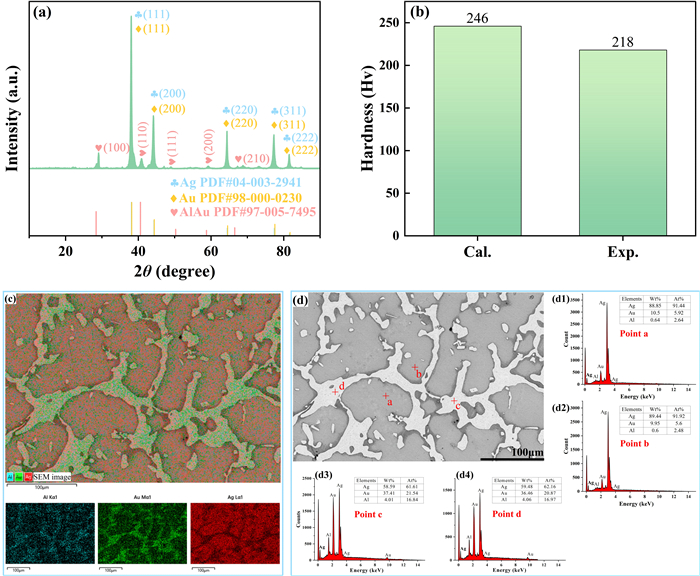
Microalloying elements (<1 wt%) are widely used in the steel industry, but their effect on AgAu alloys is still unclear. Therefore, this paper uses first-principles calculations and experimental verification to explore this topic. For first-principles calculations, the formation enthalpy, elastic constants, and mechanical properties of AgAu alloys and microalloyed AgAu systems (doped with Pd, Pt, Ni, Cu, Zn, Ti, Y, Be, Mg, Al, Sr) were calculated. The results show that the AgAu alloys and AgAu-Malloys have thermodynamic and mechanical stability. Doping elements increase the hardness, shear modulus, and Young's modulus of the alloys to varying degrees. Except for Be, other doping elements all reduce the elastic anisotropy index of the alloys to varying degrees. Experimentally, an Ag-16wt%Au-0.5wt%Al alloy was prepared, and the alloy contained Ag, Au, AlAu, and trace amounts of AlAu2 phases. The experimental hardness value was slightly lower than the calculated value. Energy-dispersive spectrometer (EDS) results proved that the alloy matrix was an Ag(Au, Al) solid solution and the intermetallic phase AlAu was distributed in the matrix. Additionally, trace amounts of the AlAu2 may be interspersed within the Ag(Au, Al) solid solution. There is a certain mutual verification between the calculation results and experimental results in this article. Therefore, this study provides a new approach to improving the performance of AgAu alloys by doping with microalloying elements.
Citation: Lisen Huang, Kun Zhu, Jianying Yang, Junjie Feng, Hui Xiong, Rong Jiang, Xiaolong Zhou. First-principles calculations and experiments of AgAu and microalloyed AgAu systems[J]. AIMS Materials Science, 2026, 13(2): 258-281. doi: 10.3934/matersci.2026015
Microalloying elements (<1 wt%) are widely used in the steel industry, but their effect on AgAu alloys is still unclear. Therefore, this paper uses first-principles calculations and experimental verification to explore this topic. For first-principles calculations, the formation enthalpy, elastic constants, and mechanical properties of AgAu alloys and microalloyed AgAu systems (doped with Pd, Pt, Ni, Cu, Zn, Ti, Y, Be, Mg, Al, Sr) were calculated. The results show that the AgAu alloys and AgAu-Malloys have thermodynamic and mechanical stability. Doping elements increase the hardness, shear modulus, and Young's modulus of the alloys to varying degrees. Except for Be, other doping elements all reduce the elastic anisotropy index of the alloys to varying degrees. Experimentally, an Ag-16wt%Au-0.5wt%Al alloy was prepared, and the alloy contained Ag, Au, AlAu, and trace amounts of AlAu2 phases. The experimental hardness value was slightly lower than the calculated value. Energy-dispersive spectrometer (EDS) results proved that the alloy matrix was an Ag(Au, Al) solid solution and the intermetallic phase AlAu was distributed in the matrix. Additionally, trace amounts of the AlAu2 may be interspersed within the Ag(Au, Al) solid solution. There is a certain mutual verification between the calculation results and experimental results in this article. Therefore, this study provides a new approach to improving the performance of AgAu alloys by doping with microalloying elements.

| [1] | Cao J, Fan J, Gao W (2016) Effect of Ag-4Pd alloy bonding wire properties and structure on bond strengths and reliability. 2016 International Conference on Electronics Packaging (ICEP), Hokkaido, Japan, 502–507. https://doi.org/10.1109/ICEP.2016.7486878 |
| [2] |
Hailu A, Shaw SK (2020) Implications of surface strain for enhanced carbon dioxide reduction on copper-silver alloys. J Electrochem Soc 167: 126509. https://doi.org/10.1149/1945-7111/abaf74 doi: 10.1149/1945-7111/abaf74

|
| [3] |
Park J, Lee J, Park S, et al. (2016) Development of hybrid process for double-side flexible printed circuit boards using roll-to-roll gravure printing, via-hole printing, and electroless plating. Int J Adv Manuf Technol 82: 1921–1931. https://doi.org/10.1007/s00170-015-7507-2 doi: 10.1007/s00170-015-7507-2
|
| [4] | Zhou W, Apkarian R, Wang Z, et al. (2006) Fundamentals of scanning electron microscopy (SEM), In: Zhou W, Wang Z, Scanning Microscopy for Nanotechnology, New York: Springer, 1–40. https://doi.org/10.1007/978-0-387-39620-0_1 |
| [5] |
Shi Z, Zhang L, Ma Y, et al. (2022) Kinetics and mechanism of the sulfurization behavior of silver conductive material in automobile industry. Rare Met 41: 37–44. https://doi.org/10.1007/s12598-021-01803-3 doi: 10.1007/s12598-021-01803-3
|
| [6] |
Bacon R, Smith CS (1956) Single crystal elastic constants of silver and silver alloys. Acta Metall 4: 337–341. https://doi.org/10.1016/0001-6160(56)90021-9 doi: 10.1016/0001-6160(56)90021-9
|
| [7] |
Kuo B, Tsai D, Huang Y, et al. (2019) Effect of alloying Au on the microstructural, mechanical and electrical properties of Ag-based alloy wires. J Mater Sci Mater Electron 30: 9396–9409. https://doi.org/10.1007/s10854-019-01270-8 doi: 10.1007/s10854-019-01270-8
|
| [8] | Nakamichi I (1996) Electrical resistivity and grain boundaries in metals. Mater Sci Forum 207–209: 47–58. https://doi.org/10.4028/www.scientific.net/MSF.207-209.47 |
| [9] |
Tseng Y, Hung F, Lui T, et al. (2015) Effect of annealing on the microstructure and bonding interface properties of Ag–2Pd alloy wire. Microelectron Reliab 55: 1256–1261. https://doi.org/10.1016/j.microrel.2015.05.012 doi: 10.1016/j.microrel.2015.05.012
|
| [10] |
Jiang C, Sordelet DJ, Gleeson B (2006) Effects of Pt on the elastic properties of B2 NiAl: A combined first-principles and experimental study. Acta Mater 54: 2361–2369. https://doi.org/10.1016/j.actamat.2006.01.010 doi: 10.1016/j.actamat.2006.01.010
|
| [11] |
Hu J, Xie M, Chen Y, et al. (2022) Thermodynamic reassessment of Au-Pt-Sn system. Mater Res Express 9: 016507. https://doi.org/10.1088/2053-1591/ac475f doi: 10.1088/2053-1591/ac475f
|
| [12] |
Delczeg-Czirjak EK, Delczeg L, Vitos L, et al. (2015) Monovacancy formation energies and fermi surface topological transitions in Pd-Ag alloys. Phys Rev B 92: 224107. https://doi.org/10.1103/PhysRevB.92.224107 doi: 10.1103/PhysRevB.92.224107
|
| [13] |
Semidey-Flecha L, Ling C, Sholl DS (2010) Detailed first-principles models of hydrogen permeation through PdCu-based ternary alloys. J Membr Sci 362: 384–392. https://doi.org/10.1016/j.memsci.2010.06.063 doi: 10.1016/j.memsci.2010.06.063
|
| [14] |
Gong H (2010) Electronic structures and related properties of Ag-Au bulks and surfaces. Mater Chem Phys 123: 326–330. https://doi.org/10.1016/j.matchemphys.2010.04.024 doi: 10.1016/j.matchemphys.2010.04.024
|
| [15] |
Han X, Liu M, Zhou X (2023) Calculation of mechanical properties, electronic properties, and thermodynamic properties of AuAl crystal: First-principles calculation. Cryst Res Technol 58: 2300061. https://doi.org/10.1002/crat.202300061 doi: 10.1002/crat.202300061
|
| [16] |
Yi Z, Hu J, Wen D, et al. (2023) Impact of alloying elements on generalized stacking fault energy and twinning of Ag-based alloys. Phys B 670: 415368. https://doi.org/10.1016/j.physb.2023.415368 doi: 10.1016/j.physb.2023.415368
|
| [17] |
Bellaiche L, Vanderbilt D (2000) Virtual crystal approximation revisited: application to dielectric and piezoelectric properties of perovskites. Phys Rev B 61: 7877–7882. https://doi.org/10.1103/PhysRevB.61.7877 doi: 10.1103/PhysRevB.61.7877
|
| [18] |
Raphel A, Vivekanandhan P, Rajasekaran AK, et al. (2022) Tuning figure of merit in Na doped nanocrystalline PbSnTeSe high entropy alloy via band engineering. Mater Sci Semicond Process 138: 106270. https://doi.org/10.1016/j.mssp.2021.106270 doi: 10.1016/j.mssp.2021.106270
|
| [19] |
Hashimoto Y, Seniutinas G, Balcytis A, et al. (2016) Au-Ag-Cu nano-alloys: Tailoring of permittivity. Sci Rep 6: 25010. https://doi.org/10.1038/srep25010 doi: 10.1038/srep25010
|
| [20] |
Levy M (1979) Universal variational functionals of electron densities, first-order density matrices, and natural spin-orbitals and solution of the v-representability problem. Proc Natl Acad Sci USA 76: 6062–6065. https://doi.org/10.1073/pnas.76.12.6062 doi: 10.1073/pnas.76.12.6062
|
| [21] |
Clark SJ, Segall MD, Pickard CJ, et al. (2005) First principles methods using CASTEP. Z Kristall 220: 567–570. https://doi.org/10.1524/zkri.220.5.567.65075 doi: 10.1524/zkri.220.5.567.65075
|
| [22] |
Perdew JP, Burke K, Ernzerhof M (1996) Generalized gradient approximation made simple. Phys Rev Lett 77: 3865–3868. https://doi.org/10.1103/PhysRevLett.77.3865 doi: 10.1103/PhysRevLett.77.3865
|
| [23] |
Lejaeghere K, Van Speybroeck V, Van Oost G, et al. (2014) Error estimates for solid-state density-functional theory predictions: An overview by means of the ground-state elemental crystals. Crit Rev Solid State Mat Sci 39: 1–24. https://doi.org/10.1080/10408436.2013.772503 doi: 10.1080/10408436.2013.772503
|
| [24] |
Kresse G, Furthmüller J (1996) Efficient iterative schemes for ab initio total-energy calculations using a plane-wave basis set. Phys Rev B 54: 11169–11186. https://doi.org/10.1103/PhysRevB.54.11169 doi: 10.1103/PhysRevB.54.11169
|
| [25] |
Pfrommer BG, Côté M, Louie SG, et al. (1997) Relaxation of crystals with the quasi-newton method. J Comput Phys 131: 233–240. https://doi.org/10.1006/jcph.1996.5612 doi: 10.1006/jcph.1996.5612
|
| [26] |
Owen EA, Williams GI (1954) A low-temperature X-ray camera. J Sci Instrum 31: 49. https://doi.org/10.1088/0950-7671/31/2/305 doi: 10.1088/0950-7671/31/2/305
|
| [27] | Warlimont H, Martienssen W (2018) Springer Handbook of Materials Data, Cham: Springer International Publishing. https://doi.org/10.1007/978-3-319-69743-7 |
| [28] |
Yang S, Liu M, Gan G, et al. (2023) First-principles study on X (Co, In, Ni, pd, Ge, Ca) doping on the structural stability and mechanical properties of AlCu. Cryst Res Technol 58: 2300142. https://doi.org/10.1002/crat.202300142 doi: 10.1002/crat.202300142
|
| [29] |
Mouhat F, Coudert FX (2014) Necessary and sufficient elastic stability conditions in various crystal systems. Phys Rev B 90: 224104. https://doi.org/10.1103/PhysRevB.90.224104 doi: 10.1103/PhysRevB.90.224104
|
| [30] |
Hill R (1952) The elastic behaviour of a crystalline aggregate. Proc Phys Soc A 65: 349. https://doi.org/10.1088/0370-1298/65/5/307 doi: 10.1088/0370-1298/65/5/307
|
| [31] |
Chen W, Cheng H, Yu C (2016) The mechanical, thermodynamic, and electronic properties of cubic Au4Al crystal via first-principles calculations. J Alloy Compd 689: 857–864. https://doi.org/10.1016/j.jallcom.2016.08.050 doi: 10.1016/j.jallcom.2016.08.050
|
| [32] |
Liu Q, Zhang N, Liu F, et al. (2014) Structural, electronic, optical, elastic properties and born effective charges of monoclinic HfO2 from first-principles calculations. Chinese Phys B 23: 47101. https://doi.org/10.1088/1674-1056/23/4/047101 doi: 10.1088/1674-1056/23/4/047101
|
| [33] |
Teter DM (1998) Computational alchemy: The search for new superhard materials. MRS Bull 23: 22–27. https://doi.org/10.1557/S0883769400031420 doi: 10.1557/S0883769400031420
|
| [34] |
Tian Y, Xu B, Zhao Z (2012) Microscopic theory of hardness and design of novel superhard crystals. Int J Refract Met Hard Mat 33: 93–106. https://doi.org/10.1016/j.ijrmhm.2012.02.021 doi: 10.1016/j.ijrmhm.2012.02.021
|
| [35] |
Chen XQ, Niu H, Li D, et al. (2011) Modeling hardness of polycrystalline materials and bulk metallic glasses. Intermetallics 19: 1275–1281. https://doi.org/10.1016/j.intermet.2011.03.026 doi: 10.1016/j.intermet.2011.03.026
|
| [36] |
Yang W, Zhang X, Wang F (2023) The elastic anisotropy, electronic and optical properties of Bi4Si3O12, Bi2SiO5, Bi12SiO20 and Bi2Si3O9 crystals from first-principles calculations. Chem Phys Lett 814: 140323. https://doi.org/10.1016/j.cplett.2023.140323 doi: 10.1016/j.cplett.2023.140323
|
| [37] |
Anderson OL (1963) A simplified method for calculating the debye temperature from elastic constants. J Phys Chem Solids 24: 909–917. https://doi.org/10.1016/0022-3697(63)90067-2 doi: 10.1016/0022-3697(63)90067-2
|
| [38] |
Nielsen OH, Martin RM (1985) Quantum-mechanical theory of stress and force. Phys Rev B 32: 3780–3791. https://doi.org/10.1103/PhysRevB.32.3780 doi: 10.1103/PhysRevB.32.3780
|
| [39] |
Ranganathan SI, Ostoja-Starzewski M (2008) Universal elastic anisotropy index. Phys Rev Lett 101: 55504. https://doi.org/10.1103/PhysRevLett.101.055504 doi: 10.1103/PhysRevLett.101.055504
|
| [40] | Anderson TL (2017) Fracture Mechanics: Fundamentals and Applications, 4 Eds., Boca Raton: CRC Press, 25–65. https://doi.org/10.1201/9781315370293 |
| [41] | Kittel C (2022) Introduction to solid state physics, In: Olaf Stenzel, Light–Matter Interaction, Hoboken: Springer, 397–425. https://doi.org/10.1007/978-3-030-87144-4_16 |
| [42] |
Peng G, Gan X, Li Z, et al. (2018) First-principles study of the (CuxNi1−x)3Sn precipitations with different structures in Cu–Ni–Sn alloys. Chinese Phys B 27: 086302. https://doi.org/10.1088/1674-1056/27/8/086302 doi: 10.1088/1674-1056/27/8/086302
|
| [43] |
Zhang C, Yan M, You Y, et al. (2014) Stability and properties of alloyed ε-(Fe1−xMx)3N nitrides (M = Cr, Ni, Mo, V, Co, Nb, Mn, Ti and Cu): A first-principles calculations. J Alloys Compd 615: 854–862. https://doi.org/10.1016/j.jallcom.2014.07.069 doi: 10.1016/j.jallcom.2014.07.069
|
| [44] |
Song Y, Wang G, Ni J, et al. (2024) First-principles study on the structural, mechanical and thermodynamic properties of Cu-Cr-Zr alloy. Phys B 685: 416029. https://doi.org/10.1016/j.physb.2024.416029 doi: 10.1016/j.physb.2024.416029
|
| [45] |
Jiang F, Yu H, Hu Q, et al. (2020) Effect of alloying elements on lattice misfit and elasticities of Ni-based single crystal superalloys by first-principle calculations. Solid State Commun 310: 113852. https://doi.org/10.1016/j.ssc.2020.113852 doi: 10.1016/j.ssc.2020.113852
|
| [46] |
Deng L, Wang X, Zhou X, et al. (2024) Thermodynamic optimization and calculation of the phase diagrams of Au-Ag-Al system. Precious Met 45: 11–18. https://doi.org/10.3969/j.issn.1004-0676.2024.02.002 doi: 10.3969/j.issn.1004-0676.2024.02.002
|
Figures(9) / Tables(8)

Lisen Huang, Kun Zhu, Jianying Yang, Junjie Feng, Hui Xiong, Rong Jiang, Xiaolong Zhou. First-principles calculations and experiments of AgAu and microalloyed AgAu systems[J]. AIMS Materials Science, 2026, 13(2): 258-281. doi: 10.3934/matersci.2026015





 DownLoad: