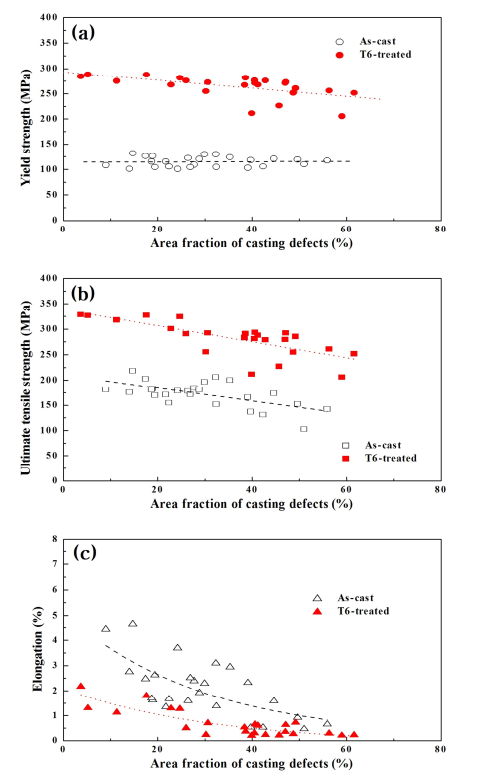
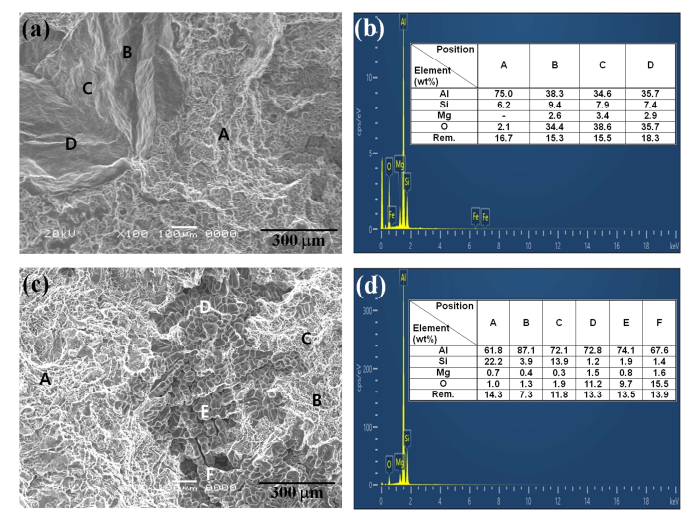
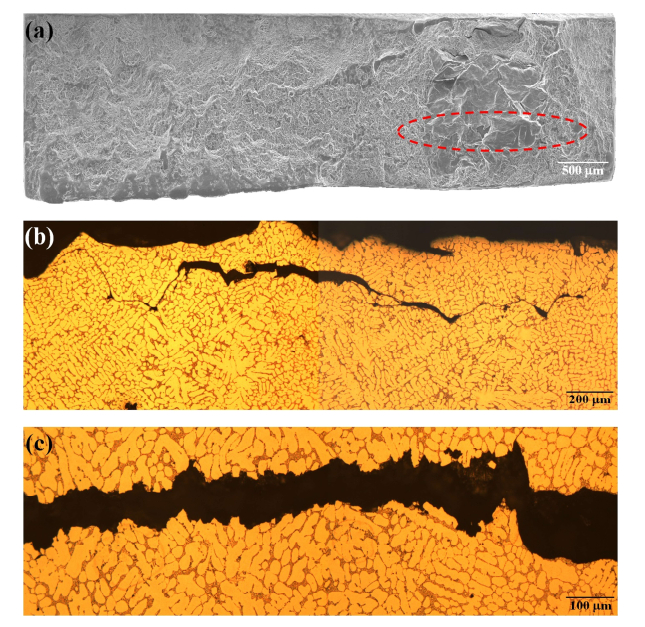
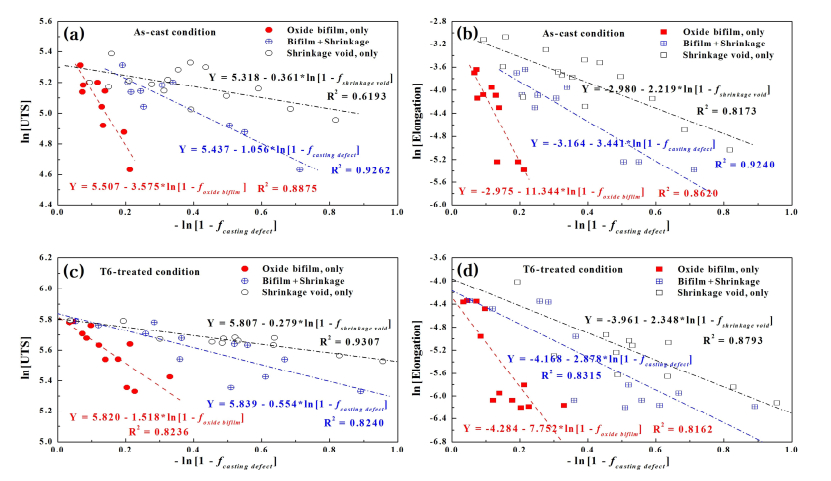
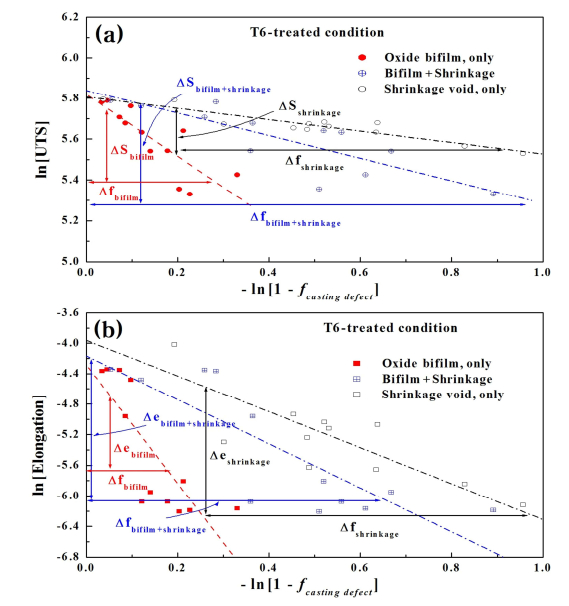
This study aims to evaluate the relative contribution of shrinkage voids and oxide bifilms to the tensile properties of Al-7Si-0.4Mg alloys in terms of defect susceptibility due to the existence of casting defects. Tensile specimens were fabricated via gravity casting using commercial A356 aluminum alloy, and the area fraction of casting defects was measured using scanning electron microscope (SEM) fractographic analysis of the tensile fracture surfaces. Shrinkage voids and oxide bifilms are representative casting defects that significantly influence the tensile properties of A356 alloys. When oxide bifilms are present alongside shrinkage voids, tensile properties exhibit greater sensitivity to changes in the area fraction of casting defects compared to specimens containing only micro-voids in the form of shrinkage voids containing a thin oxide film. However, the defect susceptibility coefficients for tensile strength and elongation under T6-treated conditions are somewhat lower than those observed in the as-cast specimens. In this study, the area fraction of oxide bifilms on the fracture surfaces of the tensile specimens averaged 12.5%, with an inclusion frequency of approximately 45%, which is relatively lower than that of shrinkage voids present on all fracture surfaces. The defect susceptibility coefficients for tensile strength and elongation in as-cast specimens where the casting defects consisted solely of oxide bifilms were approximately 3.58 and 11.34, respectively. These values represent clear increases of approximately 3.2 and 9.1 compared to specimens containing only shrinkage voids; a similar trend was observed under T6-treated conditions.
Citation: Choongdo Lee. Relative contribution of oxide bifilms and micro-voids to tensile property of Al-7Si-0.4Mg alloys[J]. AIMS Materials Science, 2026, 13(2): 282-299. doi: 10.3934/matersci.2026016
This study aims to evaluate the relative contribution of shrinkage voids and oxide bifilms to the tensile properties of Al-7Si-0.4Mg alloys in terms of defect susceptibility due to the existence of casting defects. Tensile specimens were fabricated via gravity casting using commercial A356 aluminum alloy, and the area fraction of casting defects was measured using scanning electron microscope (SEM) fractographic analysis of the tensile fracture surfaces. Shrinkage voids and oxide bifilms are representative casting defects that significantly influence the tensile properties of A356 alloys. When oxide bifilms are present alongside shrinkage voids, tensile properties exhibit greater sensitivity to changes in the area fraction of casting defects compared to specimens containing only micro-voids in the form of shrinkage voids containing a thin oxide film. However, the defect susceptibility coefficients for tensile strength and elongation under T6-treated conditions are somewhat lower than those observed in the as-cast specimens. In this study, the area fraction of oxide bifilms on the fracture surfaces of the tensile specimens averaged 12.5%, with an inclusion frequency of approximately 45%, which is relatively lower than that of shrinkage voids present on all fracture surfaces. The defect susceptibility coefficients for tensile strength and elongation in as-cast specimens where the casting defects consisted solely of oxide bifilms were approximately 3.58 and 11.34, respectively. These values represent clear increases of approximately 3.2 and 9.1 compared to specimens containing only shrinkage voids; a similar trend was observed under T6-treated conditions.

| [1] | Campbell J (2011) Complete Casting Handbook: Metal Casting Processes, Metallurgy, Techniques and Design, Boston: Butterworth-Heinemann. |
| [2] |
Eisaabadi BG, Davami P, Kim SK, et al. (2012) Effects of hydrogen and oxides on tensile properties of Al-Si-Mg cast alloys. Mater Sci Eng A 552: 36–47. https://dx.doi.org/10.1016/j.msea.2012.04.111 doi: 10.1016/j.msea.2012.04.111

|
| [3] |
Eisaabadi BG, Varahram N, Davami P, et al. (2012) Effect of oxide bifilms on the mechanical properties of cast Al-7Si-0.3Mg alloy and the roll of runner height after filter on their formation. Mater Sci Eng A 548: 99–105. https://doi.org/10.1016/j.msea.2012.03.097 doi: 10.1016/j.msea.2012.03.097
|
| [4] |
Dispinar D, Akhtar S, Nordmark A, et al. (2010) Degassing, hydrogen and porosity phenomena in A356. Mater Sci Eng A 527: 3719–3725. https://doi.org/10.1016/j.msea.2010.01.088 doi: 10.1016/j.msea.2010.01.088
|
| [5] |
Dispinar D, Campbell J (2011) Porosity, hydrogen and bifilm content in Al alloy castings. Mater Sci Eng A 528: 3860–3865. https://doi.org/10.1016/j.msea.2011.01.084 doi: 10.1016/j.msea.2011.01.084
|
| [6] |
Bogdanoff T, Borjesson J, Seifeddine S, et al. (2023) On the secondary cracks during crack propagation in an Al-Si-Cu-Mg alloy: An in-situ study. Mater Charact 203: 113046. https://doi.org/10.1016/j.matchar.2023.113046 doi: 10.1016/j.matchar.2023.113046
|
| [7] |
Eisaabadi BG, Tiryakioğlu M, Davami P, et al. (2014) The effect of remelting on the melt and casting quality in Al–7%Si–Mg castings. Mater Sci Eng A 605: 203–209. https://doi.org/10.1016/j.msea.2014.03.032 doi: 10.1016/j.msea.2014.03.032
|
| [8] |
Tiryakioğlu M, Yousefian P, Eason PD (2018) Quantification of entrainment damage in A356 aluminum alloy castings. Metall Mater Trans A 49: 5815–5822. https://doi.org/10.1007/s11661-018-4865-z doi: 10.1007/s11661-018-4865-z
|
| [9] |
Bogdanoff T, Tiryakioğlu M, Jarfors AEW, et al. (2023) On the combined effects of surface quality and pore size on the fatigue life of Al-7Si-3Cu-Mg alloy casting. Mater Sci Eng A 885: 145618. https://doi.org/10.1016/j.msea.2023.145618 doi: 10.1016/j.msea.2023.145618
|
| [10] |
Song H, Zhang L, Cao F, et al. (2021) Three-dimensional reconstruction of bifilm defects. Scr Mater 191: 179–184. https://doi.org/10.1016/j.scriptamat.2020.09.040 doi: 10.1016/j.scriptamat.2020.09.040
|
| [11] |
Sahin H, Dispinar D (2025) Estimating toughness limit of cast aluminum alloys with reduced pressure test. Inter Metalcast 19: 2161–2167. https://doi.org/10.1007/s40962-024-01453-y doi: 10.1007/s40962-024-01453-y
|
| [12] |
Kutsal U, Colak M, Ertugrul O (2025) Relationship between aluminum liquid metal quality and defects. Inter Metalcast https://doi.org/10.1007/s40962-025-01733-1 doi: 10.1007/s40962-025-01733-1
|
| [13] |
Liu J, Wang Q, Qi Y (2019) Atomic simulation of the formation and fracture of oxide bifilms in cast aluminum. Acta Mater 164: 673–682. https://doi.org/10.1016/j.actamat.2018.11.008 doi: 10.1016/j.actamat.2018.11.008
|
| [14] |
Kavousi S, Zaeem MS (2023) Mechanisms of nucleation and defect growth in undercooled melt containing oxide clusters. Acta Mater 252: 118942. https://doi.org/10.1016/j.actamat.2023.118942 doi: 10.1016/j.actamat.2023.118942
|
| [15] |
Gokhale AM, Patel GR (2005) Origins of variability in the fracture-related mechanical properties of a tilt-pour-permanent-mold cast Al-alloy. Scr Mater 52: 237–241. https://doi.org/10.1016/j.scriptamat.2004.09.011 doi: 10.1016/j.scriptamat.2004.09.011
|
| [16] |
Gokhale AM, Patel GR (2005) Quantitative fractographic analysis of variability in tensile ductility of a squeeze cast Al-Si-Mg base alloy. Mater Character 54: 13–20. https://doi.org/10.1016/j.matchar.2004.10.003 doi: 10.1016/j.matchar.2004.10.003
|
| [17] |
Lee CD, Shin KS, Kim YJ (2017) Dependence of tensile ductility on damage evolution of eutectic Si-particles and pre-existing micro-voids in Al-Si casting alloy. Eng Mater Frac 175: 339–356. https://doi.org/10.1016/j.engfracmech.2016.12.014 doi: 10.1016/j.engfracmech.2016.12.014
|
| [18] |
Lee CD, Shin KS (2014) Constitutive prediction of the defect susceptibility of tensile properties to microporosity variation in A356 aluminum alloy. Mater Sci Eng A 599: 223–232. https://doi.org/10.1016/j.msea.2014.01.091 doi: 10.1016/j.msea.2014.01.091
|
| [19] |
Lee CD (2018) Effect of artificial ageing on the defect susceptibility of tensile properties to porosity variation in A356 aluminium alloys Inter Metalcast 12: 321–330. https://doi.org/10.1007/s40962-017-0168-1 doi: 10.1007/s40962-017-0168-1
|
| [20] |
Uludağ M, Gurtaran M, Dispinar D (2020) The effect of bifilm and Sr modification on the mechanical properties of AlSi12Fe alloy. Arc Found Eng 20: 99–104. https://doi.org/10.24425/afe.2020.133337 doi: 10.24425/afe.2020.133337
|
| [21] |
El-Sayed MA, Essa K, Hassanin H (2022) Effect of runner thickness and hydrogen content on the mechanical properties of A356 alloy castings. Inter Metalcast 16: 2175–2186. https://doi.org/10.1007/s40962-021-00753-x doi: 10.1007/s40962-021-00753-x
|
| [22] |
Liu L, Zhou W, Liu F, et al. (2024) Melt quality of A356.2 alloy in the pressure counter pressure casting process for steering knuckles. Inter Metalcast 18: 1247–1261. https://doi.org/10.1007/s40962-023-01079-6 doi: 10.1007/s40962-023-01079-6
|
Figures(9) / Tables(4)

Choongdo Lee. Relative contribution of oxide bifilms and micro-voids to tensile property of Al-7Si-0.4Mg alloys[J]. AIMS Materials Science, 2026, 13(2): 282-299. doi: 10.3934/matersci.2026016





 DownLoad: