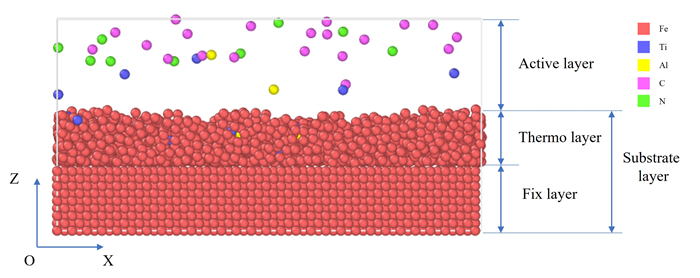
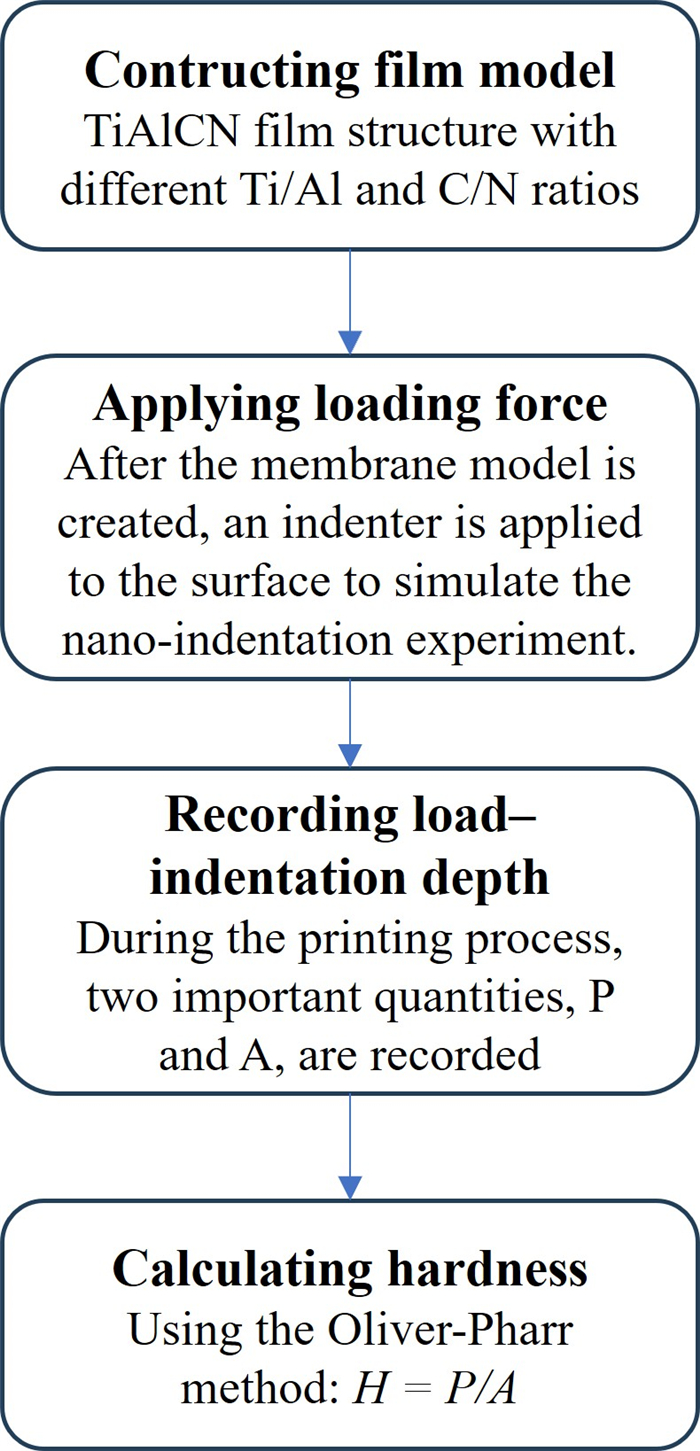
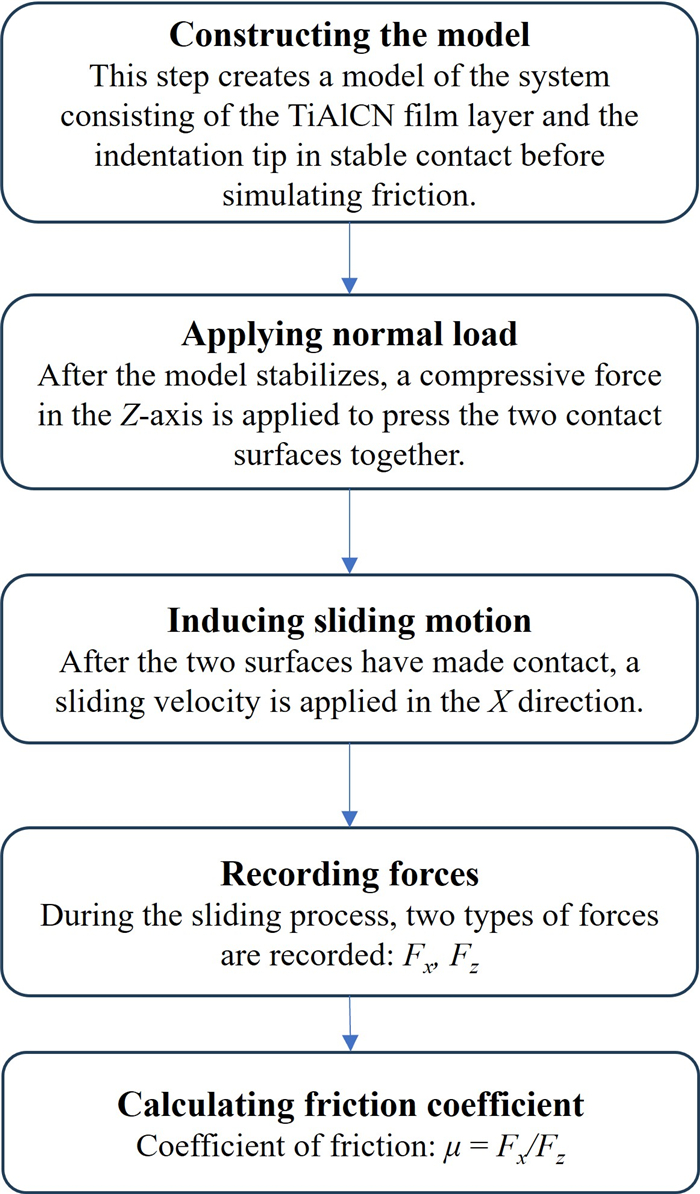
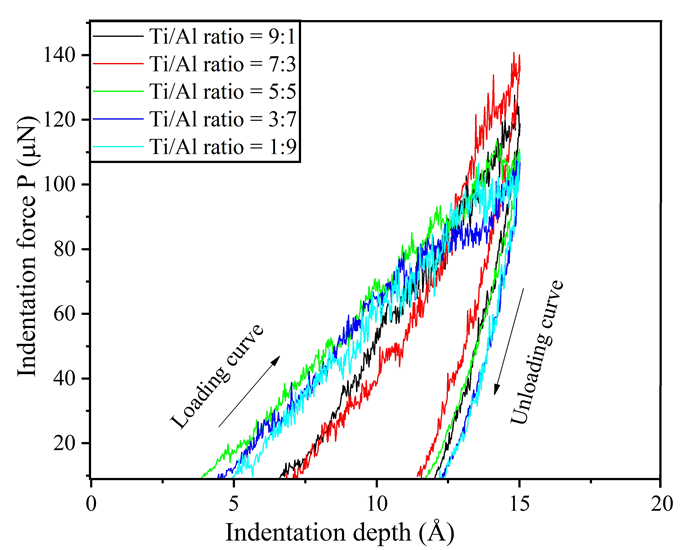
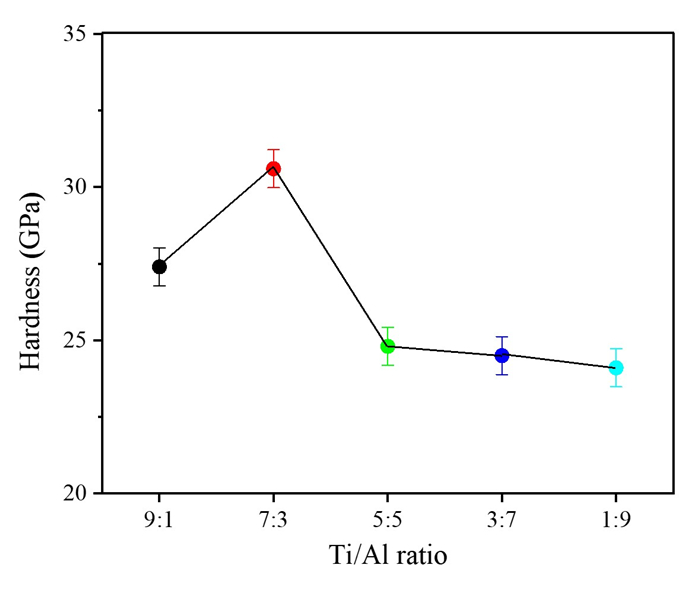
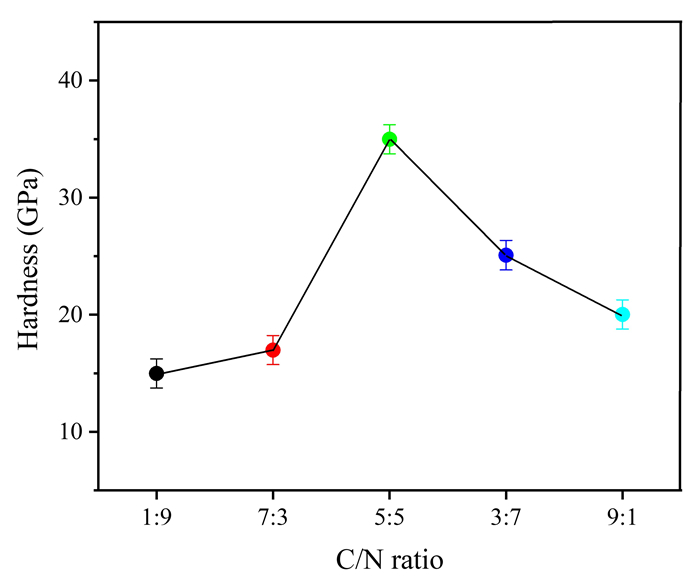
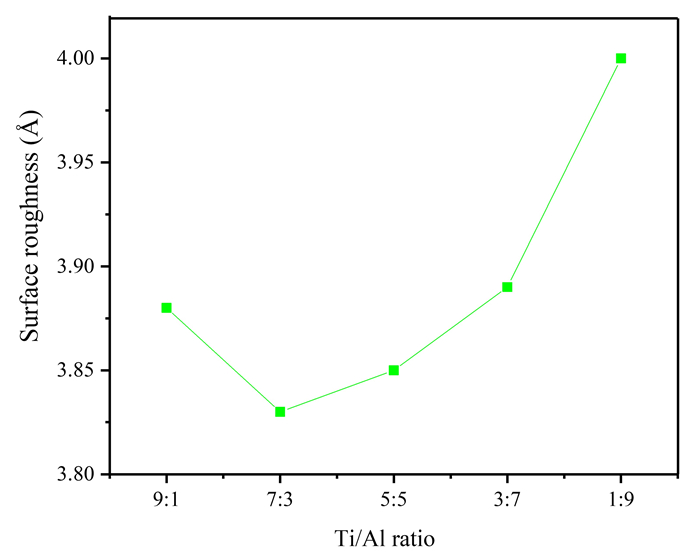
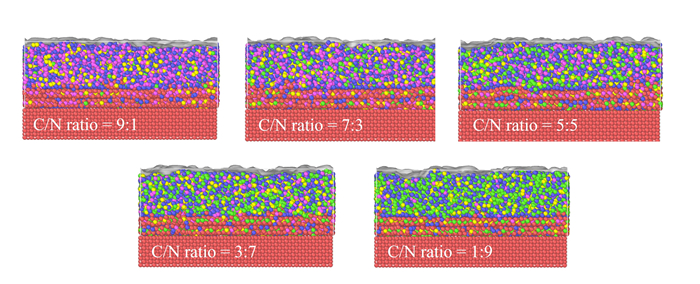
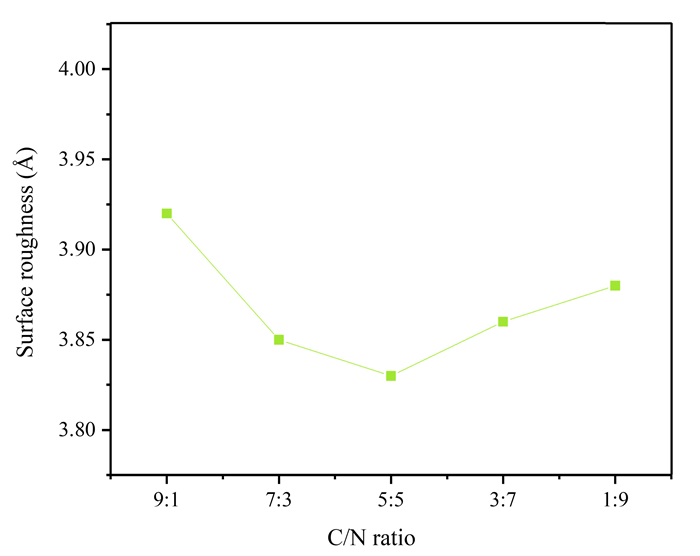
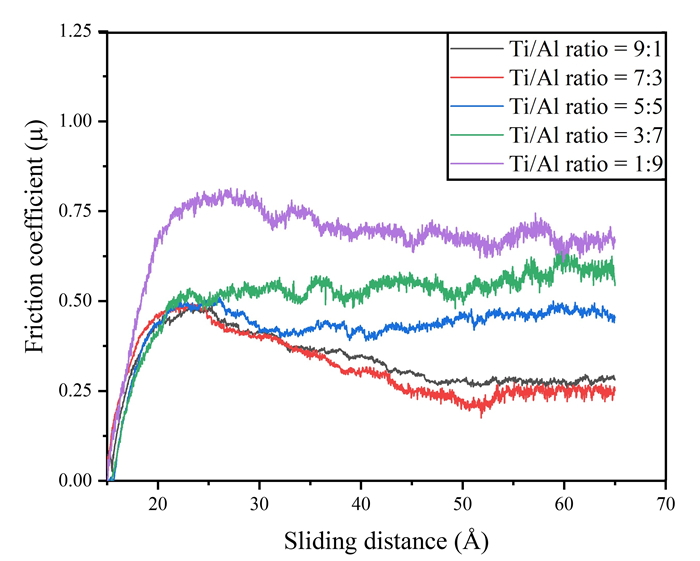
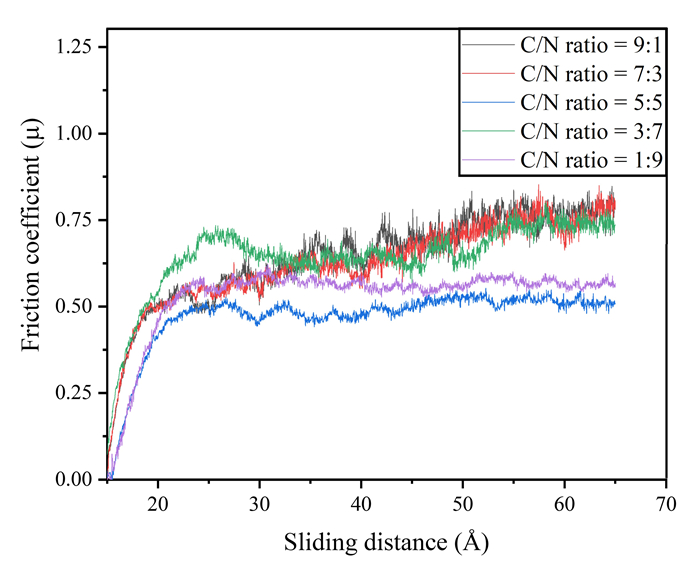
TiAlCN coatings are increasingly widely applied in practice. Mathematical models of the formation and development of these coatings provide a foundation for researchers to predict and control their physical, chemical, and mechanical properties. In this paper, we present an atomic-scale molecular dynamics model for the growth of TiAlCN coatings, in which the deposition conditions are designed to represent typical cathodic arcs' evaporation parameters. By describing the deposition process of Ti, Al, C, and N atoms on the Fe substrate's surface, we evaluate the influence of Ti/Al and C/N atomic ratios on the hardness, friction coefficient, and surface roughness of TiAlCN coatings. These properties are critical for applications in mechanical fields, such as cutting tools and molds. The simulation results show that the maximum hardness of the TiAlCN coating is 31 GPa at a Ti/Al ratio of 7:3 and 36 GPa at a C/N ratio of 5:5. The minimum roughness is 3.83 Å at a Ti/Al ratio of 7:3 and 3.82 Å at a C/N ratio of 5:5. The lowest friction coefficient is 0.38 at a Ti/Al ratio of 7:3 and 0.25 at a C/N ratio of 5:5. These results are consistent with the experimental findings, confirming the reliability of the proposed theoretical model.
Citation: Duc Luan Nguyen, Duc Cuong Pham. Simulation of the effect of atomic ratio Ti/Al and C/N on the properties of TiAlCN film by molecular dynamics method[J]. AIMS Materials Science, 2026, 13(2): 240-257. doi: 10.3934/matersci.2026014
TiAlCN coatings are increasingly widely applied in practice. Mathematical models of the formation and development of these coatings provide a foundation for researchers to predict and control their physical, chemical, and mechanical properties. In this paper, we present an atomic-scale molecular dynamics model for the growth of TiAlCN coatings, in which the deposition conditions are designed to represent typical cathodic arcs' evaporation parameters. By describing the deposition process of Ti, Al, C, and N atoms on the Fe substrate's surface, we evaluate the influence of Ti/Al and C/N atomic ratios on the hardness, friction coefficient, and surface roughness of TiAlCN coatings. These properties are critical for applications in mechanical fields, such as cutting tools and molds. The simulation results show that the maximum hardness of the TiAlCN coating is 31 GPa at a Ti/Al ratio of 7:3 and 36 GPa at a C/N ratio of 5:5. The minimum roughness is 3.83 Å at a Ti/Al ratio of 7:3 and 3.82 Å at a C/N ratio of 5:5. The lowest friction coefficient is 0.38 at a Ti/Al ratio of 7:3 and 0.25 at a C/N ratio of 5:5. These results are consistent with the experimental findings, confirming the reliability of the proposed theoretical model.

| [1] | Anders A (2008) Cathodic Arcs: From Fractal Spots to Energetic Condensation, NY: Springer New York. https://doi.org/10.1007/978-0-387-79108-1 |
| [2] |
Mayrhofer PH, Mitterer C, Hultman L, et al. (2006) Microstructural design of hard coatings. Prog Mater Sci 51: 1032–1114. https://doi.org/10.1016/j.pmatsci.2006.02.002 doi: 10.1016/j.pmatsci.2006.02.002

|
| [3] |
PalDey S, Deevi SC (2003) Single layer and multilayer wear resistant coatings of (Ti, Al)N: A review. Mater Sci Eng A 342: 58–79. https://doi.org/10.1016/s0921-5093(02)00259-9 doi: 10.1016/s0921-5093(02)00259-9
|
| [4] |
Sousa VFC, Da Silva FJG, Pinto GF, et al. (2021) Characteristics and wear mechanisms of TiAlN-based coatings for machining applications: A comprehensive review. Metals 11: 260. https://doi.org/10.3390/met11020260 doi: 10.3390/met11020260
|
| [5] |
Cheng YC, Li JX, Liu F, et al. (2025) The mechanical performance enhancement of the CrN/TiAlCN coating on GCr15 bearing steel by controlling the nitrogen flow rate in the transition layer. Coatings 15: 254. https://doi.org/10.3390/coatings15030254 doi: 10.3390/coatings15030254
|
| [6] |
Lei Z, Zhu X, Li Y, et al. (2018) Characterization and tribological behavior of TiAlN/TiAlCN multilayer coatings. J Tribol 140: 051301. https://doi.org/10.1115/1.4039723 doi: 10.1115/1.4039723
|
| [7] |
Chen L, Xu YX, Du Y, et al. (2015) Effect of bilayer period on structure, mechanical and thermal properties of TiAlN/AlTiN multilayer coatings. Thin Solid Films 592: 207–214. https://doi.org/10.1016/J.TSF.2015.09.029 doi: 10.1016/J.TSF.2015.09.029
|
| [8] |
Naghashzadeh AR, Shafyei A, Sourani F (2022) Nanoindentation and tribological behavior of TiN-TiCN-TiAlN multilayer coatings on AISI D3 tool steel. J Mater Eng Perform 31: 4335–4342. https://doi.org/10.1007/s11665-021-06533-2 doi: 10.1007/s11665-021-06533-2
|
| [9] |
Musil J (2000) Hard and superhard nanocomposite coatings. Surf Coat Technol 125: 322–330. https://doi.org/10.1016/S0257-8972(99)00586-1 doi: 10.1016/S0257-8972(99)00586-1
|
| [10] |
Endrino JL, Fox-Rabinovich GS, Gey C (2006) Hard AlTiN, AlCrN PVD coatings for machining of austenitic stainless steel. Surf Coat Technol 200: 6840–6845. https://doi.org/10.1016/j.surfcoat.2005.10.030 doi: 10.1016/j.surfcoat.2005.10.030
|
| [11] |
Fox-Rabinovich GS, Yamamoto K, Veldhuis SC, et al (2005) Tribological adaptability of TiAlCrN PVD coatings under high performance dry machining conditions. Surf Coat Technol 200: 1804–1813. https://doi.org/10.1016/j.surfcoat.2005.08.057 doi: 10.1016/j.surfcoat.2005.08.057
|
| [12] |
Zhang X, Jiang J, Zeng, et al. (2009) Effect of carbon on TiAlCN coatings deposited by reactive magnetron sputtering. Surf Coat Technol 203: 594–597. https://doi.org/10.1016/j.surfcoat.2008.06.175 doi: 10.1016/j.surfcoat.2008.06.175
|
| [13] |
Zhou B, Wang Y, Liu Z, et al (2023) Effect of modulation ratio on microstructure and tribological properties of TiAlN/TiAlCN multilayer coatings prepared by multi-excitation source plasma. Vacuum 211: 111917. https://doi.org/10.1016/j.vacuum.2023.111917 doi: 10.1016/j.vacuum.2023.111917
|
| [14] |
Yan N, Zhu Z, Cheng Y, et al. (2024) Preparation and performance of a Cr/CrN/TiAlCN composite coating on a GCr15 bearing steel surface. Coatings 14: 782. https://doi.org/10.3390/coatings14070782 doi: 10.3390/coatings14070782
|
| [15] |
Walunj G, Choudhari A, Digole S, et al. (2024) Microstructure, mechanical, and tribological behaviour of spark plasma sintered TiN, TiC, TiCN, TaN, and NbN ceramic coatings on titanium substrate. Metals 14: 1437. https://doi.org/10.3390/met14121437 doi: 10.3390/met14121437
|
| [16] |
Kumar N, Krishnan R, Dinesh Kumar D, et al. (2011) Tribological properties of nanostructured TiC coatings deposited on steel and silicon substrates using pulse laser deposition technique. Tribol-Mater Surf Interfaces 5: 1–9. https://doi.org/10.1179/1751584X10Y.0000000006 doi: 10.1179/1751584X10Y.0000000006
|
| [17] |
Rashidi M, Tamizifar M, Boutorabi SMA (2020) Characteristics of TiAlCN ceramic coatings prepared via pulsed-DC PACVD, part Ⅰ: Influence of precursors' ratio. Ceram Int 46: 1269–1280. https://doi.org/10.1016/j.ceramint.2019.06.303 doi: 10.1016/j.ceramint.2019.06.303
|
| [18] |
Moritz Y, Kainz C, Tkadletz M, et al. (2021) Microstructure and mechanical properties of arc evaporated Ti(Al, Si)N coatings. Surf Coat Technol 421: 127461. https://doi.org/10.1016/j.surfcoat.2021.127461 doi: 10.1016/j.surfcoat.2021.127461
|
| [19] |
Chen SN, Zhao YM, Zhang YF, et al. (2021) Influence of carbon content on the structure and tribocorrosion properties of TiAlCN/TiAlN/TiAl multilayer composite coatings. Surf Coat Technol 411: 126886. https://doi.org/10.1016/j.surfcoat.2021.126886 doi: 10.1016/j.surfcoat.2021.126886
|
| [20] |
Baskes MI (1992) Modified embedded-atom potentials for cubic materials and impurities. Phys Rev B 46: 2727–2742. https://doi.org/10.1103/PhysRevB.46.2727 doi: 10.1103/PhysRevB.46.2727
|
| [21] |
Tersoff J (1988) Empirical interatomic potential for carbon, with applications to amorphous carbon. Phys Rev Lett 61: 2879–2882. https://doi.org/10.1103/PhysRevLett.61.2879 doi: 10.1103/PhysRevLett.61.2879
|
| [22] |
Vashishta P, Kalia RK, Rino JP, et al. (1990) Interaction potential for SiO2: A molecular-dynamics study of structural correlations. Phys Rev B 41: 12197–12209. https://doi.org/10.1103/PhysRevB.41.12197 doi: 10.1103/PhysRevB.41.12197
|
| [23] |
Thompson AP, Aktulga HM, Berger R, et al. (2022) LAMMPS–A flexible simulation tool for particle-based materials modeling at the atomic, meso, and continuum scales. Comput Phys Commun 271: 108171. https://doi.org/10.1016/j.cpc.2021.108171 doi: 10.1016/j.cpc.2021.108171
|
| [24] |
Brown IG (1998) Cathodic arc deposition of films. Annu Rev Mater Sci 28: 243–269. https://doi.org/10.1146/annurev.matsci.28.1.243 doi: 10.1146/annurev.matsci.28.1.243
|
| [25] |
Oliver WC, Pharr GM (1992) An improved technique for determining hardness and elastic modulus using load and displacement sensing indentation experiments. J Mater Res 7: 1564–1583. https://doi.org/10.1557/JMR.1992.1564 doi: 10.1557/JMR.1992.1564
|
| [26] | Persson BNJ (2000) Sliding Friction: Physical Principles and Applications, Heidelberg: Springer Berlin. https://doi.org/10.1007/978-3-662-04283-0 |
| [27] | Müser MH, Urbakh M, Robbins MO (2003) Statistical mechanics of static and low-velocity kinetic friction, In: Prigogine I, Rice SA, Advances in Chemical Physics, New York: Wiley, 187–272. https://doi.org/10.1002/0471428019.ch5 |
| [28] | Fischer-Cripps AC (2011) Nanoindentation, 3Eds., NY: Springer New York. https://doi.org/10.1007/978-1-4419-9872-9 |
| [29] |
Dobierzewska-Mozrzymas E, Rysiakiewicz-Pasek E, Biegański P, et al. (2008) Application of the optical method for determining of the RMS roughness of porous glass surfaces. J Non Cryst Solids 354: 3241–3245. https://doi.org/10.1016/j.jnoncrysol.2008.02.013 doi: 10.1016/j.jnoncrysol.2008.02.013
|
Figures(14) / Tables(4)

Duc Luan Nguyen, Duc Cuong Pham. Simulation of the effect of atomic ratio Ti/Al and C/N on the properties of TiAlCN film by molecular dynamics method[J]. AIMS Materials Science, 2026, 13(2): 240-257. doi: 10.3934/matersci.2026014





 DownLoad: