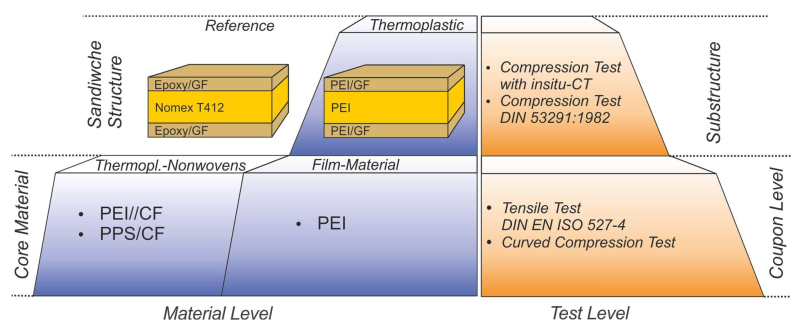
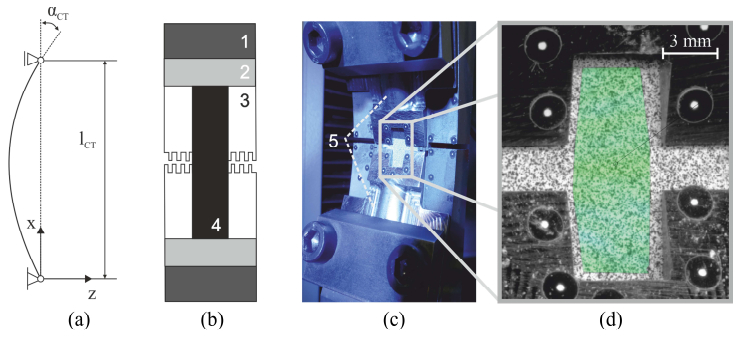
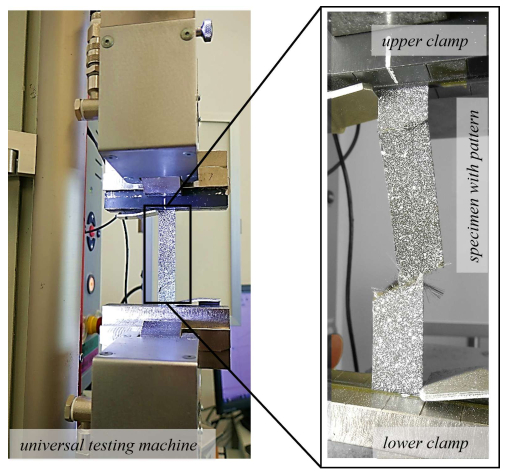
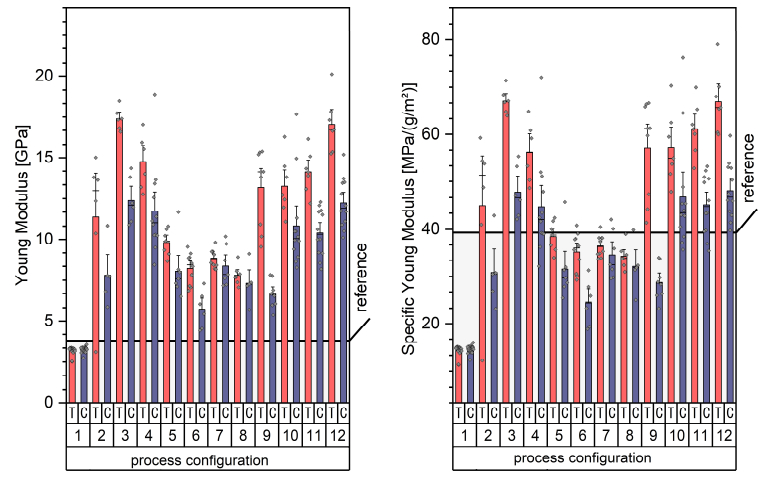
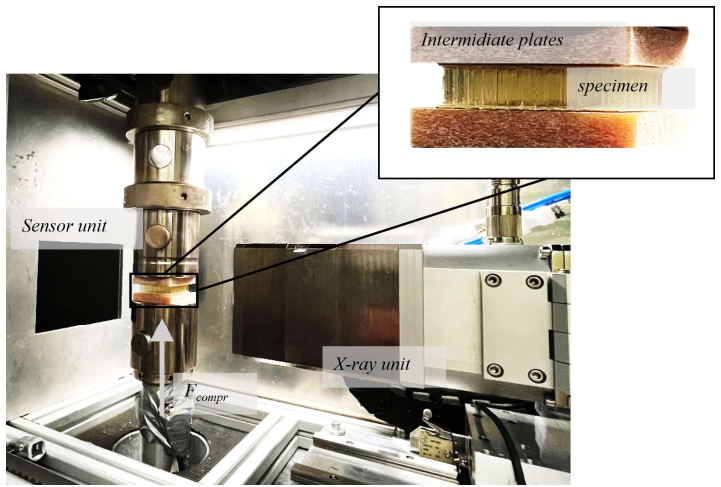
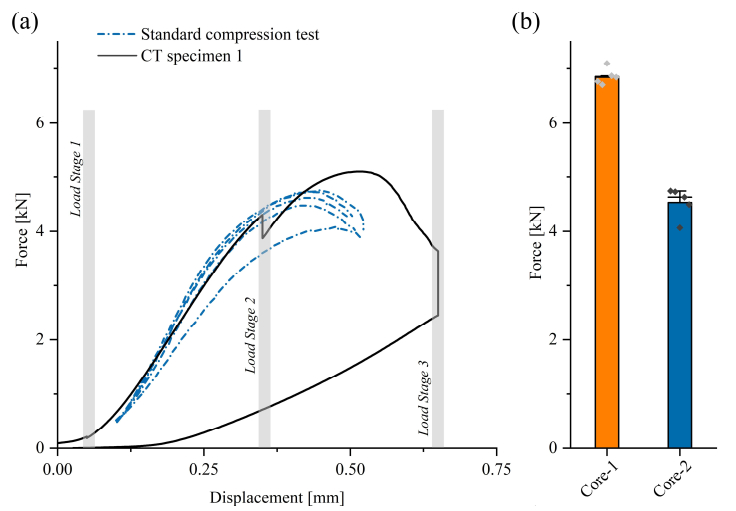
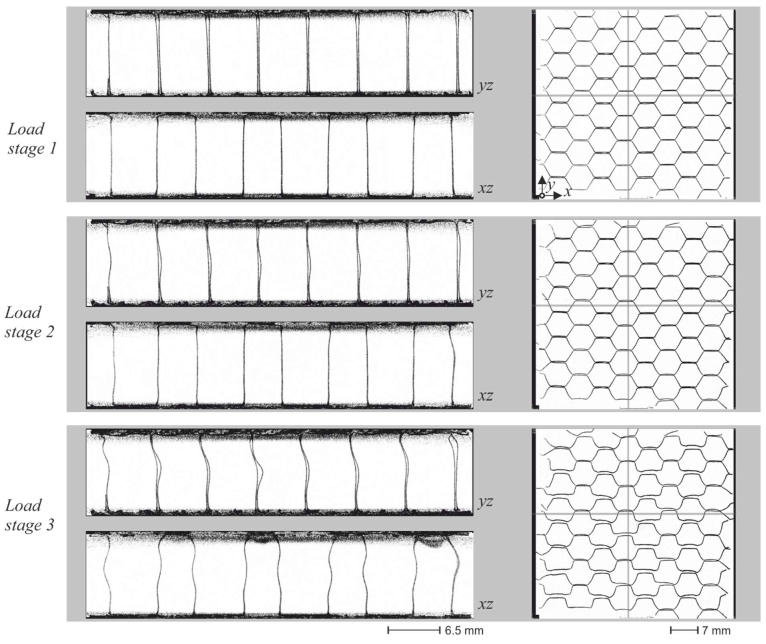
Thermoplastic honeycomb cores for sandwich structures offer, in addition to high stiffness and low weight, further advantages such as recyclability, chemical resistance, and suitability for large-scale processing. These properties, combined with the broad range of characteristics offered by high-performance thermoplastics such as polyetherimide (PEI), polyphenylene sulfide (PPS), and polyether ether ketone (PEEK), make these materials promising for use in the aerospace industry. With this focus, this paper examined PEI films and carbon fiber-reinforced non-woven materials with PEI and PPS matrices to assess their potential as thermoplastic cores in sandwich structures. Assessing the performance of new material combinations requires adapted testing methods, since conventional characterization of sandwich structures is complex due to their multi-layered nature, especially with regard to the structured core layer. This work introduces a simplified test method for determining the compressive stiffness of film-like and paper-like non-woven thermoplastic core materials. The approach is based on curved compression tests at the coupon level and complemented by in situ computed tomography (CT) analysis of the thermoplastic sandwich at the substructure level, enabling the extraction of mechanical properties and the evaluation of failure mechanisms. Using ThermHex® honeycombs as an example and in comparison to Nomex® structures, the study demonstrates that thermoplastic sandwich semi-finished products hold high potential for efficient, sustainable, and high-performance lightweight applications in aviation.
Citation: Tony Weber, Kurt Böhme, Maik Gude. Mechanical compression behavior of reinforced and unreinforced thermoplastic film materials as high-performance core layer for semi-finished sandwich products[J]. AIMS Materials Science, 2026, 13(2): 223-239. doi: 10.3934/matersci.2026013
Thermoplastic honeycomb cores for sandwich structures offer, in addition to high stiffness and low weight, further advantages such as recyclability, chemical resistance, and suitability for large-scale processing. These properties, combined with the broad range of characteristics offered by high-performance thermoplastics such as polyetherimide (PEI), polyphenylene sulfide (PPS), and polyether ether ketone (PEEK), make these materials promising for use in the aerospace industry. With this focus, this paper examined PEI films and carbon fiber-reinforced non-woven materials with PEI and PPS matrices to assess their potential as thermoplastic cores in sandwich structures. Assessing the performance of new material combinations requires adapted testing methods, since conventional characterization of sandwich structures is complex due to their multi-layered nature, especially with regard to the structured core layer. This work introduces a simplified test method for determining the compressive stiffness of film-like and paper-like non-woven thermoplastic core materials. The approach is based on curved compression tests at the coupon level and complemented by in situ computed tomography (CT) analysis of the thermoplastic sandwich at the substructure level, enabling the extraction of mechanical properties and the evaluation of failure mechanisms. Using ThermHex® honeycombs as an example and in comparison to Nomex® structures, the study demonstrates that thermoplastic sandwich semi-finished products hold high potential for efficient, sustainable, and high-performance lightweight applications in aviation.

| [1] | Baker AA, Scott ML (2016) Composite Materials for Aircraft Structures, 3 Eds., Reston, VA: American Institute of Aeronautics and Astronautics Inc. https://doi.org/10.2514/4.103261 |
| [2] | Ma W, Elkin R (2022) Sandwich Structural Composites: Theories and Practices, 1 Ed., Boca Raton, FL: CRC Press. https://doi.org/10.1201/9781003035374 |
| [3] | Schürmann H (2007) Konstruieren mit Faser-Kunststoff-Verbunden, 2 Eds., Heidelberg: Springer Berlin. https://doi.org/10.1007/978-3-540-72190-1 |
| [4] | Boeing (2022) Commercial Market Outlook 2022–2041. Available from: https://www.boeing.com/content/dam/boeing/boeingdotcom/market/assets/downloads/CMO_2022_Report_FINAL_v02.pdf (accessed on 16 May 2024). |
| [5] | Airbus (2025) Airbus Global Market Forecast 2025–2044. Available from: https://www.airbus.com/en/products-services/commercial-aircraft/global-market-forecast(accessed on 23 July 2025). |
| [6] | Mcgarva LD (2002) Thermoplastic Composite Sandwich Components: Experimental and Numerical Investigation of Manufacturing Issues, Stockholm, Sweden: Royal Institute of Technology. |
| [7] | Carlsson LA, Kardomateas GA (2011) Structural and Failure Mechanics of Sandwich Composites, Dordrecht: Springer Netherlands. https://doi.org/10.1007/978-1-4020-3225-7 |
| [8] | Philipp Bratfisch J, Vandepitte D, Pflug J, et al. (2005) Development and validation of a continuous production concept for thermoplastic honeycomb, In: Thomsen O, Bozhevolnaya E, Lyckegaard A, Sandwich Structures 7: Advancing with Sandwich Structures and Materials, Dordrecht: Springer. https://doi.org/10.1007/1-4020-3848-8_77 |
| [9] |
Fan X, Verpoest I, Pflug J, et al. (2009) Investigation of continuously produced thermoplastic honeycomb processing—Part I: Thermoforming. J Sandw Struct Mater 11: 151–178. https://doi.org/10.1177/1099636208098216 doi: 10.1177/1099636208098216

|
| [10] |
Latsuzbaya T, Middendorf P, Voelkle D, et al. (2024) Thermomechanical analysis of thermoplastic mono-material sandwich structures with honeycomb core. J Compos Sci 8: 18. https://doi.org/10.3390/jcs8010018 doi: 10.3390/jcs8010018
|
| [11] |
Martin RG, Johansson C, Tavares JR, et al. (2024) CF/PEEK skins assembly by induction welding for thermoplastic composite sandwich panels. Compos Part B Eng 284: 111676. https://doi.org/10.1016/j.compositesb.2024.111676 doi: 10.1016/j.compositesb.2024.111676
|
| [12] |
Jiang H, Jia R, Aiyiti W, et al. (2023) Infill strategies for 3D-printed CF-PEEK/HA-PEEK honeycomb core-shell composite structures. J Manuf Process 92: 338–349. https://doi.org/10.1016/j.jmapro.2023.02.058 doi: 10.1016/j.jmapro.2023.02.058
|
| [13] | ThermHex (2025) Thermoplastische Polypropylen-Wabenkerne und Sandwichplatten für Leichtbauanwendungen und Verbundwerkstoffe. Available from: https://thermhex.com/de (accessed on 1 June 2025). |
| [14] |
Pakdel E, Kashi S, Varley R, et al. (2021) Recent progress in recycling carbon fibre reinforced composites and dry carbon fibre wastes. Resour Conserv Recycl 166: 105340. https://doi.org/10.1016/j.resconrec.2020.105340 doi: 10.1016/j.resconrec.2020.105340
|
| [15] |
Pimenta S, Pinho ST (2011) Recycling carbon fibre reinforced polymers for structural applications: Technology review and market outlook. Waste Manage 31: 378–392. https://doi.org/10.1016/j.wasman.2010.09.019 doi: 10.1016/j.wasman.2010.09.019
|
| [16] |
Wiegand N, Mäder E (2017) Commingled yarn spinning for thermoplastic/glass fiber composites. Fibers 5: 26. https://doi.org/10.3390/fib5030026 doi: 10.3390/fib5030026
|
| [17] |
Patou J, Bonnaire R, De Luycker E, et al. (2019) Influence of consolidation process on voids and mechanical properties of powdered and commingled carbon/PPS laminates. Compos Part A Appl Sci Manuf 117: 260–275. https://doi.org/10.1016/j.compositesa.2018.11.012 doi: 10.1016/j.compositesa.2018.11.012
|
| [18] |
Mankodi H, Patel P (2009) Study the effect of commingling parameters on glass/polypropylene hybrid yarns properties. Autex Res J 9: 70–73. https://doi.org/10.1515/aut-2009-090303 doi: 10.1515/aut-2009-090303
|
| [19] |
Minupala VK, Zscheyge M, Glaesser T, et al. (2024) Numerical modelling of the thermoforming behaviour of thermoplastic honeycomb composite sandwich laminates. Polymers 16: 594. https://doi.org/10.3390/polym16050594 doi: 10.3390/polym16050594
|
| [20] | Bugiel A (2020) Ein Beitrag zur mechanischen Charakterisierung und numerischen Simulation von Aramid-Papier für Luftfahrtanwendungen. TUD Dresden University of Technology, Dresden, Germany. Available from: https://tud.qucosa.de/api/qucosa%3A74255/attachment/ATT-0/. |
| [21] | Bugiel A, Hähnel F, Wolf K (2018) Erhöhung der Zuverlässigkeit von hochbelasteten Leichtbau-Faserverbund-Sandwich-Strukturen durch abgesicherte Nachweismethoden zur Bewertung der Schadenstoleranz, Technische Universität Dresden, Fakultät Maschinenwesen, Institut für Luft- und Raumfahrttechnik, Lehrstuhl für Luftfahrzeugtechnik: Dresden. |
| [22] | Gottwald R (2015) Beitrag zur analytischen, numerischen und experimentellen Kerbspannungsanalyse endlich berandeter anisotroper Mehrschichtverbunde, TUD Dresden University of Technology, Dresden, Germany. |
| [23] | Hähnel F (2016) Ein Beitrag zur Simulation des Versagens von Honigwaben aus Meta-Aramid-Papier in schlagbelasteten Sandwich-Strukturen, Aachen: Shaker Verlag. Available from: www.shaker.de/shop/978-3-8440-4366-2. |
| [24] |
Köhler D, Kupfer R, Troschitz J, et al. (2021) In situ computed tomography-analysis of a single-lap shear test with clinch points. Materials 14: 1859. https://doi.org/10.3390/ma14081859 doi: 10.3390/ma14081859
|
Figures(10) / Tables(1)

Tony Weber, Kurt Böhme, Maik Gude. Mechanical compression behavior of reinforced and unreinforced thermoplastic film materials as high-performance core layer for semi-finished sandwich products[J]. AIMS Materials Science, 2026, 13(2): 223-239. doi: 10.3934/matersci.2026013





 DownLoad: