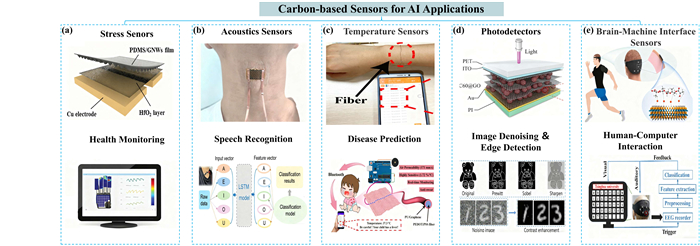
Carbon-based sensors based on low-dimensional carbon nanomaterials demonstrate broad application prospects in fields such as wearable devices and human–computer interaction, owing to the exceptional properties of carbon nanomaterials. Driven by advancements in artificial intelligence (AI) technology, these sensors are progressively evolving from single-function devices into intelligent systems. This article highlights five types of AI-oriented carbon-based sensors, discussing the integration and application of artificial intelligence with carbon-based sensing technology. To address challenges like insufficient external information acquisition capability and system redundancy caused by the separation of sensing and computation, we introduce the multimodal sensing system and the sensing-computation integrated architecture: the former enhances information dimensionality through collaborative perception of multiple physical signals, while the latter seamlessly integrates signal acquisition with intelligent processing. Ultimately, AI-empowered carbon-based sensing systems not only improve perception accuracy and processing efficiency but also establish the foundation for autonomous intelligent sensing systems, demonstrating substantial prospects for next-generation smart hardware.
Citation: Yi Zhang, Lu-Yu Zhao, Yu-Tao Li, Ye-Liang Wang. Recent progress in low dimensional carbon nanomaterials sensors and their integration with artificial intelligence technologies[J]. AIMS Materials Science, 2025, 12(5): 1041-1064. doi: 10.3934/matersci.2025048
Carbon-based sensors based on low-dimensional carbon nanomaterials demonstrate broad application prospects in fields such as wearable devices and human–computer interaction, owing to the exceptional properties of carbon nanomaterials. Driven by advancements in artificial intelligence (AI) technology, these sensors are progressively evolving from single-function devices into intelligent systems. This article highlights five types of AI-oriented carbon-based sensors, discussing the integration and application of artificial intelligence with carbon-based sensing technology. To address challenges like insufficient external information acquisition capability and system redundancy caused by the separation of sensing and computation, we introduce the multimodal sensing system and the sensing-computation integrated architecture: the former enhances information dimensionality through collaborative perception of multiple physical signals, while the latter seamlessly integrates signal acquisition with intelligent processing. Ultimately, AI-empowered carbon-based sensing systems not only improve perception accuracy and processing efficiency but also establish the foundation for autonomous intelligent sensing systems, demonstrating substantial prospects for next-generation smart hardware.

| [1] |
Obuchowicz R, Lasek J, Wodziński M, et al. (2025) Artificial intelligence-empowered radiology-current status and critical review. Diagnostics 15: 282. https://doi.org/10.3390/diagnostics15030282 doi: 10.3390/diagnostics15030282

|
| [2] |
Ahmed S, Alshater MM, Ammari AE, et al. (2022) Artificial intelligence and machine learning in finance: A bibliometric review. Res Int Bus Financ 61: 101646. https://doi.org/10.1016/j.ribaf.2022.101646 doi: 10.1016/j.ribaf.2022.101646
|
| [3] |
Cavus M, Dissanayake D, Bell M (2025) Next generation of electric vehicles: AI-driven approaches for predictive maintenance and battery management. Energies 18: 1041. https://doi.org/10.3390/en18051041 doi: 10.3390/en18051041
|
| [4] |
Leite D, Andrade E, Rativa D, et al. (2025) Fault detection and diagnosis in industry 4.0: A review on challenges and opportunities. Sensors 25: 60. https://doi.org/10.3390/s25010060 doi: 10.3390/s25010060
|
| [5] |
Peres RS, Jia X, Lee J, et al. (2020) Industrial artificial intelligence in industry 4.0—Systematic review, challenges and outlook. IEEE Access 8: 220121-220139. https://doi.org/10.1109/ACCESS.2020.3042874 doi: 10.1109/ACCESS.2020.3042874
|
| [6] |
Geim AK, Novoselov KS (2007) The rise of graphene. Nat Mater 6: 183-191. https://doi.org/10.1038/nmat1849 doi: 10.1038/nmat1849
|
| [7] |
Zhang T, Zhao Y, Long Q, et al. (2024) Graphene/MXene/cellulose cellulosic paper-based flexible bifunctional sensors utilizing molecular bridge strategy with tunable piezoresistive effect for temperature-pressure sensing. Chem Eng J 497: 154972. https://doi.org/10.1016/j.cej.2024.154972 doi: 10.1016/j.cej.2024.154972
|
| [8] |
Rathinavel S, Priyadharshini K, Panda D (2021) A review on carbon nanotube: An overview of synthesis, properties, functionalization, characterization, and the application. Mat Sci Eng B 268: 115095. https://doi.org/10.1016/j.mseb.2021.115095 doi: 10.1016/j.mseb.2021.115095
|
| [9] |
Zhang H, Yan Z, Zhang T, et al. (2024) Bioinspired high-linearity, wide-sensing-range flexible stretchable bioelectronics based on MWCNTs/GR/Nd2Fe14B/PDMS nanocomposites for human-computer interaction and biomechanics detection. ACS Sens 9: 3947-3957. https://doi.org/10.1021/acssensors.4c00664 doi: 10.1021/acssensors.4c00664
|
| [10] |
Li S, Lin J, Zhao L, et al. (2022) Nano carbon/vertical graphene/MnO2 nanosheets composite particles for high-performance supercapacitors. Energy Technol 10: 2100884. https://doi.org/10.1002/ente.202100884 doi: 10.1002/ente.202100884
|
| [11] |
Liu YF, Zhang ZY (2022) Carbon based electronic technology in post-Moore era: Progress, applications and challenges. Acta Phys Sin 71: 068503. https://doi.org/10.7498/aps.71.20212076 doi: 10.7498/aps.71.20212076
|
| [12] |
Zhao Y, Hao J, Lin Z, et al. (2025) Triethoxysilane-enhanced graphene/carbon nanoparticles conductive network for multifunctional fabric electronics with pressure, temperature and strain sensing capabilities. Chem Eng J 511: 162254. https://doi.org/10.1016/j.cej.2025.162254 doi: 10.1016/j.cej.2025.162254
|
| [13] |
Hong W, Guo X, Zhang T, et al. (2024) Dual bionic-inspired stretchable strain sensor based on graphene/multi-walled carbon nanotubes/polymer composites for electronic skin. Compos Part A-Appl S 179: 108043. https://doi.org/10.1016/j.compositesa.2024.108043 doi: 10.1016/j.compositesa.2024.108043
|
| [14] |
Xiang Q, Zhao G, Tang T, et al. (2025) All-carbon piezoresistive sensor: Enhanced sensitivity and wide linear range via multiscale design for wearable applications. Adv Funct Mater 35: 2418706. https://doi.org/10.1002/adfm.202418706 doi: 10.1002/adfm.202418706
|
| [15] |
Sun H, Li L, Tao LQ, et al. (2025) An intelligent multifunction graphene skin patch for ear health monitoring and acoustic interaction. Nano Energy 137: 110790. https://doi.org/10.1016/j.nanoen.2025.110790 doi: 10.1016/j.nanoen.2025.110790
|
| [16] |
Xue P, Wang K, Ma C, et al. (2025) Throat map of speech recognition achieved by flexible ultrasensitive carbon array sensors with deep learning. Carbon 244: 120720. https://doi.org/10.1016/j.carbon.2025.120720 doi: 10.1016/j.carbon.2025.120720
|
| [17] |
Nag A, Simorangkir RBVB, Gawade DR, et al. (2022) Graphene-based wearable temperature sensors: A review. Mater Design 221: 110971. https://doi.org/10.1016/j.matdes.2022.110971 doi: 10.1016/j.matdes.2022.110971
|
| [18] |
Li C, Yang S, Guo Y, et al. (2021) Flexible, multi-functional sensor based on all-carbon sensing medium with low coupling for ultrahigh-performance strain, temperature and humidity sensing. Chem Eng J 426: 130364. https://doi.org/10.1016/j.cej.2021.130364 doi: 10.1016/j.cej.2021.130364
|
| [19] |
Zhang D, Xu Z, Huang Z, et al. (2021) Neural network based 3D tracking with a graphene transparent focal stack imaging system. Nat Commun 12: 2413. https://doi.org/10.1038/s41467-021-22696-x doi: 10.1038/s41467-021-22696-x
|
| [20] |
Zhang Z, Wu B, Wang Y, et al. (2024) Multilevel design and construction in nanomembrane rolling for three-dimensional angle-sensitive photodetection. Nat Common 15: 3066. https://doi.org/10.1038/s41467-024-47405-2 doi: 10.1038/s41467-024-47405-2
|
| [21] |
Chen S, Jiang D, Li M, et al. (2025) Brain-computer interface and electrochemical sensor based on boron-nitrogen co-doped graphene-diamond microelectrode for EEG and dopamine detection. ACS Sens 10: 868-880. https://doi.org/10.1021/acssensors.4c02461 doi: 10.1021/acssensors.4c02461
|
| [22] |
Viana D, Walston ST, Masvidal-Codina E, et al. (2024) Nanoporous graphene-based thin-film microelectrodes for in vivo high-resolution neural recording and stimulation. Nat Nanotechnol 19: 514-523. https://doi.org/10.1038/s41565-023-01570-5 doi: 10.1038/s41565-023-01570-5
|
| [23] |
Choi Y, Jin P, Lee S, et al. (2025) All-printed chip-less wearable neuromorphic system for multimodal physicochemical health monitoring. Nat Commun 16: 5689. https://doi.org/10.1038/s41467-025-60854-7 doi: 10.1038/s41467-025-60854-7
|
| [24] |
Ali A, Naeem HMY, Sharafian A, et al. (2025) Dynamic multi-graph spatio-temporal learning for citywide traffic flow prediction in transportation systems. Chaos Soliton Fract 199: 116898. https://doi.org/10.1016/j.chaos.2025.116898 doi: 10.1016/j.chaos.2025.116898
|
| [25] |
Tian X, Cheng G, Wu Z, et al. (2024) High-resolution carbon-based tactile sensor array for dynamic pulse imaging. Adv Funct Mater 34: 2406022. https://doi.org/10.1002/adfm.202406022 doi: 10.1002/adfm.202406022
|
| [26] |
He H, Yang T, Liu T, et al. (2024) Soft-hard janus nanoparticles triggered hierarchical conductors with large stretchability, high sensitivity, and superior mechanical properties. Adv Mater 36: 2312278. https://doi.org/10.1002/adma.202312278 doi: 10.1002/adma.202312278
|
| [27] |
Fan W, Liu T, Wu F, et al. (2023) An antisweat interference and highly sensitive temperature sensor based on poly(3, 4-ethylenedioxythiophene)-poly(styrenesulfonate) fiber coated with polyurethane/graphene for real-time monitoring of body temperature. ACS Nano 17: 21073-21082. https://doi.org/10.1021/acsnano.3c04246 doi: 10.1021/acsnano.3c04246
|
| [28] |
Zhang H, Wang S, Wang L, et al. (2025) Bio-inspired retina by regulating ion-confined transport in hydrogels. Adv Mater 37: 2500809. https://doi.org/10.1002/adma.202500809 doi: 10.1002/adma.202500809
|
| [29] |
Chen Y, Fan Z, Shi N, et al. (2025) MXene-based microneedle electrode for brain-computer interface in diverse scenarios. ACS Appl Mater Interfaces 17: 33451-33464. https://doi.org/10.1021/acsami.5c03798 doi: 10.1021/acsami.5c03798
|
| [30] |
Wang H, Liu J, Cui H, et al. (2021) Strain sensor with high sensitivity and large response range based on self-assembled elastic-sliding conductive networks. ACS Appl Electron Mater 3: 1758-1770. https://doi.org/10.1021/acsaelm.1c00044 doi: 10.1021/acsaelm.1c00044
|
| [31] |
Jian M, Xia K, Wang Q, et al. (2017) Flexible and highly sensitive pressure sensors based on bionic hierarchical structures. Adv Funct Mater 27: 1606066. https://doi.org/10.1002/adfm.201606066 doi: 10.1002/adfm.201606066
|
| [32] |
Li H, Zhang C, Xu H, et al. (2025) Microstructured liquid metal-based embedded-type sensor array for curved pressure mapping. Adv Sci 12: 2413233. https://doi.org/10.1002/advs.202413233 doi: 10.1002/advs.202413233
|
| [33] |
Yao S, Zhu Y (2014) Wearable multifunctional sensors using printed stretchable conductors made of silver nanowires. Nanoscale 6: 2345-2352. https://doi.org/10.1039/C3NR05496A doi: 10.1039/C3NR05496A
|
| [34] |
Song X, Gu Y, Wang S, et al. (2025) Scalable integration of high sensitivity strain sensors based on silicon nanowire spring array directly grown on flexible polyimide films. Nano Lett 25: 2290-2297. https://doi.org/10.1021/acs.nanolett.4c05553 doi: 10.1021/acs.nanolett.4c05553
|
| [35] |
Shen Z, Zhang Z, Zhang N, et al. (2022) High-stretchability, ultralow-hysteresis conductingpolymer hydrogel strain sensors for soft machines. Adv Mater 34: 2203650. https://doi.org/10.1002/adma.202203650 doi: 10.1002/adma.202203650
|
| [36] |
Shen HY, Li YT, Liu H, et al. (2024) Machine learning-assisted gesture sensor made with graphene/carbon nanotubes for sign language recognition. ACS Appl Mater Interfaces 16: 52911-52920. https://doi.org/10.1021/acsami.4c10872 doi: 10.1021/acsami.4c10872
|
| [37] |
Song Y, Liu Y, Okabe Y (2025) Refined multi-stage segmentation of the resistance signal from CNT-based sensors for structural strain warning. Mater Today Commun 47: 112971. https://doi.org/10.1016/j.mtcomm.2025.112971 doi: 10.1016/j.mtcomm.2025.112971
|
| [38] |
Zeng Z, Liu M, Xu H, et al. (2017) Ultra-broadband frequency responsive sensor based on lightweight and flexible carbon nanostructured polymeric nanocomposites. Carbon 121: 490-501. https://doi.org/10.1016/j.carbon.2017.06.011 doi: 10.1016/j.carbon.2017.06.011
|
| [39] |
Zhai H (2025) Stress predictions in polycrystal plasticity using graph neural networks with subgraph training. Comput Mech 76: 387-408. https://doi.org/10.1007/s00466-025-02604-6 doi: 10.1007/s00466-025-02604-6
|
| [40] |
Barleanu A, Hulea M (2024) Neuromorphic sensor based on force-sensing resistors. Biomimetics 9: 326. https://doi.org/10.3390/biomimetics9060326 doi: 10.3390/biomimetics9060326
|
| [41] |
Cui D, Zhao Z, Tian F, et al. (2025) Strain-insensitive, air-stable stretchable carbon nanotube-based synaptic transistors array via direct microfabrication for neuromorphic computing. ACS Nano 19: 20491-20501. https://doi.org/10.1021/acsnano.4c16874 doi: 10.1021/acsnano.4c16874
|
| [42] |
Dong W, Peng S, Wang K, et al. (2025) Integrated triboelectric self-powering and piezoresistive self-sensing cementitious composites for intelligent civil infrastructure. Nano Energy 135: 110656. https://doi.org/10.1016/j.nanoen.2025.110656 doi: 10.1016/j.nanoen.2025.110656
|
| [43] |
Dong W, Duan Z, Peng S, et al. (2025) Triboelectric nanogenerator-powering piezoresistive cement-based sensors for energy harvesting and structural health monitoring. Nano Energy 137: 110823. https://doi.org/10.1016/j.nanoen.2025.110823 doi: 10.1016/j.nanoen.2025.110823
|
| [44] |
Yang Q, Jin W, Zhang Q, et al. (2023) Mixed-modality speech recognition and interaction using a wearable artificial throat. Nat Mach Intell 5: 169-180. https://doi.org/10.1038/s42256-023-00616-6 doi: 10.1038/s42256-023-00616-6
|
| [45] |
Tang C, Xu M, Yi W, et al. (2024) Ultrasensitive textile strain sensors redefine wearable silent speech interfaces with high machine learning efficiency. npj Flex Electron 8: 27. https://doi.org/10.1038/s41528-024-00315-1 doi: 10.1038/s41528-024-00315-1
|
| [46] | Sun H, Gao X, Guo LY, et al. (2023) Graphene-based dual-function acoustic transducers for machine learning-assisted human-robot interfaces. InfoMat 5: e12385. https://doi.org/10.1002/inf2.12385 |
| [47] |
Li Y, Liu H, Yang B (2025) STNet: Deep audio-visual fusion network for robust speaker tracking. IEEE T Multimedia 27: 1835-1847. https://doi.org/10.1109/TMM.2024.3521737 doi: 10.1109/TMM.2024.3521737
|
| [48] |
Liu W, Wang J, Guo J, et al. (2025) Efficient carbon-based optoelectronic synapses for dynamic visual recognition. Adv Sci 12: 2414319. https://doi.org/10.1002/advs.202414319 doi: 10.1002/advs.202414319
|
| [49] |
Li YT, Lin J, Shen HY, et al. (2025) Artificial retina with adjustable dynamic vision perception using carbon nanotubes and bacteriorhodopsin. Device 3: 100750. https://doi.org/10.1016/j.device.2025.100750 doi: 10.1016/j.device.2025.100750
|
| [50] |
Faisal SN, Amjadipour M, Izzo K, et al. (2021) Non-invasive on-skin sensors for brain machine interfaces with epitaxial graphene. J Neural Eng 18: 066035. https://doi.org/10.1088/1741-2552/ac4085 doi: 10.1088/1741-2552/ac4085
|
| [51] |
Tian L, Gao FL, Li YX, et al. (2025) High-performance bimodal temperature/pressure tactile sensor based on lamellar CNT/MXene/cellulose nanofibers aerogel with enhanced multifunctionality. Adv Funct Mater 35: 2418988. https://doi.org/10.1002/adfm.202418988 doi: 10.1002/adfm.202418988
|
| [52] |
Zhao H, Zhang Y, Han L, et al. (2023) Intelligent recognition using ultralight multifunctional nano-layered carbon aerogel sensors with human-like tactile perception. Nano-Mico Lett 16: 11. https://doi.org/10.1007/s40820-023-01216-0 doi: 10.1007/s40820-023-01216-0
|
| [53] |
Huang Z, Yu S, Xu Y, et al. (2024) In-sensor tactile fusion and logic for accurate intention recognition. Adv Mater 36: 2407329. https://doi.org/10.1002/adma.202407329 doi: 10.1002/adma.202407329
|
| [54] |
Mao Q, Liao Z, Yuan J, et al. (2024) Multimodal tactile sensing fused with vision for dexterous robotic housekeeping. Nat Commun 15: 6871. https://doi.org/10.1038/s41467-024-51261-5 doi: 10.1038/s41467-024-51261-5
|
| [55] |
Shi L, Song J, Wang Y, et al. (2025) Applications of carbon-based multivariable chemical sensors for analyte recognition. Nano-Micro Lett 17: 246. https://doi.org/10.1007/s40820-025-01741-0 doi: 10.1007/s40820-025-01741-0
|
| [56] |
Zhang HS, Dong XM, Zhang ZC, et al. (2022) Co-assembled perylene/graphene oxide photosensitive heterobilayer for efficient neuromorphics. Nat Common 13: 4996. https://doi.org/10.1038/s41467-022-32725-y doi: 10.1038/s41467-022-32725-y
|
Figures(8) / Tables(2)

Yi Zhang, Lu-Yu Zhao, Yu-Tao Li, Ye-Liang Wang. Recent progress in low dimensional carbon nanomaterials sensors and their integration with artificial intelligence technologies[J]. AIMS Materials Science, 2025, 12(5): 1041-1064. doi: 10.3934/matersci.2025048





 DownLoad: