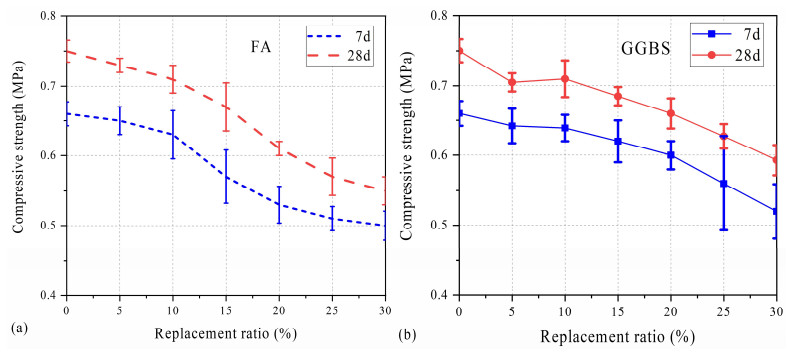
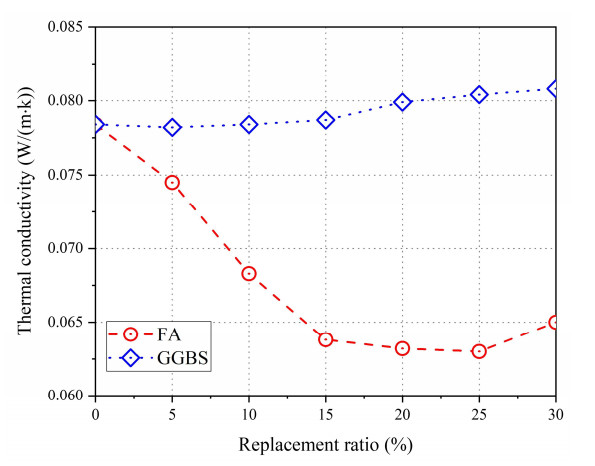
Calcium sulphoaluminate cement (CSA) has been recognized for its rapid hardening, high early strength, strong chloride resistance, and low carbon emissions. This study developed a CSA-based foam concrete using a physical foaming method, incorporating industrial by-products—fly ash (FA) and ground granulated blast-furnace slag (GGBS)—at replacement ratios of 0%–30% to reduce costs and modify properties. Key properties assessed were flowability, dry shrinkage, density, compressive strength, and thermal conductivity. Results showed that FA and GGBS enhance flowability, reduce dry shrinkage and density, and diminish compressive strength, with dosage-dependent effects. The optimal replacement ratio of FA was 15%, yielding the lowest thermal conductivity at 0.0638 W/m·K, with only a minor strength reduction relative to the pure CSA foam concrete. The findings enable tailored design of sustainable, cost-effective CSA foam concrete using industrial by-products.
Citation: Yun-Lin Liu, Xing-Zheng Xiao, Xing-Yu Zhou, Lan-Ping Qian, Dong Guo. Tailoring mechanical and functional properties of calcium sulphoaluminate cement (CSA) foam concrete with FA and GGBS replacements[J]. AIMS Materials Science, 2025, 12(5): 1025-1040. doi: 10.3934/matersci.2025047
Calcium sulphoaluminate cement (CSA) has been recognized for its rapid hardening, high early strength, strong chloride resistance, and low carbon emissions. This study developed a CSA-based foam concrete using a physical foaming method, incorporating industrial by-products—fly ash (FA) and ground granulated blast-furnace slag (GGBS)—at replacement ratios of 0%–30% to reduce costs and modify properties. Key properties assessed were flowability, dry shrinkage, density, compressive strength, and thermal conductivity. Results showed that FA and GGBS enhance flowability, reduce dry shrinkage and density, and diminish compressive strength, with dosage-dependent effects. The optimal replacement ratio of FA was 15%, yielding the lowest thermal conductivity at 0.0638 W/m·K, with only a minor strength reduction relative to the pure CSA foam concrete. The findings enable tailored design of sustainable, cost-effective CSA foam concrete using industrial by-products.

| [1] |
Ramamurthy K, Kunhanandan Nambiar EK, Indu Siva Ranjani G (2009) A classification of studies on properties of foam concrete. Cement Concrete Comp 31: 388–396. https://doi.org/10.1016/j.cemconcomp.2009.04.006 doi: 10.1016/j.cemconcomp.2009.04.006

|
| [2] |
Terzi A, Pezo L, Miti V, et al. (2015) Artificial fly ash based aggregates properties influence on lightweight concrete performances. Ceram Int 41: 2714–2726. https://doi.org/10.1016/j.ceramint.2014.10.086 doi: 10.1016/j.ceramint.2014.10.086
|
| [3] |
Sang G, Zhu Y, Yang G, et al. (2015) Preparation and characterization of high porosity cement-based foam material. Constr Build Mater 91: 133–137. https://doi.org/10.1016/j.conbuildmat.2015.05.032 doi: 10.1016/j.conbuildmat.2015.05.032
|
| [4] |
Ding Z, Dong B, Xing F, et al. (2012) Cementing mechanism of potassium phosphate based magnesium phosphate cement. Ceram Int 38: 6281–6288. https://doi.org/10.1016/j.ceramint.2012.04.083 doi: 10.1016/j.ceramint.2012.04.083
|
| [5] |
Bildirici ME (2019) Cement production, environmental pollution, and economic growth: Evidence from China and USA. Clean Technol Envir 21: 783–793. https://doi.org/10.1007/s10098-019-01667-3 doi: 10.1007/s10098-019-01667-3
|
| [6] |
Provis JL (2014) Geopolymers and other alkali activated materials: Why, how, and what? Mater Struct 47: 11–25. https://doi.org/10.1617/s11527-013-0211-5 doi: 10.1617/s11527-013-0211-5
|
| [7] |
Sirtoli D, Wyrzykowski M, Riva P, et al. (2019) Shrinkage and creep of high-performance concrete based on calcium sulfoaluminate cement. Cement Concrete Comp 98: 61–73. https://doi.org/10.1016/j.cemconcomp.2019.02.006 doi: 10.1016/j.cemconcomp.2019.02.006
|
| [8] |
Zhang G, Yang Y, Yang H, et al. (2020) Calcium sulphoaluminate cement used as mineral accelerator to improve the property of Portland cement at sub-zero temperature. Cement Concrete Comp 106: 103452. https://doi.org/10.1016/j.cemconcomp.2019.103452 doi: 10.1016/j.cemconcomp.2019.103452
|
| [9] |
Shen Y, Qian J, Chai J, et al. (2014) Calcium sulphoaluminate cements made with phosphogypsum: Production issues and material properties. Cement Concrete Comp 48: 67–74. https://doi.org/10.1016/j.cemconcomp.2014.01.009 doi: 10.1016/j.cemconcomp.2014.01.009
|
| [10] |
Ke G, Zhang J, Liu Y (2022) Shrinkage characteristics of calcium sulphoaluminate cement concrete. Constr Build Mater 337: 127627. https://doi.org/10.1016/j.conbuildmat.2022.127627 doi: 10.1016/j.conbuildmat.2022.127627
|
| [11] |
Li T, Huang F, Li L, et al. (2020) Preparation and properties of sulphoaluminate cement-based foamed concrete with high performance. Constr Build Mater 263: 120945. https://doi.org/10.1016/j.conbuildmat.2020.120945 doi: 10.1016/j.conbuildmat.2020.120945
|
| [12] |
García-Maté M, De la Torre A, León-Reina L, et al. (2013) Hydration studies of calcium sulfoaluminate cements blended with fly ash. Cem Concr Res 54: 12–20. https://doi.org/10.1016/j.cemconres.2013.07.010 doi: 10.1016/j.cemconres.2013.07.010
|
| [13] |
Shang J, Dai JG, Zhao TJ, et al. (2018) Alternation of traditional cement mortars using fly ash-based geopolymer mortars modified by slag. J Clean Prod 203: 746–756. https://doi.org/10.1016/j.jclepro.2018.08.255 doi: 10.1016/j.jclepro.2018.08.255
|
| [14] |
Qian LP, Xu LY, Alrefaei Y, et al. (2022) Artificial alkali-activated aggregates developed from wastes and by-products: A state-of-the-art review. Resour Conserv Recy 177: 105971. https://doi.org/10.1016/j.resconrec.2021.105971 doi: 10.1016/j.resconrec.2021.105971
|
| [15] |
Ahmad MR, Qian LP, Fang Y, et al. (2023) A multiscale study on gel composition of hybrid alkali-activated materials partially utilizing air pollution control residue as an activator. Cement Concrete Comp 136: 104856. https://doi.org/10.1016/j.cemconcomp.2022.104856 doi: 10.1016/j.cemconcomp.2022.104856
|
| [16] |
Wang YS, Alrefaei Y, Dai JG (2021) Roles of hybrid activators in improving the early-age properties of one-part geopolymer pastes. Constr Build Mater 306: 124880. https://doi.org/10.1016/j.conbuildmat.2021.124880 doi: 10.1016/j.conbuildmat.2021.124880
|
| [17] |
Wang YS, Alrefaei Y, Dai JG (2020) Influence of coal fly ash on the early performance enhancement and formation mechanisms of silico-aluminophosphate geopolymer. Cem Concr Res 127: 105932. https://doi.org/10.1016/j.cemconres.2019.105932 doi: 10.1016/j.cemconres.2019.105932
|
| [18] |
Cong M, Bing C (2015) Properties of a foamed concrete with soil as filler. Constr Build Mater 76: 61–69. https://doi.org/10.1016/j.conbuildmat.2014.11.066 doi: 10.1016/j.conbuildmat.2014.11.066
|
| [19] |
Alrefaei Y, Wang YS, Dai JG, et al. (2020) Effect of superplasticizers on properties of one-part Ca(OH)2/Na2SO4 activated geopolymer pastes. Constr Build Mater 241: 117990. https://doi.org/10.1016/j.conbuildmat.2019.117990 doi: 10.1016/j.conbuildmat.2019.117990
|
| [20] |
Scrivener K, Martirena F, Bishnoi S, et al. (2018) Calcined clay limestone cements (LC3). Cem Concr Res 114: 49–56. https://doi.org/10.1016/j.cemconres.2017.08.017 doi: 10.1016/j.cemconres.2017.08.017
|
| [21] |
Poon CS, Kou S, Lam L, et al. (2001) Activation of fly ash/cement systems using calcium sulfate anhydrite (CaSO4). Cem Concr Res 31: 873–881. https://doi.org/10.1016/S0008-8846(01)00478-1 doi: 10.1016/S0008-8846(01)00478-1
|
| [22] |
Pan Z, Li H, Liu W (2014) Preparation and characterization of super low density foamed concrete from Portland cement and admixtures. Constr Build Mater 72: 256–261. https://doi.org/10.1016/j.conbuildmat.2014.08.078 doi: 10.1016/j.conbuildmat.2014.08.078
|
| [23] |
Xue J, Li S, Zhang Z, et al. (2025) Hydration, mechanical properties, and corrosion resistance of ferroaluminate cement in the presence of FA and GGBS. J Build Eng 102: 111974. https://doi.org/10.1016/j.jobe.2025.111974 doi: 10.1016/j.jobe.2025.111974
|
| [24] |
Muller AC, Scrivener KL, Gajewicz AM, et al. (2013) Densification of C–S–H measured by 1H NMR relaxometry. J Phys Chem C 117: 403–412. https://doi.org/10.1021/jp3102964 doi: 10.1021/jp3102964
|
| [25] |
Liu YL, Liu C, Qian LP, et al. (2023) Foaming processes and properties of geopolymer foam concrete: Effect of the activator. Constr Build Mater 391: 131830. https://doi.org/10.1016/j.conbuildmat.2023.131830 doi: 10.1016/j.conbuildmat.2023.131830
|
| [26] |
Liu YL, Li CF, Zhai HX, et al. (2023) Production and performance of CO2 modified foam concrete. Constr Build Mater 389: 131671. https://doi.org/10.1016/j.conbuildmat.2023.131671 doi: 10.1016/j.conbuildmat.2023.131671
|
| [27] |
Hilal AA, Thom NH, Dawson AR (2015) On void structure and strength of foamed concrete made without/with additives. Constr Build Mater 85: 157–164. https://doi.org/10.1016/j.conbuildmat.2015.03.093 doi: 10.1016/j.conbuildmat.2015.03.093
|
| [28] |
Shao N, Zhang Y, Liu Z, et al. (2018) Fabrication of hollow microspheres filled fly ash based foam geopolymers with ultra-low thermal conductivity and relative high strength. Constr Build Mater 185: 567–573. https://doi.org/10.1016/j.conbuildmat.2018.07.077 doi: 10.1016/j.conbuildmat.2018.07.077
|
| [29] |
Gu G, Xu F, Ruan S, et al. (2020) Influence of precast foam on the pore structure and properties of fly ash-based geopolymer foams. Constr Build Mater 256: 119410. https://doi.org/10.1016/j.conbuildmat.2020.119410 doi: 10.1016/j.conbuildmat.2020.119410
|
| [30] |
Dembovska L, Bajare D, Ducman V, et al. (2017) The use of different by-products in the production of lightweight alkali activated building materials. Constr Build Mater 135: 315–322. https://doi.org/10.1016/j.conbuildmat.2017.01.005 doi: 10.1016/j.conbuildmat.2017.01.005
|
| [31] |
Liu Y, Huo S, Fu J, et al. (2024) Dynamic properties of CO2-cured foam concrete at different loading rates: Effect of the foam admixtures and addition of polypropylene fiber. Front Mater 11: 1445848. https://doi.org/10.3389/fmats.2024.1445848 doi: 10.3389/fmats.2024.1445848
|
| [32] |
Al Bakri Abdullah MM, Hussin K, Bnhussain M, et al. (2012) Fly ash-based geopolymer lightweight concrete using foaming agent. Int J Mol Sci 13: 7186–7198. https://doi.org/10.3390/ijms13067186 doi: 10.3390/ijms13067186
|
| [33] |
Zhang Z, Provis JL, Reid A, et al. (2015) Mechanical, thermal insulation, thermal resistance and acoustic absorption properties of geopolymer foam concrete. Cement Concrete Comp 62: 97–105. https://doi.org/10.1016/j.cemconcomp.2015.03.013 doi: 10.1016/j.cemconcomp.2015.03.013
|
| [34] |
Wang L, Tan X (2011) Preparation and properties of alkali activated foam cement reinforced with polypropylene fibers. J WuHan Univ Technol 26: 960–964. https://doi.org/10.1007/s11595-011-0345-7 doi: 10.1007/s11595-011-0345-7
|
| [35] |
Abdollahnejad Z, Pacheco-Torgal F, Félix T, et al. (2015) Mix design, properties and cost analysis of fly ash-based geopolymer foam. Constr Build Mater 80: 18–30. https://doi.org/10.1016/j.conbuildmat.2015.01.063 doi: 10.1016/j.conbuildmat.2015.01.063
|
| [36] |
Hlaváček P, Šmilauer V, Škvára F, et al. (2015) Inorganic foams made from alkali-activated fly ash: Mechanical, chemical and physical properties. J Eur Ceram Soc 35: 703–709. https://doi.org/10.1016/j.jeurceramsoc.2014.08.024 doi: 10.1016/j.jeurceramsoc.2014.08.024
|
| [37] |
Ducman V, Korat L (2016) Characterization of geopolymer fly-ash based foams obtained with the addition of Al powder or H2O2 as foaming agents. Mater Charact 113: 207–213. https://doi.org/10.1016/j.matchar.2016.01.019 doi: 10.1016/j.matchar.2016.01.019
|
| [38] |
Phavongkham V, Wattanasiriwech S, Cheng TW, et al. (2020) Effects of surfactant on thermo-mechanical behavior of geopolymer foam paste made with sodium perborate foaming agent. Constr Build Mater 243: 118282. https://doi.org/10.1016/j.conbuildmat.2020.118282 doi: 10.1016/j.conbuildmat.2020.118282
|
| [39] |
Hashim M, Tantray M (2021) Comparative study on the performance of protein and synthetic-based foaming agents used in foamed concrete. Case Stud Constr Mater 14: e00524. https://doi.org/10.1016/j.cscm.2021.e00524 doi: 10.1016/j.cscm.2021.e00524
|
| [40] |
Gao M, Li M, Wang J, et al. (2024) Effect of fly ash on properties and hydration of calcium sulphoaluminate cement-based materials with high water content. De Gruyter Brill 63: 20240046. https://doi.org/10.1515/rams-2024-0046 doi: 10.1515/rams-2024-0046
|
| [41] |
Lin L, Tao J, Chen B, et al. (2022) Preparation and properties of foamed cement for lightweight thermal insulation with Ti-extraction blast furnace slag and sulfoaluminate cement by chemical foaming. Constr Build Mater 337: 127634. https://doi.org/10.1016/j.conbuildmat.2022.127634 doi: 10.1016/j.conbuildmat.2022.127634
|
| [42] |
Behnia S, Jafari A, Soltanpoor W, et al. (2009) Nonlinear transitions of a spherical cavitation bubble. Chaos Solition Frac 41: 818–828. https://doi.org/10.1016/j.chaos.2008.04.011 doi: 10.1016/j.chaos.2008.04.011
|
| [43] |
Nath P, Sarker P (2011) Effect of fly ash on the durability properties of high strength concrete. Procedia Eng 14: 1149–1156. https://doi.org/10.1016/j.proeng.2011.07.144 doi: 10.1016/j.proeng.2011.07.144
|
| [44] |
Kang M, Jia Y, Guo P, et al. (2024) Influence of fly ash content on macroscopic properties and microstructure of high-performance concrete. Res Sq 14: 3844–3844. https://doi.org/10.21203/rs.3.rs-4821515/v1 doi: 10.21203/rs.3.rs-4821515/v1
|
| [45] |
Aamar D, Ali MM (2021) Influence of cenospheres and fly ash on the mechanical and durability properties of high-performance cement mortar under different curing regimes. Constr Build Mater 279: 122458. https://doi.org/10.1016/j.conbuildmat.2021.122458 doi: 10.1016/j.conbuildmat.2021.122458
|
| [46] |
Gao D, Meng Y, Yang L, et al. (2019) Effect of ground granulated blast furnace slag on the properties of calcium sulfoaluminate cement. Constr Build Mater 227: 116665. https://doi.org/10.1016/j.conbuildmat.2019.08.046 doi: 10.1016/j.conbuildmat.2019.08.046
|
| [47] | Standard for test methods of basic properties of construction mortar JGJ/T 70-2009. Ministry of Housing and Urban-Rural Development of the People's Republic of China (MOHURD); 2009[in Chinese]. Available from: https://openstd.samr.gov.cn. |
| [48] |
Li G, Tan H, He X, et al. (2021) The influence of wet ground fly ash on the performance of foamed concrete. Constr Build Mater 304: 124676. https://doi.org/10.1016/j.conbuildmat.2021.124676 doi: 10.1016/j.conbuildmat.2021.124676
|
| [49] |
Libre NA, Khoshnazar R, Shekarchi M (2009) Relationship between fluidity and stability of self-consolidating mortar incorporating chemical and mineral admixtures. Constr Build Mater 24: 1262–1271. https://doi.org/10.1016/j.conbuildmat.2009.12.009 doi: 10.1016/j.conbuildmat.2009.12.009
|
| [50] |
Zhang T, Ma B, Jiang D, et al. (2021) Comparative research on the effect of various mineral admixtures on the early hydration process of cement. Constr Build Mater 301: 124372. https://doi.org/10.1016/j.conbuildmat.2021.124372 doi: 10.1016/j.conbuildmat.2021.124372
|
| [51] |
Azimi AH (2015) Experimental investigations on the physical and rheological characteristics of sand–foam mixtures. J Non-newton Fluid 221: 28–39. https://doi.org/10.1016/j.jnnfm.2015.04.003 doi: 10.1016/j.jnnfm.2015.04.003
|
| [52] | Khan MI (2014) Experimental investigation on mechanical characterization of fiber reinforced foamed concrete. Master's Thesis, University of Akron, Akron, OH, USA. |
| [53] |
Bentz DP (2007) Internal curing of high-performance blended cement mortars. J Mater Res 104: 408–414. https://doi.org/10.14359/18831 doi: 10.14359/18831
|
| [54] |
Bentz DP, Snyder KA (1999) Protected paste volume in concrete: Extension to internal curing using saturated lightweight fine aggregate. Cem Concr Res 29: 1863–1867. https://doi.org/10.1016/S0008-8846(99)00178-7 doi: 10.1016/S0008-8846(99)00178-7
|
| [55] |
Bentz DP, Hansen AS, Guynn JM (2011) Optimization of cement and fly ash particle sizes to produce sustainable concretes. Cement Concrete Comp 33: 824–831. https://doi.org/10.1016/j.cemconcomp.2011.04.008 doi: 10.1016/j.cemconcomp.2011.04.008
|
| [56] |
Wang H, Long G, Xie Y, et al. (2022) Effects of intense ultraviolet irradiation on drying shrinkage and microstructural characteristics of cement mortar. Constr Build Mater 347: 128513. https://doi.org/10.1016/j.conbuildmat.2022.128513 doi: 10.1016/j.conbuildmat.2022.128513
|
| [57] |
Zhang W, Hama Y, Na SH (2015) Drying shrinkage and microstructure characteristics of mortar incorporating ground granulated blast furnace slag and shrinkage reducing admixture. Constr Build Mater 93: 267–277. https://doi.org/10.1016/j.conbuildmat.2015.05.103 doi: 10.1016/j.conbuildmat.2015.05.103
|
| [58] |
Alnahhal MF, Kim T, Hajimohammadi A (2020) Evolution of flow properties, plastic viscosity, and yield stress of alkali-activated fly ash/slag pastes. RILEM Tech Lett 5: 141–149. https://doi.org/10.21809/rilemtechlett.2020.123 doi: 10.21809/rilemtechlett.2020.123
|
| [59] |
Hu C, Li H, Liu Z, et al. (2016) Research on properties of foamed concrete reinforced with small sized glazed hollow beads. Adv Mater Sci Eng 2016: 5820870. https://doi.org/10.1155/2016/5820870 doi: 10.1155/2016/5820870
|
| [60] |
Shahidan S, Aminuddin E, Mohd Noor K, et al. (2017) Potential of hollow glass microsphere as cement replacement for lightweight foam concrete on thermal insulation performance. MATEC Web Conf 103: 01014. https://doi.org/10.1051/matecconf/201710301014 doi: 10.1051/matecconf/201710301014
|
| [61] |
Gołaszewski J, Klemczak B, Smolana A, et al. (2022) Effect of foaming agent, binder and density on the compressive strength and thermal conductivity of ultra-light foam concrete. Buildings 12: 1176. https://doi.org/10.3390/buildings12081176 doi: 10.3390/buildings12081176
|
| [62] |
Demirboǧa R (2003) Influence of mineral admixtures on thermal conductivity and compressive strength of mortar. Energy Build 35: 189–192. https://doi.org/10.1016/S0378-7788(02)00052-X doi: 10.1016/S0378-7788(02)00052-X
|
Figures(6) / Tables(3)

Yun-Lin Liu, Xing-Zheng Xiao, Xing-Yu Zhou, Lan-Ping Qian, Dong Guo. Tailoring mechanical and functional properties of calcium sulphoaluminate cement (CSA) foam concrete with FA and GGBS replacements[J]. AIMS Materials Science, 2025, 12(5): 1025-1040. doi: 10.3934/matersci.2025047





 DownLoad: