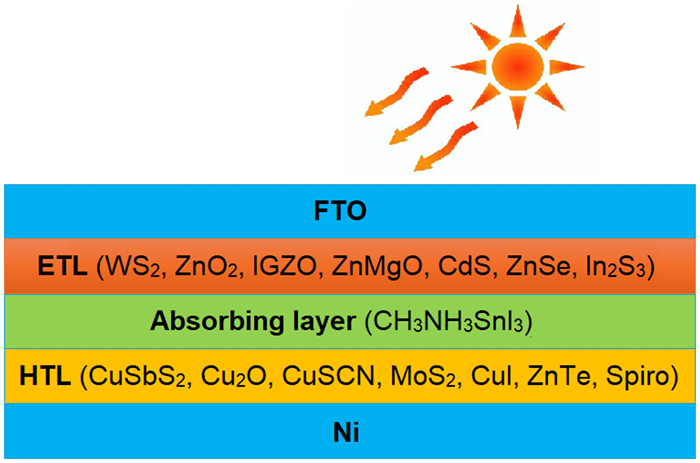
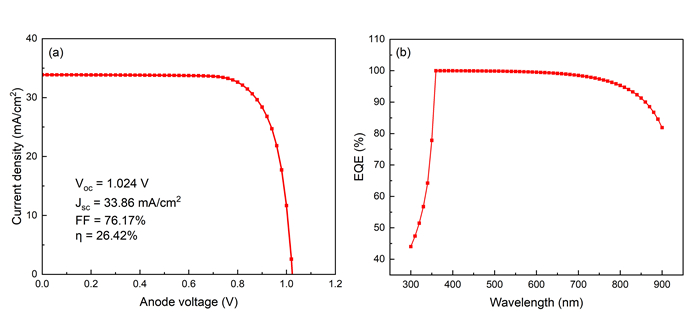
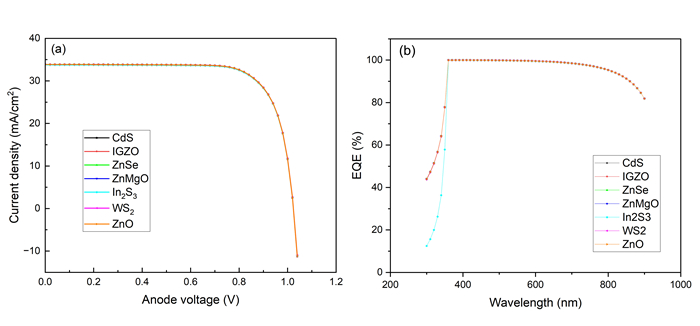
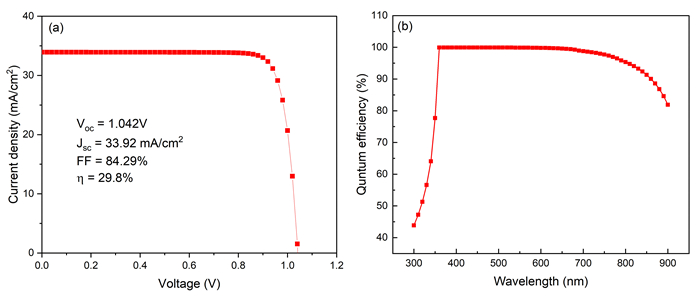
This study explored how varying the material and physical properties of the electron transport layer (ETL) and hole transport layer (HTL) layers affects the performance of CH3NH3SnI3 perovskite solar cells. Numerical simulations were conducted using 1D Solar Cell Capacity Simulator (SCAPS-1D) software, with the AM1.5G solar spectrum at an intensity of 1000 W/m2 applied from the ETL side. The simulation started with the structure fluorine-doped tin oxide (FTO)/ETL/CH3NH3SnI3/HTL/Ni, where ZnO2 was assigned as the ETL layer and CuSCN as the HTL layer. Then, different materials were suggested to act as the ETL and HTL layers. Finally, the doping and thickness of the best material obtained for the ETL and HTL layers were optimized. The results reveal that WS2 is the most promising for the ETL, while CuSbS2 was identified as the most suitable material for the HTL in CH3NH3SnI3 solar cells. By increasing the doping levels and layer thicknesses of the ETL and HTL, the conversion efficiency of the solar cell was slightly enhanced. The electrical performance of the CH3NH3SnI3 solar cell showed significant improvement compared to the initial configuration: the Voc increased from 1.024 to 1.042 V, Jsc slightly increased from 33.86 to 33.92 mA/cm2, the fill factor improved from 76.17% to 84.29%, and the overall efficiency (η) increased from 26.42% to 29.8%. This study highlights how material and structural optimizations can improve the performance of CH3NH3SnI3 perovskite solar cells, offering valuable insights for the future design of high-efficiency perovskite photovoltaics.
Citation: Ala'eddin A. Saif, Ghalyiah Alahmadi. Optimization of HTL and ETL materials and parameters for high-efficiency CH3NH3SnI3 perovskite solar cells[J]. AIMS Materials Science, 2025, 12(5): 1004-1024. doi: 10.3934/matersci.2025046
This study explored how varying the material and physical properties of the electron transport layer (ETL) and hole transport layer (HTL) layers affects the performance of CH3NH3SnI3 perovskite solar cells. Numerical simulations were conducted using 1D Solar Cell Capacity Simulator (SCAPS-1D) software, with the AM1.5G solar spectrum at an intensity of 1000 W/m2 applied from the ETL side. The simulation started with the structure fluorine-doped tin oxide (FTO)/ETL/CH3NH3SnI3/HTL/Ni, where ZnO2 was assigned as the ETL layer and CuSCN as the HTL layer. Then, different materials were suggested to act as the ETL and HTL layers. Finally, the doping and thickness of the best material obtained for the ETL and HTL layers were optimized. The results reveal that WS2 is the most promising for the ETL, while CuSbS2 was identified as the most suitable material for the HTL in CH3NH3SnI3 solar cells. By increasing the doping levels and layer thicknesses of the ETL and HTL, the conversion efficiency of the solar cell was slightly enhanced. The electrical performance of the CH3NH3SnI3 solar cell showed significant improvement compared to the initial configuration: the Voc increased from 1.024 to 1.042 V, Jsc slightly increased from 33.86 to 33.92 mA/cm2, the fill factor improved from 76.17% to 84.29%, and the overall efficiency (η) increased from 26.42% to 29.8%. This study highlights how material and structural optimizations can improve the performance of CH3NH3SnI3 perovskite solar cells, offering valuable insights for the future design of high-efficiency perovskite photovoltaics.

| [1] |
Rono N, Merad AE, Kibet JK, et al. (2021) A theoretical investigation of the effect of the hole and electron transport materials on the performance of a lead-free perovskite solar cell based on CH3NH3SnI3. J Comput Electron 20: 993–1005. https://doi.org/10.1007/s10825-021-01673-z doi: 10.1007/s10825-021-01673-z

|
| [2] |
Casas GA, Cappelletti MA, Cedola AP, et al. (2017) Analysis of the power conversion efficiency of perovskite solar cells with different materials as hole-transport layer by numerical simulations. Superlattice Microst 107: 136–143. https://doi.org/10.1016/j.spmi.2017.04.007 doi: 10.1016/j.spmi.2017.04.007
|
| [3] |
Green MA, Dunlop ED, Hohl-Ebinger J, et al. (2023) Solar cell efficiency tables (version 62). Prog Photovolt Res Appl 31: 3–16. https://doi.org/10.1002/pip.3646 doi: 10.1002/pip.3646
|
| [4] |
Xu K (2021) Development of tin-based perovskite materials for solar cell applications: A minireview. Instrum Sci Technol 49: 91–105. https://doi.org/10.1080/10739149.2020.1785891 doi: 10.1080/10739149.2020.1785891
|
| [5] |
Patel PK (2021) Device simulation of highly efficient eco-friendly CH3NH3SnI3 perovskite solar cell. Sci Rep 11: 3082. https://doi.org/10.1038/s41598-021-82817-w doi: 10.1038/s41598-021-82817-w
|
| [6] |
Mottakin M, Sobayel K, Sarkar D, et al. (2021) Design and modelling of eco-friendly CH3NH3SnI3-based perovskite solar cells with suitable transport layers. Energies 14: 7200. https://doi.org/10.3390/en14217200 doi: 10.3390/en14217200
|
| [7] |
Chen L, Fu S, Li Y, et al. (2024) On the durability of tin‐containing perovskite solar cells. Adv Sci 11: 202304811. https://doi.org/10.1002/advs.202304811 doi: 10.1002/advs.202304811
|
| [8] |
Zhou T, Huang X, Yao R, et al. (2025) Integrative enhancement of energy‐level alignment and defect passivation for high-performance lead-free perovskite solar cells. Adv Theory Simul 8: 2401064. https://doi.org/10.1002/adts.202401064 doi: 10.1002/adts.202401064
|
| [9] |
Howlader AH, Dipta SS, Tarique WB, et al. (2024) Self-formation of SnCl2 passivation layer on SnO2 electron-transport layer in chloride–iodide-based perovskite solar cell. Adv Energy Sustain Res 5: 2400030. https://doi.org/10.1002/aesr.202400030 doi: 10.1002/aesr.202400030
|
| [10] |
Dipta SS, Rahaman MH, Tarique WB, et al. (2024) Highly efficient double-side-passivated perovskite solar cells for reduced degradation and low photovoltage loss. Sol Energy Mater Sol Cells 266: 112655. https://doi.org/10.1016/j.solmat.2023.112655 doi: 10.1016/j.solmat.2023.112655
|
| [11] |
Ayad M, Fathi M, Mellit A (2021) Study and performance analysis of perovskite solar cell structure based on organic and inorganic thin films. Optik 233: 166619. https://doi.org/10.1016/j.ijleo.2021.166619 doi: 10.1016/j.ijleo.2021.166619
|
| [12] |
Huang ZP, Chen YX, Huang ZH, et al. (2023) Simulation of highly efficient GeSe-based solar cells with SCAPS-1D. Heliyon 9: e18776. https://doi.org/10.1016/j.heliyon.2023.e18776 doi: 10.1016/j.heliyon.2023.e18776
|
| [13] |
Lenka TR, Soibam AC, Dey K, et al. (2020) Numerical analysis of high efficiency lead-free perovskite solar cell with NiO as hole transport material and PCBM as electron transport material. CSIT 8: 111–116. https://doi.org/10.1007/s40012-020-00291-7 doi: 10.1007/s40012-020-00291-7
|
| [14] |
Karimi E, Ghorashi SMB (2017) Investigation of the influence of different hole transporting materials on the performance of perovskite solar cells. Optik 130: 650–658. https://doi.org/10.1016/J.IJLEO.2016.10.122 doi: 10.1016/J.IJLEO.2016.10.122
|
| [15] |
Karthick S, Velumani S, Boucle J (2020) Experimental and SCAPS simulated for mamidinium perovskite solar cells: A comparison of device performance. Sol Energy 205: 349–357. https://doi.org/10.1016/j.solener.2020.05.041 doi: 10.1016/j.solener.2020.05.041
|
| [16] |
Dipta SS, Howlader AH, Tarique WB, et al. (2025) Evaluating different alkylammonium bromide passivation films to stabilize and enhance PV performance of perovskite solar cells. Sol Energy 286: 113195. https://doi.org/10.1016/j.solener.2024.113195 doi: 10.1016/j.solener.2024.113195
|
| [17] |
Tarique WB, Rahaman MH, Dipta SS, et al. (2024) Solution-processed bilayered ZnO electron transport layer for efficient inverted non-fullerene organic solar cells. Nanomanufacturing 4: 81–98. https://doi.org/10.3390/nanomanufacturing4020006 doi: 10.3390/nanomanufacturing4020006
|
| [18] |
Valeti NJ, Prakash K, Singha MK (2023) Numerical simulation and optimization of lead free CH3NH3SnI3 perovskite solar cell with CuSbS2 as HTL using SCAPS 1D. Results Opt 12: 100440. https://doi.org/10.1016/j.rio.2023.100440 doi: 10.1016/j.rio.2023.100440
|
| [19] |
Gagandeep, Singh M, Kumar R, et al. (2021) Investigation of CH3NH3PbI3 and CH3NH3SnI3 based perovskite solar cells with CuInSe2 nanocrystals. Optik 246: 167839. https://doi.org/10.1016/j.ijleo.2021.167839 doi: 10.1016/j.ijleo.2021.167839
|
| [20] |
Zainal Abidin NA, Arith F, Noorasid NS, et al. (2023) Dopant engineering for ZnO electron transport layer towards efficient perovskite solar cells. RSC Adv 13: 33797–33819. https://doi.org/10.1039/d3ra04823c doi: 10.1039/d3ra04823c
|
| [21] |
Rai N, Rai S, Singh PK, et al. (2020) Analysis of various ETL materials for an efficient perovskite solar cell by numerical simulation. J Mater Sci Mater Electron 31: 16269–16280. https://doi.org/10.1007/s10854-020-04175-z doi: 10.1007/s10854-020-04175-z
|
| [22] |
Mercy PAM, Wilson KSJ (2023) Development of environmental friendly high performance Cs2TiBr6 based perovskite solar cell using numerical simulation. Appl Surf Sci Adv 15: 100394. https://doi.org/10.1016/j.apsadv.2023.100394 doi: 10.1016/j.apsadv.2023.100394
|
| [23] |
Bag A, Radhakrishnan R, Nekovei R, et al. (2020) Effect of absorber layer, hole transport layer thicknesses, and its doping density on the performance of perovskite solar cells by device simulation. Sol Energ 196: 177–182. https://doi.org/10.1016/j.solener.2019.12.014 doi: 10.1016/j.solener.2019.12.014
|
| [24] |
Krishna BG, Ghosh DS, Tiwari S (2023) Hole and electron transport materials: A review on recent progress in organic charge transport materials for efficient, stable, and scalable perovskite solar cells. Chem Inorg Mater 1: 100026, https://doi.org/10.1016/j.cinorg.2023.100026 doi: 10.1016/j.cinorg.2023.100026
|
| [25] |
Li S, Cao YL, Li WH, et al. (2021) A brief review of hole transporting materials commonly used in perovskite solar cells. Rare Met 40: 2712–2729. https://doi.org/10.1007/s12598-020-01691-z doi: 10.1007/s12598-020-01691-z
|
| [26] |
Zhang B, Zhou Y, Xue Q, et al. (2019) The energy-alignment engineering in polytriphenylamines-based hole transport polymers realizes low energy loss and high efficiency for all-inorganic perovskite solar cells. Solar RRL 3: 1900265. https://doi.org/10.1002/solr.201900265 doi: 10.1002/solr.201900265
|
| [27] |
Devi C, Mehra R (2019) Device simulation of lead-free MASnI3 solar cell with CuSbS2 (copper antimony sulfide). J Mater Sci 54: 5615–5624. https://doi.org/10.1007/s10853-018-03265-y doi: 10.1007/s10853-018-03265-y
|
| [28] |
Yu X, Zou X, Cheng J, et al. (2020) Numerical simulation analysis of effect of energy band alignment and functional layer thickness on the performance for perovskite solar cells with Cd1−xZnxS electron transport layer. Mater Res Express 7: 105906. https://doi.org/10.1088/2053-1591/abbf12 doi: 10.1088/2053-1591/abbf12
|
| [29] |
Sławek A, Starowicz Z, Lipinski M (2021) The influence of the thickness of compact TiO2 electron transport layer on the performance of planar CH3NH3PbI3 perovskite solar cells. Materials 14: 3295. https://doi.org/10.3390/ma14123295 doi: 10.3390/ma14123295
|
| [30] |
Jamal S, Khan AD, Khan AD (2020) High performance perovskite solar cell based on efficient materials for electron and hole transport layers. Optik 218: 164787. https://doi.org/10.1016/j.ijleo.2020.164787 doi: 10.1016/j.ijleo.2020.164787
|
| [31] |
Moiz SA, Alshaikh MS, Alahmadi ANM (2023) Simulation design of novel non-fluorine polymers as electron transport layer for lead-free perovskite solar cells. Polymers 15: 4387. https://doi.org/10.3390/polym15224387 doi: 10.3390/polym15224387
|
| [32] |
Sabbah H, Arayro J, Mezher R (2022) Simulation and investigation of 26% efficient and robust inverted planar perovskite solar cells based on GA0.2FA0.78SnI3-1%EDAI2 films. Nanomater 12: 3885. https://doi.org/10.3390/nano12213885 doi: 10.3390/nano12213885
|
Figures(17) / Tables(8)

Ala'eddin A. Saif, Ghalyiah Alahmadi. Optimization of HTL and ETL materials and parameters for high-efficiency CH3NH3SnI3 perovskite solar cells[J]. AIMS Materials Science, 2025, 12(5): 1004-1024. doi: 10.3934/matersci.2025046





 DownLoad: