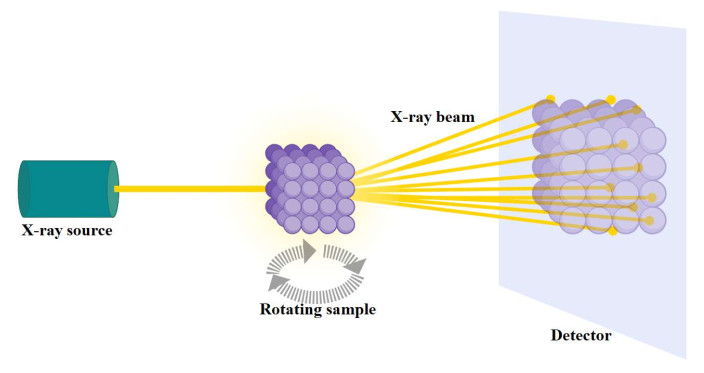
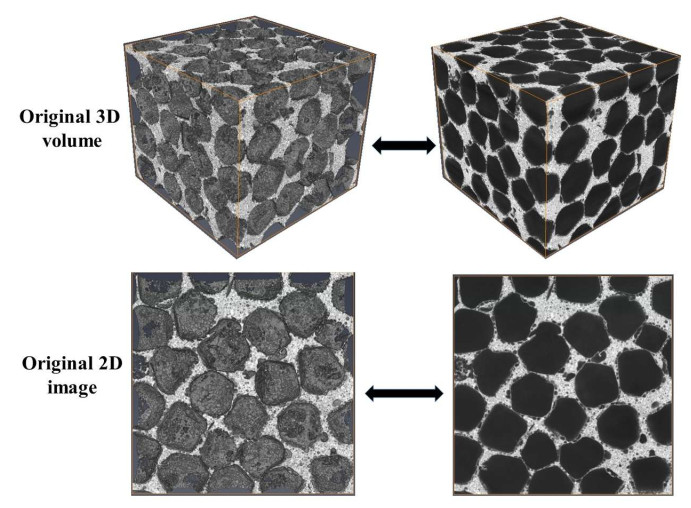
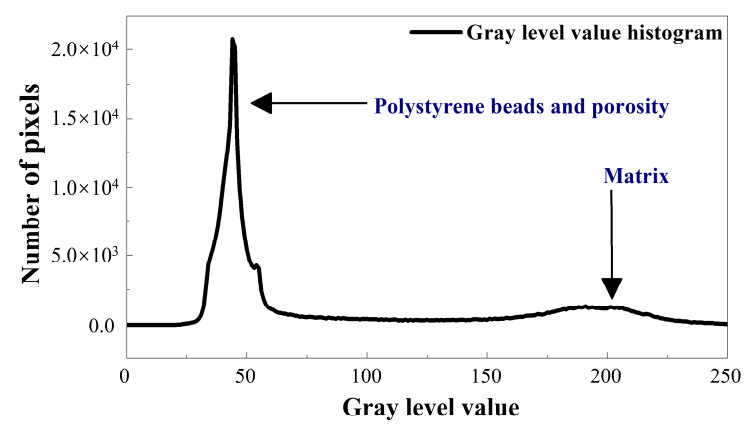
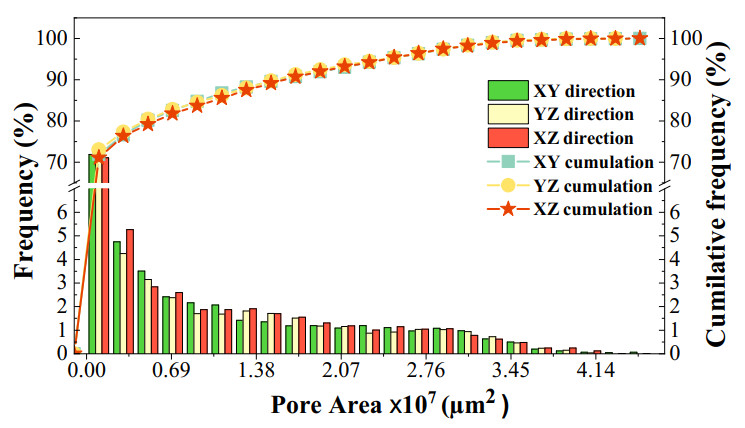
In this study, we performed a multi-scale three-dimensional (3D) analysis of a new type of lightweight composite material made with coal fly ash and expanded polystyrene wastes. For this, a methodology for identifying and quantifying the microstructure property of the lightweight composite material was developed using X-ray micro-tomography. The material studied mainly contained polystyrene beads, which have approximately the same density as the air voids; they share the same grayscale, and it is not easy to distinguish them, which makes it challenging to characterize the porous 3D structure of this material. The 3D visualization software "Avizo" enabled the 3D reconstruction of the composite and its microstructural characterization. Several microstructure parameters were explored and characterized quantitatively, including porosity distribution, pore surface area, representative elementary volume (REV), sphericity, pore equivalent diameter, and pore network model. The results demonstrated that X-ray micro-tomography is a valuable instrument for non-destructive and complete detection of the microstructural properties of polystyrene reinforced composite.
Citation: Saleh Eladaoui, Mouad El Mouzahim, El Mehdi Eddarai, Maroua Maaroufi, Mustapha El Kanzaoui, Abdelkabir Bellaouchou, Abdelkader Zarrouk, Ratiba Boussen. Three-dimensional examination of fly ash-PVCA composite reinforced by expanded polystyrene beads using X-ray micro-tomography[J]. AIMS Materials Science, 2025, 12(5): 975-992. doi: 10.3934/matersci.2025044
In this study, we performed a multi-scale three-dimensional (3D) analysis of a new type of lightweight composite material made with coal fly ash and expanded polystyrene wastes. For this, a methodology for identifying and quantifying the microstructure property of the lightweight composite material was developed using X-ray micro-tomography. The material studied mainly contained polystyrene beads, which have approximately the same density as the air voids; they share the same grayscale, and it is not easy to distinguish them, which makes it challenging to characterize the porous 3D structure of this material. The 3D visualization software "Avizo" enabled the 3D reconstruction of the composite and its microstructural characterization. Several microstructure parameters were explored and characterized quantitatively, including porosity distribution, pore surface area, representative elementary volume (REV), sphericity, pore equivalent diameter, and pore network model. The results demonstrated that X-ray micro-tomography is a valuable instrument for non-destructive and complete detection of the microstructural properties of polystyrene reinforced composite.

| [1] |
Kumar V, Khan A, Rabnawaz M (2022) Efficient depolymerization of polystyrene with table salt and oxidized copper. ACS Sustain Chem Eng 10: 6493–6502. https://doi.org/10.1021/acssuschemeng.1c08400 doi: 10.1021/acssuschemeng.1c08400

|
| [2] |
Aljabri NM, Lai Z, Hadjichristidis N, et al. (2017) Renewable aromatics from the degradation of polystyrene under mild conditions. J Saudi Chem Soc 21: 983–989. https://doi.org/10.1016/J.JSCS.2017.05.005 doi: 10.1016/J.JSCS.2017.05.005
|
| [3] |
Koksal F, Mutluay E, Gencel O (2020) Characteristics of isolation mortars produced with expanded vermiculite and waste expanded polystyrene. Constr Build Mater 236: 117789. https://doi.org/10.1016/j.conbuildmat.2019.117789 doi: 10.1016/j.conbuildmat.2019.117789
|
| [4] |
Ferrándiz-Mas V, Bond T, García-Alcocel E, et al. (2014) Lightweight mortars containing expanded polystyrene and paper sludge ash. Constr Build Mater 61: 285–292. https://doi.org/10.1016/j.conbuildmat.2014.03.028 doi: 10.1016/j.conbuildmat.2014.03.028
|
| [5] |
Fernando PLN, Jayasinghe MTR, Jayasinghe C (2017) Structural feasibility of expanded polystyrene (EPS) based lightweight concrete sandwich wall panels. Constr Build Mater 139: 45–51. https://doi.org/10.1016/j.conbuildmat.2017.02.027 doi: 10.1016/j.conbuildmat.2017.02.027
|
| [6] |
Shi G, Liu T, Li G, et al. (2021) A novel thermal insulation composite fabricated with industrial solid wastes and expanded polystyrene beads by compression method. J Clean Prod 279: 123420. https://doi.org/10.1016/j.jclepro.2020.123420 doi: 10.1016/j.jclepro.2020.123420
|
| [7] |
Colangelo F, Roviello G, Ricciotti L, et al. (2018) Mechanical and thermal properties of lightweight geopolymer composites. Cem Concr Compos 86: 266–272. https://doi.org/10.1016/J.CEMCONCOMP.2017.11.016 doi: 10.1016/J.CEMCONCOMP.2017.11.016
|
| [8] |
Mucsi G, Szabó R, Nagy S, et al. (2017) Development of polystyrene-geopolymer composite for thermal insulating material and its properties with special regards to flame resistance. IOP Conf Ser Mater Sci Eng 251: 012079. https://doi.org/10.1088/1757-899X/251/1/012079 doi: 10.1088/1757-899X/251/1/012079
|
| [9] |
Nawghare SM, Mandal JN (2020) Effectiveness of expanded polystyrene (EPS) beads size on fly ash properties. Int J Geosynth Ground Eng 6: 6. https://doi.org/10.1007/s40891-020-0189-3 doi: 10.1007/s40891-020-0189-3
|
| [10] |
Cadere CA, Barbuta M, Rosca B, et al. (2018) Engineering properties of concrete with polystyrene granules. Procedia Manuf 22: 288–293. https://doi.org/10.1016/J.PROMFG.2018.03.044 doi: 10.1016/J.PROMFG.2018.03.044
|
| [11] |
Nagrockienė D, Rutkauskas A (2019) The effect of fly ash additive on the resistance of concrete to alkali silica reaction. Constr Build Mater 201: 599–609. https://doi.org/10.1016/j.conbuildmat.2018.12.225 doi: 10.1016/j.conbuildmat.2018.12.225
|
| [12] |
Bhatt A, Priyadarshini S, Acharath Mohanakrishnan A, et al. (2019) Physical, chemical, and geotechnical properties of coal fly ash: A global review. Case Stud Constr Mater 11: e00263. https://doi.org/10.1016/J.CSCM.2019.E00263 doi: 10.1016/J.CSCM.2019.E00263
|
| [13] |
Wang N, Sun X, Zhao Q, et al. (2020) Leachability and adverse effects of coal fly ash: A review. J Hazard Mater 396: 122725. https://doi.org/10.1016/J.JHAZMAT.2020.122725 doi: 10.1016/J.JHAZMAT.2020.122725
|
| [14] |
Yao ZT, Ji XS, Sarker PK, et al (2015) A comprehensive review on the applications of coal fly ash. Earth-Science Rev 141: 105–121. https://doi.org/10.1016/j.earscirev.2014.11.016 doi: 10.1016/j.earscirev.2014.11.016
|
| [15] |
Dixit A, Pang SD, Kang SH, et al. (2019) Lightweight structural cement composites with expanded polystyrene (EPS) for enhanced thermal insulation. Cem Concr Compos 102: 185–197. https://doi.org/10.1016/j.cemconcomp.2019.04.023 doi: 10.1016/j.cemconcomp.2019.04.023
|
| [16] |
Bouvard D, Chaix JM, Dendievel R, et al. (2007) Characterization and simulation of microstructure and properties of EPS lightweight concrete. Cem Concr Res 37: 1666–1673. https://doi.org/10.1016/j.cemconres.2007.08.028 doi: 10.1016/j.cemconres.2007.08.028
|
| [17] |
Kanzaoui M El, Ennawaoui C, Eladaoui S, et al. (2021) Study of the physical behavior of a new composite material based on fly ash from the combustion of coal in an ultra-supercritical thermal power plant. J Compos Sci 5: 151. https://doi.org/https://doi.org/10.3390/jcs5060151 doi: 10.3390/jcs5060151
|
| [18] |
Bossa N, Chaurand P, Vicente J, et al. (2015) Micro- and nano-X-ray computed-tomography: A step forward in the characterization of the pore network of a leached cement paste. Cem Concr Res 67: 138–147. https://doi.org/10.1016/j.cemconres.2014.08.007 doi: 10.1016/j.cemconres.2014.08.007
|
| [19] |
Olawuyi BJ, Boshoff WP (2017) Influence of SAP content and curing age on air void distribution of high performance concrete using 3D volume analysis. Constr Build Mater 135: 580–589. https://doi.org/10.1016/j.conbuildmat.2016.12.128 doi: 10.1016/j.conbuildmat.2016.12.128
|
| [20] |
Guo Y, Chen X, Chen B, et al. (2021) Analysis of foamed concrete pore structure of railway roadbed based on X-ray computed tomography. Constr Build Mater 273: 121773. https://doi.org/10.1016/j.conbuildmat.2020.121773 doi: 10.1016/j.conbuildmat.2020.121773
|
| [21] |
Qsymah A, Sharma R, Yang Z, et al. (2017) Micro X-ray computed tomography image-based two-scale homogenisation of ultra high performance fibre reinforced concrete. Constr Build Mater 130: 230–240. https://doi.org/10.1016/j.conbuildmat.2016.09.020 doi: 10.1016/j.conbuildmat.2016.09.020
|
| [22] |
Deboodt T, Ideker JH, Isgor OB, et al. (2017) Quantification of synthesized hydration products using synchrotron microtomography and spectral analysis. Constr Build Mater 157: 476–488. https://doi.org/10.1016/j.conbuildmat.2017.09.031 doi: 10.1016/j.conbuildmat.2017.09.031
|
| [23] |
Pei Y, Agostini F, Skoczylas F (2017) Rehydration on heat-treated cementitious materials up to 700 ℃-coupled transport properties characterization. Constr Build Mater 144: 650–662. https://doi.org/10.1016/j.conbuildmat.2017.03.100 doi: 10.1016/j.conbuildmat.2017.03.100
|
| [24] |
Yuan R, Singh SS, Liao X, et al. (2020) Fracture analysis of particulate metal matrix composite using X-ray tomography and extended finite element method (XFEM). J Compos Sci 4: 62. https://doi.org/10.3390/jcs4020062 doi: 10.3390/jcs4020062
|
| [25] |
Fan G, Geng L, Wu H, et al. (2017) Improving the tensile ductility of metal matrix composites by laminated structure: A coupled X-ray tomography and digital image correlation study. Scr Mater 135: 63–67. https://doi.org/10.1016/J.SCRIPTAMAT.2017.03.030 doi: 10.1016/J.SCRIPTAMAT.2017.03.030
|
| [26] |
Ríos JD, Leiva C, Ariza MP, et al. (2019) Analysis of the tensile fracture properties of ultra-high-strength fiber-reinforced concrete with different types of steel fibers by X-ray tomography. Mater Des 165: 107582. https://doi.org/10.1016/J.MATDES.2019.107582 doi: 10.1016/J.MATDES.2019.107582
|
| [27] |
Ríos JD, Cifuentes H, Leiva C, et al. (2019) Analysis of the mechanical and fracture behavior of heated ultra-high-performance fiber-reinforced concrete by X-ray computed tomography. Cem Concr Res 119: 77–88. https://doi.org/10.1016/J.CEMCONRES.2019.02.015 doi: 10.1016/J.CEMCONRES.2019.02.015
|
| [28] |
Korat L, Ducman V, Legat A, et al. (2013) Characterisation of the pore-forming process in lightweight aggregate based on silica sludge by means of X-ray micro-tomography (micro-CT) and mercury intrusion porosimetry (MIP). Ceram Int 39: 6997–7005. https://doi.org/10.1016/j.ceramint.2013.02.037 doi: 10.1016/j.ceramint.2013.02.037
|
| [29] |
Chen B, Lin W, Liu X, et al. (2019) Pore structure development during hydration of tricalcium silicate by X-ray nano-imaging in three dimensions. Constr Build Mater 200: 318–323. https://doi.org/10.1016/j.conbuildmat.2018.12.120 doi: 10.1016/j.conbuildmat.2018.12.120
|
| [30] |
Meftah R, Berger S, Jacqus G, et al. (2019) Multiscale characterization of glass wools using X-ray micro-CT. Mater Charact 156: 109852. https://doi.org/10.1016/j.matchar.2019.109852 doi: 10.1016/j.matchar.2019.109852
|
| [31] |
Maaroufi M, Abahri K, El hachem C, et al. (2018) Characterization of EPS lightweight concrete microstructure by X-ray tomography with consideration of thermal variations. Constr Build Mater 178: 339–348. https://doi.org/10.1016/j.conbuildmat.2018.05.142 doi: 10.1016/j.conbuildmat.2018.05.142
|
| [32] |
Moradian M, Hu Q, Aboustait M, et al. (2019) Direct in-situ observation of early age void evolution in sustainable cement paste containing fly ash or limestone. Compos Part B 175: 107099. https://doi.org/10.1016/j.compositesb.2019.107099 doi: 10.1016/j.compositesb.2019.107099
|
| [33] |
Yin S, Chen X, Yan R, et al. (2021) Pore structure characterization of undisturbed weathered crust elution-deposited rare earth ore based on X-ray micro-CT scanning. Minerals 11: 236. https://doi.org/https://doi.org/10.3390/min11030236 doi: 10.3390/min11030236
|
| [34] |
Sun J, Yan K, Zhu Y, et al. (2021) A high-similarity modeling method for low-porosity porous material and its application in bearing cage self-lubrication simulation. Materials 14: 5449. https://doi.org/https://doi.org/10.3390/ma14185449 doi: 10.3390/ma14185449
|
| [35] |
Feng Z, Dong X, Fan Y, et al. (2020) Use of X-ray microtomography to quantitatively characterize the pore structure of three-dimensional filter cakes. Miner Eng 152: 106275. https://doi.org/10.1016/j.mineng.2020.106275 doi: 10.1016/j.mineng.2020.106275
|
| [36] |
Jing G, Xu K, Feng H, et al. (2020) The non-uniform spatial dispersion of graphene oxide: A step forward to understand the inconsistent properties of cement composites. Constr Build Mater 264: 120729. https://doi.org/10.1016/j.conbuildmat.2020.120729 doi: 10.1016/j.conbuildmat.2020.120729
|
| [37] |
Li Y, Chi Y, Han S, et al. (2021) Pore-throat structure characterization of carbon fiber reinforced resin matrix composites: Employing micro-CT and Avizo technique. PLoS One 16: 9. https://doi.org/10.1371/journal.pone.0257640 doi: 10.1371/journal.pone.0257640
|
| [38] |
Desbois G, Urai JL, Hemes S, et al. (2016) Multi-scale analysis of porosity in diagenetically altered reservoir sandstone from the Permian Rotliegend (Germany). J Pet Sci Eng 140: 128–148. https://doi.org/10.1016/j.petrol.2016.01.019 doi: 10.1016/j.petrol.2016.01.019
|
| [39] |
Luo X, Zhang Y, Zhou H, et al. (2022) Pore structure characterization and seepage analysis of ionic rare earth orebodies based on computed tomography images. Int J Min Sci Technol 32: 411–421. https://doi.org/10.1016/j.ijmst.2022.02.006 doi: 10.1016/j.ijmst.2022.02.006
|
| [40] |
Uttaravalli AN, Dinda S, Gidla BR (2020) Scientific and engineering aspects of potential applications of post-consumer (waste) expanded polystyrene: A review. Process Saf Environ Prot 137: 140–148. https://doi.org/10.1016/j.psep.2020.02.023 doi: 10.1016/j.psep.2020.02.023
|
| [41] |
Fan M, Chen Y, Wan K (2021) Representative elementary volume analysis of hardened cement paste during hydration using X-ray computed tomography. Constr Build Mater 277: 122268. https://doi.org/10.1016/j.conbuildmat.2021.122268 doi: 10.1016/j.conbuildmat.2021.122268
|
| [42] |
Borges JAR, Pires LF, Belmont Pereira A (2012) Computed tomography to estimate the representative elementary area for soil porosity measurements. Sci World J 2012: 526380. https://doi.org/10.1100/2012/526380 doi: 10.1100/2012/526380
|
| [43] |
Schmitt M, Halisch M, Müller C, et al. (2016) Classification and quantification of pore shapes in sandstone reservoir rocks with 3-D X-ray micro-computed tomography. Solid Earth 7: 285–300. https://doi.org/10.5194/se-7-285-2016 doi: 10.5194/se-7-285-2016
|
| [44] |
Rooney EC, Bailey VL, Patel KF, et al (2022) Soil pore network response to freeze-thaw cycles in permafrost aggregates. Geoderma 411: 115674. https://doi.org/10.1016/j.geoderma.2021.115674 doi: 10.1016/j.geoderma.2021.115674
|
Figures(12) / Tables(1)

Saleh Eladaoui, Mouad El Mouzahim, El Mehdi Eddarai, Maroua Maaroufi, Mustapha El Kanzaoui, Abdelkabir Bellaouchou, Abdelkader Zarrouk, Ratiba Boussen. Three-dimensional examination of fly ash-PVCA composite reinforced by expanded polystyrene beads using X-ray micro-tomography[J]. AIMS Materials Science, 2025, 12(5): 975-992. doi: 10.3934/matersci.2025044





 DownLoad: