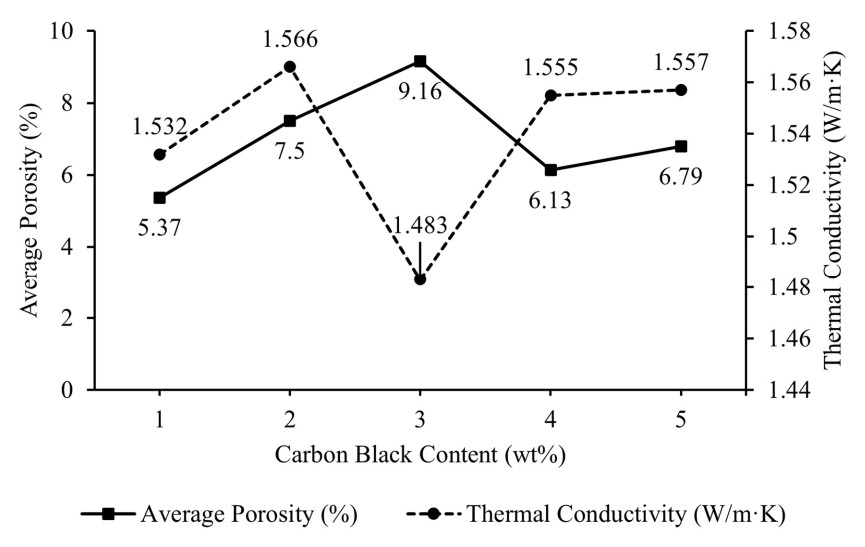
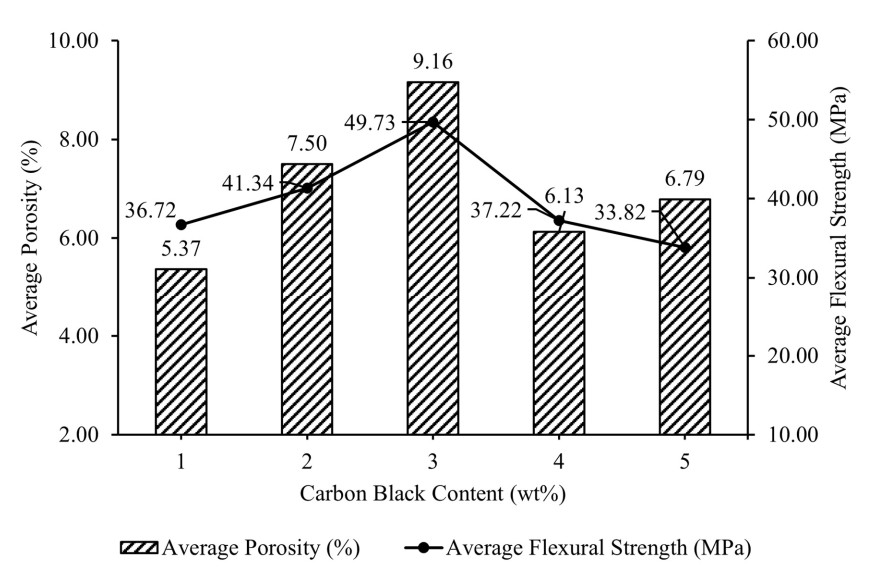
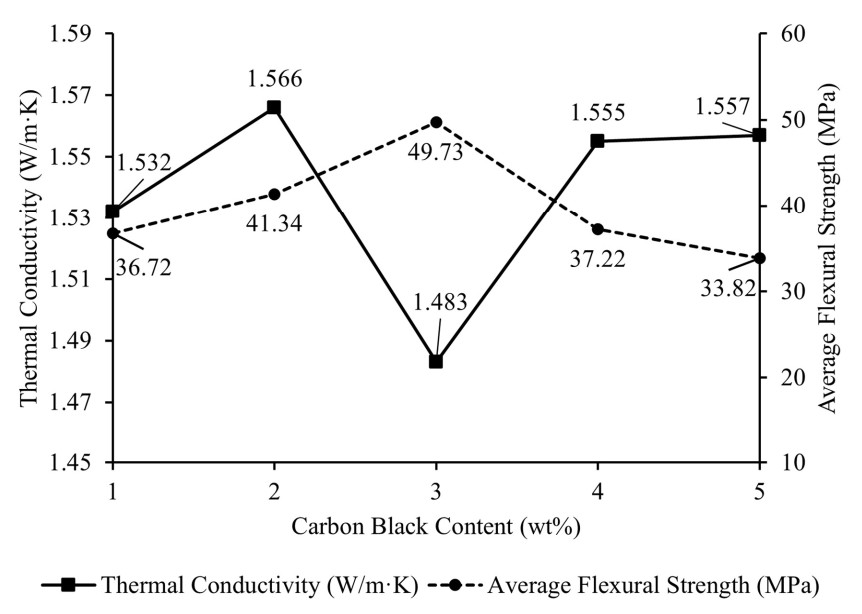
This paper focuses on the correlations between porosity, thermal conductivity, and mechanical strength in bi-layered ceramics with varying carbon black (CB) contents. Dense/porous bi-layered ceramics were synthesized via a solid-state reaction using feldspar, silica, and kaolinite powders, with CB incorporated into the porous bottom layer at 1–5 wt.% as a pore-forming agent, while the dense top layer remained CB-free. All specimens were fabricated under identical processing conditions, which involved uniaxial pressing at 20 MPa and sintering at 1175 ℃ for 3 h. A non-linear relationship was established between the CB content and the material properties. The optimum composition, 3 wt.% CB, exhibited the highest porosity (9.16%), the lowest thermal conductivity (1.483 W/m·K), and the maximum flexural strength (49.73 MPa), thus representing the best compromise between insulation efficiency and mechanical strength. At lower CB contents (1–2 wt.%), insufficient pore development limited the reduction in thermal conductivity, whereas excessive CB loadings (4–5 wt.%) produced diminished porosity and corresponding decreases in strength. These results highlight that controlled CB burnout during sintering governs pore evolution in a manner that optimizes phonon scattering and stress redistribution. Overall, this study demonstrates that precise control of pore-former content is critical to tailor multifunctional properties in bi-layered ceramics and establishes a design guideline for developing lightweight ceramic systems with superior thermal and structural performances.
Citation: Mohamed Lokman Jalaluddin, Umar Al-Amani Azlan, Mohd Warikh Abd Rashid, Muchlis. Correlations between porosity, thermal conductivity, and mechanical strength in bi-layered ceramics with varying carbon black contents[J]. AIMS Materials Science, 2025, 12(5): 965-974. doi: 10.3934/matersci.2025043
This paper focuses on the correlations between porosity, thermal conductivity, and mechanical strength in bi-layered ceramics with varying carbon black (CB) contents. Dense/porous bi-layered ceramics were synthesized via a solid-state reaction using feldspar, silica, and kaolinite powders, with CB incorporated into the porous bottom layer at 1–5 wt.% as a pore-forming agent, while the dense top layer remained CB-free. All specimens were fabricated under identical processing conditions, which involved uniaxial pressing at 20 MPa and sintering at 1175 ℃ for 3 h. A non-linear relationship was established between the CB content and the material properties. The optimum composition, 3 wt.% CB, exhibited the highest porosity (9.16%), the lowest thermal conductivity (1.483 W/m·K), and the maximum flexural strength (49.73 MPa), thus representing the best compromise between insulation efficiency and mechanical strength. At lower CB contents (1–2 wt.%), insufficient pore development limited the reduction in thermal conductivity, whereas excessive CB loadings (4–5 wt.%) produced diminished porosity and corresponding decreases in strength. These results highlight that controlled CB burnout during sintering governs pore evolution in a manner that optimizes phonon scattering and stress redistribution. Overall, this study demonstrates that precise control of pore-former content is critical to tailor multifunctional properties in bi-layered ceramics and establishes a design guideline for developing lightweight ceramic systems with superior thermal and structural performances.

| [1] |
Chen A, Li L, Ren W, et al. (2023) Enhancing thermal insulation and mechanical strength of porous ceramic through size-graded MA hollow spheres. Ceram Int 49: 33247–33254. https://doi.org/10.1016/j.ceramint.2023.08.033 doi: 10.1016/j.ceramint.2023.08.033

|
| [2] |
Chen Y, Wang N, Ola O, et al. (2021) Porous ceramics: Light in weight but heavy in energy and environment technologies. Mater Sci Eng R Rep 143: 100589. https://doi.org/10.1016/j.mser.2020.100589 doi: 10.1016/j.mser.2020.100589
|
| [3] |
Chung Y, Gubarevich AV, Yoshida K, et al. (2023) Effects of solid solution grain size and porosity on the thermal conductivity of aluminum- and boron-added porous silicon carbide ceramics with in-situ grain growth. J Eur Ceram Soc 43: 792–804. https://doi.org/10.1016/j.jeurceramsoc.2022.10.060 doi: 10.1016/j.jeurceramsoc.2022.10.060
|
| [4] |
Celik A, Caglar G, Celik Y, et al. (2022) Fabrication of porous Al2O3 ceramics using carbon black as a pore forming agent by spark plasma sintering. Ceram Int 48: 28181–28190. https://doi.org/10.1016/j.ceramint.2022.06.121 doi: 10.1016/j.ceramint.2022.06.121
|
| [5] |
Fang L, Chen C, Wang Y (2022) Carbon fibers and graphite as pore-forming agents for the obtention of porous alumina: Correlating physical and fractal characteristics. Fractal Fract 6: 501. https://doi.org/10.3390/fractalfract6090501 doi: 10.3390/fractalfract6090501
|
| [6] |
Popov O, Tiden S, Taher M, et al. (2024) Influence of reduced graphene oxide and carbon black on mechanical and thermal characteristics of TiB2–SiC ceramics. J Eur Ceram Soc 44: 4844–4852. https://doi.org/10.1016/j.jeurceramsoc.2024.02.029 doi: 10.1016/j.jeurceramsoc.2024.02.029
|
| [7] |
Teocoli F, Marani D, Kiebach R, et al. (2017) Effect of spherical porosity on co-fired dense/porous zirconia bi-layers cambering. J Eur Ceram Soc 38: 173–179. https://doi.org/10.1016/j.jeurceramsoc.2017.08.039 doi: 10.1016/j.jeurceramsoc.2017.08.039
|
| [8] |
Rumi MK, Urazaeva EM, Irmatova SK, et al. (2023) Sintering characteristics and thermal properties of porous ceramic based on hydrophlogopite and refractory clays. Glass Ceram 80: 45–51. https://doi.org/10.1007/s10717-023-00555-z doi: 10.1007/s10717-023-00555-z
|
| [9] | Azlan UAA, Jalaluddin ML, Borhanuddin M, et al. (2024) Effect of carbon black content on morphological crystalline phase and mechanical characteristics of porous ceramic layers. Malays J Microsc 20: 306–316. Available from: https://malaysianjournalofmicroscopy.org/ojs/index.php/mjm/article/view/849/457. |
| [10] |
Jalaluddin ML, Azlan UAA, Rashid MWA, et al. (2024) Effect of sintering temperatures on the physical structural properties and microstructure of mullite-based ceramics. AIMS Mater Sci 11: 243–255. https://doi.org/10.3934/matersci.2024014 doi: 10.3934/matersci.2024014
|
| [11] |
Liu H, Zhao X (2022) Thermal conductivity analysis of high porosity structures with open and closed pores. Int J Heat Mass Transf 183: 122089. https://doi.org/10.1016/j.ijheatmasstransfer.2021.122089 doi: 10.1016/j.ijheatmasstransfer.2021.122089
|
| [12] |
Li X, Yan L, Guo A, et al. (2024) Lightweight porous mullite–silica ceramics with multistage pore structure low thermal conductivity and improved strength. Ceram Int 50: 35609–35614. https://doi.org/10.1016/j.ceramint.2024.06.376 doi: 10.1016/j.ceramint.2024.06.376
|
| [13] |
Nguyen V, Pazhouhanfar Y, Delbari SA, et al. (2020) Beneficial role of carbon black on the properties of TiC ceramics. Ceram Int 46: 23544–23555. https://doi.org/10.1016/j.ceramint.2020.06.125 doi: 10.1016/j.ceramint.2020.06.125
|
| [14] |
Fu F, Hu N, Ye Y, et al. (2023) The foaming mechanism and properties of SiO2–Al2O3–CaO-based foamed ceramics with varied foaming agents. Ceram Int 49: 32448–32457. https://doi.org/10.1016/j.ceramint.2023.07.192 doi: 10.1016/j.ceramint.2023.07.192
|
| [15] |
Seesala VS, Rajasekaran R, Dutta A, et al. (2021) Dense–porous multilayer ceramics by green shaping and salt leaching. Open Ceram 5: 100084. https://doi.org/10.1016/j.oceram.2021.100084 doi: 10.1016/j.oceram.2021.100084
|
| [16] |
Huang Y, Hu N, Ye Y, et al. (2022) Preparation and pore-forming mechanism of MgO–Al2O3–CaO-based porous ceramics using phosphorus tailings. Ceram Int 48: 29882–29891. https://doi.org/10.1016/j.ceramint.2022.06.253 doi: 10.1016/j.ceramint.2022.06.253
|
| [17] |
Ren Y, Zhang B, Ye J, et al. (2023) Preparation of porous Y2SiO5 ceramics with high porosity and extremely low thermal conductivity for radome applications. Ceram Int 49: 2394–2400. https://doi.org/10.1016/j.ceramint.2022.09.212 doi: 10.1016/j.ceramint.2022.09.212
|
Figures(3)

Mohamed Lokman Jalaluddin, Umar Al-Amani Azlan, Mohd Warikh Abd Rashid, Muchlis. Correlations between porosity, thermal conductivity, and mechanical strength in bi-layered ceramics with varying carbon black contents[J]. AIMS Materials Science, 2025, 12(5): 965-974. doi: 10.3934/matersci.2025043





 DownLoad: