Disruptions in liner shipping service procurement (LSSP) reduce available transportation capacity and cause delays, additional costs, and sustainability challenges. Existing studies of the winner determination problem (WDP) emphasize procurement cost and provider selection, with limited integration of disruption-induced third-party logistics (3PL) capacity losses, carbon emission control, soft-time-window deviation costs, and coordinated resilience strategies. This study investigates a WDP for LSSP auctions under disruption risk from a fourth-party logistics (4PL) perspective by integrating greenness, timeliness, and resilience. A hybrid strategy combining multilevel fortification, capacity reservation, and emergency outsourcing mitigates capacity losses, and soft time windows quantify earliness and tardiness penalties. A two-stage stochastic winner determination model with a carbon emission cap is formulated and reformulated as a mixed-integer linear programming model. A hybrid algorithm integrating scenario reduction with scenario-sorting-based dual decomposition and Lagrangian relaxation (SR-SSDDLR) is developed for large-scale disruption scenarios. Experiments based on African container shipping data confirm the model's computational efficiency and stability. Sensitivity analyses and strategy comparisons indicate that protective investment and soft time-window settings jointly shape procurement costs and hybrid resilience strategy configuration under capacity losses and a carbon emission cap. The findings guide 4PLs in coordinating multiple 3PL resources and developing cost-effective and sustainable LSSP plans under disruptions.
Citation: Mingkun Yu, Liyan Wang, Mingqiang Yin, Linlin Kong, Guihua Bo, Xiaohu Qian. Embedding disruption-generated delay losses to co-optimize greenness, timeliness, and resilience under 4PL-driven coordination for winner determination in liner shipping procurement auctions[J]. Journal of Industrial and Management Optimization, 2026, 22(12): 6593-6637. doi: 10.3934/jimo.2026221
Disruptions in liner shipping service procurement (LSSP) reduce available transportation capacity and cause delays, additional costs, and sustainability challenges. Existing studies of the winner determination problem (WDP) emphasize procurement cost and provider selection, with limited integration of disruption-induced third-party logistics (3PL) capacity losses, carbon emission control, soft-time-window deviation costs, and coordinated resilience strategies. This study investigates a WDP for LSSP auctions under disruption risk from a fourth-party logistics (4PL) perspective by integrating greenness, timeliness, and resilience. A hybrid strategy combining multilevel fortification, capacity reservation, and emergency outsourcing mitigates capacity losses, and soft time windows quantify earliness and tardiness penalties. A two-stage stochastic winner determination model with a carbon emission cap is formulated and reformulated as a mixed-integer linear programming model. A hybrid algorithm integrating scenario reduction with scenario-sorting-based dual decomposition and Lagrangian relaxation (SR-SSDDLR) is developed for large-scale disruption scenarios. Experiments based on African container shipping data confirm the model's computational efficiency and stability. Sensitivity analyses and strategy comparisons indicate that protective investment and soft time-window settings jointly shape procurement costs and hybrid resilience strategy configuration under capacity losses and a carbon emission cap. The findings guide 4PLs in coordinating multiple 3PL resources and developing cost-effective and sustainable LSSP plans under disruptions.

| [1] |
United Nations Conference on Trade and Development (UNCTAD), Review of maritime transport 2024: Navigating maritime chokepoints, UNCTAD/RMT/2024, United Nations, Geneva, 2024. https://doi.org/10.18356/9789211065923 |
| [2] |
Y. Tao, E. P. Chew, L. H. Lee, Y. Shi, A column generation approach for the route planning problem in fourth party logistics, J. Oper. Res. Soc., 68 (2017), 165–181. https://doi.org/10.1057/s41274-016-0024-3 doi: 10.1057/s41274-016-0024-3
|
| [3] |
X. Qian, M. Yin, F. T. S. Chan, K. Yue, Winner determination with sustainable-flexible considerations under demand uncertainty in transportation service procurement auctions, Netw. Spat. Econ., 23 (2023), 953–984. https://doi.org/10.1007/s11067-023-09599-8 doi: 10.1007/s11067-023-09599-8
|
| [4] |
Y. Zhou, M. Yin, Q. Liu, X. Qian, D. Jin, X. Lang, Optimizing winner determination for sustainability and timeliness in fresh agricultural product logistics service procurement auctions: insights from a fourth-party logistics perspective, Front. Sustain. Food Syst., 9 (2025), 1585053. https://doi.org/10.3389/fsufs.2025.1585053 doi: 10.3389/fsufs.2025.1585053
|
| [5] |
N. K. Tran, H. Haralambides, T. Notteboom, K. Cullinane, The costs of maritime supply chain disruptions: The case of the Suez Canal blockage by the 'Ever Given' megaship, Int. J. Prod. Econ., 279 (2025), 109464. https://doi.org/10.1016/j.ijpe.2024.109464 doi: 10.1016/j.ijpe.2024.109464
|
| [6] |
W. Y. Yap, D. Yang, Geopolitical tension and shipping network disruption: Analysis of the Red Sea crisis on container port calls, J. Transp. Geogr., 121 (2024), 104004. https://doi.org/10.1016/j.jtrangeo.2024.104004 doi: 10.1016/j.jtrangeo.2024.104004
|
| [7] |
United Nations Conference on Trade and Development (UNCTAD), Strait of Hormuz disruptions: Implications for global trade and development, UNCTAD/OSG/TT/INF/2026/1, United Nations, Geneva, 2026. |
| [8] |
M. Salani, M. Battarra, The opportunity cost of time window violations, EURO J. Transp. Logist., 7 (2018), 343–361. https://doi.org/10.1007/s13676-018-0121-3 doi: 10.1007/s13676-018-0121-3
|
| [9] |
S. El Noshokaty, Shipping optimization systems (SOS) for tramp: stochastic cargo soft time windows, J. Shipp. Trade, 6 (2021), 17. https://doi.org/10.1186/s41072-021-00097-z doi: 10.1186/s41072-021-00097-z
|
| [10] |
Y. Sheffi, Combinatorial auctions in the procurement of transportation services, Interfaces, 34 (2004), 245–252. https://doi.org/10.1287/inte.1040.0075 doi: 10.1287/inte.1040.0075
|
| [11] |
M. R. Hasan, A. Elomri, C. Triki, Combinatorial-based auction for the transportation procurement: An optimization-oriented review, IEEE Access, 11 (2023), 60191–60210. https://doi.org/10.1109/ACCESS.2023.3284310 doi: 10.1109/ACCESS.2023.3284310
|
| [12] |
Z. Ma, R. H. Kwon, C. G. Lee, A stochastic programming winner determination model for truckload procurement under shipment uncertainty, Transp. Res. Part E Logist. Transp. Rev., 46 (2010), 49–60. https://doi.org/10.1016/j.tre.2009.02.002 doi: 10.1016/j.tre.2009.02.002
|
| [13] |
N. Remli, M. Rekik, A robust winner determination problem for combinatorial transportation auctions under uncertain shipment volumes, Transp. Res. Part C Emerg. Technol., 35 (2013), 204–217. https://doi.org/10.1016/j.trc.2013.07.006 doi: 10.1016/j.trc.2013.07.006
|
| [14] |
B. Zhang, T. Yao, T. L. Friesz, Y. Sun, A tractable two-stage robust winner determination model for truckload service procurement via combinatorial auctions, Transp. Res. Part B Methodol., 78 (2015), 16–31. https://doi.org/10.1016/j.trb.2015.03.019 doi: 10.1016/j.trb.2015.03.019
|
| [15] |
N. Remli, A. Amrouss, I. El Hallaoui, M. Rekik, A robust optimization approach for the winner determination problem with uncertainty on shipment volumes and carriers' capacity, Transp. Res. Part B Methodol., 123 (2019), 127–148. https://doi.org/10.1016/j.trb.2019.03.017 doi: 10.1016/j.trb.2019.03.017
|
| [16] |
M. Safari, A. Dolati, On the winner determination problem with uncertain bids' prices, Iran. J. Sci. Technol. Trans. Sci., 46 (2022), 1265–1273. https://doi.org/10.1007/s40995-022-01340-3 doi: 10.1007/s40995-022-01340-3
|
| [17] |
N. Li, Y. Zhang, S. Tiwari, G. Kou, Winner determination problem with purchase budget for transportation procurement under uncertain shipment volume, Transp. Res. Part E Logist. Transp. Rev., 176 (2023), 103182. https://doi.org/10.1016/j.tre.2023.103182 doi: 10.1016/j.tre.2023.103182
|
| [18] |
X. Qian, M. Yin, X. Li, Q. Zhang, Two-stage stochastic nonlinear winner determination for logistics service procurement auctions under quantity discounts, J. Ind. Manag. Optim., 19 (2023), 7072–7089. https://doi.org/10.3934/jimo.2022252 doi: 10.3934/jimo.2022252
|
| [19] |
Y. Fu, K. Z. Gao, L. Wang, M. Huang, Y. C. Liang, H. Y. Dong, Scheduling stochastic distributed flexible job shops using an multi-objective evolutionary algorithm with simulation evaluation, Int. J. Prod. Res., 63 (2025), 86–103. https://doi.org/10.1080/00207543.2024.2356628 doi: 10.1080/00207543.2024.2356628
|
| [20] |
P. R. Kleindorfer, G. H. Saad, Managing disruption risks in supply chains, Prod. Oper. Manag., 14 (2005), 53–68. https://doi.org/10.1111/j.1937-5956.2005.tb00009.x doi: 10.1111/j.1937-5956.2005.tb00009.x
|
| [21] |
X. Qian, F. T. S. Chan, M. Yin, Q. Zhang, M. Huang, X. Fu, A two-stage stochastic winner determination model integrating a hybrid mitigation strategy for transportation service procurement auctions, Comput. Ind. Eng., 149 (2020), 106703. https://doi.org/10.1016/j.cie.2020.106703 doi: 10.1016/j.cie.2020.106703
|
| [22] |
M. Yin, X. Qian, M. Huang, Q. Zhang, Winner determination for logistics service procurement auctions under disruption risks and quantity discounts, Eng. Appl. Artif. Intell., 105 (2021), 104424. https://doi.org/10.1016/j.engappai.2021.104424 doi: 10.1016/j.engappai.2021.104424
|
| [23] |
W. Zhang, K. Wang, A. Jacquillat, S. Wang, Optimized scenario reduction: Solving large-scale stochastic programs with quality guarantees, INFORMS J. Comput., 35 (2023), 886–908. https://doi.org/10.1287/ijoc.2023.1295 doi: 10.1287/ijoc.2023.1295
|
| [24] |
D. Bertsimas, N. Mundru, Optimization-based scenario reduction for data-driven two-stage stochastic optimization, Oper. Res., 71 (2022), 1343–1361. https://doi.org/10.1287/opre.2022.2265 doi: 10.1287/opre.2022.2265
|
| [25] |
M. Yin, H. Wang, Q. Liu, X. Qian, H. Zhang, X. Lang, A sampling-based winner determination model and algorithm for logistics service procurement auctions under double uncertainty, Sci. Rep., 15 (2025), 12054. https://doi.org/10.1038/s41598-025-94748-x doi: 10.1038/s41598-025-94748-x
|
| [26] |
A. Jabbarzadeh, B. Fahimnia, J. B. Sheu, H. Shahmoradi Moghadam, Designing a supply chain resilient to major disruptions and supply/demand interruptions, Transp. Res. Part B Methodol., 94 (2016), 121–149. https://doi.org/10.1016/j.trb.2016.09.004 doi: 10.1016/j.trb.2016.09.004
|
| [27] |
T. Sawik, Disruption mitigation and recovery in supply chains using portfolio approach, Omega, 84 (2019), 232–248. https://doi.org/10.1016/j.omega.2018.05.006 doi: 10.1016/j.omega.2018.05.006
|
| [28] |
X. Qian, M. Yin, F. T. S. Chan, J. Zhang, M. Huang, Sustainable–responsive winner determination for transportation service procurement auctions under accidental disruptions, J. Clean. Prod., 320 (2021), 128833. https://doi.org/10.1016/j.jclepro.2021.128833 doi: 10.1016/j.jclepro.2021.128833
|
| [29] |
Y. Zhou, D. Dong, M. Yin, Q. Liu, X. Qian, X. Li, Transforming resilient fourth-party logistics networks: An innovative hybrid mitigation strategy for disruption risks, J. Ind. Manag. Optim., 21 (2025), 7132–7160. https://doi.org/10.3934/jimo.2025162 doi: 10.3934/jimo.2025162
|
| [30] |
M. Yin, Y. Zhou, X. Qian, Q. Liu, X. Guo, Optimizing multi-period green electric vehicle battery recycling network: Integrating winner determination within a 4PL framework, IEEE Trans. Eng. Manag., 73 (2026), 1769–1783. https://doi.org/10.1109/TEM.2026.3658193 doi: 10.1109/TEM.2026.3658193
|
| [31] |
X. Wang, Q. Liu, M. Yin, Transforming electric vehicle battery recycling network with integrated winner determination for enhanced resilience, Comput. Chem. Eng., 208 (2026), 109561. https://doi.org/10.1016/j.compchemeng.2026.109561 doi: 10.1016/j.compchemeng.2026.109561
|
| [32] |
Z. Wang, Z. Zhang, M. Yin, N. Yuan, X. Qian, X. Li, 4PL-Driven optimization of electric vehicle battery recycling networks: enhancing greenness, timeliness and resilience against disruptions, Waste Manag., 222 (2026), 115650. https://doi.org/10.1016/j.wasman.2026.115650 doi: 10.1016/j.wasman.2026.115650
|
| [33] |
Q. Hu, Z. Zhang, A. Lim, Transportation service procurement problem with transit time, Transp. Res. Part B Methodol., 86 (2016), 19–36. https://doi.org/10.1016/j.trb.2016.01.007 doi: 10.1016/j.trb.2016.01.007
|
| [34] |
C. Y. Lee, S. Shu, Z. Xu, Optimal global liner service procurement by utilizing liner service schedules, Prod. Oper. Manag., 30 (2021), 703–714. https://doi.org/10.1111/poms.13311 doi: 10.1111/poms.13311
|
| [35] |
F. Yang, F. J. Hwang, Y. H. Huang, A two-stage method for the shipper lane selection problem with time windows in transportation service procurement, Int. Trans. Oper. Res., 31 (2024), 2209–2230. https://doi.org/10.1111/itor.13243 doi: 10.1111/itor.13243
|
| [36] |
R. Jothi Basu, R. Bai, PL. K. Palaniappan, A strategic approach to improve sustainability in transportation service procurement, Transp. Res. Part E Logist. Transp. Rev., 74 (2015), 152–168. https://doi.org/10.1016/j.tre.2014.10.015 doi: 10.1016/j.tre.2014.10.015
|
| [37] |
C. Triki, M. R. Hasan, A. Elomri, Solving the winner determination problem with discounted bids in transportation auctions, Ann. Oper. Res., 351 (2025), 35–58. https://doi.org/10.1007/s10479-023-05457-5 doi: 10.1007/s10479-023-05457-5
|
| [38] |
H. C. Lau, B. Li, Solving the winner determination problem for online B2B transportation matching platforms, Transp. Res. Part E Logist. Transp. Rev., 150 (2021), 102324. https://doi.org/10.1016/j.tre.2021.102324 doi: 10.1016/j.tre.2021.102324
|
| [39] |
L. V. Snyder, M. S. Daskin, Models for reliable supply chain network design, in Critical Infrastructure: Reliability and Vulnerability (eds. A. T. Murray and T. H. Grubesic), Springer, Berlin, Heidelberg, 2007,257–289. https://doi.org/10.1007/978-3-540-68056-7_13 |
| [40] |
M. Yin, M. Huang, D. Wang, S. C. Fang, X. Qian, X. Wang, Multi-period fourth-party logistics network design with the temporary outsourcing service under demand uncertainty, Comput. Oper. Res., 164 (2024), 106564. https://doi.org/10.1016/j.cor.2024.106564 doi: 10.1016/j.cor.2024.106564
|
| [41] |
B. D. Brouer, J. F. Alvarez, C. E. M. Plum, D. Pisinger, M. M. Sigurd, A base integer programming model and benchmark suite for liner-shipping network design, Transp. Sci., 48 (2013), 281–312. https://doi.org/10.1287/trsc.2013.0471 doi: 10.1287/trsc.2013.0471
|
| [42] |
M. Yin, Z. Han, X. Qian, G. Bo, X. Li, From predictive accuracy to prescriptive value: A data-driven framework for sustainable multi-period electric vehicle battery recycling networks, J. Clean. Prod., 574 (2026), 149022. https://doi.org/10.1016/j.jclepro.2026.149022 doi: 10.1016/j.jclepro.2026.149022
|
| [43] |
B. Peng, H. Y. Shi, T. Y. Chai, C. L. Su, P. Li, Improved predictive functional control based on unmodeled dynamics compensation for ethylene cracking furnace, IEEE Trans. Ind. Electron., (2026). https://doi.org/10.1109/TIE.2026.3695191 |
| [44] |
J. Li, X. Wang, X. Meng, F. L. Lewis, Optimal sensor selection of linear quadratic regulation with unknown sensor noise covariances, IEEE/CAA J. Autom. Sinica, 13 (2026), 1747–1754. https://doi.org/10.1109/JAS.2025.125915 doi: 10.1109/JAS.2025.125915
|
Figures(11) / Tables(10)
Mingkun Yu, Liyan Wang, Mingqiang Yin, Linlin Kong, Guihua Bo, Xiaohu Qian. Embedding disruption-generated delay losses to co-optimize greenness, timeliness, and resilience under 4PL-driven coordination for winner determination in liner shipping procurement auctions[J]. Journal of Industrial and Management Optimization, 2026, 22(12): 6593-6637. doi: 10.3934/jimo.2026221

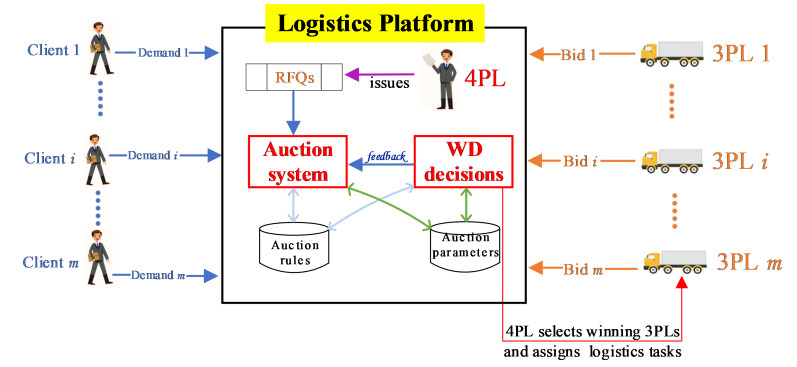
CRA process for LSSP on a 4PL platform
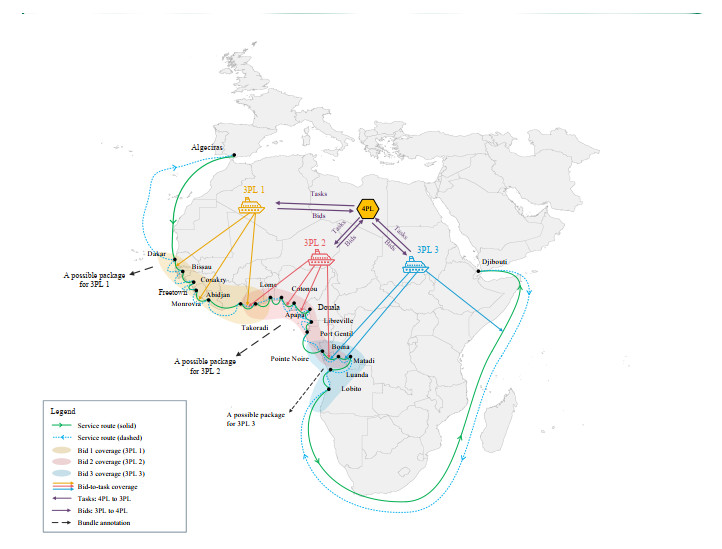
Bundle-bid coverage of transportation tasks in the 4PL–CRA framework
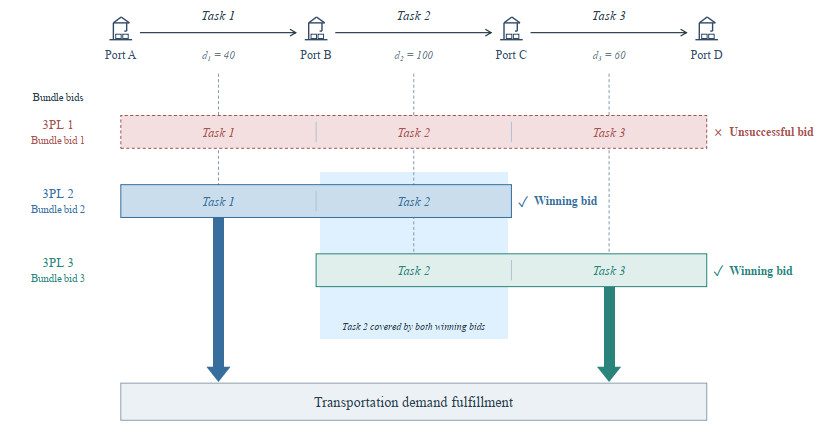
An example of overlapping bundle bids and transportation demand fulfillment
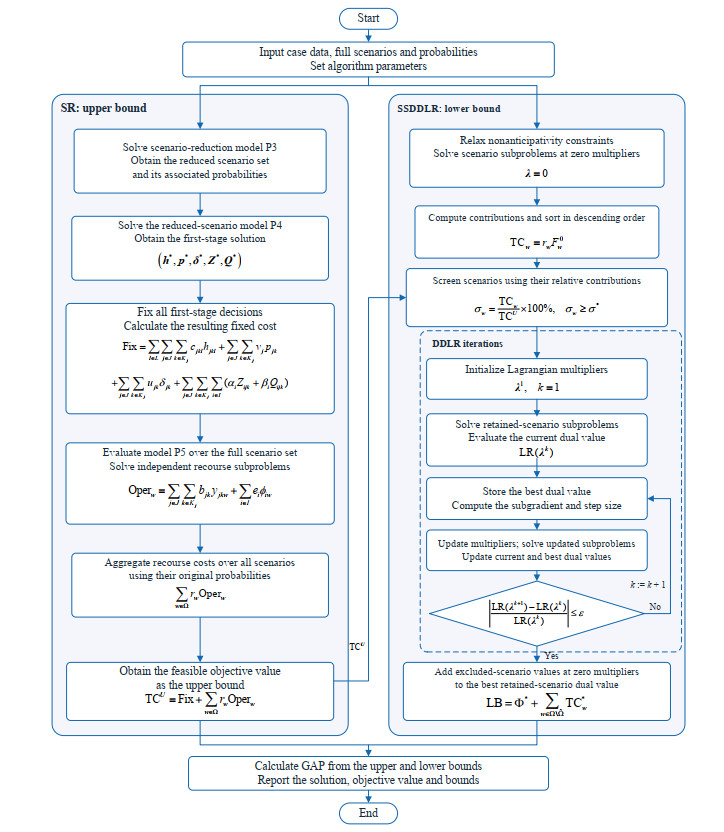
Flowchart of the SR-SSDDLR algorithm
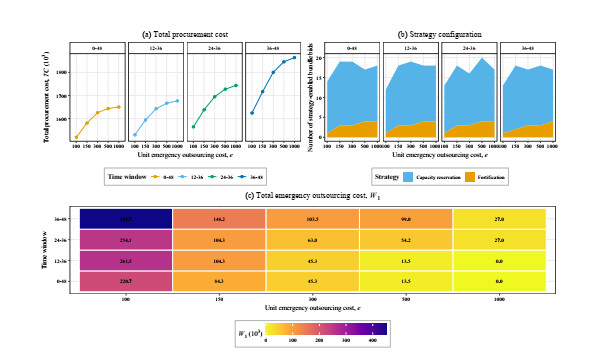
Effects of the unit emergency outsourcing cost on optimal decisions
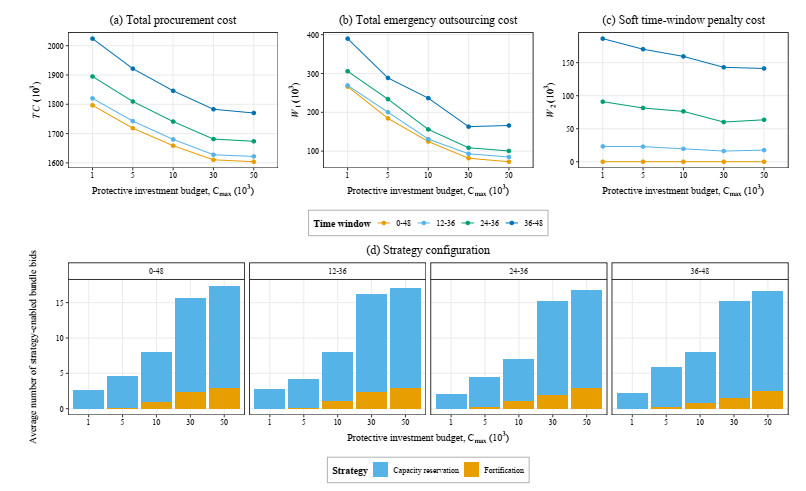
Effects of the protective investment budget on costs and resilience strategy configuration. Values in panels (a)–(d) are averaged over the five tested unit emergency outsourcing cost levels for each combination of $ C_{\max} $ and soft time-window setting
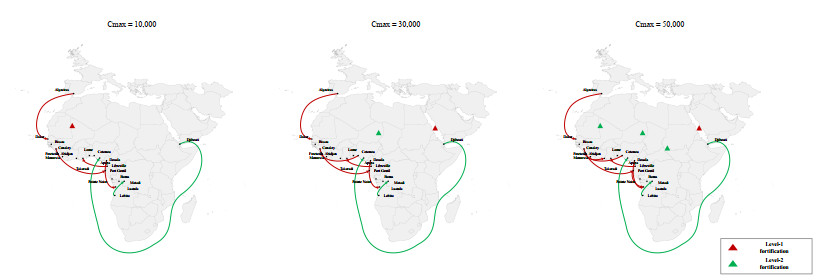
Schematic illustration of fortification decisions under different protective investment budgets
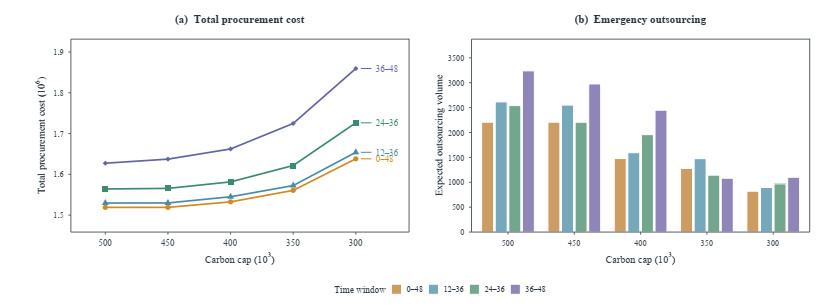
Total procurement cost and expected emergency outsourcing volume under different carbon-emission caps and time windows
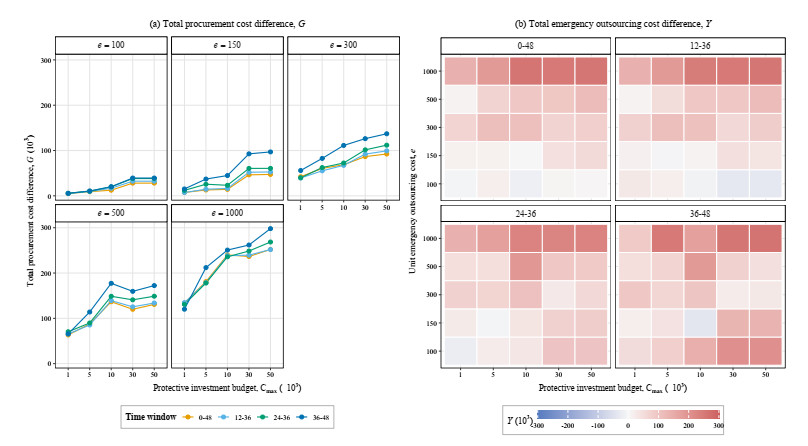
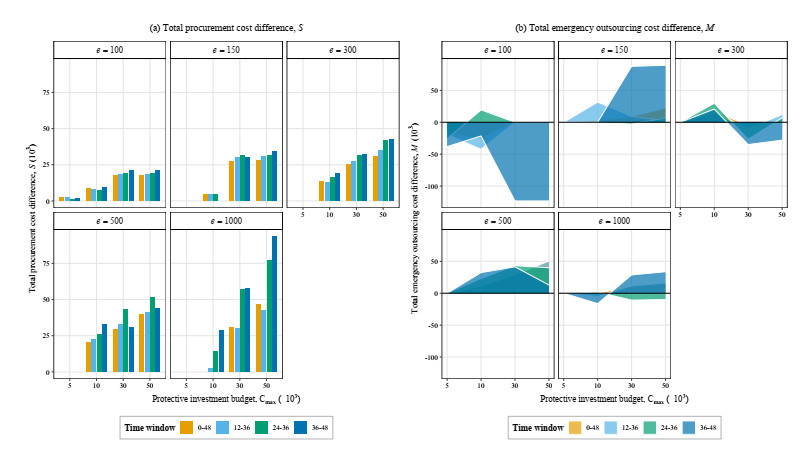
Effects of capacity reservation on total procurement and emergency outsourcing costs
Effects of multilevel fortification on total procurement and emergency outsourcing costs
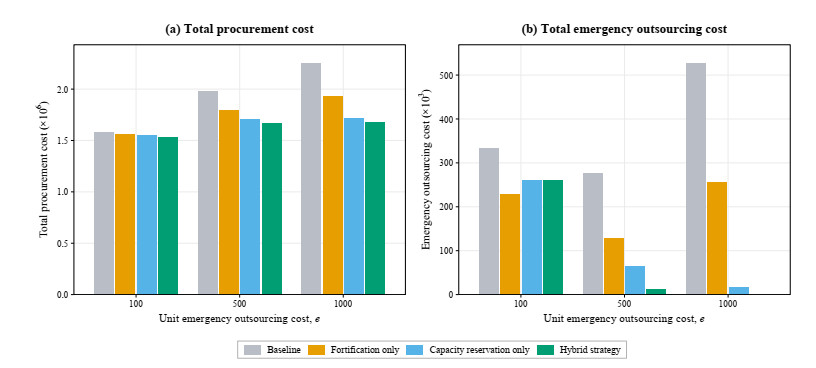
Comparison of total procurement cost and expected emergency outsourcing cost under different resilience strategies



 DownLoad: