Multi-level bill-of-materials (BOM) planning is exposed to both demand uncertainty and production or procurement yield uncertainty. Two modeling issues are especially important in this setting. First, a component shortage should restrict the production of its parent items rather than appear only as a penalized negative inventory. Second, paired demand–yield observations contain cross-source dependence information that is lost when ambiguity is imposed separately on the two marginals. This paper developed a material-feasible and dependence-informed distributionally robust lot-sizing model for multi-level BOM planning. Internal components and subassemblies were subject to hard material-availability constraints, whereas finished-product demand may be backlogged. Under box support, the robust material-feasibility conditions admitted an exact finite linear counterpart. To use the dependence information in paired observations without imposing an independence assumption, the Wasserstein ground metric was constructed from a regularized covariance geometry of standardized joint demand–yield samples. Standard Wasserstein duality then yielded an exact semi-infinite representation. The material-feasible BOM structure reduced the combinatorial dimension of the sample-wise separation problem because sign-selection binaries are required only for finished-product positions whose surplus can change sign over the support. Computational experiments calibrated ambiguity radii model by model and varied dependence by fixed-marginal re-pairing. The full-versus-block metric ablation showed that cross-source dependence changes the cost–risk trade-off: under favorable dependence, the full metric reduces the conservatism of the block metric, whereas under neutral and adverse dependence, the paired comparisons did not establish a statistically clear advantage for either joint distributionally robust optimization (DRO) model. Across tree, assembly, and shared-component BOM structures, the master–separation procedure returned explicit optimality certificates under a common time budget.
Citation: Jiayu Shen, Kai Zhu. Material-feasible and dependence-informed distributionally robust lot-sizing for multi-level BOM planning[J]. Journal of Industrial and Management Optimization, 2026, 22(12): 6638-6667. doi: 10.3934/jimo.2026222
Multi-level bill-of-materials (BOM) planning is exposed to both demand uncertainty and production or procurement yield uncertainty. Two modeling issues are especially important in this setting. First, a component shortage should restrict the production of its parent items rather than appear only as a penalized negative inventory. Second, paired demand–yield observations contain cross-source dependence information that is lost when ambiguity is imposed separately on the two marginals. This paper developed a material-feasible and dependence-informed distributionally robust lot-sizing model for multi-level BOM planning. Internal components and subassemblies were subject to hard material-availability constraints, whereas finished-product demand may be backlogged. Under box support, the robust material-feasibility conditions admitted an exact finite linear counterpart. To use the dependence information in paired observations without imposing an independence assumption, the Wasserstein ground metric was constructed from a regularized covariance geometry of standardized joint demand–yield samples. Standard Wasserstein duality then yielded an exact semi-infinite representation. The material-feasible BOM structure reduced the combinatorial dimension of the sample-wise separation problem because sign-selection binaries are required only for finished-product positions whose surplus can change sign over the support. Computational experiments calibrated ambiguity radii model by model and varied dependence by fixed-marginal re-pairing. The full-versus-block metric ablation showed that cross-source dependence changes the cost–risk trade-off: under favorable dependence, the full metric reduces the conservatism of the block metric, whereas under neutral and adverse dependence, the paired comparisons did not establish a statistically clear advantage for either joint distributionally robust optimization (DRO) model. Across tree, assembly, and shared-component BOM structures, the master–separation procedure returned explicit optimality certificates under a common time budget.

| [1] |
J. Orlicky, Material Requirements Planning: The New Way of Life in Production and Inventory Management, McGraw-Hill, New York, 1975. |
| [2] |
P. J. Billington, J. O. McClain, L. J. Thomas, Mathematical programming approaches to capacity-constrained MRP systems: Review, formulation and problem reduction, Manag. Sci., 29 (1983), 1126–1141. https://doi.org/10.1287/mnsc.29.10.1126 doi: 10.1287/mnsc.29.10.1126
|
| [3] |
H. M. Wagner, T. M. Whitin, Dynamic version of the economic lot size model, Manag. Sci., 5 (1958), 89–96. https://doi.org/10.1287/mnsc.5.1.89 doi: 10.1287/mnsc.5.1.89
|
| [4] |
W. I. Zangwill, A backlogging model and a multi-echelon model of a dynamic economic lot size production system: A network approach, Manag. Sci., 15 (1969), 506–527. https://doi.org/10.1287/mnsc.15.9.506 doi: 10.1287/mnsc.15.9.506
|
| [5] |
A. J. Clark, H. Scarf, Optimal policies for a multi-echelon inventory problem, Manag. Sci., 6 (1960), 475–490. https://doi.org/10.1287/mnsc.6.4.475 doi: 10.1287/mnsc.6.4.475
|
| [6] |
H. Tempelmeier, S. Helber, A heuristic for dynamic multi-item multi-level capacitated lotsizing for general product structures, Eur. J. Oper. Res., 75 (1994), 296–311. https://doi.org/10.1016/0377-2217(94)90076-0 doi: 10.1016/0377-2217(94)90076-0
|
| [7] |
A. Drexl, A. Kimms, Lot sizing and scheduling: Survey and extensions, Eur. J. Oper. Res., 99 (1997), 221–235. https://doi.org/10.1016/S0377-2217(97)00030-1 doi: 10.1016/S0377-2217(97)00030-1
|
| [8] |
H. Stadtler, Multilevel lot sizing with setup times and multiple constrained resources: Internally rolling schedules with lot-sizing windows, Oper. Res., 51 (2003), 487–502. https://doi.org/10.1287/opre.51.3.487.14949 doi: 10.1287/opre.51.3.487.14949
|
| [9] |
Y. Pochet, L. A. Wolsey, Production Planning by Mixed Integer Programming, Springer, New York, 2006. https://doi.org/10.1007/0-387-33477-7 |
| [10] |
S. Helber, F. Sahling, A fix-and-optimize approach for the multi-level capacitated lot sizing problem, Int. J. Prod. Econ., 123 (2010), 247–256. https://doi.org/10.1016/j.ijpe.2009.08.022 doi: 10.1016/j.ijpe.2009.08.022
|
| [11] |
B. Karimi, S. M. T. Fatemi Ghomi, J. M. Wilson, The capacitated lot sizing problem: A review of models and algorithms, Omega, 31 (2003), 365–378. https://doi.org/10.1016/S0305-0483(03)00059-8 doi: 10.1016/S0305-0483(03)00059-8
|
| [12] |
R. Jans, Z. Degraeve, Modeling industrial lot sizing problems: A review, Int. J. Prod. Res., 46 (2008), 1619–1643. https://doi.org/10.1080/00207540600902262 doi: 10.1080/00207540600902262
|
| [13] |
L. Buschkuehl, F. Sahling, S. Helber, H. Tempelmeier, Dynamic capacitated lot-sizing problems: A classification and review of solution approaches, OR Spectr., 32 (2010), 231–261. https://doi.org/10.1007/s00291-008-0150-7 doi: 10.1007/s00291-008-0150-7
|
| [14] |
J. H. Bookbinder, J.-Y. Tan, Strategies for the probabilistic lot-sizing problem with service-level constraints, Manag. Sci., 34 (1988), 1096–1108. https://doi.org/10.1287/mnsc.34.9.1096 doi: 10.1287/mnsc.34.9.1096
|
| [15] |
S. Helber, F. Sahling, K. Schimmelpfeng, Dynamic capacitated lot sizing with random demand and dynamic safety stocks, OR Spectr., 35 (2013), 75–105. https://doi.org/10.1007/s00291-012-0283-6 doi: 10.1007/s00291-012-0283-6
|
| [16] |
A. Shapiro, D. Dentcheva, A. Ruszczynski, Lectures on Stochastic Programming: Modeling and Theory, SIAM, Philadelphia, 2009. https://doi.org/10.1137/1.9780898718751 |
| [17] |
N. Sereshti, Y. Adulyasak, R. Jans, Managing flexibility in stochastic multi-level lot sizing problem with service level constraints, Omega, 122 (2024), 102957. https://doi.org/10.1016/j.omega.2023.102957 doi: 10.1016/j.omega.2023.102957
|
| [18] |
M. Henig, Y. Gerchak, The structure of periodic review policies in the presence of random yield, Oper. Res., 38 (1990), 634–643. https://doi.org/10.1287/opre.38.4.634 doi: 10.1287/opre.38.4.634
|
| [19] |
C. A. Yano, H. L. Lee, Lot sizing with random yields: A review, Oper. Res., 43 (1995), 311–334. https://doi.org/10.1287/opre.43.2.311 doi: 10.1287/opre.43.2.311
|
| [20] |
A. Hsu, Y. Bassok, Random yield and random demand in a production system with downward substitution, Oper. Res., 47 (1999), 277–290. https://doi.org/10.1287/opre.47.2.277 doi: 10.1287/opre.47.2.277
|
| [21] |
A. Grosfeld-Nir, Y. Gerchak, Multiple lot sizing in production to order with random yields: Review of recent advances, Ann. Oper. Res., 126 (2004), 43–69. https://doi.org/10.1023/B:ANOR.0000012275.01260.f5 doi: 10.1023/B:ANOR.0000012275.01260.f5
|
| [22] |
P. Berling, D. R. Sonntag, Inventory control in production–inventory systems with random yield and rework: The unit-tracking approach, Prod. Oper. Manag., 31 (2022), 2628–2645. https://doi.org/10.1111/poms.13706 doi: 10.1111/poms.13706
|
| [23] |
P. Metzker, S. Thevenin, Y. Adulyasak, A. Dolgui, Robust optimization for lot-sizing problems under yield uncertainty, Comput. Oper. Res., 149 (2023), 106025. https://doi.org/10.1016/j.cor.2022.106025 doi: 10.1016/j.cor.2022.106025
|
| [24] |
P. Metzker Soares, S. Thevenin, Y. Adulyasak, A. Dolgui, Adaptive robust optimization for lot-sizing under yield uncertainty, Eur. J. Oper. Res., 313 (2024), 513–526. https://doi.org/10.1016/j.ejor.2023.08.036 doi: 10.1016/j.ejor.2023.08.036
|
| [25] |
P. Metzker, S. Thevenin, Y. Adulyasak, A. Dolgui, Distributionally robust optimization for the multi-period multi-item lot-sizing problems under yield uncertainty, IEEE Trans. Autom. Sci. Eng., 22 (2025), 11731–11752. https://doi.org/10.1109/TASE.2025.3535945 doi: 10.1109/TASE.2025.3535945
|
| [26] |
A. Ben-Tal, A. Nemirovski, Robust convex optimization, Math. Oper. Res., 23 (1998), 769–805. https://doi.org/10.1287/moor.23.4.769 doi: 10.1287/moor.23.4.769
|
| [27] |
D. Bertsimas, M. Sim, The price of robustness, Oper. Res., 52 (2004), 35–53. https://doi.org/10.1287/opre.1030.0065 doi: 10.1287/opre.1030.0065
|
| [28] |
E. Delage, Y. Ye, Distributionally robust optimization under moment uncertainty with application to data-driven problems, Oper. Res., 58 (2010), 595–612. https://doi.org/10.1287/opre.1090.0741 doi: 10.1287/opre.1090.0741
|
| [29] |
W. Wiesemann, D. Kuhn, M. Sim, Distributionally robust convex optimization, Oper. Res., 62 (2014), 1358–1376. https://doi.org/10.1287/opre.2014.1314 doi: 10.1287/opre.2014.1314
|
| [30] |
P. Mohajerin Esfahani, D. Kuhn, Data-driven distributionally robust optimization using the Wasserstein metric: Performance guarantees and tractable reformulations, Math. Program., 171 (2018), 115–166. https://doi.org/10.1007/s10107-017-1172-1 doi: 10.1007/s10107-017-1172-1
|
| [31] |
R. Gao, A. J. Kleywegt, Distributionally robust stochastic optimization with Wasserstein distance, Math. Oper. Res., 48 (2023), 603–655. https://doi.org/10.1287/moor.2022.1275 doi: 10.1287/moor.2022.1275
|
| [32] |
H. K. Okyay, F. Karaesmen, S. Özekici, Newsvendor models with dependent random supply and demand, Optim. Lett., 8 (2014), 983–999. https://doi.org/10.1007/s11590-013-0616-7 doi: 10.1007/s11590-013-0616-7
|
| [33] |
Z. Chen, W. Xie, Regret in the newsvendor model with demand and yield randomness, Prod. Oper. Manag., 30 (2021), 4176–4197. https://doi.org/10.1111/poms.13515 doi: 10.1111/poms.13515
|
| [34] |
S. Thevenin, Y. Adulyasak, J.-F. Cordeau, Material requirements planning under demand uncertainty using stochastic optimization, Prod. Oper. Manag., 30 (2021), 475–493. https://doi.org/10.1111/poms.13277 doi: 10.1111/poms.13277
|
| [35] |
M. Schlenkrich, S. N. Parragh, Capacitated multi-item multi-echelon lot sizing with setup carry-over under uncertain demand, Int. J. Prod. Econ., 277 (2024), 109379. https://doi.org/10.1016/j.ijpe.2024.109379 doi: 10.1016/j.ijpe.2024.109379
|
| [36] |
M. Schlenkrich, J.-F. Cordeau, S. N. Parragh, Progressive hedging for multi-stage stochastic lot sizing problems with setup carry-over under uncertain demand, Comput. Oper. Res., 193 (2026), 107523. https://doi.org/10.1016/j.cor.2026.107523 doi: 10.1016/j.cor.2026.107523
|
| [37] |
O. Ledoit, M. Wolf, A well-conditioned estimator for large-dimensional covariance matrices, J. Multivar. Anal., 88 (2004), 365–411. https://doi.org/10.1016/S0047-259X(03)00096-4 doi: 10.1016/S0047-259X(03)00096-4
|
 jimo-22-12-222-s001.pdf |
 |
Figures(2) / Tables(11)
Jiayu Shen, Kai Zhu. Material-feasible and dependence-informed distributionally robust lot-sizing for multi-level BOM planning[J]. Journal of Industrial and Management Optimization, 2026, 22(12): 6638-6667. doi: 10.3934/jimo.2026222

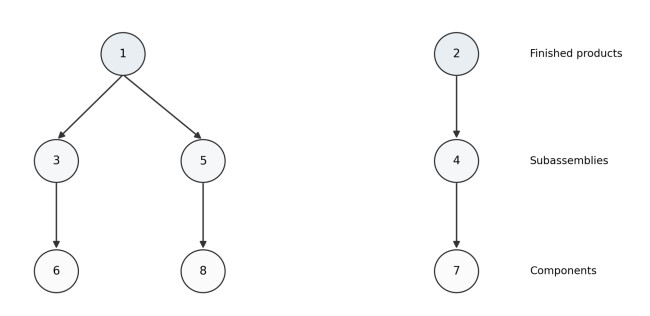
Topology of the eight-item BOM used in the main computational experiments. Nodes 1 and 2 are finished products, nodes 3–5 are subassemblies, and nodes 6–8 are lower-level components. The numerical BOM coefficients for the ten replications are reported in Table 3
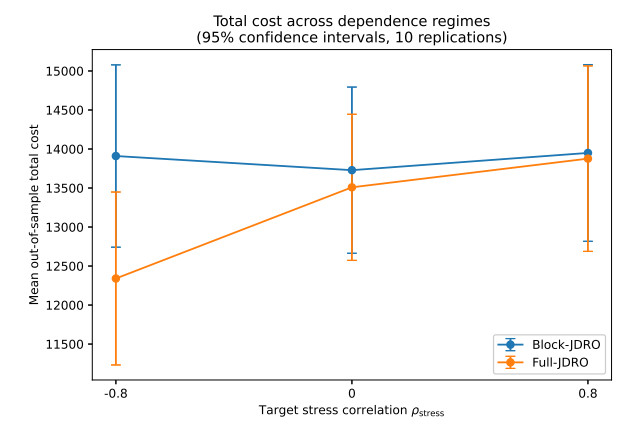
Mean out-of-sample total cost for Block-JDRO and Full-JDRO across demand–yield dependence regimes. Error bars indicate 95% confidence intervals based on ten independent replications



 DownLoad: