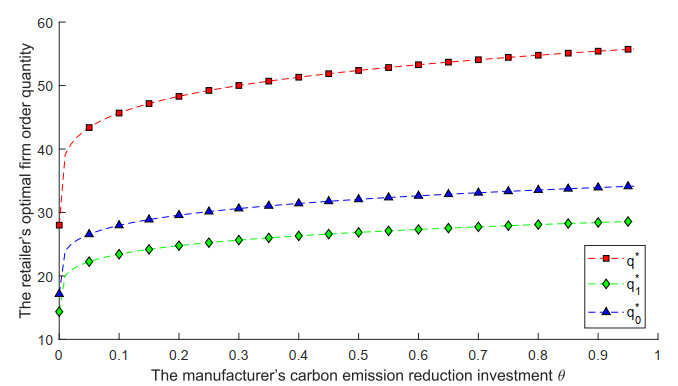
This paper investigated operational decisions in a supply chain consisting of a risk-neutral manufacturer and a risk-averse retailer with carbon abatement cost-sharing and call option contracts under carbon tax policy, where market demand is stochastic and dependent on green investment. Specifically, the optimal ordering and green investment strategies were derived for four distinct scenarios: with/without carbon abatement cost-sharing and with/without call option contracts. Further, it was shown that carbon abatement cost-sharing and call option contracts can mutually benefit the manufacturer and the retailer, and enhance the performance of the supply chain. This paper further revealed that the retailer's optimal total order quantity and optimal firm order quantity are monotonically increasing in the manufacturer's green investment. In addition, it was demonstrated that supply-chain coordination requires satisfying two key conditions, which are related to green investment and carbon tax policy. Finally, the numerical experiments in this study serve as illustrative demonstrations to intuitively visualize the theoretical findings and yield practical managerial insights for supply-chain practitioners.
Citation: Han Zhao, Wei Liu, Yu Liao, Yuli Zhang, Shiji Song. Joint operational decisions for a supply chain considering demand-dependent green investment[J]. Journal of Industrial and Management Optimization, 2026, 22(12): 6317-6338. doi: 10.3934/jimo.2026212
This paper investigated operational decisions in a supply chain consisting of a risk-neutral manufacturer and a risk-averse retailer with carbon abatement cost-sharing and call option contracts under carbon tax policy, where market demand is stochastic and dependent on green investment. Specifically, the optimal ordering and green investment strategies were derived for four distinct scenarios: with/without carbon abatement cost-sharing and with/without call option contracts. Further, it was shown that carbon abatement cost-sharing and call option contracts can mutually benefit the manufacturer and the retailer, and enhance the performance of the supply chain. This paper further revealed that the retailer's optimal total order quantity and optimal firm order quantity are monotonically increasing in the manufacturer's green investment. In addition, it was demonstrated that supply-chain coordination requires satisfying two key conditions, which are related to green investment and carbon tax policy. Finally, the numerical experiments in this study serve as illustrative demonstrations to intuitively visualize the theoretical findings and yield practical managerial insights for supply-chain practitioners.

| [1] |
X. Xu, X. Xu, H. Ping, Joint production and pricing decisions for multiple products with cap-and-trade and carbon tax regulations, J. Clean. Prod., 112 (2016), 4093–4106. https://doi.org/10.1016/j.jclepro.2015.08.081 doi: 10.1016/j.jclepro.2015.08.081
|
| [2] |
Y. Zhou, F. Hu, Z. Zhou, Pricing decisions and social welfare in a supply chain with multiple competing retailers and carbon tax policy, J. Clean. Prod., 190 (2018), 752–777. https://doi.org/10.1016/j.jclepro.2018.04.162 doi: 10.1016/j.jclepro.2018.04.162
|
| [3] |
M. Alegoz, O. Kaya, Z.P. Bayindir, A comparison of pure manufacturing and hybrid manufacturing-remanufacturing systems under carbon tax policy, Eur. J. Oper. Res., 294 (2021), 161–173. https://doi.org/10.1016/j.ejor.2021.01.018 doi: 10.1016/j.ejor.2021.01.018
|
| [4] |
H. E. KlingelhöFer, Investments in eop-technologies and emissions trading - results from a linear programming approach and sensitivity analysis, Eur. J. Oper. Res., 196 (2009), 370–383. https://doi.org/10.1016/j.ejor.2008.03.016 doi: 10.1016/j.ejor.2008.03.016
|
| [5] |
N. S. Kim, M. Janic, B. V. Wee, Trade-off between carbon dioxide emissions and logistics costs based on multiobjective optimization, Transp. Res. Rec., 2139 (2009), 107–116. https://doi.org/doi:10.3141/2139-13 doi: 10.3141/2139-13
|
| [6] |
H. Rosič, W. Jammernegg, The economic and environmental performance of dual sourcing: A newsvendor approach, Int. J. Prod. Econ., 143 (2013), 109–119. https://doi.org/10.1016/j.ijpe.2012.12.007 doi: 10.1016/j.ijpe.2012.12.007
|
| [7] |
D. Battini, A. Persona, F. Sgarbossa, A sustainable EOQ model: Theoretical formulation and applications, Int. J. Prod. Econ., 149 (2014), 145–153. https://doi.org/10.1016/j.ijpe.2013.06.026 doi: 10.1016/j.ijpe.2013.06.026
|
| [8] |
Y. Dou, Q. Zhu, J. Sarkis, Evaluating green supplier development programs with a grey-analytical network process-based methodology, Eur. J. Oper. Res., 233 (2014), 420–431. https://doi.org/10.1016/j.ejor.2013.03.004 doi: 10.1016/j.ejor.2013.03.004
|
| [9] |
I. Harris, M. Naim, A. Palmer, A. Potter, C. Mumford, Assessing the impact of cost optimization based on infrastructure modelling on CO$_2$ emissions, Int. J. Prod. Econ., 131 (2011), 313–321. https://doi.org/10.1016/j.ijpe.2010.03.005 doi: 10.1016/j.ijpe.2010.03.005
|
| [10] |
K. Colaneri, R. Frey, and V. Köck, Random carbon tax policy and investment into emission abatement technologies, Math. Finance, 36(2026), 804–825. https://doi.org/10.1111/mafi.70031 doi: 10.1111/mafi.70031
|
| [11] |
M. Jin, N. A. Granda-Marulanda, I. Down, The impact of carbon policies on supply chain design and logistics of a major retailer, J. Clean. Prod., 85 (2014), 453–461. https://doi.org/10.1016/j.jclepro.2013.08.042 doi: 10.1016/j.jclepro.2013.08.042
|
| [12] |
J. Guo, Y. Yang, Z. Ma, Carbon emission reduction for competitive supply chains under the cap-and-trade scheme, Ind. Eng. J., 21 (2018), 36–42. https://doi.org/10.3969/j.issn.1007-7375.e17-1170 doi: 10.3969/j.issn.1007-7375.e17-1170
|
| [13] |
H. Yang, J. Luo, H. Wang, The role of revenue sharing and first-mover advantage in emission abatement with carbon tax and consumer environmental awareness, Int. J. Prod. Econ., 193 (2017), 691–702. https://doi.org/10.1016/j.ijpe.2017.08.032 doi: 10.1016/j.ijpe.2017.08.032
|
| [14] |
T. L. Chen, X. Cui, Y. Zou, Carbon emission controls and optimal carbon related regulation in oligopoly: Examination of policy effects on competitiveness and entry deterrence, J. Clean. Prod., 484 (2024), 144292. https://doi.org/10.1016/j.jclepro.2024.144292 doi: 10.1016/j.jclepro.2024.144292
|
| [15] |
C. Lu, Q. Tong, X. Liu, The impacts of carbon tax and complementary policies on Chinese economy, Energy Policy, 38 (2010), 7278–7285. https://doi.org/10.1016/j.enpol.2010.07.055 doi: 10.1016/j.enpol.2010.07.055
|
| [16] |
W. Liu, S. Song, Y. Qiao, H. Zhao, The loss-averse newsvendor problem with random supply capacity, J. Ind. Manag. Optim., 13 (2017), 1417–1429. https://doi.org/10.3934/jimo.2016080 doi: 10.3934/jimo.2016080
|
| [17] |
W. Liu, S. Song, Y. Qiao, H. Zhao, H. Wang, The loss-averse newsvendor problem with quantity-oriented reference point under CVaR criterion, J. Ind. Manag. Optim., 18 (2022), 2633–2650. https://doi.org/10.3934/jimo.2021085 doi: 10.3934/jimo.2021085
|
| [18] |
B. M. Beamon, Designing the green supply chain, Logist. Inf. Manag., 12 (1999), 332–342. https://doi.org/10.1108/09576059910284159 doi: 10.1108/09576059910284159
|
| [19] |
P. He, Y. Sun, The impacts of retailer's carbon tax on the price and carbon reduction decisions in supply chain, Comput. Ind. Eng., 190 (2024), 110034. https://doi.org/10.1016/j.cie.2024.110034 doi: 10.1016/j.cie.2024.110034
|
| [20] |
Y. Zhang, T. Zhang, Complex dynamics of a low-carbon supply chain with government green subsidies and carbon cap-and-trade policies, Int. J. Bifurcat. Chaos, 32 (2022), 2250090. https://doi.org/10.1142/S0218127422500900 doi: 10.1142/S0218127422500900
|
| [21] |
L. Yang, Y. Cai, Optimal dynamic pricing for fresh products under the cap-and-trade scheme, 2017 14th Int. Conf. Serv. Syst. Serv. Manag., 2017. https://doi.org/10.1109/ICSSSM.2017.7996183 |
| [22] |
G. Ji, A. Gunasekaran, G. Yang, Constructing sustainable supply chain under double environmental medium regulations, Int. J. Prod. Econ., 147 (2014), 211–219. https://doi.org/10.1016/j.ijpe.2013.04.012 doi: 10.1016/j.ijpe.2013.04.012
|
| [23] |
H. Zhao, S. Song, Y. Zhang, J. N. D. Gupta, A. G. Devlin, R. Chiong, Supply chain coordination with a risk-averse retailer and a combined buy-back and revenue sharing contract, Asia-Pac. J. Oper. Res., 36 (2019), 1950028. https://doi.org/10.1142/S0217595919500283 doi: 10.1142/S0217595919500283
|
| [24] |
B. Li, P. W. Hou, P. Chen, Q. H. Li, Pricing strategy and coordination in a dual channel supply chain with a risk-averse retailer, Int. J. Prod. Econ., 178 (2016), 154–168. https://doi.org/10.1016/j.ijpe.2016.05.010 doi: 10.1016/j.ijpe.2016.05.010
|
| [25] |
W. A. Jauhari, S. C. N. Ramadhany, C. N. Rosyidi, U. Mishra, H. Hishamuddin, Pricing and green inventory decisions for a supply chain system with green investment and carbon tax regulation, J. Clean. Prod., 425 (2023), 138897. https://doi.org/10.1016/j.jclepro.2023.138897 doi: 10.1016/j.jclepro.2023.138897
|
| [26] |
W. A. Jauhari, C. T. C. Sakti, M. Hisjam, H. Hishamuddin, A sustainable circular economic supply chain model with green production, delays in payment, and carbon tax regulation, J. Clean. Prod., 495 (2025), 145008. https://doi.org/10.1016/j.jclepro.2025.145008 doi: 10.1016/j.jclepro.2025.145008
|
| [27] |
K. Jörnsten, S. L. Nonås, L. Sandal, J. Ubøe, Mixed contracts for the newsvendor problem with real options and discrete demand, Omega, 41 (2013), 809–819. https://doi.org/10.1016/j.omega.2012.10.011 doi: 10.1016/j.omega.2012.10.011
|
| [28] |
Q. Fu, C. Y. Lee, C. P. Teo, Procurement management using option contracts: random spot price and the portfolio effect, IIE Trans., 42 (2010), 793–811. https://doi.org/10.1080/07408171003670983 doi: 10.1080/07408171003670983
|
| [29] |
Y. Feng, Y. Mu, B. Hu, A. Kumar, Commodity options purchasing and credit financing under capital constraint, Int. J. Prod. Econ., 153 (2014), 230–237. https://doi.org/10.1016/j.ijpe.2014.03.003 doi: 10.1016/j.ijpe.2014.03.003
|
| [30] |
Y. T. Chung, F. Erhun, Designing supply contracts for perishable goods with two periods of shelf life, IIE Trans., 45 (2013), 53–67. https://doi.org/10.1080/0740817X.2012.654847 doi: 10.1080/0740817X.2012.654847
|
| [31] |
C. Y. Lee, X. Li, M. Yu, The loss-averse newsvendor problem with supply options, Nav. Res. Logist., 62 (2015), 46–59. https://doi.org/10.1002/nav.21613 doi: 10.1002/nav.21613
|
| [32] |
F. Hu, C. C. Lim, Z. Lu, Optimal production and procurement decisions in a supply chain with an option contract and partial backordering under uncertainties, Appl. Math. Comput., 232 (2014), 1225–1234. https://doi.org/10.1016/j.amc.2014.01.149 doi: 10.1016/j.amc.2014.01.149
|
| [33] |
H. Xu, Managing production and procurement through option contracts in supply chains with random yield, Int. J. Prod. Econ., 126 (2010), 306–313. https://doi.org/10.1016/j.ijpe.2010.04.007 doi: 10.1016/j.ijpe.2010.04.007
|
| [34] |
H. Zhao, B. Sun, H. Wang, S. Song, Y. Zhang, L. Wang, Optimization and coordination in a service-constrained supply chain with the bidirectional option contract under conditional value-at-risk, J. Ind. Manag. Optim., 15 (2022), 3383–3412. https://doi.org/10.3934/dcdss.2022021 doi: 10.3934/dcdss.2022021
|
| [35] |
H. Zhao, S. Song, Y. Zhang, Y. Liao, F. Yue, Optimal decisions in supply chains with a call option contract under the carbon emissions tax regulation, J. Clean. Prod., 271 (2020), 122199. https://doi.org/10.1016/j.jclepro.2020.122199 doi: 10.1016/j.jclepro.2020.122199
|
 jimo-22-12-212-s001.pdf |
 |
Figures(3) / Tables(1)
Han Zhao, Wei Liu, Yu Liao, Yuli Zhang, Shiji Song. Joint operational decisions for a supply chain considering demand-dependent green investment[J]. Journal of Industrial and Management Optimization, 2026, 22(12): 6317-6338. doi: 10.3934/jimo.2026212

The effect of green investment on the optimal order quantity
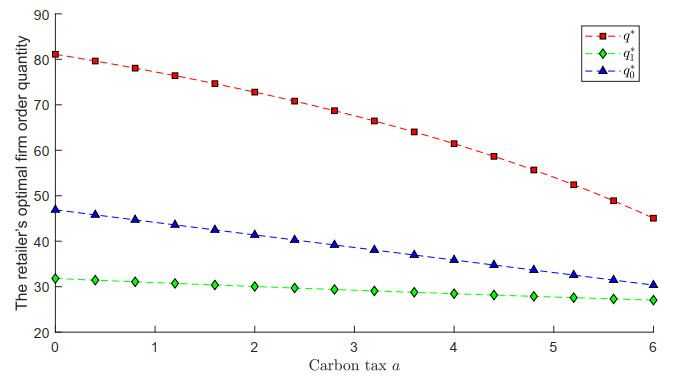
The effect of carbon tax on the optimal order quantity
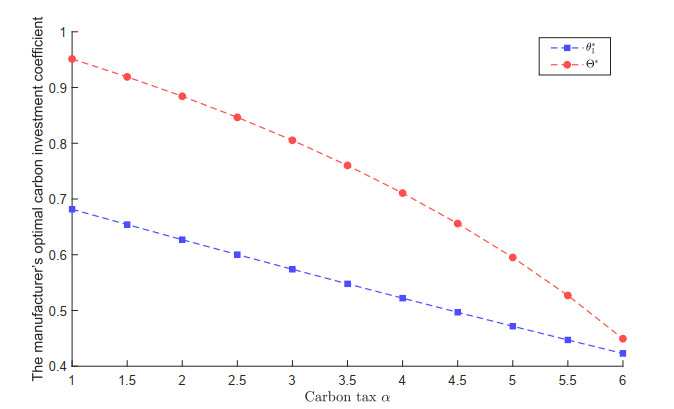
The effect of carbon tax on the manufacturer's optimal green investment



 DownLoad: