Based on the Euler–Lagrange partial differential equations (PDEs) of anti-trace type, interpreted as an extension of the standard Euler–Lagrange PDEs and generated by multi-dimensional autonomous controlled Lagrangians of second order, we introduce the associated anti-trace Hamilton PDEs. In addition, new conservation laws are established as a direct application of the mathematical concepts presented in this paper. In addition, by using block matrices built from Kronecker products, we formulate the compact (matrix) form of (generalized) Hamilton PDEs of the anti-trace type. The theory is further extended to Lagrangian and Hamiltonian tensor fields. To illustrate the applicability of the theoretical framework, we provide an illustrative application.
Citation: Savin Treanță, Marius-Alin Dragu. Controlled anti-trace Hamilton dynamics and related conservation laws[J]. Journal of Industrial and Management Optimization, 2026, 22(12): 6271-6316. doi: 10.3934/jimo.2026211
Based on the Euler–Lagrange partial differential equations (PDEs) of anti-trace type, interpreted as an extension of the standard Euler–Lagrange PDEs and generated by multi-dimensional autonomous controlled Lagrangians of second order, we introduce the associated anti-trace Hamilton PDEs. In addition, new conservation laws are established as a direct application of the mathematical concepts presented in this paper. In addition, by using block matrices built from Kronecker products, we formulate the compact (matrix) form of (generalized) Hamilton PDEs of the anti-trace type. The theory is further extended to Lagrangian and Hamiltonian tensor fields. To illustrate the applicability of the theoretical framework, we provide an illustrative application.

| [1] |
M. A. Dragu, S. Treanță, Optimal control models with gradient-type variations constrained by third-order PDEs, Commun. Nonlinear Sci. Numer. Simul., 159 (2026), 109947. https://doi.org/10.1016/j.cnsns.2026.109947 doi: 10.1016/j.cnsns.2026.109947
|
| [2] |
S. Treanță, Lagrange-Hamilton approach in optimization problems with isoperimetric-type constraints, J. Optim. Theory Appl., 194 (2022), 508–520. https://doi.org/10.1007/s10957-022-02036-9 doi: 10.1007/s10957-022-02036-9
|
| [3] |
C. Udrişte, L. Matei, Lagrange-Hamilton Theories (in romanian), Bucharest: Geometry Balkan Press, 2008. |
| [4] |
R. McLachlan, Symplectic integration of Hamiltonian wave equations, Numer. Math., 66 (1993), 465–492. https://doi.org/10.1007/BF01385708 doi: 10.1007/BF01385708
|
| [5] |
J. E. Marsden, G. W. Patrick, S. Shkoller, Multi-symplectic geometry, variational integrators, and nonlinear PDEs, Commun. Math. Phys., 199 (1998), 351–395. https://doi.org/10.1007/s002200050505 |
| [6] |
T. J. Bridges, S. Reich, Multi-symplectic integrators: numerical schemes for Hamiltonian PDEs that conserve symplecticity, Phys. Lett. A, 284 (2001), 184–193. https://doi.org/10.1016/S0375-9601(01)00294-8 doi: 10.1016/S0375-9601(01)00294-8
|
| [7] |
J. T. Horwood, R. G. McLenaghan, R. G. Smirnov, Invariant classification of orthogonally separable Hamiltonian systems in Euclidean space, Commun. Math. Phys., 259 (2005), 679–709. https://doi.org/10.1007/s00220-005-1331-8 doi: 10.1007/s00220-005-1331-8
|
| [8] |
B. E. Moore, L. Noreña, C. M. Schober, Conformal conservation laws and geometric integration for damped Hamiltonian PDEs, J. Comput. Phys., 232 (2013), 214–233. https://doi.org/10.1016/j.jcp.2012.08.010 doi: 10.1016/j.jcp.2012.08.010
|
| [9] |
Y. Gong, J. Cai, Y. Wang, Some new structure-preserving algorithms for general multi-symplectic formulations of Hamiltonian PDEs, J. Comput. Phys., 279 (2014), 80–102. https://doi.org/10.1016/j.jcp.2014.09.001 doi: 10.1016/j.jcp.2014.09.001
|
| [10] |
Y. Brenier, The initial value problem for the Euler equations of incompressible fluids viewed as a concave maximization problem, Commun. Math. Phys., 364 (2018), 579-605. https://doi.org/10.1007/s00220-018-3240-7 doi: 10.1007/s00220-018-3240-7
|
| [11] |
D. Bambusi, R. Feola, R. Montalto, Almost global existence for some Hamiltonian PDEs with small Cauchy data on general tori, Commun. Math. Phys., 405 (2024). https://doi.org/10.1007/s00220-023-04899-z |
| [12] |
E. D. Fagerholm, W. M. C. Foulkes, K. J. Friston, R. J. Moran, R. Leech, Rendering neuronal state equations compatible with the principle of stationary action, J. Math. Neurosci., 11 (2021). https://doi.org/10.1186/s13408-021-00108-0 |
| [13] |
H. Wang, Hamilton-Jacobi equations for a regular controlled Hamiltonian system and its reduced systems, Acta Math. Sci., 43 (2023), 855–906. https://doi.org/10.1007/s10473-023-0221-5 doi: 10.1007/s10473-023-0221-5
|
| [14] |
M. de León, M. Lainz, A. López-Gordón, X. Rivas, Hamilton–Jacobi theory and integrability for autonomous and non-autonomous contact systems, J. Geom. Phys., 187 (2023). https://doi.org/10.1016/j.geomphys.2023.104787 |
| [15] |
M. Motta, F. Rampazzo, Nonsmooth multi-time Hamilton–Jacobi systems, Indiana Univ. Math. J., 55 (2006), 1573–1614. https://doi.org/10.1512/iumj.2006.55.2760 doi: 10.1512/iumj.2006.55.2760
|
| [16] |
F. Cardin, C. Viterbo, Commuting Hamiltonians and Hamilton–Jacobi multi-time equations, Duke Math. J., 144 (2008), 235–284. https://doi.org/10.1215/00127094-2008-036 doi: 10.1215/00127094-2008-036
|
| [17] |
S. Treanță, Higher-order Hamilton dynamics and Hamilton-Jacobi divergence PDE, Comput. Math. Appl., 75 (2018), 547–560. https://doi.org/10.1016/j.camwa.2017.09.033 doi: 10.1016/j.camwa.2017.09.033
|
| [18] |
S. Treanță, K. Nonlaopon, M. B. Khan, On controlled Hamilton and Hamilton-Jacobi differential equations of higher-order, Sci. Rep., 12 (2022). https://doi.org/10.1038/s41598-022-18626-6 |
| [19] |
P. Chen, T. Meng, Z. Zou, J. Darbon, G. E. Karniadakis, Leveraging multitime Hamilton–Jacobi PDEs for certain scientific machine learning problems, SIAM J. Sci. Comput., 46 (2024). https://doi.org/10.1137/23M1561397 |
| [20] |
S. Yoo-Kong, S. Lobb, F. Nijho, Discrete-time Calogero-Moser system and Lagrangian $1$-form structure, J. Phys. A: Math. Theor., 44 (2011). https://doi.org/10.1088/1751-8113/44/36/365203 |
| [21] |
S. Boulaaras, Multiple solutions for nonlocal fourth-order variable exponent Kirchhoff problems with weighted Hardy–Rellich potentials and nonlinear Robin boundary conditions, J. Appl. Anal. Comput., 17 (2026), 908–947. https://doi.org/10.11948/20260214 doi: 10.11948/20260214
|
| [22] |
N. Azevedo, D. Pinheiro, G. W. Weber, Dynamic programming for a Markov-switching jump–diffusion, J. Comput. Appl. Math., 267 (2014), 1–19. https://doi.org/10.1016/j.cam.2014.01.021 doi: 10.1016/j.cam.2014.01.021
|
| [23] |
H. Ö. Bakan, F. Yılmaz, G. W. Weber, Minimal truncation error constants for Runge–Kutta method for stochastic optimal control problems, J. Comput. Appl. Math., 331 (2018), 196–207. https://doi.org/10.1016/j.cam.2017.10.011 doi: 10.1016/j.cam.2017.10.011
|
| [24] |
F. Yılmaz, H. Ö. Bakan, G. W. Weber, Strong-order conditions of Runge-Kutta method for stochastic optimal control problems, Appl. Numer. Math., 157 (2020), 470–489. https://doi.org/10.1016/j.apnum.2020.07.002 doi: 10.1016/j.apnum.2020.07.002
|
| [25] |
F. Yılmaz, H. Ö. Bakan, G.W. Weber, Weak second-order conditions of Runge–Kutta method for stochastic optimal control problems, J. Optim. Theory Appl., 202 (2024), 497–517. https://doi.org/10.1007/s10957-023-02324-y doi: 10.1007/s10957-023-02324-y
|
| [26] |
I. Baltas, L. Dopierala, K. Kolodziejczyk, M. Szczepański, G. W. Weber, A. N. Yannacopoulos, Optimal management of defined contribution pension funds under the effect of inflation, mortality and uncertainty, Eur. J. Oper. Res., 298 (2022), 1162–1174. https://doi.org/10.1016/j.ejor.2021.08.038 doi: 10.1016/j.ejor.2021.08.038
|
| [27] |
E. Savku, N. Azevedo, G. W. Weber, Optimal control of stochastic hybrid models in the framework of regime switches, Int. Conf. Dyn. Games Sci., 195 (2014), 371–387. https://doi.org/10.1007/978-3-319-55236-1_18 doi: 10.1007/978-3-319-55236-1_18
|
| [28] |
B. Z. Temoçin, G. W. Weber, Optimal control of stochastic hybrid system with jumps: a numerical approximation, J. Comput. Appl. Math., 259 (2014), 443–451. https://doi.org/10.1016/j.cam.2013.10.021 doi: 10.1016/j.cam.2013.10.021
|
| [29] |
K. Mahdi, S. Boulaaras, A. Alharbi, Complete Hyers–Ulam Stability Classification for Second-Order Linear Oscillators on the Real Line, J. Funct. Spaces, 2026 (2026). https://doi.org/10.1155/jofs/5328022 |
| [30] |
S. Boulaaras, Dispersion-Managed Lump Waves in a Variable-Coefficient Generalized KP Model: Exact Rational Localization and Accelerated Trajectories, Wave Motion, 148 (2027). https://doi.org/10.1016/j.wavemoti.2026.103855 |
| [31] |
S. Treanță, I. Ahmad, Controlled nonlinear dynamics generated by isoperimetric constrained optimization problems involving second-order partial derivatives, Syst. Control Lett., 179 (2023). https://doi.org/10.1016/j.sysconle.2023.105591 |
| [32] |
D. J. Saunders, The Geometry of Jet Bundles, Cambridge: Cambridge University Press, 1989. https://doi.org/10.1017/CBO9780511526411 |
| [33] |
S. Treanță, On multi-time Hamilton-Jacobi theory via second order Lagrangians, UPB Sci. Bull. Ser. A, 76 (2014), 129-140. |
| [34] |
A. Jayswal, Preeti, S. Treanță, Multi-dimensional control problems: Robust approach, Singapore: Springer, 2022. https://doi.org/10.1007/978-981-19-6561-6 |
| [35] |
S. Treanță, M. A. Dragu, Euler-Lagrange equation for gradient-type Lagrangian and related conservation laws, J. Appl. Math. Comput., 71 (2025), 1565–1579. https://doi.org/10.1007/s12190-024-02303-0 doi: 10.1007/s12190-024-02303-0
|
| [36] |
W. X. Ma, Conservation laws by symmetries and adjoint symmetries, Discrete Contin. Dyn. Syst. Ser. S, 11 (2018), 707–721. https://doi.org/10.3934/dcdss.2018044 doi: 10.3934/dcdss.2018044
|
| [37] |
W. X. Ma, A real four-component integrable extension of the standard Kaup–Newell hierarchy with two diagonal blocks, Axioms, 15 (2026), 411. https://doi.org/10.3390/axioms15060411 doi: 10.3390/axioms15060411
|
| [38] |
W. X. Ma, A matrix integrable enlargement of the DNLS soliton hierarchy incorporating two diagonal matrix blocks, Mathematics, 14 (2026), 2081. https://doi.org/10.3390/math14122081 doi: 10.3390/math14122081
|
Figures(1) / Tables(8)
Savin Treanță, Marius-Alin Dragu. Controlled anti-trace Hamilton dynamics and related conservation laws[J]. Journal of Industrial and Management Optimization, 2026, 22(12): 6271-6316. doi: 10.3934/jimo.2026211

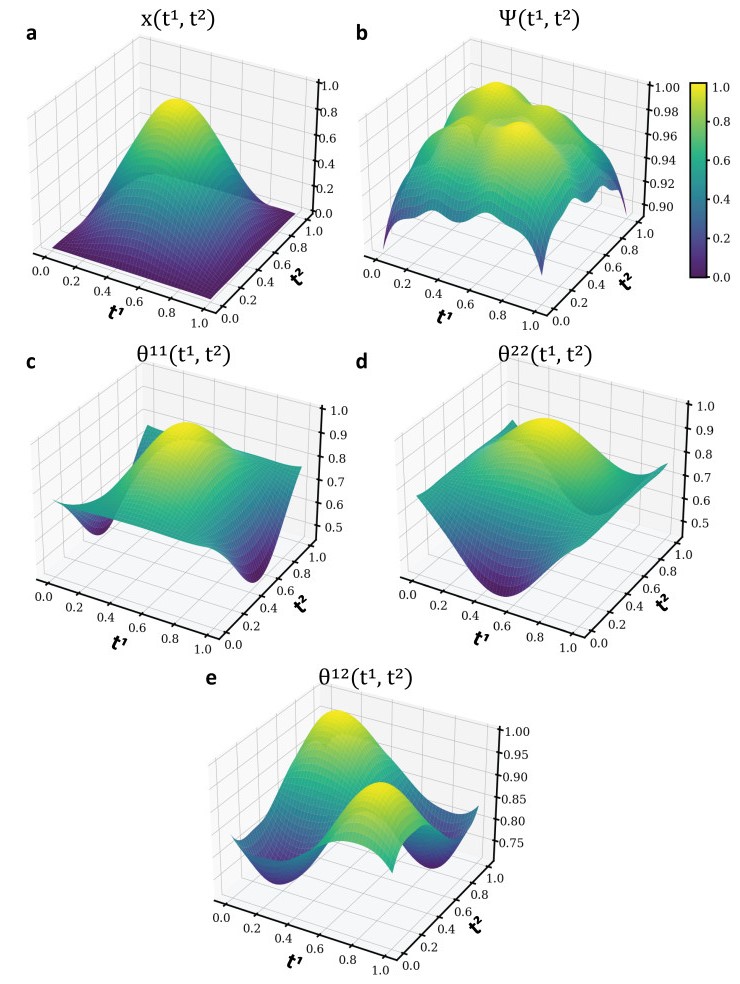
The numerical results (graphical representation) of (a) $ x(t^{1}, t^{2}) $ (the state function), (b) $ \varPsi(t^{1}, t^{2}) $ (the control function), (c) $ \theta^{11}(t^{1}, t^{2}) $ (the co-state function associated with with the state equation $ X_{11} = 0 $), and (d) $ \theta^{22}(t^{1}, t^{2}) $ (the co-state function associated with the state equation $ X_{22} = 0 $), (e) $ \theta^{12}(t^{1}, t^{2}) $ (co-state function associated with with the state equation $ X_{12} = 0 $)



 DownLoad: