Hi-tech industries have experienced rapid evolution in manufacturing technology, leading to current technology (i.e., the technology currently employed in the firm's production process) becoming obsolete more quickly. Furthermore, fluctuating demand also harms the firm's expected profit due to the costs of shortages or excess demand. In this circumstance, the firm must allocate appropriate resource capacity to hedge the risks associated with the above uncertainties. In this study, we proposed a technology adoption and capacity planning model that accounted for demand uncertainty and technological evolution. It also considered the economic life of the current technology and the corresponding capacity and resource allocation plan. The research problem was modeled by stochastic dynamic programming (SDP). Each corresponding action presented a possible economic life of the current technology. The reward of an action was the risk-adjusted expected profit of the corresponding capacity planning problem, modeled as a stochastic mixed-integer programming (SMIP). For the solution approach, the SMIP sub-problems were solved by a parallel sampling-based differential evolution (PSDE) procedure with an infeasible-solution repair mechanism, and the SDP model was then solved by backward induction. The numerical results showed that technology and demand uncertainties jointly affect expected profit and technology adoption decisions. A higher probability of new technology introduction raises the expected profit and the cost of delaying replacement, whereas greater demand uncertainty reduces profitability. The optimal policy retains the current technology for a short period and then re-evaluates the decision; the current technology is retained until the end of the planning horizon only when the decision maker's risk aversion exceeds a threshold, which is lower under high demand variability and under a low probability of new technology introduction. Moreover, the proposed PSDE efficiently solves the stochastic optimization problems and scales well to larger problem instances.
Citation: Hong-Phuc Nguyen, Kung-Jeng Wang. Technology adoption and capacity planning under technological evolution and demand uncertainty[J]. Journal of Industrial and Management Optimization, 2026, 22(11): 6064-6088. doi: 10.3934/jimo.2026204
Hi-tech industries have experienced rapid evolution in manufacturing technology, leading to current technology (i.e., the technology currently employed in the firm's production process) becoming obsolete more quickly. Furthermore, fluctuating demand also harms the firm's expected profit due to the costs of shortages or excess demand. In this circumstance, the firm must allocate appropriate resource capacity to hedge the risks associated with the above uncertainties. In this study, we proposed a technology adoption and capacity planning model that accounted for demand uncertainty and technological evolution. It also considered the economic life of the current technology and the corresponding capacity and resource allocation plan. The research problem was modeled by stochastic dynamic programming (SDP). Each corresponding action presented a possible economic life of the current technology. The reward of an action was the risk-adjusted expected profit of the corresponding capacity planning problem, modeled as a stochastic mixed-integer programming (SMIP). For the solution approach, the SMIP sub-problems were solved by a parallel sampling-based differential evolution (PSDE) procedure with an infeasible-solution repair mechanism, and the SDP model was then solved by backward induction. The numerical results showed that technology and demand uncertainties jointly affect expected profit and technology adoption decisions. A higher probability of new technology introduction raises the expected profit and the cost of delaying replacement, whereas greater demand uncertainty reduces profitability. The optimal policy retains the current technology for a short period and then re-evaluates the decision; the current technology is retained until the end of the planning horizon only when the decision maker's risk aversion exceeds a threshold, which is lower under high demand variability and under a low probability of new technology introduction. Moreover, the proposed PSDE efficiently solves the stochastic optimization problems and scales well to larger problem instances.

| [1] |
H. Y. Gao, Q. X. Yao, P. Liu, Z. Q. Zheng, J. C. Liu, H. D. Zheng, et al., Latest development of display technologies, Chin. Phys. B, 25 (2016), 094203. https://doi.org/10.1088/1674-1056/25/9/094203 doi: 10.1088/1674-1056/25/9/094203
|
| [2] |
C. M. Christensen, The innovator's dilemma: When new technologies cause great firms to fail, Boston: Harvard Business Review Press, 1997. |
| [3] |
K. J. Wang, S. M. Wang, Simultaneous resource portfolio planning under demand and technology uncertainty in the semiconductor testing industry, Robot. Comput. Integr. Manuf., 29 (2013), 278–287. https://doi.org/10.1016/j.rcim.2013.01.003 doi: 10.1016/j.rcim.2013.01.003
|
| [4] |
T. L. Chen, J. T. Lin, C. H. Wu, Coordinated capacity planning in two-stage thin-film-transistor liquid-crystal-display (TFT-LCD) production networks, Omega, 42 (2014), 141–156. https://doi.org/10.1016/j.omega.2013.05.004 doi: 10.1016/j.omega.2013.05.004
|
| [5] |
K. J. Wang, S. M. Wang, J. C. Chen, A resource portfolio planning model using sampling-based stochastic programming and genetic algorithm, Eur. J. Oper. Res., 184 (2008), 327–340. https://doi.org/10.1016/j.ejor.2006.10.037 doi: 10.1016/j.ejor.2006.10.037
|
| [6] |
Z. L. Chen, S. Li, D. Tirupati, A scenario-based stochastic programming approach for technology and capacity planning, Comput. Oper. Res., 29 (2002), 781–806. https://doi.org/10.1016/S0305-0548(00)00076-9 doi: 10.1016/S0305-0548(00)00076-9
|
| [7] |
A. Prékopa, Probabilistic programming, Stochastic Programming, 10 (2003), 267–351. https://doi.org/10.1016/S0927-0507(03)10005-9 |
| [8] |
A. Prékopa, Stochastic programming, Dordrecht: Springer, 1995. https://doi.org/10.1007/978-94-017-3087-7 |
| [9] |
S. K. Nair, W. J. Hopp, A model for equipment replacement due to technological obsolescence, Eur. J. Oper. Res., 63 (1992), 207–221. https://doi.org/10.1016/0377-2217(92)90026-6 doi: 10.1016/0377-2217(92)90026-6
|
| [10] |
S. Rajagopalan, M. R. Singh, T. E. Morton, Capacity expansion and replacement in growing markets with uncertain technological breakthroughs, Manag. Sci., 44 (1998), 12–30. https://doi.org/10.1287/mnsc.44.1.12 doi: 10.1287/mnsc.44.1.12
|
| [11] |
R. Bellman, Equipment replacement policy, J. Soc. Ind. Appl. Math., 3 (1955), 133–136. https://doi.org/10.1137/0103011 doi: 10.1137/0103011
|
| [12] |
C. Derman, Optimal replacement and maintenance under Markovian deterioration with probability bounds on failure, Manag. Sci., 9 (1963), 478–481. https://doi.org/10.1287/mnsc.9.3.478 doi: 10.1287/mnsc.9.3.478
|
| [13] |
Y. Hatoyama, On Markov maintenance problems, IEEE Trans. Reliab., 33 (1984), 280–283. https://doi.org/10.1109/TR.1984.5221822 doi: 10.1109/TR.1984.5221822
|
| [14] |
H. M. Wagner, Principles of operations research: With applications to managerial decisions, 2nd edition, Englewood Cliffs, NJ: Prentice-Hall, 1975. |
| [15] |
S. Sethi, S. Chand, Planning horizon procedures for machine replacement models, Manag. Sci., 25 (1979), 140–151. https://doi.org/10.1287/mnsc.25.2.140 doi: 10.1287/mnsc.25.2.140
|
| [16] |
J. C. Bean, J. R. Lohmann, R. L. Smith, A dynamic infinite horizon replacement economy decision model, Eng. Econ., 30 (1984), 99–120. https://doi.org/10.1080/00137918408902899 doi: 10.1080/00137918408902899
|
| [17] |
W. J. Hopp, S. K. Nair, Timing replacement decisions under discontinuous technological change, Nav. Res. Logist., 38 (1991), 203–220. https://doi.org/ 10.1002/1520-6750(199104)38:23.0.CO; 2-E doi: 10.1002/1520-6750(199104)38:23.0.CO; 2-E
|
| [18] |
W. J. Hopp, S. K. Nair, Markovian deterioration and technological change, IIE Trans., 26 (1994), 74–82. https://doi.org/10.1080/07408179408966640 doi: 10.1080/07408179408966640
|
| [19] |
Y. Y. Cho, G. H. Jeong, S. H. Kim, A Delphi technology forecasting approach using a semi-Markov concept, Technol. Forecast. Soc. Change, 40 (1991), 273–287. https://doi.org/10.1016/0040-1625(91)90057-M doi: 10.1016/0040-1625(91)90057-M
|
| [20] |
J. C. Hartman, J. Rogers, Dynamic programming approaches for equipment replacement problems with continuous and discontinuous technological change, IMA J. Manag. Math., 17 (2006), 143–158. https://doi.org/10.1093/imaman/dpi032 doi: 10.1093/imaman/dpi032
|
| [21] |
R. Uzsoy, L. A. Martin-Vega, C. Y. Lee, P. A. Leonard, Production scheduling algorithms for a semiconductor test facility, IEEE Trans. Semicond. Manuf., 4 (1991), 270–280. https://doi.org/10.1109/66.97809 doi: 10.1109/66.97809
|
| [22] |
A. Atamtürk, D. S. Hochbaum, Capacity acquisition, subcontracting, and lot sizing, Manag. Sci., 47 (2001), 1081–1100. https://doi.org/10.1287/mnsc.47.8.1081.10232 doi: 10.1287/mnsc.47.8.1081.10232
|
| [23] |
J. Olhager, M. Rudberg, J. Wikner, Long-term capacity management: Linking the perspectives from manufacturing strategy and sales and operations planning, Int. J. Prod. Econ., 69 (2001), 215–225. https://doi.org/10.1016/S0925-5273(99)00098-5 doi: 10.1016/S0925-5273(99)00098-5
|
| [24] |
C. Martínez-Costa, M. Mas-Machuca, E. Benedito, A. Corominas, A review of mathematical programming models for strategic capacity planning in manufacturing, Int. J. Prod. Econ., 153 (2014), 66–85. https://doi.org/10.1016/j.ijpe.2014.03.011 doi: 10.1016/j.ijpe.2014.03.011
|
| [25] |
K. J. Wang, S. M. Wang, S. J. Yang, A resource portfolio model for equipment investment and allocation of semiconductor testing industry, Eur. J. Oper. Res., 179 (2007), 390–403. https://doi.org/10.1016/j.ejor.2006.04.006 doi: 10.1016/j.ejor.2006.04.006
|
| [26] |
K. J. Wang, T. C. Hou, Modelling and resolving the joint problem of capacity expansion and allocation with multiple resources and a limited budget in the semiconductor testing industry, Int. J. Prod. Res., 41 (2003), 3217–3235. https://doi.org/10.1080/0020754031000109152 doi: 10.1080/0020754031000109152
|
| [27] |
N. Geng, Z. Jiang, F. Chen, Stochastic programming based capacity planning for semiconductor wafer fab with uncertain demand and capacity, Eur. J. Oper. Res., 198 (2009), 899–908. https://doi.org/10.1016/j.ejor.2008.09.029 doi: 10.1016/j.ejor.2008.09.029
|
| [28] |
A. G. Balter, K. J. M. Huisman, P. M. Kort, New insights in capacity investment under uncertainty, J. Econ. Dyn. Control, 144 (2022), 104499. https://doi.org/10.1016/j.jedc.2022.104499 doi: 10.1016/j.jedc.2022.104499
|
| [29] |
L. H. Sendstad, M. Chronopoulos, V. Hagspiel, Optimal risk adoption and capacity investment in technological innovations, IEEE Trans. Eng. Manag., 70 (2023), 576–589. https://doi.org/10.1109/TEM.2021.3056142 doi: 10.1109/TEM.2021.3056142
|
| [30] |
F. Ye, N. Paulson, M. Khanna, Strategic innovation and technology adoption under technological uncertainty, J. Econ. Dyn. Control, 165 (2024), 104879. https://doi.org/10.1016/j.jedc.2024.104879 doi: 10.1016/j.jedc.2024.104879
|
| [31] |
T. P. Filomena, E. Campos-Náñez, M. R. Duffey, Technology selection and capacity investment under uncertainty, Eur. J. Oper. Res., 232 (2014), 125–136. https://doi.org/10.1016/j.ejor.2013.07.019 doi: 10.1016/j.ejor.2013.07.019
|
| [32] |
I. Correia, T. Melo, Integrated facility location and capacity planning under uncertainty, Comput. Appl. Math., 40 (2021), 175. https://doi.org/10.1007/s40314-021-01560-0 doi: 10.1007/s40314-021-01560-0
|
| [33] |
Y. Jiang, R. N. Fan, Capacity investment and process efficiency at flexible firms, Mathematics, 10 (2022), 1692. https://doi.org/10.3390/math10101692 doi: 10.3390/math10101692
|
| [34] |
T. C. A. Bashyam, Competitive capacity expansion under demand uncertainty, Eur. J. Oper. Res., 95 (1996), 89–114. https://doi.org/10.1016/0377-2217(95)00170-0 doi: 10.1016/0377-2217(95)00170-0
|
| [35] |
Y. F. Hung, R. C. Leachman, A production planning methodology for semiconductor manufacturing based on iterative simulation and linear programming calculations, IEEE Trans. Semicond. Manuf., 9 (1996), 257–269. https://doi.org/10.1109/66.492820 doi: 10.1109/66.492820
|
| [36] |
Y. F. Hung, Q. Z. Wang, A new formulation technique for alternative material planning—an approach for semiconductor bin allocation planning, Comput. Ind. Eng., 32 (1997), 281–297. https://doi.org/10.1016/S0360-8352(96)00303-8 doi: 10.1016/S0360-8352(96)00303-8
|
| [37] |
J. F. Bard, K. Srinivasan, D. Tirupati, An optimization approach to capacity expansion in semiconductor manufacturing facilities, Int. J. Prod. Res., 37 (1999), 3359–3382. https://doi.org/10.1080/002075499190095 doi: 10.1080/002075499190095
|
| [38] |
K. J. Wang, M. J. Chen, Cooperative capacity planning and resource allocation by mutual outsourcing using ant algorithm in a decentralized supply chain, Expert Syst. Appl., 36 (2009), 2831–2842. https://doi.org/10.1016/j.eswa.2008.01.089 doi: 10.1016/j.eswa.2008.01.089
|
| [39] |
W. H. Ip, Y. Li, K. F. Man, K. S. Tang, Multi-product planning and scheduling using genetic algorithm approach, Comput. Ind. Eng., 38 (2000), 283–296. https://doi.org/10.1016/S0360-8352(00)00044-9 doi: 10.1016/S0360-8352(00)00044-9
|
| [40] |
S. M. Wang, J. C. Chen, K. J. Wang, Resource portfolio planning of make-to-stock products using a constraint programming-based genetic algorithm, Omega, 35 (2007), 237–246. https://doi.org/10.1016/j.omega.2005.06.001 doi: 10.1016/j.omega.2005.06.001
|
| [41] |
R. Storn, K. Price, Differential evolution – a simple and efficient heuristic for global optimization over continuous spaces, J. Global Optim., 11 (1997), 341–359. https://doi.org/10.1023/A:1008202821328 doi: 10.1023/A:1008202821328
|
| [42] |
M. Mohajery, F. Khoshalhan, Application of differential evolution for a single-item resource-constrained aggregate production planning problem, Proceedings of the International MultiConference of Engineers and Computer Scientists 2008, 1773–1778. Available from: https://www.iaeng.org/publication/IMECS2008/IMECS2008_pp1773-1778.pdf. |
| [43] |
K. Lieckens, N. Vandaele, Differential evolution to solve the lot size problem in stochastic supply chain management systems, Ann. Oper. Res., 242 (2016), 239–263. https://doi.org/10.1007/s10479-014-1778-0 doi: 10.1007/s10479-014-1778-0
|
| [44] |
T. Tušar, B. Filipič, Differential evolution versus genetic algorithms in multiobjective optimization, Evolutionary Multi-Criterion Optimization, Lecture Notes in Computer Science, Springer, 4403 (2007), 257–271. https://doi.org/10.1007/978-3-540-70928-2_22 |
| [45] |
A. Deb, B. Gupta, J. S. Roy, Performance comparison of differential evolution, genetic algorithm and particle swarm optimization in impedance matching of aperture coupled microstrip antennas, 2011 11th Mediterranean Microwave Symposium, 2011. https://doi.org/10.1109/MMS.2011.6068519 |
| [46] |
A. Shapiro, T. Homem-de-Mello, A simulation-based approach to two-stage stochastic programming with recourse, Math. Program., 81 (1998), 301–325. https://doi.org/10.1007/BF01580086 doi: 10.1007/BF01580086
|
| [47] |
T. Santoso, S. Ahmed, M. Goetschalckx, A. Shapiro, A stochastic programming approach for supply chain network design under uncertainty, Eur. J. Oper. Res., 167 (2005), 96–115. https://doi.org/10.1016/j.ejor.2004.01.046 doi: 10.1016/j.ejor.2004.01.046
|
| [48] |
K. V. Price, R. M. Storn, J. A. Lampinen, Differential evolution: A practical approach to global optimization, Berlin Heidelberg Springer, 2005. https://doi.org/10.1007/3-540-31306-0 |
| [49] |
MathWorks, Genetic algorithm, 2026. Available from: http://www.mathworks.com/help/gads/genetic-algorithm.html. |
 jimo-22-11-204-s001.pdf |
 |
Figures(8) / Tables(4)
Hong-Phuc Nguyen, Kung-Jeng Wang. Technology adoption and capacity planning under technological evolution and demand uncertainty[J]. Journal of Industrial and Management Optimization, 2026, 22(11): 6064-6088. doi: 10.3934/jimo.2026204

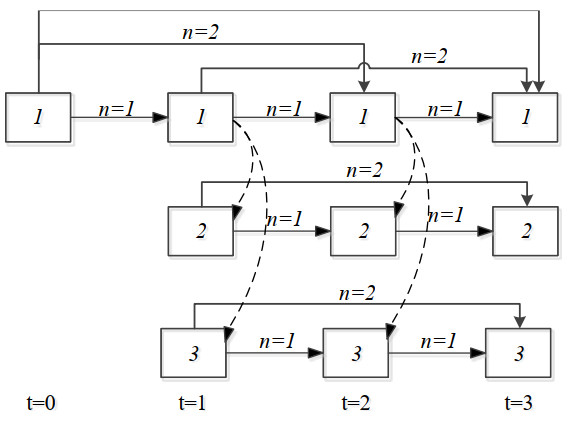
The EL model of new technology adoption
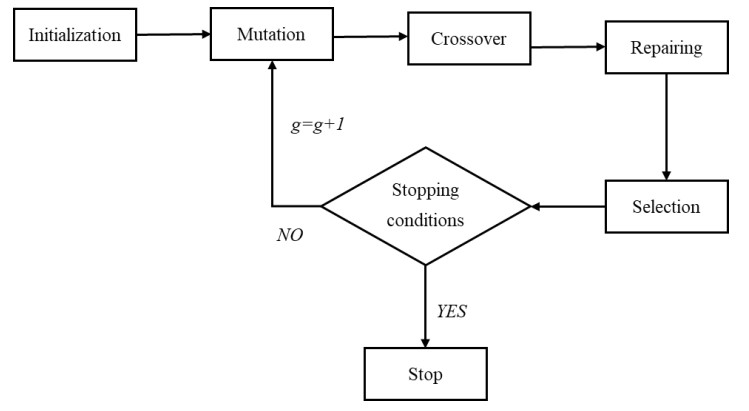
General DE algorithm procedure
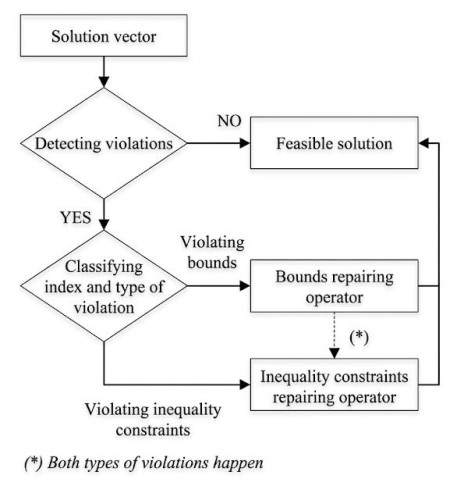
Operation of the repairing mechanism for infeasible solutions
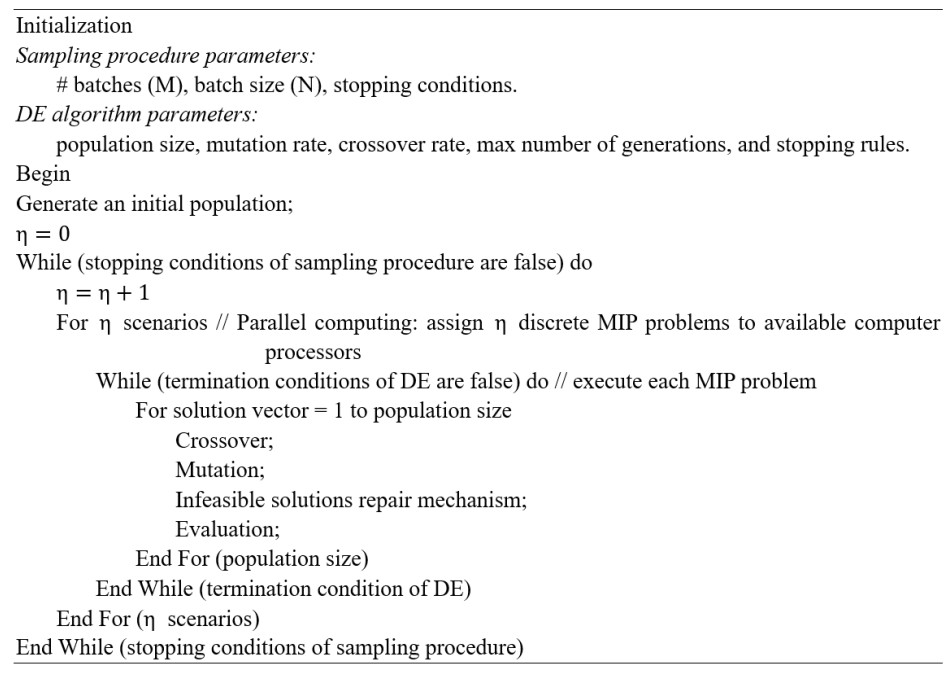
PSDE procedure
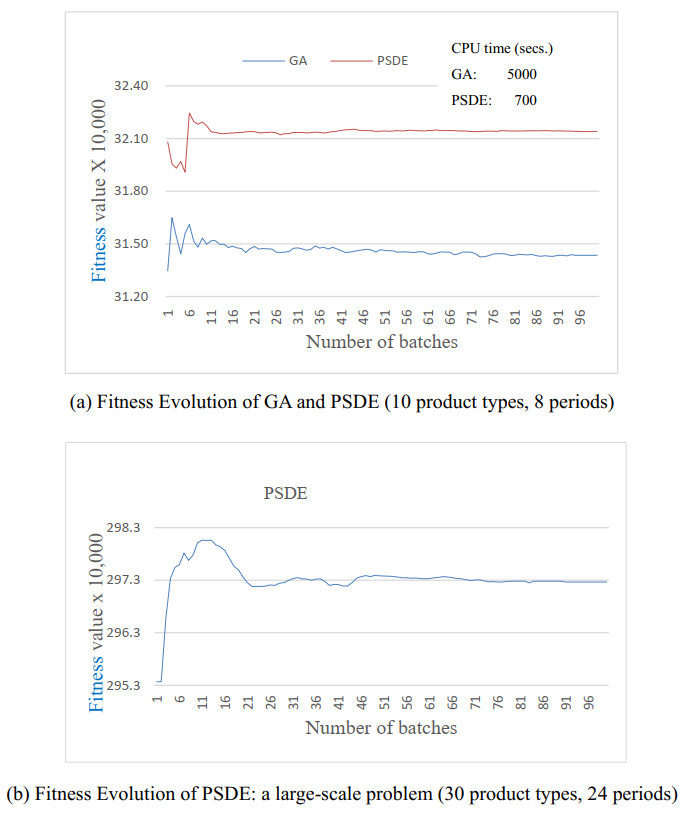
Fitness value evolution (maximum number of batches = 100, $ \mathrm{\lambda } = 0.5 $)
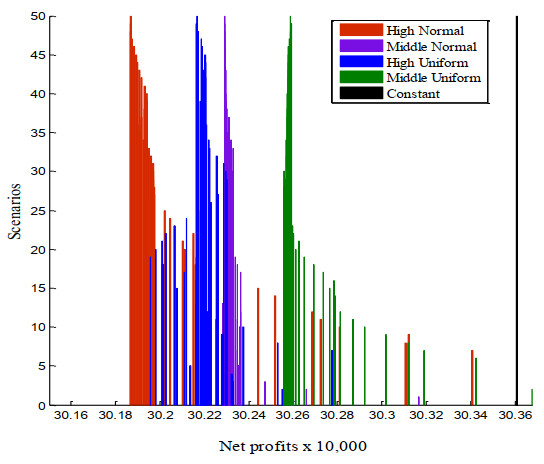
Profits of scenarios $ (\lambda = 0.5) $ under different demand distributions (Normal vs. Uniform) and demand variability ($ \sigma = 20\% $ and $ \sigma = 10\% $ of average demand are considered as high variability and average variability, respectively)
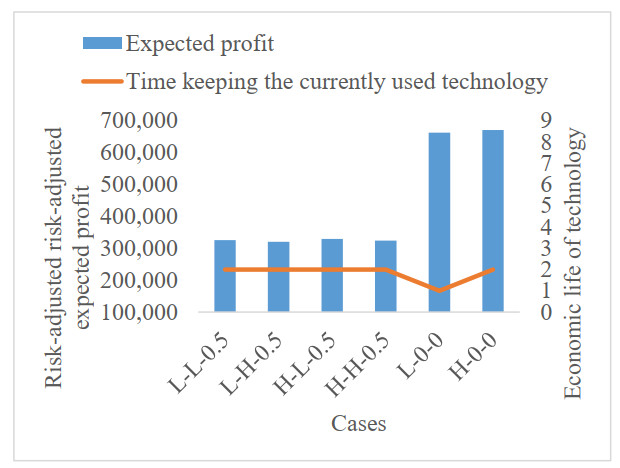
Impact of technological innovation speed, demand variability levels, and risk of investment on the expected profits and economic life of the current technology
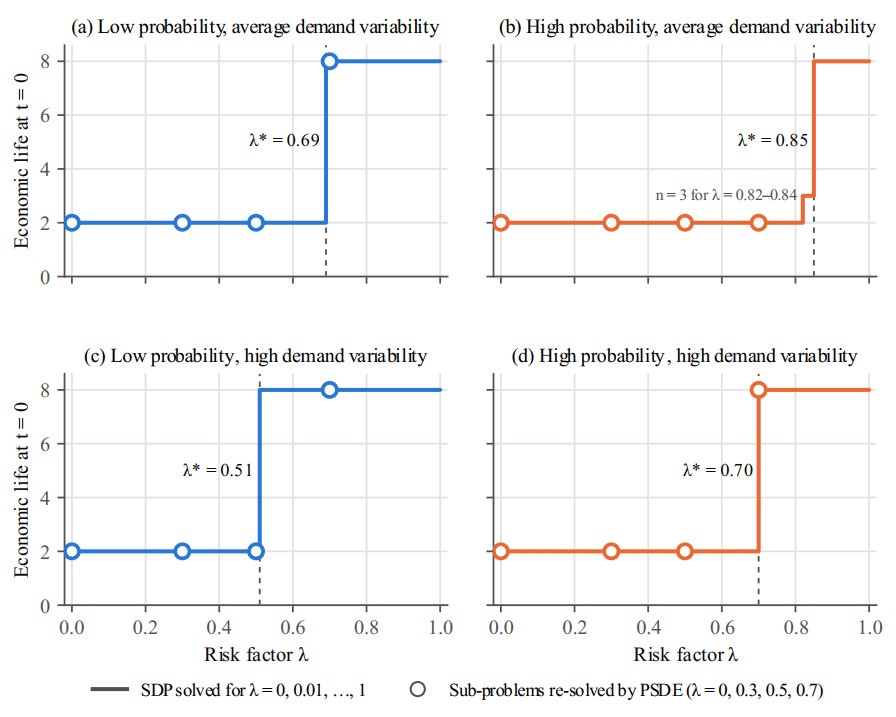
Economic life of the current technology at t = 0 as a function of the risk factor λ. (λ* is the smallest value of λ at which the current technology is retained until the end of the planning horizon)



 DownLoad: