With the rapid development of the electric vehicle industry, the environmental pollution caused by retired batteries has made effective battery recycling increasingly important. The battery recycling market is characterized by the coexistence of whitelist-compliant enterprises and black-market workshops. To analyze their competitive relationship, this study develops a static Bertrand game and a discrete-time dynamic model under bounded rationality. The static analysis focuses on recycling prices, quantities, and research and development (R&D) effort, while the dynamic analysis examines how behavioral adjustment speeds and policy interventions jointly shape system stability. The results indicate that recycling R&D, consumer low-carbon preference, and regulatory pressure affect equilibrium decisions and profits, with some effects depending on technological and consumer characteristics. From a dynamic perspective, moderate adjustment speeds facilitate convergence, whereas excessive adjustments may induce oscillations and chaos. The stability threshold of each adjustment speed depends on the speeds of the other decision variables. Under the examined parameter settings, stronger regulatory pressure on black-market workshops expands the stability region, whereas higher subsidies for whitelist-compliant enterprises may shrink it. The joint policy analysis further shows that jointly increasing the three adjustment speeds reduces the range of subsidy-regulation combinations compatible with steady convergence. These findings provide insights into coordinating regulatory and subsidy policies while accounting for firms' adjustment behavior.
Citation: Haohao Song, Wenping Liu, Xiaobo Wang, Jing Zhang, Ying Wang. Dynamic competition and stability analysis of dual-track battery recycling systems under low-carbon transition[J]. Journal of Industrial and Management Optimization, 2026, 22(11): 6034-6063. doi: 10.3934/jimo.2026203
With the rapid development of the electric vehicle industry, the environmental pollution caused by retired batteries has made effective battery recycling increasingly important. The battery recycling market is characterized by the coexistence of whitelist-compliant enterprises and black-market workshops. To analyze their competitive relationship, this study develops a static Bertrand game and a discrete-time dynamic model under bounded rationality. The static analysis focuses on recycling prices, quantities, and research and development (R&D) effort, while the dynamic analysis examines how behavioral adjustment speeds and policy interventions jointly shape system stability. The results indicate that recycling R&D, consumer low-carbon preference, and regulatory pressure affect equilibrium decisions and profits, with some effects depending on technological and consumer characteristics. From a dynamic perspective, moderate adjustment speeds facilitate convergence, whereas excessive adjustments may induce oscillations and chaos. The stability threshold of each adjustment speed depends on the speeds of the other decision variables. Under the examined parameter settings, stronger regulatory pressure on black-market workshops expands the stability region, whereas higher subsidies for whitelist-compliant enterprises may shrink it. The joint policy analysis further shows that jointly increasing the three adjustment speeds reduces the range of subsidy-regulation combinations compatible with steady convergence. These findings provide insights into coordinating regulatory and subsidy policies while accounting for firms' adjustment behavior.

| [1] |
Z. Wang, Y. Wang, Y. Gong, J. Zhan, Cooperate or not? Strategic analysis of formal and informal recyclers under different retired power battery recycling market structures, Comput. Ind. Eng., 193 (2024), 110294. https://doi.org/10.1016/j.cie.2024.110294 doi: 10.1016/j.cie.2024.110294
|
| [2] |
M. Zhai, Y. Wu, S. Tian, H. Yuan, B. Li, X. Luo, et al., A circular economy approach for the global ithium-ion battery supply chain, Nature, 646 (2025), 8087. https://doi.org/10.1038/s41586-025-09617-4 doi: 10.1038/s41586-025-09617-4
|
| [3] |
M. Azadi, E. Lebre, S. H. Ali, J. Steen, F. Wall, Future of battery metals supply, Resour. Conserv. Recycl., 182 (2022), 106283. https://doi.org/10.1016/j.resconrec.2022.106283 doi: 10.1016/j.resconrec.2022.106283
|
| [4] |
Y. Wang, B. Dong, J. Ge, How can the recycling of power batteries for EVs be promoted in China? A multiparty cooperative game analysis, Waste Manag., 186 (2024), 64–76. https://doi.org/10.1016/j.wasman.2024.06.005 doi: 10.1016/j.wasman.2024.06.005
|
| [5] |
X. Zhao, B. Peng, C. Zheng, A. Wan, Closed-loop supply chain pricing strategy for electric vehicle batteries recycling in China, Environ. Dev. Sustain., 24 (2022), 7725–7752. https://doi.org/10.1007/s10668-021-01755-9 doi: 10.1007/s10668-021-01755-9
|
| [6] |
K. Liu, How government intervention and supply chain competition and cooperation affect power battery recycling from a game theory perspective? Int. J. Low-Carbon Technol., 20 (2025), 1121–1135. https://doi.org/10.1093/ijlct/ctaf059 |
| [7] |
H. Yu, J. Mi, N. Xu, Recycling, pricing decisions, and coordination in the dual-channel closed-loop supply chain: A dynamic perspective, J. Clean. Prod., 456 (2024), 142297. https://doi.org/10.1016/j.jclepro.2024.142297 doi: 10.1016/j.jclepro.2024.142297
|
| [8] |
Z. Xiang, T. Ji, L. Dong, Coordination for a closed-loop supply chain with recycling platform considering dynamic setting, J. Syst. Sci. Syst. Eng., 33 (2024), 425–451. https://doi.org/10.1007/s11518-024-5598-8 doi: 10.1007/s11518-024-5598-8
|
| [9] |
J. Luo, Y. Yang, Y. Jiang, Assessing the antecedents, processes, and consequences of sustainable electric vehicle battery recycling: A systematic literature review, Int. J. Prod. Econ., 282 (2025), 109551. https://doi.org/10.1016/j.ijpe.2025.109551 doi: 10.1016/j.ijpe.2025.109551
|
| [10] |
X. Fu, H. Tan, E. Tsenina, S. Liu, G. Han, Information sharing based on two-way perceptions of trust and supply chain decisions: A simulation based approach, Chaos Solitons Fractals, 157 (2022), 111938. https://doi.org/10.1016/j.chaos.2022.111938 doi: 10.1016/j.chaos.2022.111938
|
| [11] |
J. Wang, H. Zhou, Y. Zhao, Behavior evolution of supply chain networks under disruption risk–-From aspects of time dynamic and spatial feature, Chaos Solitons Fractals, 158 (2022), 112073. https://doi.org/10.1016/j.chaos.2022.112073 doi: 10.1016/j.chaos.2022.112073
|
| [12] |
F. E. Alsaadi, S. Bekiros, Q. Yao, J. Liu, H. Jahanshahi, Achieving resilient chaos suppression and synchronization of fractional-order supply chains with fault-tolerant control, Chaos Solitons Fractals, 174 (2023), 113878. https://doi.org/10.1016/j.chaos.2023.113878 doi: 10.1016/j.chaos.2023.113878
|
| [13] |
X. Xia, P. Li, Y. Cheng, Economic and environmental evaluation of different collection models for spent power batteries, Energy, 299 (2024), 131471. https://doi.org/10.1016/j.energy.2024.131471 doi: 10.1016/j.energy.2024.131471
|
| [14] |
F. Xu, K. Tan, Optimal decisions of closed-loop electric vehicle batteries supply chains under extended producer responsibility policies, Int. J. Syst. Sci. Oper. Logist., 12 (2025), 2437153. https://doi.org/10.1080/23302674.2024.2437153 doi: 10.1080/23302674.2024.2437153
|
| [15] |
K. Cai, J. Zeng, S. Liu, Y. Yang, Research on dual-channel recycling strategy and policy recommendations of spent power battery, Kybernetes 55 (2026), 1596–1616. https://doi.org/10.1108/K-01-2025-0252 |
| [16] |
W. Zhang, L. Zhu, X. Liu, W. Wang, H. Song, Optimal strategies in electric vehicle battery closed-loop supply chain considering government subsidies and echelon utilization, J. Energy Storage, 99 (2024), 113341. https://doi.org/10.1016/j.est.2024.113341 doi: 10.1016/j.est.2024.113341
|
| [17] |
B. Gong, Y. Gao, K. W. Li, Z. Liu, J. Huang, Cooperate or compete? A strategic analysis of formal and informal electric vehicle battery recyclers under government intervention, Int. J. Logist. Res. Appl., 27 (2024), 149–169. https://doi.org/10.1080/13675567.2022.2047621 doi: 10.1080/13675567.2022.2047621
|
| [18] |
M. Xiao, C. Xu, F. Xie, Research on the impact of information sharing and government subsidy on competitive power battery recycling, J. Clean. Prod., 467 (2024), 142989. https://doi.org/10.1016/j.jclepro.2024.142989 doi: 10.1016/j.jclepro.2024.142989
|
| [19] |
Q. Xiao, Y. Zheng, J. Zhang, Recycling mode selection for the reverse supply chain of waste power batteries: An environmental responsibility perspective, J. Ind. Prod. Eng., 42 (2025), 127–146. https://doi.org/10.1080/21681015.2024.2429551 doi: 10.1080/21681015.2024.2429551
|
| [20] |
L. Ma, J. Wang, J. Yang, Research on recycling decisions in closed-loop supply chains of power batteries based on blockchain technology, J. Energy Storage, 141 (2026), 118869. https://doi.org/10.1016/j.est.2025.118869 doi: 10.1016/j.est.2025.118869
|
| [21] |
W. Wu, Electric vehicle battery recycling strategy considering channel leadership under the carbon trading mechanism: Cooperation, competition, or monopoly? Energy, 335 (2025), 138262. https://doi.org/10.1016/j.energy.2025.138262 |
| [22] |
S. Zhao, Y. Han, Q. Zhou, X. Xia, Collaborative management of battery manufacturer responsibility in electric vehicle production with ESG due diligence, J. Clean. Prod., 486 (2025), 144591. https://doi.org/10.1016/j.jclepro.2024.144591 doi: 10.1016/j.jclepro.2024.144591
|
| [23] |
L. Yang, L. Lan, Y. Wan, Recycling and differential pricing strategies in closed-loop supply chains considering blockchain, Electron. Commer. Res., 25 (2025), 3859–3887. https://doi.org/10.1007/s10660-024-09831-8 doi: 10.1007/s10660-024-09831-8
|
| [24] |
S. Wang, D. Zhu, C. Liu, Y. Li, A differential game approach to the low-carbon chains considering the role of shareholding, Environ. Dev. Sustain., 26 (2024), 31577–31600. https://doi.org/10.1007/s10668-024-04538-0 doi: 10.1007/s10668-024-04538-0
|
| [25] |
Y. Wang, H. Wen, Z. Hu, Y. Zhang, Collaborative innovation strategy of supply chain in the context of MCU domestic substitution: A differential game analysis, Comput. Econ., 61 (2023), 1039–1074. https://doi.org/10.1007/s10614-023-10372-9 doi: 10.1007/s10614-023-10372-9
|
| [26] |
L. Zhu, J. He, Battery passport collaborative development strategy: A cooperative-stochastic evolutionary game analysis, Energy, 329 (2025), 136770. https://doi.org/10.1016/j.energy.2025.136770 doi: 10.1016/j.energy.2025.136770
|
| [27] |
X. Xia, P. Li, Y. Cheng, Tripartite evolutionary game analysis of power battery carbon footprint disclosure under the EU battery regulation, Energy, 284 (2023), 129315. https://doi.org/10.1016/j.energy.2023.129315 doi: 10.1016/j.energy.2023.129315
|
| [28] |
R. Ahmed, M. Z. A. Qureshi, M. Abbas, N. Mumtaz, Bifurcation and chaos control in a heterogeneous Cournot-Bertrand duopoly game model, Chaos Solitons Fractals, 190 (2025), 115757. https://doi.org/10.1016/j.chaos.2024.115757 doi: 10.1016/j.chaos.2024.115757
|
| [29] |
X. Liu, W. Zhou, L. Xie, Dynamic competitive game study of a green supply chain with R&D level, Comput. Ind. Eng., 163 (2022), 107785. https://doi.org/10.1016/j.cie.2021.107785 doi: 10.1016/j.cie.2021.107785
|
| [30] |
X. Xi, Y. Zhang, Complexity analysis of production, fertilizer-saving level, and emission reduction efforts decisions in a two-parallel agricultural product supply chain, Chaos Solitons Fractals, 152 (2021), 111358. https://doi.org/10.1016/j.chaos.2021.111358 doi: 10.1016/j.chaos.2021.111358
|
| [31] |
B. Bao, J. Ma, M. Goh, Short- and long-term repeated game behaviours of two parallel supply chains based on government subsidy in the vehicle market, Int. J. Prod. Res., 58 (2020), 7507–7530. https://doi.org/10.1080/00207543.2020.1711988 doi: 10.1080/00207543.2020.1711988
|
| [32] |
R. Woeste, E. S. Drude, D. Vrucak, K. Kloeckner, E. Rombach, P. Letmathe, et al., A techno-economic assessment of two recycling processes for black mass from end-of-life lithium-ion batteries, Appl. Energy, 361 (2024), 122921. https://doi.org/10.1016/j.apenergy.2024.122921 doi: 10.1016/j.apenergy.2024.122921
|
| [33] |
W. Wu, M. Zhang, D. Jin, P. Ma, W. Wu, X. Zhang, Decision-making analysis of electric vehicle battery recycling under different recycling models and deposit-refund scheme, Comput. Ind. Eng., 191 (2024), 110109. https://doi.org/10.1016/j.cie.2024.110109 doi: 10.1016/j.cie.2024.110109
|
| [34] |
Z. H. Adnan, K. Chakraborty, S. Bag, J. S. Wu, Pricing and green investment strategies for electric vehicle supply chain in a competitive market under different channel leadership, Ann. Oper. Res., 355 (2025), 87–122. https://doi.org/10.1007/s10479-023-05523-y doi: 10.1007/s10479-023-05523-y
|
| [35] |
Q. Long, X. Tao, Y. Chen, Y. Chen, L. Xu, S. Zhang, et al., Exploring combined effects of dominance structure, green sensitivity, and green preference on manufacturing closed-loop supply chains, Int. J. Prod. Econ., 251 (2022), 108537. https://doi.org/10.1016/j.ijpe.2022.108537 doi: 10.1016/j.ijpe.2022.108537
|
| [36] |
J. Jian, B. Li, N. Zhang, J. Su, Decision-making and coordination of green closed-loop supply chain with fairness concern, J. Clean. Prod., 298 (2021), 126779. https://doi.org/10.1016/j.jclepro.2021.126779 doi: 10.1016/j.jclepro.2021.126779
|
| [37] |
J. Lin, R. Fan, X. Tan, K. Zhu, Dynamic decision and coordination in a low-carbon supply chain considering the retailer's social preference, Socioecon. Plann. Sci., 77 (2021), 101010. https://doi.org/10.1016/j.seps.2021.101010 doi: 10.1016/j.seps.2021.101010
|
| [38] |
A. Gao, B. Liu, S. Yue, The impact of channel power structures on integrated mode of recycling in a closed-loop battery supply chain, Comput. Ind. Eng., 208 (2025), 111378. https://doi.org/10.1016/j.cie.2025.111378 doi: 10.1016/j.cie.2025.111378
|
| [39] |
Y. Yi, A. Fu, Y. Li, A. Zhang, Battery recycling and coordination in information leakage prevention under blockchain technology in a new energy vehicles supply chain, Energy Econ., 139 (2024), 107862. https://doi.org/10.1016/j.eneco.2024.107862 doi: 10.1016/j.eneco.2024.107862
|
| [40] |
P. Narang, P. K. De, C. P. Lim, M. Kumari, Optimal recycling model selection in a closed-loop supply chain for electric vehicle batteries under carbon cap-trade and reward-penalty policies using the Stackelberg game, Comput. Ind. Eng., 196 (2024), 110512. https://doi.org/10.1016/j.cie.2024.110512 doi: 10.1016/j.cie.2024.110512
|
| [41] |
J. Ma, Z. Wang, Optimal pricing and complex analysis for low-carbon apparel supply chains, Appl. Math. Model., 111 (2022), 610–629. https://doi.org/10.1016/j.apm.2022.07.002 doi: 10.1016/j.apm.2022.07.002
|
| [42] |
S. Kartal, A discrete fractional order Cournot duopoly game model with relative profit delegation: Stability, bifurcation, chaos, 0-1 testing and control, J. Comput. Appl. Math., 457 (2025), 116284. https://doi.org/10.1016/j.cam.2024.116284 doi: 10.1016/j.cam.2024.116284
|
| [43] |
Y. Yan, J. Cao, Y. Zhou, G. Zhou, J. Chen, Decisions for power battery closed-loop supply chain: Cascade utilization and extended producer responsibility, Ann. Oper. Res. 364 (2024), 583–623, https://doi.org/10.1007/s10479-024-05978-7 |
| [44] |
H. Chu, W. Zhang, L. Zhu, The impact of government policies on the coordination of power battery closed-loop supply chain, J. Clean. Prod., 519 (2025), 145961. https://doi.org/10.1016/j.jclepro.2025.145961 doi: 10.1016/j.jclepro.2025.145961
|
| [45] |
Y. Lin, Z. Yu, H. Lin, Y. Wang, Supply chain cooperative strategies for electric vehicle battery recycling under joint environmental policies, Comput. Ind. Eng., 211 (2026), 111528. https://doi.org/10.1016/j.cie.2025.111528 doi: 10.1016/j.cie.2025.111528
|
 jimo-22-11-203-s001.pdf |
 |
Figures(12) / Tables(1)
Haohao Song, Wenping Liu, Xiaobo Wang, Jing Zhang, Ying Wang. Dynamic competition and stability analysis of dual-track battery recycling systems under low-carbon transition[J]. Journal of Industrial and Management Optimization, 2026, 22(11): 6034-6063. doi: 10.3934/jimo.2026203

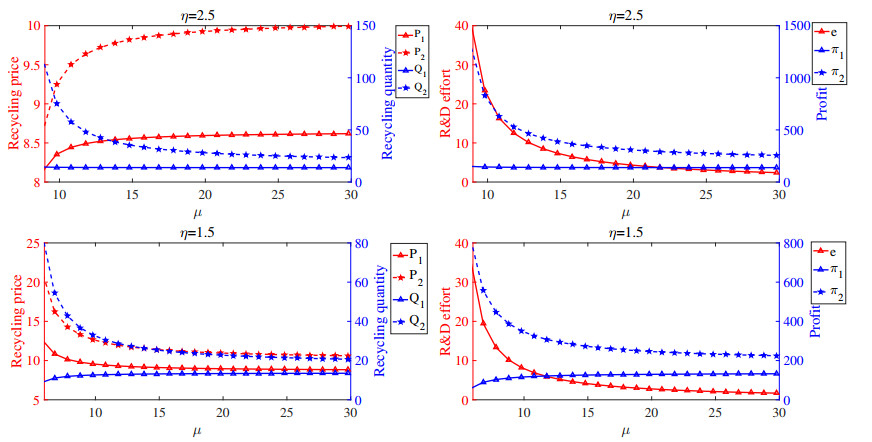
Impacts of parameter $ \mu $ on game results
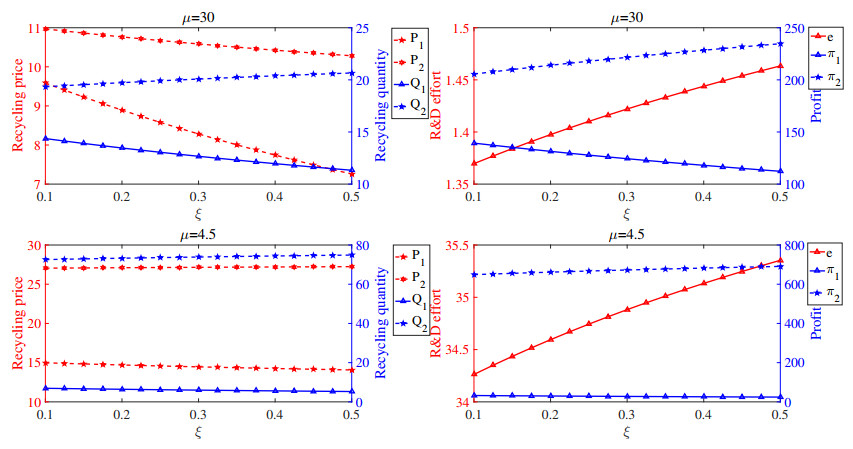
Impacts of parameter $ \xi $ on game results
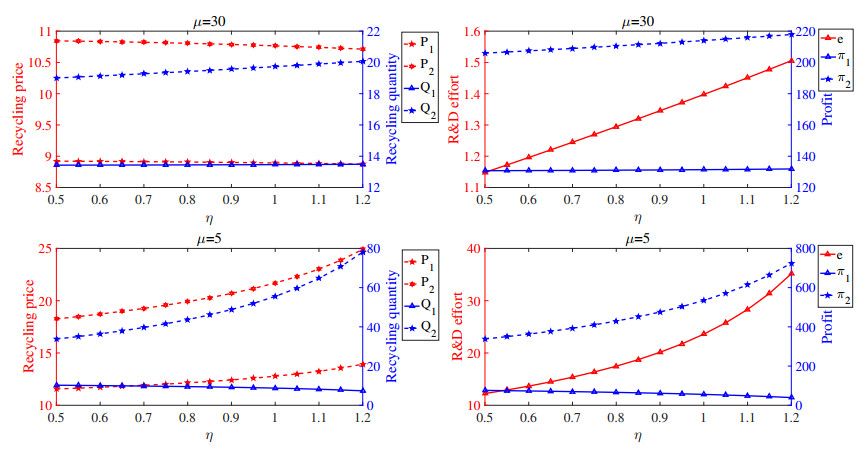
Impacts of parameter $ \eta $ on game results
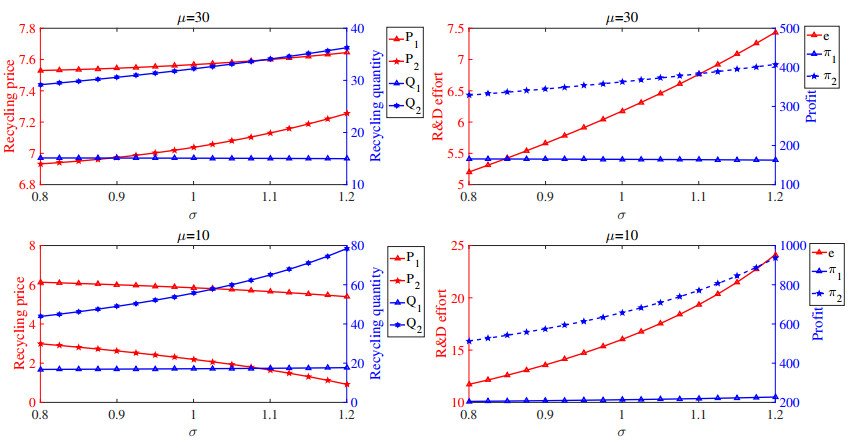
Impacts of parameter $ \sigma $ on game results
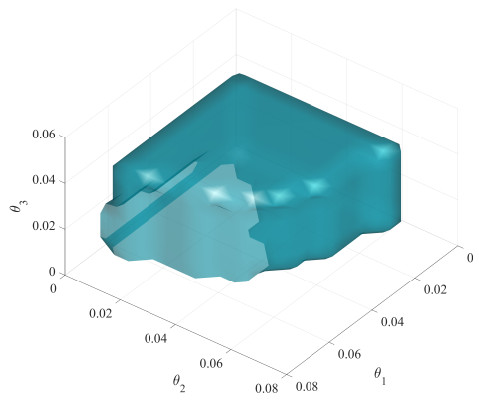
Stability region in the three-dimensional adjustment-speed space
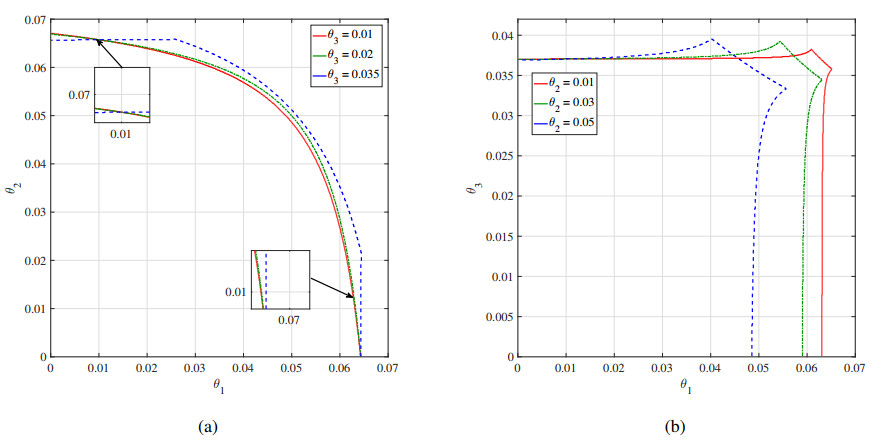
Two-dimensional stability boundaries under different adjustment speeds
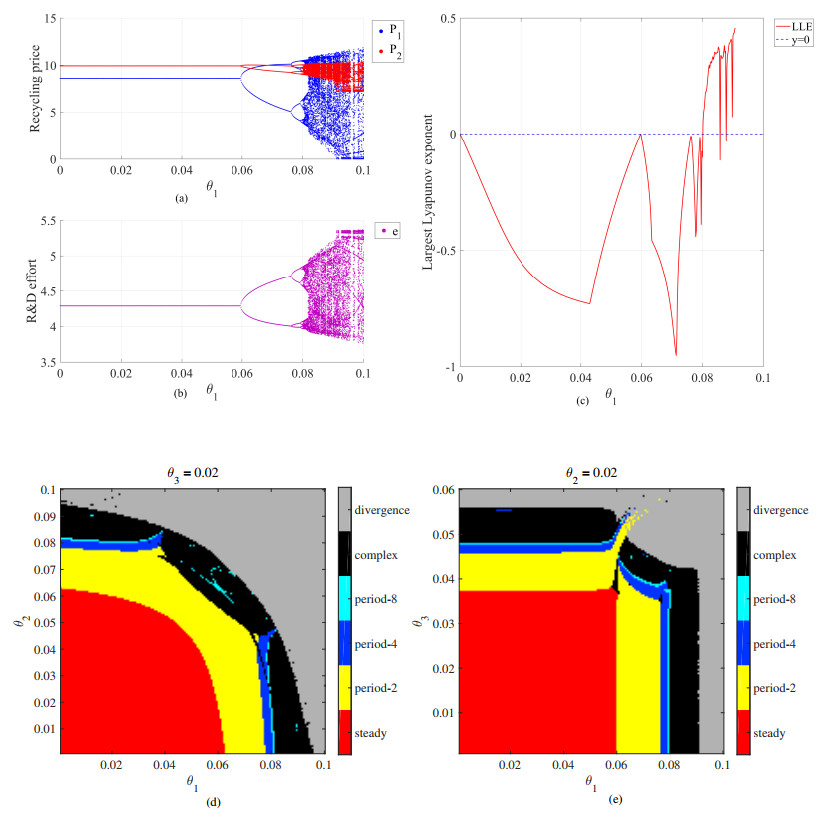
Bifurcation characteristics and dynamical states of the system
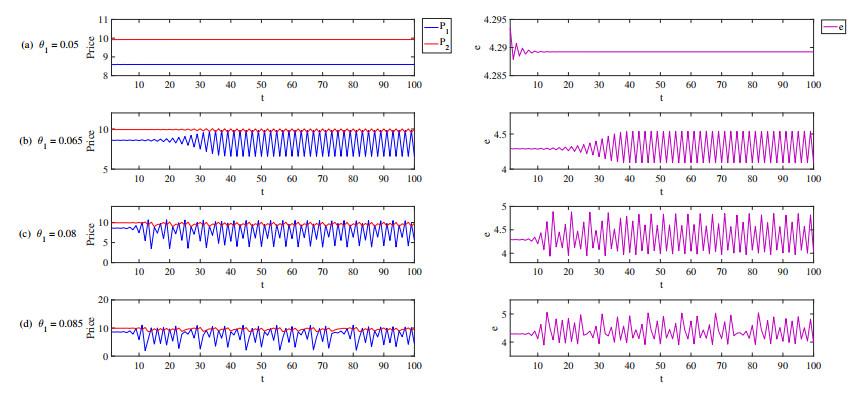
Time series evolution under different values of $ \theta_1 $
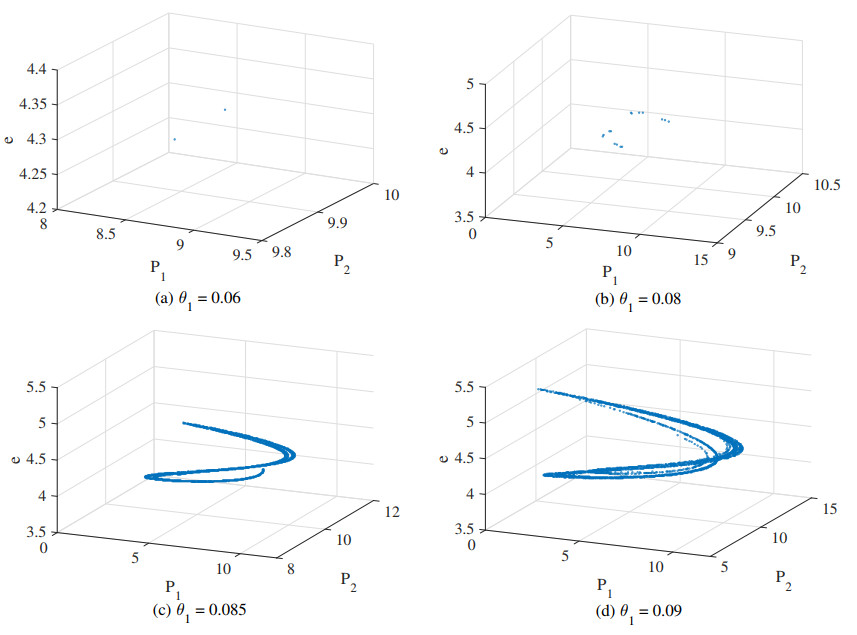
Phase portraits of system (3.10) under different values of $ \theta_1 $
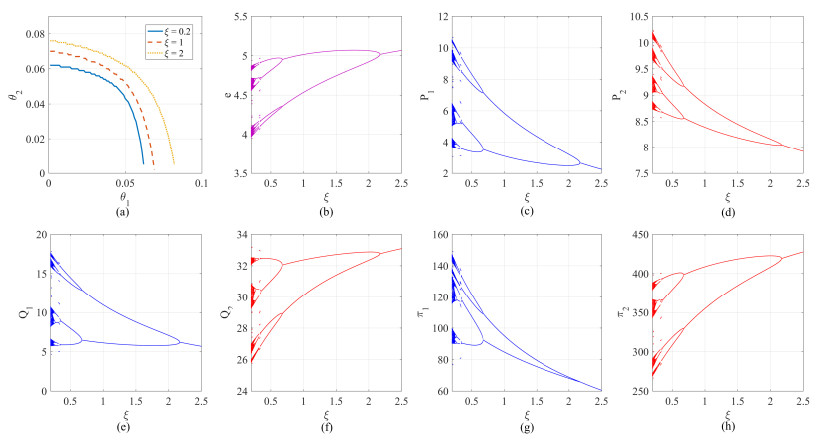
Impacts of regulatory intensity $ \xi $ on system stability and dynamic outcomes
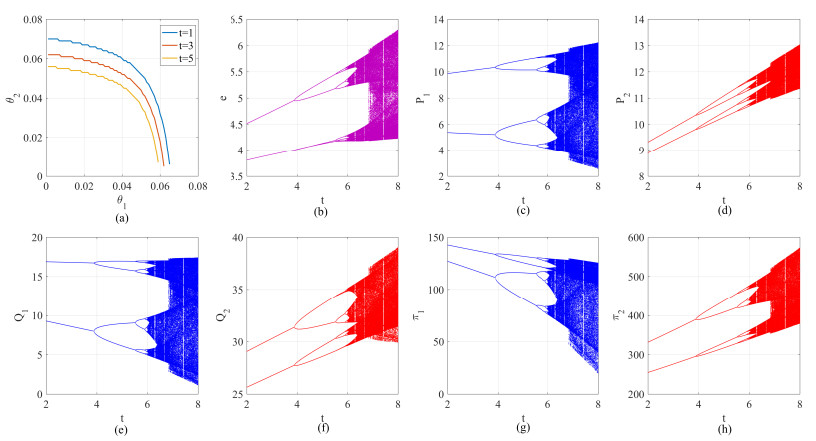
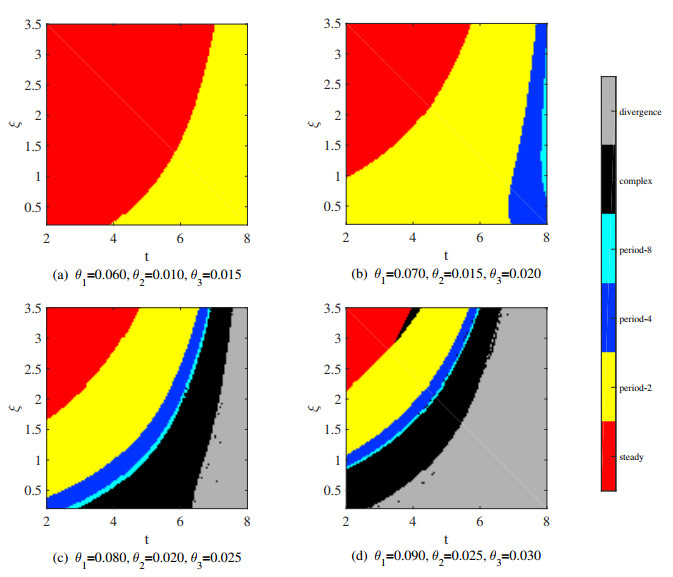
Impact of government subsidy $ t $ on dynamic stability and system outcomes
Impact of government subsidy $ t $ on dynamic stability and system outcomes



 DownLoad: