Conventional expected shortfall portfolio optimization requires an externally specified confidence level, which can make optimized portfolios sensitive to the chosen confidence level. We developed a mean-constrained lambda expected shortfall portfolio model that replaces the fixed confidence level with a loss-dependent confidence function, together with an $ \ell_2 $-regularized extension intended to stabilize portfolio weights. The resulting joint empirical formulations are generally nonlinear and nonconvex. We addressed this difficulty through a loss-level decomposition that reduces the original problems to convex fixed-confidence expected shortfall subproblems and a one-dimensional outer optimization over the loss level. For the basic model, the monotone-crossing structure yields a bisection procedure. We also developed an interval branch-and-bound procedure applicable to both models, including the regularized case in which the monotone-crossing structure is not guaranteed. Numerical experiments on four equity datasets showed that the proposed models endogenously select effective confidence levels and achieve competitive out-of-sample performance relative to fixed-confidence benchmarks, with the regularized extension further reducing portfolio turnover.
Citation: Kunpeng Zhu, Yanjing Guo. Mean-constrained portfolio optimization under lambda expected shortfall: A loss-level decomposition approach[J]. Journal of Industrial and Management Optimization, 2026, 22(11): 6003-6033. doi: 10.3934/jimo.2026202
Conventional expected shortfall portfolio optimization requires an externally specified confidence level, which can make optimized portfolios sensitive to the chosen confidence level. We developed a mean-constrained lambda expected shortfall portfolio model that replaces the fixed confidence level with a loss-dependent confidence function, together with an $ \ell_2 $-regularized extension intended to stabilize portfolio weights. The resulting joint empirical formulations are generally nonlinear and nonconvex. We addressed this difficulty through a loss-level decomposition that reduces the original problems to convex fixed-confidence expected shortfall subproblems and a one-dimensional outer optimization over the loss level. For the basic model, the monotone-crossing structure yields a bisection procedure. We also developed an interval branch-and-bound procedure applicable to both models, including the regularized case in which the monotone-crossing structure is not guaranteed. Numerical experiments on four equity datasets showed that the proposed models endogenously select effective confidence levels and achieve competitive out-of-sample performance relative to fixed-confidence benchmarks, with the regularized extension further reducing portfolio turnover.

| [1] |
H. Markowitz, Portfolio selection, J. Financ., 7 (1952), 77–91. https://doi.org/10.1111/j.1540-6261.1952.tb01525.x doi: 10.1111/j.1540-6261.1952.tb01525.x
|
| [2] |
P. Artzner, F. Delbaen, J. M. Eber, D. Heath, Coherent measures of risk, Math. Financ., 9 (1999), 203–228. https://doi.org/10.1111/1467-9965.00068 doi: 10.1111/1467-9965.00068
|
| [3] |
C. Acerbi, D. Tasche, On the coherence of expected shortfall, J. Bank. Financ., 26 (2002), 1487–1503. https://doi.org/10.1016/S0378-4266(02)00283-2 doi: 10.1016/S0378-4266(02)00283-2
|
| [4] |
W. Liu, Y. Hu, On optimal reinsurance in the presence of premium budget constraint and reinsurer's risk limit, Adv. Appl. Probab., 56 (2024), 1251–1278. https://doi.org/10.1017/apr.2024.2 doi: 10.1017/apr.2024.2
|
| [5] |
W. Jammernegg, P. Kischka, L. Silbermayr, Risk preferences, newsvendor orders and supply chain coordination using the mean-CVaR model, Int. J. Prod. Econ., 270 (2024), 109171. https://doi.org/10.1016/j.ijpe.2024.109171 doi: 10.1016/j.ijpe.2024.109171
|
| [6] |
R. T. Rockafellar, S. Uryasev, Optimization of conditional value-at-risk, J. Risk, 2 (2000), 21–41. https://doi.org/10.21314/JOR.2000.038 doi: 10.21314/JOR.2000.038
|
| [7] |
R. T. Rockafellar, S. Uryasev, Conditional value-at-risk for general loss distributions, J. Bank. Financ., 26 (2002), 1443–1471. https://doi.org/10.1016/S0378-4266(02)00271-6 doi: 10.1016/S0378-4266(02)00271-6
|
| [8] |
P. Krokhmal, J. Palmquist, S. Uryasev, Portfolio optimization with conditional value-at-risk objective and constraints, J. Risk, 4 (2002), 43–68. https://doi.org/10.21314/JOR.2002.057 doi: 10.21314/JOR.2002.057
|
| [9] |
F. Caccioli, I. Kondor, G. Papp, Portfolio optimization under expected shortfall: contour maps of estimation error, Quant. Finance, 18 (2018), 1295–1313. https://doi.org/10.1080/14697688.2017.1390245 doi: 10.1080/14697688.2017.1390245
|
| [10] |
G. Papp, I. Kondor, F. Caccioli, Optimizing expected shortfall under an $\ell_1$ constraint–-an analytic approach, Entropy, 23 (2021), 523. https://doi.org/10.3390/e23050523 doi: 10.3390/e23050523
|
| [11] |
K. Nakagawa, M. Abe, S. Kuroki, Doubly robust mean-CVaR portfolio, arXiv preprint arXiv: 2309.11693, 2023. https://doi.org/10.48550/arXiv.2309.11693 |
| [12] |
E. Anderson, H. Xu, D. Zhang, Varying confidence levels for CVaR risk measures and minimax limits, Math. Program., 180 (2020), 327–370. https://doi.org/10.1007/s10107-018-01359-8 doi: 10.1007/s10107-018-01359-8
|
| [13] |
C. S. Pun, T. Wang, Z. Yan, Data-driven distributionally robust CVaR portfolio optimization under a regime-switching ambiguity set, Manuf. Serv. Oper. Manag., 25 (2023), 1779–1795. https://doi.org/10.1287/msom.2023.1229 doi: 10.1287/msom.2023.1229
|
| [14] |
M. Frittelli, M. Maggis, I. Peri, Risk measures on $\mathcal{P}(\mathbb{R})$ and value at risk with probability/loss function, Math. Financ., 24 (2014), 442–463. https://doi.org/10.1111/mafi.12028 doi: 10.1111/mafi.12028
|
| [15] |
A. Hitaj, C. Mateus, I. Peri, Lambda value at risk and regulatory capital: A dynamic approach to tail risk, Risks, 6 (2018), 17. https://doi.org/10.3390/risks6010017 doi: 10.3390/risks6010017
|
| [16] |
J. Corbetta, I. Peri, Backtesting Lambda value at risk, Eur. J. Financ., 24 (2018), 1075–1087. https://doi.org/10.1080/1351847X.2017.1339105 doi: 10.1080/1351847X.2017.1339105
|
| [17] |
F. Bellini, M. Huang, Q. Wang, R. Wang, Lambda expected shortfall, arXiv preprint arXiv: 2512.23139, 2025. https://doi.org/10.48550/arXiv.2512.23139 |
| [18] |
T. J. Boonen, Y. Chen, X. Han, Q. Wang, Optimal insurance design with lambda-value-at-risk, Eur. J. Oper. Res., 327 (2025), 232–246. https://doi.org/10.1016/j.ejor.2025.04.038 doi: 10.1016/j.ejor.2025.04.038
|
| [19] |
I. Peri, L. Wunderlich, Numerical methods for lambda quantiles: Robust evaluation and portfolio optimization, SIAM J. Financial Math., 17 (2026), 1308–1332. https://doi.org/10.1137/25M1819983 doi: 10.1137/25M1819983
|
| [20] |
V. DeMiguel, L. Garlappi, F. J. Nogales, R. Uppal, A generalized approach to portfolio optimization: Improving performance by constraining portfolio norms, Manag. Sci., 55 (2009), 798–812. https://doi.org/10.1287/mnsc.1080.0986 doi: 10.1287/mnsc.1080.0986
|
| [21] |
S. Still, I. Kondor, Regularizing portfolio optimization, New J. Phys., 12 (2010), 075034. https://doi.org/10.1088/1367-2630/12/7/075034 doi: 10.1088/1367-2630/12/7/075034
|
| [22] |
G. Papp, F. Caccioli, I. Kondor, Bias–variance tradeoff in portfolio optimization under expected shortfall with $\ell_2$ regularization, J. Stat. Mech. Theory Exp., 2019 (2019), 013402. https://doi.org/10.1088/1742-5468/aaf108 doi: 10.1088/1742-5468/aaf108
|
| [23] |
J. Fernández, B. G. Tóth, Interval tools in branch-and-bound methods for global optimization, in The Palgrave Handbook of Operations Research, S. Salhi, J. Boylan eds., Palgrave Macmillan, Cham, 2022,237–267. https://doi.org/10.1007/978-3-030-96935-6_8 |
| [24] |
S. Elloumi, A. Lambert, B. Neveu, G. Trombettoni, Global solution of quadratic problems using interval methods and convex relaxations, J. Glob. Optim., 91 (2025), 331–353. https://doi.org/10.1007/s10898-024-01370-8 doi: 10.1007/s10898-024-01370-8
|
| [25] |
M. Alda, Importance of portfolio optimization in SRI and conventional pension funds, Financ. Innov., 11 (2025), 79. https://doi.org/10.1186/s40854-025-00761-4 doi: 10.1186/s40854-025-00761-4
|
| [26] |
K. Tanaka, R. Yamamoto, Cardinality-constrained maximal predictability portfolios with an $\ell_2$ regularization, J. Ind. Manag. Optim., 22 (2026), 2755–2783. https://doi.org/10.3934/jimo.2026101 doi: 10.3934/jimo.2026101
|
| [27] |
T. Zhang, S. Lai, Portfolio selection balancing concentration and diversification, J. Ind. Manag. Optim., 21 (2025), 3618–3647. https://doi.org/10.3934/jimo.2025025 doi: 10.3934/jimo.2025025
|
| [28] |
S. Boyd, L. Vandenberghe, Convex Optimization, Cambridge University Press, Cambridge, 2004. https://doi.org/10.1017/CBO9780511804441 |
| [29] |
I. D. Coope, C. J. Price, On the convergence of grid-based methods for unconstrained optimization, SIAM J. Optim., 11 (2001), 859–869. https://doi.org/10.1137/S1052623499354989 doi: 10.1137/S1052623499354989
|
| [30] |
J. Larson, M. Menickelly, S. M. Wild, Derivative-free optimization methods, Acta Numer., 28 (2019), 287–404. https://doi.org/10.1017/S0962492919000060 doi: 10.1017/S0962492919000060
|
| [31] |
R. Horst, H. Tuy, Global Optimization: Deterministic Approaches, 3rd edition, Springer, Berlin, Heidelberg, 1996. https://doi.org/10.1007/978-3-662-03199-5 |
| [32] |
A. Neumaier, Complete search in continuous global optimization and constraint satisfaction, Acta Numer., 13 (2004), 271–369. https://doi.org/10.1017/S0962492904000194 doi: 10.1017/S0962492904000194
|
| [33] |
O. Stein, Basic Concepts of Global Optimization, Springer, Berlin, Heidelberg, 2024. https://doi.org/10.1007/978-3-662-66240-3 |
| [34] |
F. Johansson, Arb: Efficient arbitrary-precision midpoint-radius interval arithmetic, IEEE Trans. Comput., 66 (2017), 1281–1292. https://doi.org/10.1109/TC.2017.2690633 doi: 10.1109/TC.2017.2690633
|
| [35] |
C. Bongiorno, D. Challet, Non-linear shrinkage of the price return covariance matrix is far from optimal for portfolio optimization, Financ. Res. Lett., 52 (2023), 103383. https://doi.org/10.1016/j.frl.2022.103383 doi: 10.1016/j.frl.2022.103383
|
| [36] |
B. Li, D. Sahoo, S. C. H. Hoi, OLPS: A toolbox for on-line portfolio selection, J. Mach. Learn. Res., 17 (2016), 1–5. Available from: https://www.jmlr.org/papers/v17/15-317.html. |
| [37] |
Z. R. Lai, H. Yang, A survey on gaps between mean-variance approach and exponential growth rate approach for portfolio optimization, ACM Comput. Surv., 55 (2023), 1–36. https://doi.org/10.1145/3485274 doi: 10.1145/3485274
|
| [38] |
S. Goto, Y. Xu, Improving mean variance optimization through sparse hedging restrictions, J. Financ. Quant. Anal., 50 (2015), 1415–1441. https://doi.org/10.1017/S0022109015000526 doi: 10.1017/S0022109015000526
|
| [39] |
M. Ao, Y. Li, X. Zheng, Approaching mean-variance efficiency for large portfolios, Rev. Financ. Stud., 32 (2019), 2890–2919. https://doi.org/10.1093/rfs/hhy105 doi: 10.1093/rfs/hhy105
|
| [40] |
D. Neděla, S. Ortobelli Lozza, T. Tichý, Dynamic return scenario generation approach for large-scale portfolio optimisation framework, Comput. Econ., 65 (2025), 819–843. https://doi.org/10.1007/s10614-023-10541-w doi: 10.1007/s10614-023-10541-w
|
| [41] |
J. Yu, K. C. Chang, A hierarchical signal-to-policy learning framework for risk-aware portfolio optimization, Int. J. Financ. Stud., 14 (2026), 75. https://doi.org/10.3390/ijfs14030075 doi: 10.3390/ijfs14030075
|
| [42] |
A. A. P. Santos, F. J. Nogales, E. Ruiz, D. J. C. van Dijk, Optimal portfolios with minimum capital requirements, J. Bank. Financ., 36 (2012), 1928–1942. https://doi.org/10.1016/j.jbankfin.2012.03.001 doi: 10.1016/j.jbankfin.2012.03.001
|
| [43] |
L. Callot, M. Caner, A. Ö. Önder, E. Ulaşan, A nodewise regression approach to estimating large portfolios, J. Bus. Econ. Stat., 39 (2021), 520–531. https://doi.org/10.1080/07350015.2019.1683018 doi: 10.1080/07350015.2019.1683018
|
| [44] |
P. Jorion, Value at Risk: The New Benchmark for Managing Financial Risk, 3rd edition, McGraw-Hill, New York, 2007. |
| [45] |
H. Zhao, L. Kong, Penalty method for the sparse portfolio optimization problem, J. Ind. Manag. Optim., 20 (2024), 2864–2884. https://doi.org/10.3934/jimo.2024031 doi: 10.3934/jimo.2024031
|
| [46] |
Q. Wang, K. Zhu, Y. Guo, L. Yang, Z. Wu, An efficient ADMM for multi-period sparse behavioral portfolio optimization based on cumulative prospect theory, J. Ind. Manag. Optim., 22 (2026), 1726–1757. https://doi.org/10.3934/jimo.2026064 doi: 10.3934/jimo.2026064
|
| [47] |
A. Blum, A. Kalai, Universal portfolios with and without transaction costs, Mach. Learn., 35 (1999), 193–205. https://doi.org/10.1023/A:1007530728748 doi: 10.1023/A:1007530728748
|
| [48] |
Y. Lin, Y. Zhang, Z. R. Lai, C. Li, Autonomous sparse mean-CVaR portfolio optimization, in Proceedings of the 41st International Conference on Machine Learning, vol. 235 of Proceedings of Machine Learning Research. PMLR, Vienna, Austria, 2024, 30440–30456. Available from: https://proceedings.mlr.press/v235/lin24w.html. |
| [49] |
G. Y. Ban, N. El Karoui, A. E. B. Lim, Machine learning and portfolio optimization, Manag. Sci., 64 (2018), 1136–1154. https://doi.org/10.1287/mnsc.2016.2644 doi: 10.1287/mnsc.2016.2644
|
| [50] |
L. C. Dias, P. Xidonas, A. Samitas, A novel Sigma-Mu multiple criteria decision aiding approach for mutual funds portfolio selection, Eur. J. Oper. Res., 322 (2025), 589–598. https://doi.org/10.1016/j.ejor.2024.11.003 doi: 10.1016/j.ejor.2024.11.003
|
| [51] |
E. F. Aguirre González, P. C. Manyoma Velásquez, D. F. Manotas-Duque, Prioritization of CIFs taking into account multiple criteria for the construction of efficient portfolios, Cogent Bus. Manag., 11 (2024), 2371072. https://doi.org/10.1080/23311975.2024.2371072 doi: 10.1080/23311975.2024.2371072
|
 jimo-22-11-202-s001.pdf |
 |
Figures(5) / Tables(7)
Kunpeng Zhu, Yanjing Guo. Mean-constrained portfolio optimization under lambda expected shortfall: A loss-level decomposition approach[J]. Journal of Industrial and Management Optimization, 2026, 22(11): 6003-6033. doi: 10.3934/jimo.2026202

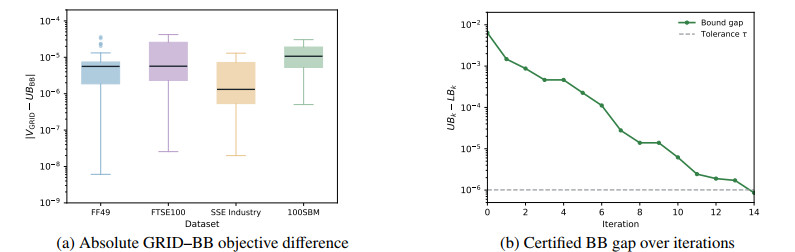
Numerical agreement and convergence diagnostics for M$ \Lambda $ES-$ \ell_2 $
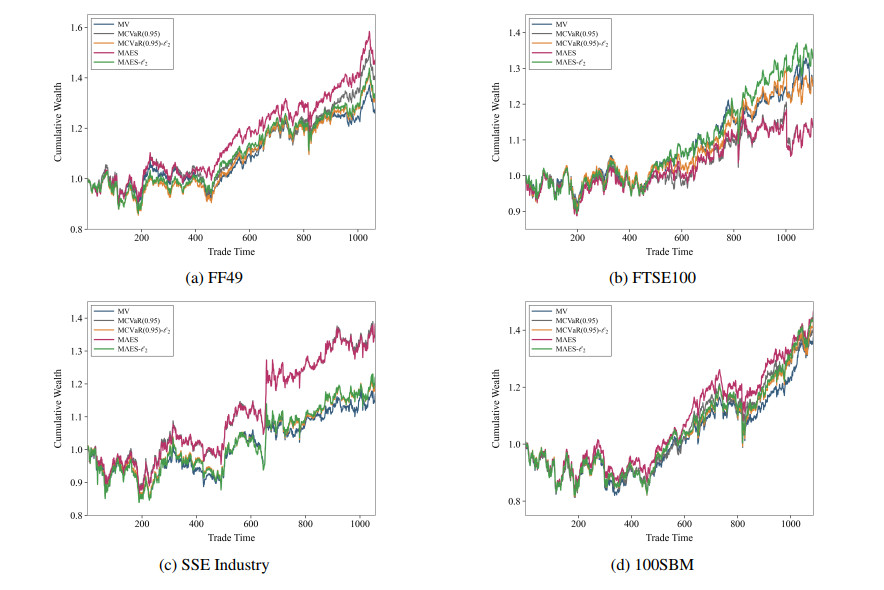
Cumulative wealth over trading time for five models on four datasets
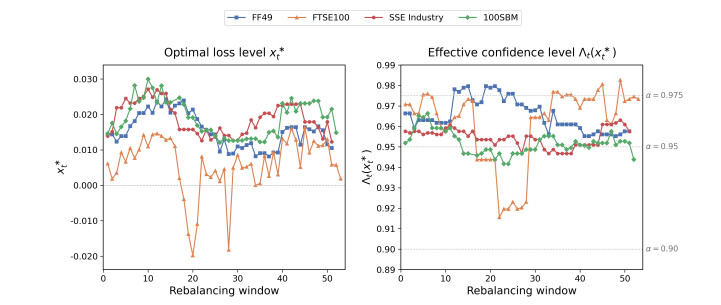
Optimized loss and effective confidence levels for M$ \Lambda $ES-$ \ell_2 $
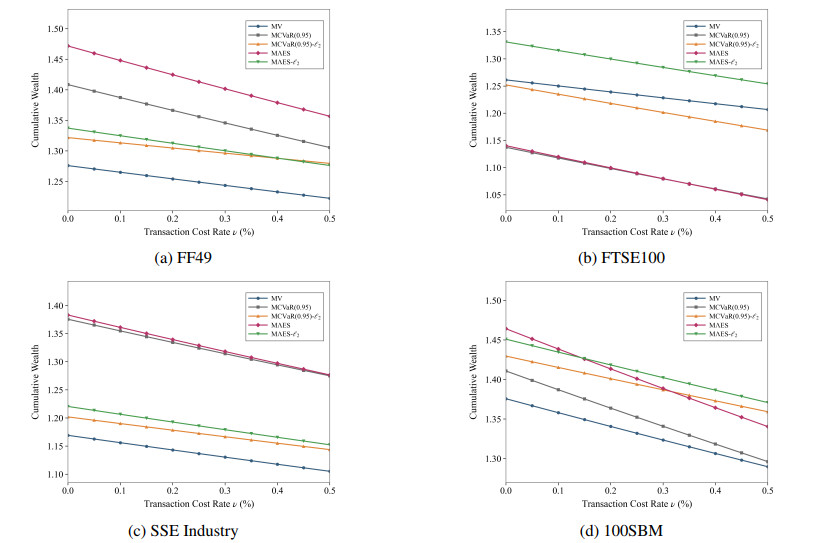
Final cumulative wealth versus transaction cost rate across four datasets
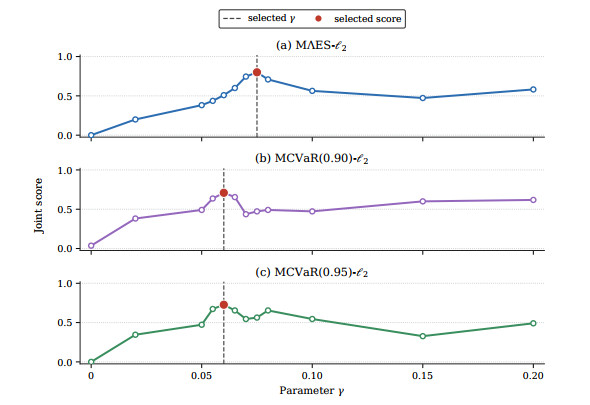
Joint calibration scores for the three regularized models on NSDX100



 DownLoad: