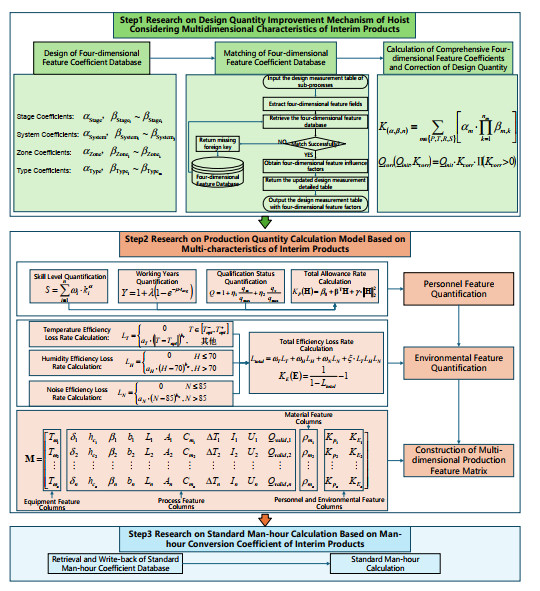
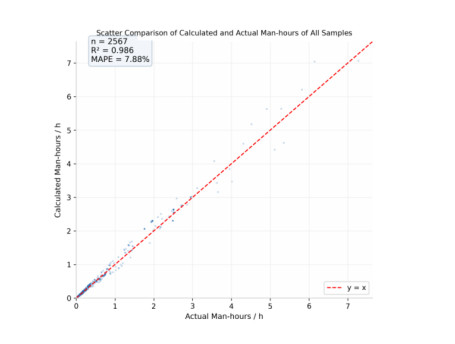
In shipbuilding, man-hour is a unit that is widely used for production planning. Refined and flexible man-hour management is a top pursuit of modern shipyards. However, significant inaccuracies are found in current shipbuilding man-hour data. Refinement is urgently required for the accuracy of design physical quantity, production physical quantity and standard man-hour data. Customized construction demands across ship types and scenarios cannot be supported by this man-hour data. To address this problem, the concept of shipbuilding interim products is introduced in this study. On this basis, a multi-level calculation model for shipbuilding standard man-hours based on the multi-dimensional features of interim products was established. A three-stage progressive framework was incorporated into this model. First, a four-dimensional feature system covering "stage, system, type, and zone" was proposed. Systematic correction of the initial design physical quantity was realized with this system. Second, key production factors were integrated into the model, which included personnel skills, equipment status, and environmental parameters. These parameters were defined as temperature, humidity, and noise levels. On this basis, a multi-dimensional production feature matrix was constructed. Matrix mapping and collaborative conversion from design data to on-site production scenarios were completed by this matrix. Finally, an adaptive man-hour calculation system covering the process and multiple scenarios was established. A practical case of the shipyard of WGQ., Ltd. was used to validate the performance of the proposed model. Satisfactory results were achieved in terms of improving the accuracy of design physical quantity, production physical quantity, and standard man-hour data in the shipbuilding process.
Citation: Lijun Liu, Jiahao Liu, Fei Ren, Huisong Meng, Zuhua Jiang. Multi-level shipbuilding standard man-hours calculation model for based on four-dimensional interim product features[J]. Journal of Industrial and Management Optimization, 2026, 22(11): 5795-5830. doi: 10.3934/jimo.2026196
In shipbuilding, man-hour is a unit that is widely used for production planning. Refined and flexible man-hour management is a top pursuit of modern shipyards. However, significant inaccuracies are found in current shipbuilding man-hour data. Refinement is urgently required for the accuracy of design physical quantity, production physical quantity and standard man-hour data. Customized construction demands across ship types and scenarios cannot be supported by this man-hour data. To address this problem, the concept of shipbuilding interim products is introduced in this study. On this basis, a multi-level calculation model for shipbuilding standard man-hours based on the multi-dimensional features of interim products was established. A three-stage progressive framework was incorporated into this model. First, a four-dimensional feature system covering "stage, system, type, and zone" was proposed. Systematic correction of the initial design physical quantity was realized with this system. Second, key production factors were integrated into the model, which included personnel skills, equipment status, and environmental parameters. These parameters were defined as temperature, humidity, and noise levels. On this basis, a multi-dimensional production feature matrix was constructed. Matrix mapping and collaborative conversion from design data to on-site production scenarios were completed by this matrix. Finally, an adaptive man-hour calculation system covering the process and multiple scenarios was established. A practical case of the shipyard of WGQ., Ltd. was used to validate the performance of the proposed model. Satisfactory results were achieved in terms of improving the accuracy of design physical quantity, production physical quantity, and standard man-hour data in the shipbuilding process.

| [1] |
M. Hur, S. Lee, B. Kim, S. Cho, D. Lee, D. Lee, A study on the man-hour prediction system for shipbuilding, J. Intell. Manuf. , 26 (2015), 1267–1279. https://doi.org/10.1007/s10845-013-0858-3 doi: 10.1007/s10845-013-0858-3

|
| [2] | A. M. Rashwan, Estimation of ship production man-hours, Alex. Eng. J. , 44 (2005), 527–533. |
| [3] |
S. Cho, J. M. Lee, J. H. Woo, Development of production planning system for shipbuilding using component-based development framework, Int. J. Nav. Archit. Ocean Eng. , 13 (2021), 405–430. https://doi.org/10.1016/j.ijnaoe.2021.05.001 doi: 10.1016/j.ijnaoe.2021.05.001
|
| [4] |
Y. Okubo, T. Mitsuyuki, Ship production planning using shipbuilding system modeling and discrete time process simulation, J. Mar. Sci. Eng. , 10 (2022), 176. https://doi.org/10.3390/jmse10020176 doi: 10.3390/jmse10020176
|
| [5] |
N. S. Krishnan, A scientific approach to measure shipbuilding productivity, Marit. Aff. , 8 (2012), 136–149. https://doi.org/10.1080/09733159.2012.690565 doi: 10.1080/09733159.2012.690565
|
| [6] |
D. Okumus, S. Fariya, S. Tamer, S. Gunbeyaz, G. Yildiz, R. Kurt, et al., The impact of fatigue on shipyard welding workers' occupational health and safety and performance, Ocean Eng. , 285 (2023), 115296. https://doi.org/10.1016/j.oceaneng.2023.115296 doi: 10.1016/j.oceaneng.2023.115296
|
| [7] |
A. Bordbar, M. Tadros, A. Nazemian, M. Aung, K. Georgoulas, P. Louvros, et al., Digitalisation of shipyard production planning: a review of simulation, optimisation, AI, and digital twin methods (2010–2025), J. Mar. Sci. Eng. , 14 (2026), 396. https://doi.org/10.3390/jmse14040396 doi: 10.3390/jmse14040396
|
| [8] |
M. Ramirez-Peña, F. J. A. Fraga, J. Salguero, M. Batista, Assessing sustainability in the shipbuilding supply chain 4.0: A systematic review, Sustainability, 12 (2020), 6373. https://doi.org/10.3390/su12166373 doi: 10.3390/su12166373
|
| [9] |
K. Kim, M. Choi, H. Seo, J. Lee, J. Kim, S. Kim, A mixed integer linear programming model for rapid rescheduling in ship and offshore unit design projects, J. Mar. Sci. Eng. , 13 (2025), 222. https://doi.org/10.3390/jmse13020222 doi: 10.3390/jmse13020222
|
| [10] |
S. Park, J. H. Huh, Study on PLM and big data collection for the digital transformation of the shipbuilding industry, J. Mar. Sci. Eng. , 10 (2022), 1488. https://doi.org/10.3390/jmse10101488 doi: 10.3390/jmse10101488
|
| [11] | W. A. Z. Wan Abd Rahman, N. I. Mohd Zaki, M. K. Abu Husain, A review of work breakdown structure and man-hours estimation method used in shipbuilding production, Int. J. Mech. Eng. Technol. , 10 (2019), 1141–1158. |
| [12] |
W. A. Z. Wan Abd Rahman, N. I. Mohd Zaki, M. K. Abu Husain, Work breakdown structure application for man-hours calculation in hull construction shipbuilding in Malaysia, Cogent Eng. , 6 (2019), 1599524. https://doi.org/10.1080/23311916.2019.1599524 doi: 10.1080/23311916.2019.1599524
|
| [13] |
J. Li, P. Lin, D. Song, Z. Yan, B. Yang, L. Zhou, Time prediction in ship block manufacturing based on transfer learning, J. Mar. Sci. Eng. , 12 (2024), 1977. https://doi.org/10.3390/jmse12111977 doi: 10.3390/jmse12111977
|
| [14] | P. Z. Roque, J. M. Gordo, A measurement of shipbuilding productivity, in: Maritime Technology and Engineering 5 Volume 1, CRC Press, 2021,801–809. https://doi.org/10.1201/9781003216582-91 |
| [15] |
J. Emblemsvåg, Lean project planning in shipbuilding, J. Ship Prod. Des. , 30 (2017), 79–88. https://doi.org/10.5957/jspd.30.1.130054 doi: 10.5957/jspd.30.1.130054
|
| [16] |
X. Jing, C. Cheng, J. Liu, S. Yue, S. Li, Y. Chen, et al., Shipbuilding workshop and storage yard scheduling: A literature review, Mar. Struct. , 107 (2026), 103988. https://doi.org/10.1016/j.marstruc.2025.103988 doi: 10.1016/j.marstruc.2025.103988
|
| [17] | T. Shinoda, T. Tanaka, H. Okamoto, D. Umemoto, A method of automated work observation for ship production using deep neural networks, paper presented at SNAME Maritime Convention 2021. https://doi.org/10.5957/smc-2021-041 |
| [18] | China Institute of International Studies, The development choices behind South Korea's "foreign labor dispute", 2026. |
| [19] | U. S. Department of Defense, National Defense Industrial Strategy (NDIS), Washington, D. C.: DoD, 2024. |
| [20] | R. O'Rourke, Navy Ford (CVN-78) Class Aircraft Carrier Program: Background and Issues for Congress, Washington, D. C.: Congressional Research Service, 2025. |
| [21] | U. S. Government Accountability Office, Navy Shipbuilding: Increased Use of Leading Practices Could Improve Timeliness, Washington, D. C.: GAO, 2024. |
| [22] | China Association of the National Shipbuilding Industry, In 2024, China's shipbuilding completions, new orders and orderbook accounted for 55.7%, 74.1% and 63.1% of the global market share respectively, Xinhua News Agency, 2025. |
| [23] |
C. Liang, X. Li, W. Niu, Y. Zhang, Internet of Things driven digital twin for intelligent manufacturing in shipbuilding workshops, Future Internet, 17 (2025), 368. https://doi.org/10.3390/fi17080368 doi: 10.3390/fi17080368
|
| [24] |
W. S. Ruy, H. K. Kim, Y. J. Cho, D. E. Ko, Implementation of welding material quantity evaluation system combined with ship design CAD system, Int. J. Nav. Archit. Ocean Eng. , 9 (2017), 219–226. https://doi.org/10.1016/j.ijnaoe.2016.10.004 doi: 10.1016/j.ijnaoe.2016.10.004
|
| [25] |
K. Kwon, J. Lee, D. Mun, Lightweight model-based weld line generation and its applications to support the construction of ships and offshore plants, J. Mar. Sci. Eng. , 11 (2023), 554. https://doi.org/10.3390/jmse11030554 doi: 10.3390/jmse11030554
|
| [26] |
Y. G. Lee, S. Ju, J. H. Woo, Simulation-based planning system for shipbuilding, Int. J. Comput. Integr. Manuf. , 33 (2020), 626–641. https://doi.org/10.1080/0951192X.2020.1775304 doi: 10.1080/0951192X.2020.1775304
|
| [27] | D. H. Kwak, Y. I. Cho, S. W. Choe, H. J. Kwon, J. H. Woo, Optimization of long-term planning with a constraint satisfaction problem algorithm with a machine learning, Int. J. Nav. Archit. Ocean Eng., (2022), 100442. https://doi.org/10.1016/j.ijnaoe.2022.100442 |
| [28] |
S. H. Nam, H. Q. Shen, C. Ryu, J. G. Shin, SCP-matrix based shipyard APS design: Application to long-term production plan, Int. J. Nav. Archit. Ocean Eng. , 10 (2018), 741–761. https://doi.org/10.1016/j.ijnaoe.2017.10.003 doi: 10.1016/j.ijnaoe.2017.10.003
|
| [29] |
S. Ju, J. H. Woo, Integration of long-term planning and mid-term scheduling of shipbuilding, Prod. Plan. Control, 34 (2023), 524–542. https://doi.org/10.1080/09537287.2021.1940344 doi: 10.1080/09537287.2021.1940344
|
| [30] |
W. S. Choi, D. H. Kim, J. H. Nam, M. J. Kim, Y. B. Son, Estimating production metric for ship assembly based on geometric and production information of ship block model, J. Mar. Sci. Eng. , 9 (2021), 39. https://doi.org/10.3390/jmse9010039 doi: 10.3390/jmse9010039
|
| [31] |
J. H. Jeong, J. H. Woo, J. G. Park, Machine learning methodology for management of shipbuilding master data, Int. J. Nav. Archit. Ocean Eng. , 12 (2020), 428–439. https://doi.org/10.1016/j.ijnaoe.2020.03.005 doi: 10.1016/j.ijnaoe.2020.03.005
|
| [32] |
J. Li, M. Sun, D. Han, J. Wang, X. Mao, X. Wu, A knowledge discovery and reuse method for time estimation in ship block manufacturing planning using DEA, Adv. Eng. Inform. , 39 (2019), 25–40. https://doi.org/10.1016/j.aei.2018.11.005 doi: 10.1016/j.aei.2018.11.005
|
| [33] |
C. Wang, D. Hua, J. Peng, L. Huang, Prediction of ship production design man-hour based on WGAN-GP and HEOA-BP neural network, J. Ship Prod. Des. , 41 (2025), 93–101. https://doi.org/10.5957/jspd.04240011 doi: 10.5957/jspd.04240011
|
| [34] |
P. A. M. Fruytier, A. K. Dev, Predicting ship maintenance and repair labor with artificial neural networks, J. Ship Prod. Des. , 38 (2022), 9–18. https://doi.org/10.5957/jspd.10200027 doi: 10.5957/jspd.10200027
|
| [35] |
Y. Genç, M. Kafali, U. B. Çelebi, Approximate estimation of man-day in ship block production: A two-stage stochastic program, Pol. Marit. Res. , 31 (2024), 146–158. https://doi.org/10.2478/pomr-2024-0015 doi: 10.2478/pomr-2024-0015
|
| [36] |
J. Liu, Y. Zhang, Z. Liu, J. Leng, H. Zhou, S. Gu, et al., Digital twins enable shipbuilding, Alex. Eng. J., (2024), 107915. https://doi.org/10.1016/j.aej.2024.09.007 doi: 10.1016/j.aej.2024.09.007
|
| [37] |
Z. Kunkera, T. Opetuk, N. Hadžić, N. Tošanović, Using digital twin in a shipbuilding project, Appl. Sci. , 12 (2022), 12721. https://doi.org/10.3390/app122412721 doi: 10.3390/app122412721
|
| [38] |
X. Zhang, D. Chen, Shipbuilding 4.0: A systematic literature review, Appl. Sci. , 14 (2024), 6363. https://doi.org/10.3390/app14146363 doi: 10.3390/app14146363
|
| [39] |
V. Stanić, M. Hadjina, N. Fafandjel, T. Matulja, Toward Shipbuilding 4.0 – An Industry 4.0 changing the face of the shipbuilding industry, Brodogradnja, 69 (2018), 111–128. https://doi.org/10.21278/brod69307 doi: 10.21278/brod69307
|
| [40] |
G. Alblas, J. Pruijn, Are current shipbuilding cost estimation methods ready for a sustainable future? A literature review of cost estimation methods and challenges, Int. Shipbuild. Prog. , 71 (2024), 3–28. https://doi.org/10.3233/ISP-230009 doi: 10.3233/ISP-230009
|
 jimo-22-11-196-s001.pdf |
 |
Figures(9) / Tables(11)
Lijun Liu, Jiahao Liu, Fei Ren, Huisong Meng, Zuhua Jiang. Multi-level shipbuilding standard man-hours calculation model for based on four-dimensional interim product features[J]. Journal of Industrial and Management Optimization, 2026, 22(11): 5795-5830. doi: 10.3934/jimo.2026196




 DownLoad: