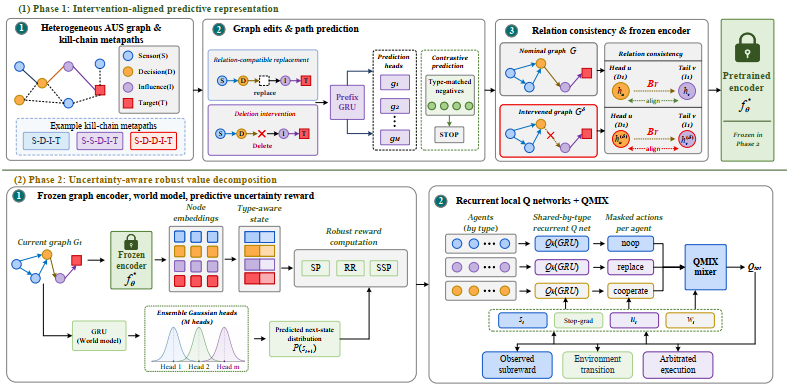
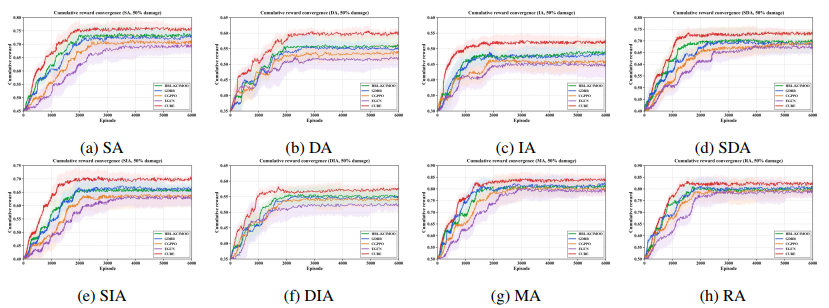
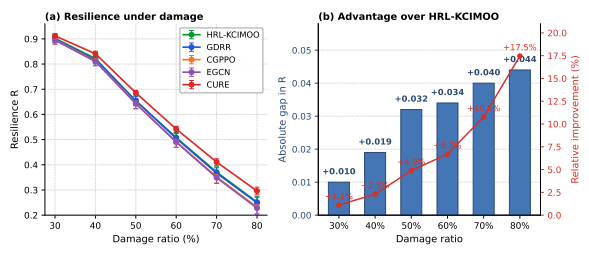
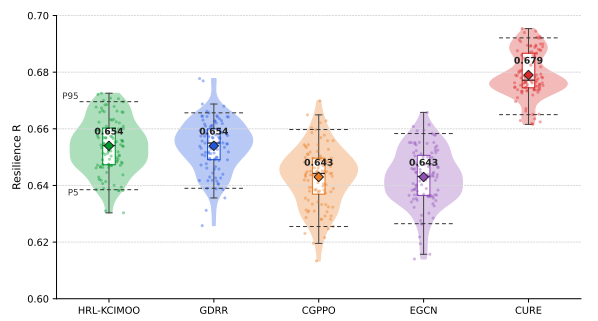
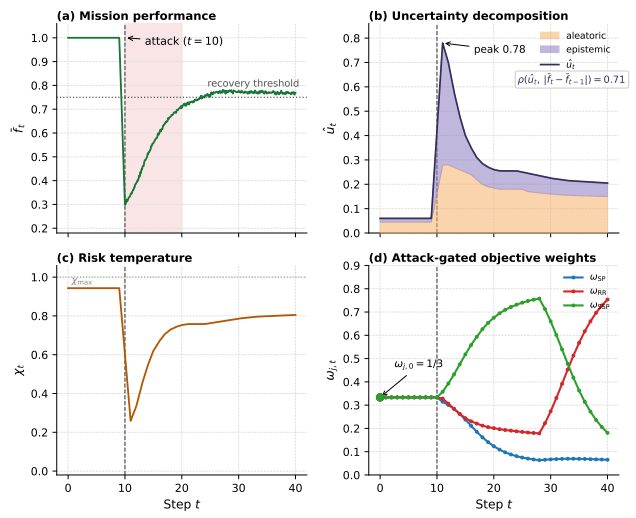
Multi-agent autonomous systems must maintain mission performance in the presence of node failures and structural disruption. Because recovery operations alter functional dependencies, representations learned from nominal graphs can become inadequate for the states encountered during reconfiguration. We present causal-intervention and uncertainty-aware resilience enhancement (CURE), a two-phase framework that combines structural interventions specified by the simulator with uncertainty-aware multiobjective value decomposition. In Phase Ⅰ, a shared encoder that models relational structure is trained on nominal graphs and graphs containing node replacements or deletions, using predefined functional metapaths. The interventions modify node availability and functional assignments within the simulator. Regenerated path targets, together with shared supervision over relations, expose the encoder to their structural consequences. In Phase Ⅱ, the encoder is frozen, and recurrent local value functions shared across node types are learned with a monotonic value mixer under a budget of one operation per decision. An ensemble of Gaussian predictors provides estimates of aleatoric variance and disagreement among ensemble members. Analytical deficit weights distribute emphasis among sustained performance, rapid recovery, and steady-state performance, whereas predictive uncertainty parameterizes a log-sum-exp reward aggregation that increasingly prioritizes lower-performing objectives as confidence declines. On a heterogeneous swarm simulator, CURE achieves greater resilience than six reinforcement-learning baselines across eight attack scenarios at 50% damage. Additional experiments characterize performance for damage ratios from 30% to 80%, recovery speed, and variation across random topologies.
Citation: Kexin Wang, Wanlong Qi, Tian Tang, Dingrui Xue. Causal-intervention and uncertainty-aware resilience enhancement for multi-agent autonomous systems[J]. Journal of Industrial and Management Optimization, 2026, 22(11): 5766-5794. doi: 10.3934/jimo.2026195
Multi-agent autonomous systems must maintain mission performance in the presence of node failures and structural disruption. Because recovery operations alter functional dependencies, representations learned from nominal graphs can become inadequate for the states encountered during reconfiguration. We present causal-intervention and uncertainty-aware resilience enhancement (CURE), a two-phase framework that combines structural interventions specified by the simulator with uncertainty-aware multiobjective value decomposition. In Phase Ⅰ, a shared encoder that models relational structure is trained on nominal graphs and graphs containing node replacements or deletions, using predefined functional metapaths. The interventions modify node availability and functional assignments within the simulator. Regenerated path targets, together with shared supervision over relations, expose the encoder to their structural consequences. In Phase Ⅱ, the encoder is frozen, and recurrent local value functions shared across node types are learned with a monotonic value mixer under a budget of one operation per decision. An ensemble of Gaussian predictors provides estimates of aleatoric variance and disagreement among ensemble members. Analytical deficit weights distribute emphasis among sustained performance, rapid recovery, and steady-state performance, whereas predictive uncertainty parameterizes a log-sum-exp reward aggregation that increasingly prioritizes lower-performing objectives as confidence declines. On a heterogeneous swarm simulator, CURE achieves greater resilience than six reinforcement-learning baselines across eight attack scenarios at 50% damage. Additional experiments characterize performance for damage ratios from 30% to 80%, recovery speed, and variation across random topologies.

| [1] | J. Dahmann, Current landscape of system of systems engineering, Proc. IEEE Int. Conf. Syst. Syst. Eng., 2024, 1–9. https://doi.org/10.1109/sose62659.2024.10620929 |
| [2] | B. Clark, D. Patt, H. Schramm, Mosaic warfare: exploiting artificial intelligence and autonomous systems to implement decision-centric operations, Center for Strategic and Budgetary Assessments, 2020. https://csbaonline.org/uploads/documents/Mosaic_Warfare.pdf. |
| [3] |
Z. Chen, S. Yin, L. Li, W. Cui, D. Hong, Resilience metric and dynamic assessment of unmanned system-of-systems considering cooperative reconfiguration strategies, IEEE Trans. Reliab., 74 (2025), 2942–2954. https://doi.org/10.1109/TR.2024.3438810 doi: 10.1109/TR.2024.3438810

|
| [4] |
K. Wang, D. Xue, Y. Gou, W. Qi, B. Li, J. Liu, et al., Meta-path-guided causal inference for hierarchical feature alignment and policy optimization in enhancing resilience of UWSoS, J. Supercomput., 81 (2025), 358. https://doi.org/10.1007/s11227-024-06848-6 doi: 10.1007/s11227-024-06848-6
|
| [5] |
M. Teng, C. Gao, Z. Wang, X. Li, A communication-based identification of critical drones in malicious drone swarm networks, Complex Intell. Syst., 10 (2024), 3197–3211. https://doi.org/10.1007/s40747-023-01316-9 doi: 10.1007/s40747-023-01316-9
|
| [6] | E. M. Hutchins, M. J. Cloppert, R. M. Amin, Intelligence-driven computer network defense informed by analysis of adversary campaigns and intrusion kill chains, Leading Issues in Information Warfare Security Research, 2011. |
| [7] |
Y. Zhong, H. Li, Q. Sun, Z. Huang, Y. Zhang, A kill chain optimization method for improving the resilience of unmanned combat system-of-systems, Chaos Solitons Fractals, 181 (2024), 114685. https://doi.org/10.1016/j.chaos.2024.114685 doi: 10.1016/j.chaos.2024.114685
|
| [8] |
C. S. Holling, Resilience and stability of ecological systems, Annu. Rev. Ecol. Syst., 4 (1973), 1–23. https://doi.org/10.1146/annurev.es.04.110173.000245 doi: 10.1146/annurev.es.04.110173.000245
|
| [9] |
M. Bruneau, S. E. Chang, R. T. Eguchi, G. C. Lee, T. D. O'Rourke, A. M. Reinhorn, et al., A framework to quantitatively assess and enhance the seismic resilience of communities, Earthq. Spectra, 19 (2003), 733–752. https://doi.org/10.1193/1.1623497 doi: 10.1193/1.1623497
|
| [10] |
S. Hosseini, K. Barker, J. E. Ramirez-Marquez, A review of definitions and measures of system resilience, Reliab. Eng. Syst. Saf., 145 (2016), 47–61. https://doi.org/10.1016/j.ress.2015.08.006 doi: 10.1016/j.ress.2015.08.006
|
| [11] |
D. D. Woods, Four concepts for resilience and the implications for the future of resilience engineering, Reliab. Eng. Syst. Saf., 141 (2015), 5–9. https://doi.org/10.1016/j.ress.2015.03.018 doi: 10.1016/j.ress.2015.03.018
|
| [12] |
H. T. Tran, M. Balchanos, J. C. Domerçant, D. N. Mavris, A framework for the quantitative assessment of performance-based system resilience, Reliab. Eng. Syst. Saf., 158 (2017), 73–84. https://doi.org/10.1016/j.ress.2016.10.014 doi: 10.1016/j.ress.2016.10.014
|
| [13] |
C. Nan, G. Sansavini, A quantitative method for assessing resilience of interdependent infrastructures, Reliab. Eng. Syst. Saf., 157 (2017), 35–53. https://doi.org/10.1016/j.ress.2016.08.013 doi: 10.1016/j.ress.2016.08.013
|
| [14] |
P. Uday, K. Marais, Designing resilient systems-of-systems: A survey of metrics, methods, and challenges, Syst. Eng., 18 (2015), 491–510. https://doi.org/10.1002/sys.21325 doi: 10.1002/sys.21325
|
| [15] |
A. Peiravi, M. Nourelfath, M. K. Zanjani, Universal redundancy strategy for system reliability optimization, Reliab. Eng. Syst. Saf., 225 (2022), 108576. https://doi.org/10.1016/j.ress.2022.108576 doi: 10.1016/j.ress.2022.108576
|
| [16] |
G. Levitin, L. Xing, Y. Dai, Optimizing partial component activation policy in multi-attempt missions, Reliab. Eng. Syst. Saf., 235 (2023), 109251. https://doi.org/10.1016/j.ress.2023.109251 doi: 10.1016/j.ress.2023.109251
|
| [17] |
Q. Sun, H. Li, Y. Wang, Y. Zhang, Multi-swarm-based cooperative reconfiguration model for resilient unmanned weapon system-of-systems, Reliab. Eng. Syst. Saf., 222 (2022), 108426. https://doi.org/10.1016/j.ress.2022.108426 doi: 10.1016/j.ress.2022.108426
|
| [18] | X. Wu, D. Sheldon, S. Zilberstein, Optimizing resilience in large scale networks, Proc. AAAI Conf. Artif. Intell., 2016. https://doi.org/10.1609/aaai.v30i1.9911 |
| [19] |
Q. Sun, H. Li, Y. Zhong, K. Ren and Y. Zhang, Deep reinforcement learning-based resilience enhancement strategy of unmanned weapon system-of-systems under inevitable interferences, Reliab. Eng. Syst. Saf., 242 (2024), 109749. https://doi.org/10.1016/j.ress.2023.109749 doi: 10.1016/j.ress.2023.109749
|
| [20] |
K. Wang, Y. Gou, D. Xue, J. Liu, W. Qi, G. Hou, et al., Resilience augmentation in unmanned weapon systems via multi-layer attention graph convolutional neural networks, Comput. Mater. Contin., 80 (2024), 2941–2962. https://doi.org/10.32604/cmc.2024.052893 doi: 10.32604/cmc.2024.052893
|
| [21] |
D. Xue, Y. Lin, S. Wei, Z. Zhang, W. Qi, J. Liu, et al., Leveraging hierarchical temporal importance sampling and adaptive noise modulation to enhance resilience in multi-agent task execution systems, Neurocomputing, 637 (2025), 130134. https://doi.org/10.1016/j.neucom.2025.130134 doi: 10.1016/j.neucom.2025.130134
|
| [22] |
Y. Peng, J. Wu, T. Duan, Y. Liu, Z. Zhang, J. Zhang, Prioritized recovery strategy for robust UAV swarm communication via graph reinforcement learning, IEEE Internet Things J., 12 (2025), 23891–23904. https://doi.org/10.1109/jiot.2025.3553919 doi: 10.1109/jiot.2025.3553919
|
| [23] |
Y. Gou, S. Wei, K. Xu, J. Liu, K. Li, B. Li, et al., Hierarchical reinforcement learning with kill chain-informed multi-objective optimization to enhance resilience in autonomous unmanned swarm, Neural Netw., 195 (2026), 108255. https://doi.org/10.1016/j.neunet.2025.108255 doi: 10.1016/j.neunet.2025.108255
|
| [24] |
K. Li, Y. Lin, X. Su, A. Liu, J. Liu, W. Qi, et al., Unified multi-agent recovery framework via multi-scale diffusion and dependency-aware hierarchical PPO for resilience enhancement, J. Big Data, 12 (2025), 226. https://doi.org/10.1186/s40537-025-01285-5 doi: 10.1186/s40537-025-01285-5
|
| [25] |
Z. Han, S. Wei, D. Xue, Y. Lin, K. Li, J. Liu, et al., MPD-RL: Meta-path-driven reinforcement learning for enhancing resilience in unmanned weapon system-of-systems, J. Supercomput., 81 (2025), 951. https://doi.org/10.1007/s11227-025-07435-z doi: 10.1007/s11227-025-07435-z
|
| [26] |
X. Han, H. Wang, Q. Jia, Y. Gou, B. Li, J. Liu, et al., Meta-path guided policy distillation for resilient coordination in autonomous unmanned swarm, PLoS One, 20 (2025), e0339675. https://doi.org/10.1371/journal.pone.0339675 doi: 10.1371/journal.pone.0339675
|
| [27] | S. Pitis, E. Creager, A. Garg, Counterfactual data augmentation using locally factored dynamics, Adv. Neural Inf. Process. Syst., 33 (2020), 3976–3990. https://proceedings.neurips.cc/paper_files/paper/2020/hash/294e09f267683c7ddc6cc5134a7e68a8-Abstract.html |
| [28] | J. Mitrovic, B. McWilliams, J. Walker, L. Buesing, C. Blundell, Representation learning via invariant causal mechanisms, Int. Conf. Learn. Represent., 2021. https://openreview.net/forum?id = 9p2ekP904Rs |
| [29] |
C. F. Hayes, R. Rădulescu, E. Bargiacchi, J. Källström, M. Macfarlane, M. Reymond, et al., A practical guide to multi-objective reinforcement learning and planning, Auton. Agents Multi-Agent Syst., 36 (2022), 26. https://doi.org/10.1007/s10458-022-09552-y doi: 10.1007/s10458-022-09552-y
|
| [30] | K. Chua, R. Calandra, R. McAllister, S. Levine, Deep reinforcement learning in a handful of trials using probabilistic dynamics models, Adv. Neural Inf. Process. Syst., 2018. https://proceedings.neurips.cc/paper_files/paper/2018/hash/3de568f8597b94bda53149c7d7f5958c-Abstract.html. |
| [31] | T. Kurutach, I. Clavera, Y. Duan, A. Tamar, P. Abbeel, Model-ensemble trust-region policy optimization, Int. Conf. Learn. Represent., 2018. https://openreview.net/forum?id = SJJinbWRZ |
| [32] | M. Janner, J. Fu, M. Zhang, S. Levine, When to trust your model: Model-based policy optimization, Adv. Neural Inf. Process. Syst., 2019. Available from: https://proceedings.neurips.cc/paper_files/paper/2019/hash/5faf461eff3099671ad63c6f3f094f7f-Abstract.html. |
| [33] |
D. Hafner, J. Pasukonis, J. Ba, T. Lillicrap, Mastering diverse control tasks through world models, Nature, 640 (2025), 647–653. https://doi.org/10.1038/s41586-025-08744-2 doi: 10.1038/s41586-025-08744-2
|
| [34] | A. Kendall, Y. Gal, What uncertainties do we need in Bayesian deep learning for computer vision? Adv. Neural Inf. Process. Syst., 2017. Available from: https://proceedings.neurips.cc/paper_files/paper/2017/hash/2650d6089a6d640c5e85b2b88265dc2b-Abstract.html. |
| [35] | N. Hansen, H. Su, X. Wang, TD-MPC2: Scalable, robust world models for continuous control, Int. Conf. Learn. Represent., 2024. https://openreview.net/forum?id = Oxh5CstDJU |
| [36] |
J. Ding, Y. Zhang, Y. Shang, Y. Zhang, Z. Zong, J. Feng, et al., Understanding world or predicting future? A comprehensive survey of world models, ACM Comput. Surv., 58 (2025), 1–38. https://doi.org/10.1145/3746449 doi: 10.1145/3746449
|
| [37] |
G. N. Iyengar, Robust dynamic programming, Math. Oper. Res., 30 (2005), 257–280. https://doi.org/10.1287/moor.1040.0129 doi: 10.1287/moor.1040.0129
|
| [38] | Y. Chow, A. Tamar, S. Mannor, M. Pavone, Risk-sensitive and robust decision-making: a CVaR optimization approach, Adv. Neural Inf. Process. Syst., 2015. Available from: https://proceedings.neurips.cc/paper_files/paper/2015/hash/64223ccf70bbb65a3a4aceac37e21016-Abstract.html. |
| [39] | E. Derman, D. J. Mankowitz, T. A. Mann, S. Mannor, Soft-robust actor-critic policy-gradient, Conf. Uncertainty Artif. Intell., 2018. https://www.auai.org/uai2018/proceedings/papers/70.pdf. |
| [40] | K. Zhang, T. Sun, Y. Tao, S. Genc, S. Mallya, T. Başar, Robust multi-agent reinforcement learning with model uncertainty, Adv. Neural Inf. Process. Syst., 2020. Available from: https://proceedings.neurips.cc/paper_files/paper/2020/hash/774412967f19ea61d448977ad9749078-Abstract.html. |
| [41] | A. Bukharin, Y. Li, Y. Yu, Q. Zhang, Z. Chen, S. Zuo, et al., Robust multi-agent reinforcement learning via adversarial regularization: theoretical foundation and stable algorithms, Adv. neural inf. process. syst., 2023. https://doi.org/10.52202/075280-2979 |
| [42] |
X. Zhao, J. Liu, F. Wu, X. Zhang, G. Wang, Uncertainty modified policy for multi-agent reinforcement learning, Appl. Intell., 54 (2024), 12020–12034. https://doi.org/10.1007/s10489-024-05811-5 doi: 10.1007/s10489-024-05811-5
|
| [43] | L. Shi, E. Mazumdar, Y. Chi, A. Wierman, Sample-efficient robust multi-agent reinforcement learning in the face of environmental uncertainty, Proc. Mach. Learn. Res., 2024. https://proceedings.mlr.press/v235/shi24d.html |
| [44] | L. Shi, J. Gai, E. Mazumdar, Y. Chi, A. Wierman, Breaking the curse of multiagency in robust multi-agent reinforcement learning, Proc. Mach. Learn. Res., 267 (2025), 54904–54918. https://proceedings.mlr.press/v267/shi25c.html |
| [45] |
C. Wu, H. Deng, H. Wu, C. Tu, Enhancing resilience of unmanned autonomous swarms through game theory-based cooperative reconfiguration, Reliab. Eng. Syst. Saf., 260 (2025), 110951. https://doi.org/10.1016/j.ress.2025.110951 doi: 10.1016/j.ress.2025.110951
|
| [46] |
Y. Wang, J. Cui, C. Zhai, ADHGR: An optimized adaptive disintegration strategy targeting heterogeneous UAV swarms based on graph reinforcement learning, Reliab. Eng. Syst. Saf., 265 (2025), 111453. https://doi.org/10.1016/j.ress.2025.111453 doi: 10.1016/j.ress.2025.111453
|
| [47] | T. N. Kipf, M. Welling, Semi-supervised classification with graph convolutional networks, Int. Conf. Learn. Represent., 2017. https://openreview.net/forum?id = SJU4ayYgl |
| [48] | P. Veličković, G. Cucurull, A. Casanova, A. Romero, P. Liò, Y. Bengio, Graph attention networks, Int. Conf. Learn. Represent., 2018. https://openreview.net/forum?id = rJXMpikCZ |
| [49] | K. Xu, W. Hu, J. Leskovec, S. Jegelka, How powerful are graph neural networks?, Int. Conf. Learn. Represent., 2019. https://openreview.net/forum?id = ryGs6iA5Km |
| [50] | X. Wang, H. Ji, C. Shi, B. Wang, Y. Ye, P. Cui, Heterogeneous graph attention network, Proc. Int. World Wide Web Conf., 2019. https://doi.org/10.1145/3308558.3313562 |
| [51] |
J. Yu, Q. Ge, X. Li, A. Zhou, Heterogeneous graph contrastive learning with meta-path contexts and adaptively weighted negative samples, IEEE Trans. Knowl. Data Eng., 36 (2024), 5181–5193. https://doi.org/10.1109/tkde.2024.3377431 doi: 10.1109/tkde.2024.3377431
|
| [52] |
B. Khemani, S. Patil, K. Kotecha, S. Tanwar, A review of graph neural networks: concepts, architectures, techniques, challenges, datasets, applications, and future directions, J. Big Data, 11 (2024), 18. https://doi.org/10.1186/s40537-023-00876-4 doi: 10.1186/s40537-023-00876-4
|
| [53] | J. Pearl, Causality: Models, Reasoning, and inference, Cambridge University Press, 2009. https://doi.org/10.1017/CBO9780511803161 |
| [54] |
J. Pearl, Causal inference in statistics: An overview, Statist. Surv., 3 (2009), 96–146. https://doi.org/10.1214/09-SS057 doi: 10.1214/09-SS057
|
| [55] |
B. Schölkopf, F. Locatello, S. Bauer, N. R. Ke, N. Kalchbrenner, A. Goyal, et al., Toward causal representation learning, Proc. IEEE, 109 (2021), 612–634. https://doi.org/10.1109/jproc.2021.3058954 doi: 10.1109/jproc.2021.3058954
|
| [56] | J. Brehmer, P. de Haan, P. Lippe, T. Cohen, Weakly supervised causal representation learning, Adv. Neural. Inf. Process Syst., 35 (2022), 38319–38331. https://doi.org/10.52202/068431-2776 |
| [57] | K. Ahuja, D. Mahajan, Y. Wang, Y. Bengio, Interventional causal representation learning, Int. Conf. Mach. Learn., 22 (2023), 372–407. https://proceedings.mlr.press/v202/ahuja23a.html |
| [58] | A. van den Oord, Y. Li, O. Vinyals, Representation learning with contrastive predictive coding, 2018. https://doi.org/10.48550/arXiv.1807.03748 |
| [59] | J. Demšar, Statistical comparisons of classifiers over multiple data sets, J. Mach. Learn. Res., 7 (2006), 1–30. https://jmlr.org/papers/v7/demsar06a.html |
| [60] | P. Henderson, R. Islam, P. Bachman, J. Pineau, D. Precup, D. Meger, Deep reinforcement learning that matters, Proc. AAAI Conf. Artif. Intell., 2018. https://doi.org/10.1609/aaai.v32i1.11694 |
Figures(6) / Tables(11)
Kexin Wang, Wanlong Qi, Tian Tang, Dingrui Xue. Causal-intervention and uncertainty-aware resilience enhancement for multi-agent autonomous systems[J]. Journal of Industrial and Management Optimization, 2026, 22(11): 5766-5794. doi: 10.3934/jimo.2026195




 DownLoad: