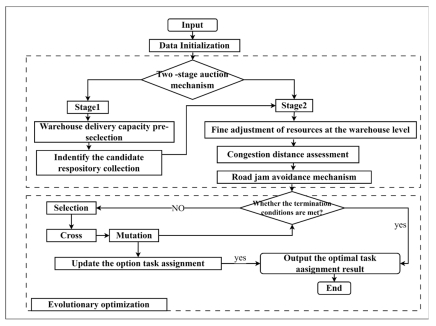
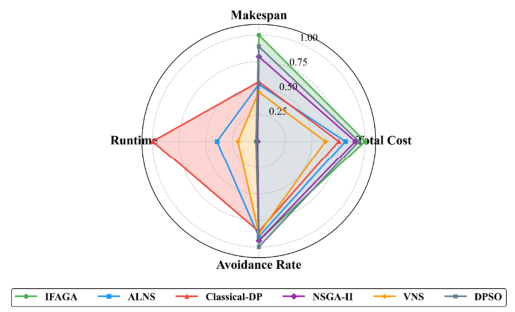
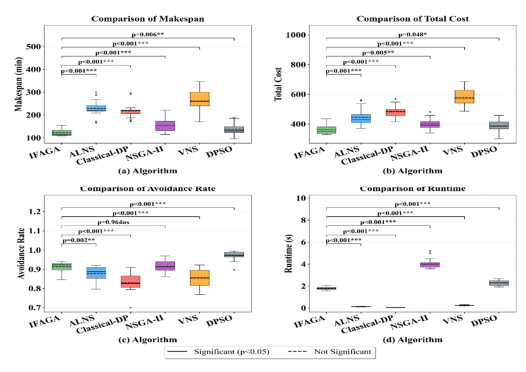
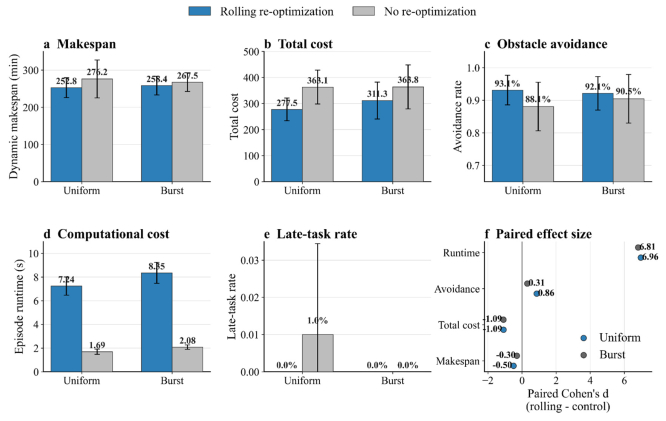
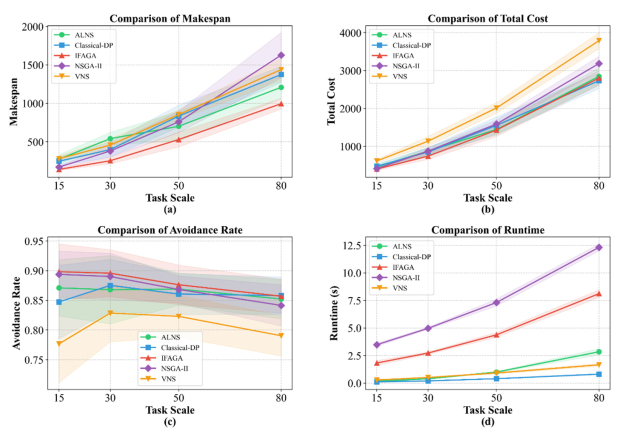
Efficient task allocation in vehicle-UAV collaborative delivery is challenged by heterogeneous resource capabilities and traffic uncertainty. Auction-based schemes often conflate feasibility screening with execution-level selection and rarely connect fuzzy bidding to subsequent route refinement. To address this issue, we proposed an Improved Fuzzy Auction-Genetic Algorithm (IFAGA) for congestion-aware task allocation and routing optimization in urban logistics. IFAGA combined a two-round fuzzy auction with collaborative evolutionary optimization. The first round screened depots using location proximity, capability matching, and time-window feasibility. The second round selected feasible vehicles or UAVs within the winning depot. The auction output then initialized a genetic stage that repaired assignments and improved workload balance and route efficiency under traffic disturbance. On a fixed 15-task benchmark with 20 independent runs, comparisons against ALNS, Classical-DP, NSGA-Ⅱ, VNS, and a discrete particle swarm optimization baseline (DPSO) showed a trade-off among makespan, total cost, obstacle avoidance, and runtime. A separate event-based rolling horizon experiment with staged task release evaluated completion, lateness, and re-optimization overhead. Across additional random scalability instances, IFAGA achieved the lowest average makespan among the tested task scales, while cost and obstacle avoidance varied by baseline and scale.
Citation: Chunping Jiang, Dingjie Wu, Chang Cai. A fuzzy auction genetic algorithm for the vehicle-UAV collaborative delivery problem[J]. Journal of Industrial and Management Optimization, 2026, 22(11): 5831-5854. doi: 10.3934/jimo.2026197
Efficient task allocation in vehicle-UAV collaborative delivery is challenged by heterogeneous resource capabilities and traffic uncertainty. Auction-based schemes often conflate feasibility screening with execution-level selection and rarely connect fuzzy bidding to subsequent route refinement. To address this issue, we proposed an Improved Fuzzy Auction-Genetic Algorithm (IFAGA) for congestion-aware task allocation and routing optimization in urban logistics. IFAGA combined a two-round fuzzy auction with collaborative evolutionary optimization. The first round screened depots using location proximity, capability matching, and time-window feasibility. The second round selected feasible vehicles or UAVs within the winning depot. The auction output then initialized a genetic stage that repaired assignments and improved workload balance and route efficiency under traffic disturbance. On a fixed 15-task benchmark with 20 independent runs, comparisons against ALNS, Classical-DP, NSGA-Ⅱ, VNS, and a discrete particle swarm optimization baseline (DPSO) showed a trade-off among makespan, total cost, obstacle avoidance, and runtime. A separate event-based rolling horizon experiment with staged task release evaluated completion, lateness, and re-optimization overhead. Across additional random scalability instances, IFAGA achieved the lowest average makespan among the tested task scales, while cost and obstacle avoidance varied by baseline and scale.

| [1] |
A. Arenas–Vasco, J. C. Rivera, M. G. Baldoquín, New formulation and valid inequalities for a periodic capacitated vehicle routing problem with multiple depots, heterogeneous fleet, and hard time-windows, PLOS One, 20 (2025), e0335389. https://doi.org/10.1371/journal.pone.0335389 doi: 10.1371/journal.pone.0335389

|
| [2] |
X. Cao, Z. Da, X. Wang, Order fulfillment planning with crowdsourcing integration, Sci. Rep., 15 (2025), 27271. https://doi.org/10.1038/s41598-025-11061-3 doi: 10.1038/s41598-025-11061-3
|
| [3] |
M. A. Sebok, H. G. Tanner, Cooperative planning for physically interacting heterogeneous robots, Front. Robot. AI, 11 (2024), 1172105. https://doi.org/10.3389/frobt.2024.1172105 doi: 10.3389/frobt.2024.1172105
|
| [4] |
P. V. Ghate, H. K. Pati, Collaborative distributed communication in heterogeneous environments: A comprehensive survey, J. Netw. Comput. Appl., 61 (2016), 1–20. https://doi.org/10.1016/j.jnca.2015.10.006 doi: 10.1016/j.jnca.2015.10.006
|
| [5] |
J. Abusalama, S. Razali, Y. H. Choo, An enhanced approach for solving winner determination problem in reverse combinatorial auctions, Indones. J. Electr. Eng. Comput. Sci., 28 (2022), 934–945. https://doi.org/10.11591/ijeecs.v28.i2.pp934-945 doi: 10.11591/ijeecs.v28.i2.pp934-945
|
| [6] |
M. De Ryck, D. Pissoort, T. Holvoet, E. Demeester, Decentral task allocation for industrial AGV-systems with routing constraints, J. Manuf. Syst., 62 (2022), 135–144. https://doi.org/10.1016/j.jmsy.2021.11.012 doi: 10.1016/j.jmsy.2021.11.012
|
| [7] | R. Liu, H. S. Shin, B. Yan, A. Tsourdos, An auction-based coordination strategy for task-constrained multi-agent stochastic planning with submodular rewards, 2022. Available from: https://arXiv.org/abs/2212.14624 |
| [8] | F. Quinton, C. Grand, C. Lesire, Communication-preserving bids in market-based task allocation, 2022 IEEE/RSJ IROS, (2022), 13708–13713. https://doi.org/10.1109/IROS47612.2022.9981699 |
| [9] |
H. B. Ozturk, N. B. Yavas, Z. Bingul, Adaptive market-based dynamic task allocation under environmental uncertainty, Proc. 15th SIMULTECH, 1 (2025), 70–80. https://doi.org/10.5220/0013522600003970 doi: 10.5220/0013522600003970
|
| [10] |
Y. Wang, H. Li, Y. Yao, An adaptive distributed auction algorithm and its application to multi-AUV task assignment, Sci. China Technol. Sci., 66 (2023), 1235–1244. https://doi.org/10.1007/s11431-022-2302-6 doi: 10.1007/s11431-022-2302-6
|
| [11] |
M. Alshaboti, U. Baroudi, Multi-robot task allocation system: Fuzzy auction-based and adaptive multi-threshold approaches, SN Comput. Sci., 2 (2021), 87. https://doi.org/10.1007/s42979-021-00479-x doi: 10.1007/s42979-021-00479-x
|
| [12] | F. Tao, W. F. Li, An improved auction algorithm for task allocation in RMFS, Logist. Technol., 41 (2022), 63–68. |
| [13] |
N. Fazal, M. T. Khan, S. Anwar, J. Iqbal, S. Khan, Task allocation in multi-robot system using resource sharing with dynamic threshold approach, PLOS One, 17 (2022), e0267982. https://doi.org/10.1371/journal.pone.0267982 doi: 10.1371/journal.pone.0267982
|
| [14] |
H. Wu, H. Shang, Potential game for dynamic task allocation in multi-agent system, ISA Trans., 102 (2020), 208–220. https://doi.org/10.1016/j.isatra.2020.03.004 doi: 10.1016/j.isatra.2020.03.004
|
| [15] |
Q. Li, T. W. Fan, L. S. Kei, Z. Li, Scalable and energy-efficient task allocation in industry 4.0: Leveraging distributed auction and IBPSO, PLOS One, 20 (2025), e0314347. https://doi.org/10.1371/journal.pone.0314347 doi: 10.1371/journal.pone.0314347
|
| [16] |
H. L. Choi, L. Brunet, J. P. How, Consensus-based decentralized auctions for robust task allocation, IEEE Trans. Robot., 25 (2009), 912–926. https://doi.org/10.1109/TRO.2009.2022423 doi: 10.1109/TRO.2009.2022423
|
| [17] | G. Wang, Q. S. Chen, Y. Q. Du, X. W. Quan, Multi-agent single-machine scheduling problem based on combinatorial auction, Comput. Integr. Manuf. Syst., 19 (2013), 106–113. |
| [18] |
L. Wang, M. Liu, M. Q. H. Meng, A hierarchical auction-based mechanism for real-time resource allocation in cloud robotic systems, IEEE Trans. Cybern., 47 (2017), 473–484. https://doi.org/10.1109/TCYB.2016.2519525 doi: 10.1109/TCYB.2016.2519525
|
| [19] | Y. L. Ren, X. Y. Zou, X. H. Zhang, Bidding game model for power generation companies based on first-price sealed auction, J. Syst. Eng., 18 (2003), 248–254. |
| [20] |
J. M. Garibaldi, T. Ozen, Uncertain fuzzy reasoning: A case study in modelling expert decision making, IEEE Trans. Fuzzy Syst., 15 (2007), 16–30. https://doi.org/10.1109/TFUZZ.2006.889755 doi: 10.1109/TFUZZ.2006.889755
|
| [21] |
D. R. Wu, Z. G. Zeng, H. Mo, F. Y. Wang, Interval type-2 fuzzy sets and systems: Overview and outlook, Acta Autom. Sin., 46 (2020), 1539–1556. https://doi.org/10.16383/j.aas.c200133 doi: 10.16383/j.aas.c200133
|
| [22] |
I. Sekhi, S. Kovács, K. Nehéz, Enhancing decision-making in uncertain domains through optimized fuzzy logic systems, Period. Polytech. Electr. Eng. Comput. Sci., 69 (2025), 63–78. https://doi.org/10.3311/PPee.38729 doi: 10.3311/PPee.38729
|
| [23] |
H. Jiang, Y. Tong, B. Song, C. Wang, J. Li, Q. Liu, et al., A robustness division based multi-population evolutionary algorithm for solving vehicle routing problems with uncertain demand, Eng. Appl. Artif. Intell., 133 (2024), 108004. https://doi.org/10.1016/j.engappai.2024.108004 doi: 10.1016/j.engappai.2024.108004
|
| [24] |
B. Rezaei, F. G. Guimaraes, R. Enayatifar, P. C. Haddow, Combining genetic local search into a multi-population imperialist competitive algorithm for the capacitated vehicle routing problem, Appl. Soft Comput., 142 (2023), 110309. https://doi.org/10.1016/j.asoc.2023.110309 doi: 10.1016/j.asoc.2023.110309
|
| [25] | K. Q. Zhu, A diversity-controlling adaptive genetic algorithm for the vehicle routing problem with time windows, ICTAI, (2003), 176–183. https://doi.org/10.1109/TAI.2003.1250187 |
| [26] |
K. Deb, A. Pratap, S. Agarwal, T. Meyarivan, A fast and elitist multiobjective genetic algorithm: NSGA-Ⅱ, IEEE Trans. Evol. Comput., 6 (2002), 182–197. https://doi.org/10.1109/4235.996017 doi: 10.1109/4235.996017
|
| [27] |
A. K. Ariyani, W. F. Mahmudy, Y. P. Anggodo, Hybrid genetic algorithms and simulated annealing for multi-trip vehicle routing problem with time windows, Int. J. Electr. Comput. Eng., 8 (2018), 4713–4723. https://doi.org/10.11591/ijece.v8i6.pp4713-4723 doi: 10.11591/ijece.v8i6.pp4713-4723
|
| [28] |
S. Ropke, D. Pisinger, An adaptive large neighborhood search heuristic for the pickup and delivery problem with time windows, Transp. Sci., 40 (2006), 393–546. https://doi.org/10.1287/trsc.1050.0135 doi: 10.1287/trsc.1050.0135
|
| [29] | L. Bertuccelli, H. L. Choi, P. Cho, J. How, Real-time multi-UAV task assignment in dynamic and uncertain environments, AIAA GNC Conf., (2009). https://doi.org/10.2514/6.2009-5776 |
| [30] |
Z. Bi, X. Guo, J. Wang, S. Qin, G. Liu, Truck-drone delivery optimization based on multi-agent reinforcement learning, Drones, 8 (2024), 27. https://doi.org/10.3390/drones8010027 doi: 10.3390/drones8010027
|
 jimo-22-11-197-s001.pdf |
 |
Figures(8) / Tables(10)
Chunping Jiang, Dingjie Wu, Chang Cai. A fuzzy auction genetic algorithm for the vehicle-UAV collaborative delivery problem[J]. Journal of Industrial and Management Optimization, 2026, 22(11): 5831-5854. doi: 10.3934/jimo.2026197




 DownLoad: