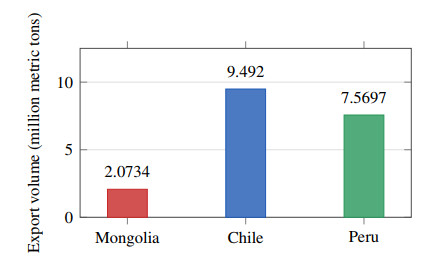
Classical cost–volume–profit (CVP) analysis usually provides point-wise break-even or target-profit calculations under fixed-price assumptions. This paper developed a nonconvex feasible–profit framework for multi-producer CVP analysis in an oligopolistic market where the common price is endogenously determined by the joint production vector. The framework was applied to a three-country copper export market consisting of Mongolia, Chile, and Peru, which are interpreted as aggregate producers, using annual data for 2013–2025. Export volumes, China's copper import demand, and London Metal Exchange copper prices were obtained from Bloomberg, while cost parameters were calibrated benchmark values. For the three reduced-form price environments, the price coefficient was estimated by least squares, feasible–profit membership was tested, and a penalty method was used to compute local stationary points. The results showed that feasible–profit membership depends strongly on the assumed price mechanism. Under the linear aggregate-output and pairwise interaction specifications, the observed export vector is infeasible only in the early years and becomes feasible later, while under the inverse aggregate-output specification, the observed vector remains feasible throughout the sample but the computed stationary points are infeasible in 2024–2025. The findings suggest that multi–producer CVP analysis should account for endogenous price formation and export competition, and the proposed framework provides an interpretable tool for examining nonconvex feasible–profit regions.
Citation: Munkhbayar Byambadash, Bayanjargal Darkhijav, Tumendelger Lkhagvasuren, Enkhbat Rentsen. A nonconvex modeling approach to cost–volume–profit analysis with variable price in an oligopolistic market[J]. Journal of Industrial and Management Optimization, 2026, 22(7): 3123-3150. doi: 10.3934/jimo.2026114
Classical cost–volume–profit (CVP) analysis usually provides point-wise break-even or target-profit calculations under fixed-price assumptions. This paper developed a nonconvex feasible–profit framework for multi-producer CVP analysis in an oligopolistic market where the common price is endogenously determined by the joint production vector. The framework was applied to a three-country copper export market consisting of Mongolia, Chile, and Peru, which are interpreted as aggregate producers, using annual data for 2013–2025. Export volumes, China's copper import demand, and London Metal Exchange copper prices were obtained from Bloomberg, while cost parameters were calibrated benchmark values. For the three reduced-form price environments, the price coefficient was estimated by least squares, feasible–profit membership was tested, and a penalty method was used to compute local stationary points. The results showed that feasible–profit membership depends strongly on the assumed price mechanism. Under the linear aggregate-output and pairwise interaction specifications, the observed export vector is infeasible only in the early years and becomes feasible later, while under the inverse aggregate-output specification, the observed vector remains feasible throughout the sample but the computed stationary points are infeasible in 2024–2025. The findings suggest that multi–producer CVP analysis should account for endogenous price formation and export competition, and the proposed framework provides an interpretable tool for examining nonconvex feasible–profit regions.

| [1] | C. T. Horngren, G. Foster, Cost Accounting: A managerial emphasis, Prentice Hall, 25 (2010), 789–790. https://doi.org/10.2308/iace.2010.25.4.789 |
| [2] |
L. Grigoryan, A. Hakobyan, Cost-volume-profit analysis as a source of information for making managerial decisions, Internauka Ser. Econ. Sci., 2017. https://doi.org/10.25313/2520-2294-2020-10-6399 doi: 10.25313/2520-2294-2020-10-6399

|
| [3] |
A. Hinterhuber, Towards value-based pricing–An integrative framework for decision making, Ind. Mark. Manag., 33 (2004), 765–778. https://doi.org/10.1016/j.indmarman.2003.10.006 doi: 10.1016/j.indmarman.2003.10.006
|
| [4] |
S. R. Abdullahi, B. A. Sulaimon, I. S. Mukhtar, M. H. Musa, Cost–volume–profit analysis as a management tool for decision making in small business enterprise within Bayero University, Kano, IOSR J. Bus. Manag., 19 (2017), 40–45. https://doi.org/10.9790/487X-1902014045 doi: 10.9790/487X-1902014045
|
| [5] |
E. P. Enyi, Joint products CVP analysis time for methodical review, J. Econ. Bus., 2 (2019), 1288–1297. https://doi.org/10.31014/aior.1992.02.04.168 doi: 10.31014/aior.1992.02.04.168
|
| [6] |
L. S. Oppusunggu, Importance of break-even analysis for the micro, small and medium enterprises, Int. J. Res., 8 (2020), 212–218. https://doi.org/10.29121/granthaalayah.v8.i6.2020.502 doi: 10.29121/granthaalayah.v8.i6.2020.502
|
| [7] |
M. Salam, L. Fudjaja, R. Darma, P. Diansari, N. M. Viantika, M. Nafisa, Revenue analysis of mobile rice milling business, IOP Conf. Ser. Earth Environ. Sci., 681 (2021), 1–5. https://doi.org/10.1088/1755-1315/681/1/012095 doi: 10.1088/1755-1315/681/1/012095
|
| [8] |
I. Abdurofi, M. M. Ismail, N. W. Ismail, A. M. Abdullah, Application of cost-benefit and break-even analysis for the development of stingless bees farming in Malaysia, Int. J. Bus. Soc., 22 (2021), 846–861. https://doi.org/10.33736/ijbs.3763.2021 doi: 10.33736/ijbs.3763.2021
|
| [9] |
D. Cottafava, M. Costamagna, M. Baricco, L. Corazza, D. Miceli, L. E. Riccardo, Assessment of the environmental break-even point for deposit return systems through an LCA analysis of single-use and reusable cups, Sustain. Prod. Consum., 27 (2021), 228–241. https://doi.org/10.1016/j.spc.2020.11.002 doi: 10.1016/j.spc.2020.11.002
|
| [10] |
P. Fousekis, Price interrelationships in the EU cow milk markets: Evidence from rank-based cointegration tests, Outlook Agric., 47 (2018), 101–107. https://doi.org/10.1177/0030727018763985 doi: 10.1177/0030727018763985
|
| [11] |
J. Syrucek, L. Barton, J. Burdych, Break-even point analysis for milk production: Selected EU countries, Agric. Econ., 68 (2022), 199–206. https://doi.org/10.17221/40/2022-AGRICECON doi: 10.17221/40/2022-AGRICECON
|
| [12] |
M. Neidhardt, J. Mas-Peiro, M. Schulz-Moenninghoff, J. O. Pou, R. Gonzalez-Olmos, A. Kwade, et al., Forecasting the global battery material flow: Analyzing the break-even points at which secondary battery raw materials can substitute primary materials in battery production, Appl. Sci., 12 (2022), 4790. https://doi.org/10.3390/app12094790 doi: 10.3390/app12094790
|
| [13] |
A. Hamidoğlu, A game theoretical approach for finding near-optimal solutions of an optimization problem, Optimization, 72 (2023), 2561–2583. https://doi.org/10.1080/02331934.2022.2069024 doi: 10.1080/02331934.2022.2069024
|
| [14] | A. Hamidoğlu, S. Gütmen, G. W. Weber, Aggregate production planning: A novel game model, Operations Research, 2025,116–129. https://doi.org/10.1201/9781003540434-7 |
| [15] |
A. Goli, Efficient optimization of robust project scheduling for Industry 4.0: A hybrid approach based on machine learning and meta-heuristic algorithms, Int. J. Prod. Econ., 278 (2024), 109427. https://doi.org/10.1016/j.ijpe.2024.109427 doi: 10.1016/j.ijpe.2024.109427
|
| [16] |
A. Ala, A. Goli, Incorporating machine learning and optimization techniques for assigning patients to operating rooms by considering fairness policies, Eng. Appl. Artif. Intell., 136 (2024), 108980. https://doi.org/10.1016/j.engappai.2024.108980 doi: 10.1016/j.engappai.2024.108980
|
| [17] |
A. Goli, Optimization of renewable energy project portfolio selection using hybrid AIS-AFS algorithm in an international case study, Sci. Rep., 14 (2024), 17388. https://doi.org/10.1038/s41598-024-68449-w doi: 10.1038/s41598-024-68449-w
|
| [18] |
A. Hosseini, A. Goli, Energy-aware dual-channel agricultural supply chain network design under uncertainty, Comput. Ind. Eng., 207 (2025), 111294. https://doi.org/10.1016/j.cie.2025.111294 doi: 10.1016/j.cie.2025.111294
|
| [19] |
S. Rahmani, A. Goli, Robust sustainable canola oil-based biodiesel supply chain network design under supply and demand uncertainty, Environ. Sci. Pollut. Res., 30 (2023), 86268–86299. https://doi.org/10.1007/s11356-023-28044-4 doi: 10.1007/s11356-023-28044-4
|
| [20] |
I. Shahsavani, A. Goli, A systematic literature review of circular supply chain network design: application of optimization models, Environ. Dev. Sustain., 27 (2025), 23483–23514. https://doi.org/10.1007/s10668-023-03362-2 doi: 10.1007/s10668-023-03362-2
|
| [21] |
R. Enkhbat, N. Tungalag, A sphere packing approach to break-even and profitability analysis, J. Ind. Manag. Optim., 19 (2023), 6750–6764. https://doi.org/10.3934/jimo.2022237 doi: 10.3934/jimo.2022237
|
| [22] | S. Barintag, R. Enkhbat, N. Tungalag, Nonconvex optimization approach to cost–volume–profit analysis, Int. J. Math. Stat. Oper. Res., 5 (2025), 67–93. |
| [23] |
A. Sharma, A. Kohar, S. K. Jakhar, Sonia, Profit maximizing hub location problem in the airline industry under coopetition, Comput. Ind. Eng., 160 (2021), 107563. https://doi.org/10.1016/j.cie.2021.107563 doi: 10.1016/j.cie.2021.107563
|
| [24] |
S. Bortolomiol, V. Lurkin, M. Bierlaire, Price-based regulation of oligopolistic markets under discrete choice, Transportation, 49 (2022), 1441–1463. https://doi.org/10.1007/s11116-021-10217-0 doi: 10.1007/s11116-021-10217-0
|
| [25] |
V. Grimm, D. Nowak, L. Schewe, M. Schmidt, A. Schwartz, G. Zöttl, A tractable multi-leader multi-follower peak-load-pricing model with strategic interaction, Math. Program., 195 (2022), 605–647. https://doi.org/10.1007/s10107-021-01708-0 doi: 10.1007/s10107-021-01708-0
|
| [26] |
D. Buccella, L. Fanti, L. Gori, M. Sodini, The abatement game in a dynamic oligopoly: social welfare versus profits, Ann. Oper. Res., 337 (2024), 1037–1065. https://doi.org/10.1007/s10479-023-05674-y doi: 10.1007/s10479-023-05674-y
|
| [27] | J. Nocedal, S. J. Wright, Numerical Optimization, Springer, 2006. https://doi.org/10.1007/978-0-387-40065-5 |
| [28] |
M. Rashidi, E. Khorram, M. Soleimani-Damaneh, An exact penalty method with nonmonotone line search and rapid infeasibility detection for constrained multiobjective optimization: Application in supervised machine learning, Comput. Oper. Res., 188 (2026), 107351. https://doi.org/10.1016/j.cor.2025.107351 doi: 10.1016/j.cor.2025.107351
|
| [29] |
A. De Marchi, A. Themelis, A penalty barrier framework for nonconvex constrained optimization, J. Nonsmooth Anal. Optim., 5 (2025), 14585. https://doi.org/10.46298/jnsao-2025-14585 doi: 10.46298/jnsao-2025-14585
|
Figures(5) / Tables(6)
Munkhbayar Byambadash, Bayanjargal Darkhijav, Tumendelger Lkhagvasuren, Enkhbat Rentsen. A nonconvex modeling approach to cost–volume–profit analysis with variable price in an oligopolistic market[J]. Journal of Industrial and Management Optimization, 2026, 22(7): 3123-3150. doi: 10.3934/jimo.2026114




 DownLoad: