This paper concerns the recovery of the initial velocity in a time-fractional diffusion–wave equation from time-dependent measurements at a single interior point. To address the inherent ill-posedness of the inverse initial-velocity problem, we introduce a Gaussian-type spectral filtering regularization scheme based on the singular system of the forward operator and establish rigorous convergence error bounds. Both a priori and Morozov-type a posteriori parameter-choice rules are analyzed. Finally, one-dimensional and two-dimensional numerical examples are presented to illustrate the reconstruction accuracy and noise stability of the proposed method.
Citation: Ying Chen, Jun Xian. Identifying the initial velocity for a time-fractional diffusion–wave equation from measurements at a single interior point[J]. Electronic Research Archive, 2027, 35(1): 69-99. doi: 10.3934/era.2027003
This paper concerns the recovery of the initial velocity in a time-fractional diffusion–wave equation from time-dependent measurements at a single interior point. To address the inherent ill-posedness of the inverse initial-velocity problem, we introduce a Gaussian-type spectral filtering regularization scheme based on the singular system of the forward operator and establish rigorous convergence error bounds. Both a priori and Morozov-type a posteriori parameter-choice rules are analyzed. Finally, one-dimensional and two-dimensional numerical examples are presented to illustrate the reconstruction accuracy and noise stability of the proposed method.

| [1] |
R. Metzler, J. Klafter, Subdiffusive transport close to thermal equilibrium: from the Langevin equation to fractional diffusion, Phys. Rev. E, 61 (2000), 6308–6311. https://doi.org/10.1103/PhysRevE.61.6308 doi: 10.1103/PhysRevE.61.6308
|
| [2] |
S. B. Yuste, L. Acedo, K. Lindenberg, Reaction front in an $A+B\to C$ reaction-subdiffusion process, Phys. Rev. E, 69 (2004), 036126. https://doi.org/10.1103/PhysRevE.69.036126 doi: 10.1103/PhysRevE.69.036126
|
| [3] |
I. M. Sokolov, J. Klafter, From diffusion to anomalous diffusion: a century after Einstein's Brownian motion, Chaos, 15 (2005), 026103. https://doi.org/10.1063/1.1860472 doi: 10.1063/1.1860472
|
| [4] |
H. W. Engl, M. Hanke, A. Neubauer, Regularization of Inverse Problems, Kluwer Academic Publishers, Dordrecht, 1996. |
| [5] |
A. Kirsch, An Introduction to the Mathematical Theory of Inverse Problems, Springer-Verlag, New York, 2021. https://doi.org/10.1007/978-3-030-63343-1 |
| [6] |
T. Wei, Y. Zhang, The backward problem for a time-fractional diffusion-wave equation in a bounded domain, Comput. Math. Appl., 75 (2018), 3632–3648. https://doi.org/10.1016/j.camwa.2018.02.022 doi: 10.1016/j.camwa.2018.02.022
|
| [7] |
G. Floridia, M. Yamamoto, Backward problems in time for fractional diffusion-wave equation, Inverse Probl., 36 (2020), 125016. https://doi.org/10.1088/1361-6420/abbc5e doi: 10.1088/1361-6420/abbc5e
|
| [8] |
C. Shi, H. Cheng, W. Fan, An iterative generalized quasi-boundary value regularization method for the backward problem of time fractional diffusion wave equation in a cylinder, Numerical Algorithms, 94 (2023), 1619–1651. https://doi.org/10.1007/s11075-023-01549-2 doi: 10.1007/s11075-023-01549-2
|
| [9] |
J. Wen, Y. P. Wang, The quasi-reversibility regularization method for backward problems of the time-fractional diffusion-wave equation, Phys. Scr., 98 (2023), 095250. https://doi.org/10.1088/1402-4896/acf0f8 doi: 10.1088/1402-4896/acf0f8
|
| [10] |
F. Yang, Y. Zhang, X. X. Li, Landweber iterative method for identifying the initial value problem of the time-space fractional diffusion-wave equation, Numerical Algorithms, 83 (2020), 1509–1530. https://doi.org/10.1007/s11075-019-00734-6 doi: 10.1007/s11075-019-00734-6
|
| [11] |
T. Wei, K. F. Liao, Identifying a time-dependent zeroth-order coefficient in a time-fractional diffusion-wave equation by using the measured data at a boundary point, Appl. Anal., 101 (2022), 6522–6547. https://doi.org/10.1080/00036811.2021.1932834 doi: 10.1080/00036811.2021.1932834
|
| [12] |
T. Wei, J. Xian, Determining a time-dependent coefficient in a time-fractional diffusion-wave equation with the Caputo derivative by an additional integral condition, J. Comput. Appl. Math., 404 (2022), 113910. https://doi.org/10.1016/j.cam.2021.113910 doi: 10.1016/j.cam.2021.113910
|
| [13] |
Y. Kian, Z. Y. Li, Y. K. Liu, M. Yamamoto, The uniqueness of inverse problems for a fractional equation with a single measurement, Math. Ann., 380 (2021), 1465–1495. https://doi.org/10.1007/s00208-020-02027-z doi: 10.1007/s00208-020-02027-z
|
| [14] |
C. Shi, H. Cheng, Identify the Robin coefficient in an inhomogeneous time-fractional diffusion-wave equation, J. Comput. Appl. Math., 434 (2023), 115337. https://doi.org/10.1016/j.cam.2023.115337 doi: 10.1016/j.cam.2023.115337
|
| [15] |
D. K. Durdiev, H. H. Turdiev, Inverse coefficient problem for a time-fractional wave equation with initial-boundary and integral type overdetermination conditions, Math. Methods Appl. Sci., 47 (2024), 5329–5340. https://doi.org/10.1002/mma.9867 doi: 10.1002/mma.9867
|
| [16] |
E. Bazhlekova, Application of subordination principle to coefficient inverse problem for multi-term time-fractional wave equation, Fract. Calc. Appl. Anal., 27 (2024), 1596–1610. https://doi.org/10.1007/s13540-024-00284-2 doi: 10.1007/s13540-024-00284-2
|
| [17] |
T. Wei, R. Deng, Simultaneous determination of the order and a coefficient in a fractional diffusion-wave equation, J. Sci. Comput., 103 (2025), 31. https://doi.org/10.1007/s10915-025-02836-x doi: 10.1007/s10915-025-02836-x
|
| [18] |
X. H. Jing, M. Yamamoto, Simultaneous uniqueness for multiple parameters identification in a fractional diffusion-wave equation, Inverse Probl. Imaging, 16 (2022), 1199–1217. https://doi.org/10.3934/ipi.2022019 doi: 10.3934/ipi.2022019
|
| [19] |
Y. H. Luo, M. J. Pei, T. Wei, Simultaneous identification of the order and potential coefficient in a time fractional diffusion-wave equation by a deep neural networks method, Comput. Appl. Math., 44 (2025), 332. https://doi.org/10.1007/s40314-025-03295-8 doi: 10.1007/s40314-025-03295-8
|
| [20] |
M. Yamamoto, Uniqueness in determining fractional orders of derivatives and initial values, Inverse Probl., 37 (2021), 095006. https://doi.org/10.1088/1361-6420/abf9e9 doi: 10.1088/1361-6420/abf9e9
|
| [21] |
M. Yamamoto, Uniqueness for inverse source problems for fractional diffusion-wave equations by data during not acting time, Inverse Probl., 39 (2023), 024004. https://doi.org/10.1088/1361-6420/aca55c doi: 10.1088/1361-6420/aca55c
|
| [22] |
K. Sakamoto, M. Yamamoto, Initial value/boundary value problems for fractional diffusion-wave equations and applications to some inverse problems, J. Math. Anal. Appl., 382 (2011), 426–447. https://doi.org/10.1016/j.jmaa.2011.04.058 doi: 10.1016/j.jmaa.2011.04.058
|
| [23] |
X. C. Huang, M. Yamamoto, Well-posedness of initial-boundary value problem for time-fractional diffusion/wave equation with time-dependent coefficients, J. Evol. Equations, 25 (2025), 68. https://doi.org/10.1007/s00028-025-01094-6 doi: 10.1007/s00028-025-01094-6
|
| [24] |
R. Gorenflo, Y. Luchko, M. Yamamoto, Time-fractional diffusion equation in the fractional Sobolev spaces, Fract. Calc. Appl. Anal., 18 (2015), 799–820. https://doi.org/10.1515/fca-2015-0048 doi: 10.1515/fca-2015-0048
|
| [25] |
Z. Z. Sun, X. N. Wu, A fully discrete difference scheme for a diffusion-wave system, Appl. Numer. Math., 56 (2006), 193–209. https://doi.org/10.1016/j.apnum.2005.03.003 doi: 10.1016/j.apnum.2005.03.003
|
| [26] |
H. Jiang, F. Liu, I. Turner, K. Burrage, Analytical solutions for the multi-term time-fractional diffusion-wave/diffusion equations in a finite domain, Comput. Math. Appl., 64 (2012), 3377–3388. https://doi.org/10.1016/j.camwa.2012.02.042 doi: 10.1016/j.camwa.2012.02.042
|
| [27] |
B. T. Jin, R. Lazarov, Z. Zhou, Two fully discrete schemes for fractional diffusion and diffusion-wave equations with nonsmooth data, SIAM J. Sci. Comput., 38 (2016), A146–A170. https://doi.org/10.1137/140979563 doi: 10.1137/140979563
|
| [28] |
C. P. Li, F. H. Zeng, Finite difference methods for fractional differential equations, Int. J. Bifurcation Chaos, 22 (2012), 1230014. https://doi.org/10.1142/S0218127412300145 doi: 10.1142/S0218127412300145
|
| [29] |
A. A. Kilbas, H. M. Srivastava, J. J. Trujillo, Theory and Applications of Fractional Differential Equations, North-Holland Mathematics Studies, Elsevier, Amsterdam, 2006. https://doi.org/10.1016/S0304-0208(06)X8001-5 |
| [30] |
I. Podlubny, Fractional Differential Equations: An Introduction to Fractional Derivatives, Fractional Differential Equations, to Methods of Their Solution and Some of Their Applications, Mathematics in Science and Engineering, Academic Press, San Diego, 1999. https://doi.org/10.1016/S0076-5392(99)X8001-5 |
| [31] |
D. A. Murio, The mollification method and the numerical solution of an inverse heat conduction problem, SIAM J. Sci. Stat. Comput., 2 (1981), 17–34. https://doi.org/10.1137/0902003 doi: 10.1137/0902003
|
| [32] |
P. C. Hansen, Rank-Deficient and Discrete Ill-Posed Problems: Numerical Aspects of Linear Inversion, SIAM, Philadelphia, 1998. https://doi.org/10.1137/1.9780898719697 |
| [33] |
D. A. Murio, The Mollification Method and the Numerical Solution of Ill-Posed Problems, John Wiley & Sons, New York, 1993. https://doi.org/10.1002/9781118033210 |
| [34] |
F. Berntsson, A spectral method for solving the sideways heat equation, Inverse Probl., 15 (1999), 891–906. https://doi.org/10.1088/0266-5611/15/4/305 doi: 10.1088/0266-5611/15/4/305
|
| [35] |
F. Bozzoli, L. Cattani, A. Mocerino, S. Rainieri, F. S. V. Bazán, A novel method for estimating the distribution of convective heat flux in ducts: Gaussian filtered singular value decomposition, Inverse Probl. Sci. Eng., 27 (2019), 1595–1607. https://doi.org/10.1080/17415977.2018.1540615 doi: 10.1080/17415977.2018.1540615
|
| [36] |
V. A. Morozov, Methods for Solving Incorrectly Posed Problems, Springer, New York, 1984. https://doi.org/10.1007/978-1-4612-5280-1 |
| [37] |
J. G. Wang, T. Wei, Y. B. Zhou, Tikhonov regularization method for a backward problem for the time-fractional diffusion equation, Appl. Math. Modell., 37 (2013), 8518–8532. https://doi.org/10.1016/j.apm.2013.03.071 doi: 10.1016/j.apm.2013.03.071
|
Figures(6) / Tables(11)
Ying Chen, Jun Xian. Identifying the initial velocity for a time-fractional diffusion–wave equation from measurements at a single interior point[J]. Electronic Research Archive, 2027, 35(1): 69-99. doi: 10.3934/era.2027003

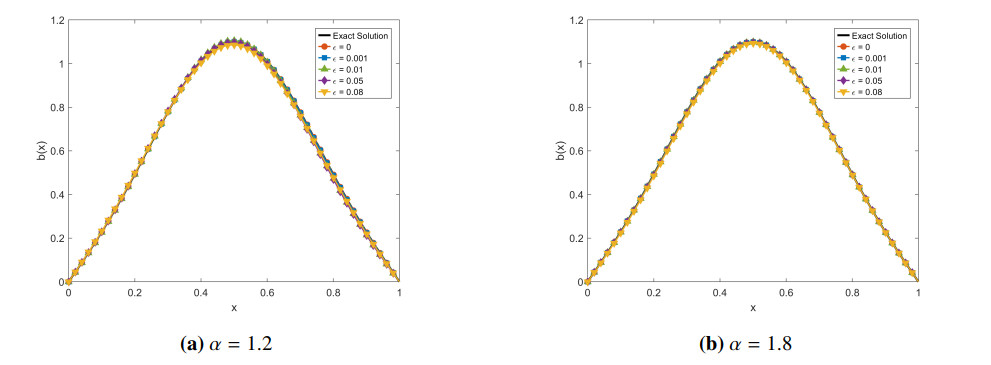
Numerical reconstructions for Example 1 under various noise levels with $ \alpha = 1.2 $ and $ \alpha = 1.8 $
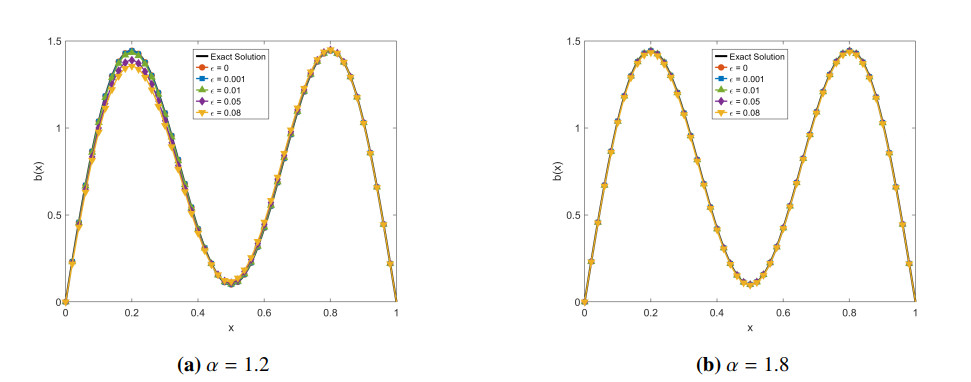
Numerical reconstructions for Example 2 under various noise levels with $ \alpha = 1.2 $ and $ \alpha = 1.8 $
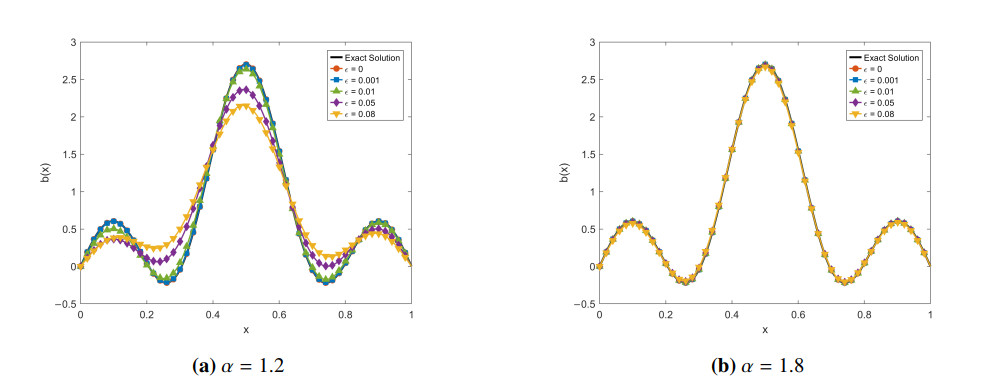
Numerical reconstructions for Example 3 under various noise levels with $ \alpha = 1.2 $ and $ \alpha = 1.8 $
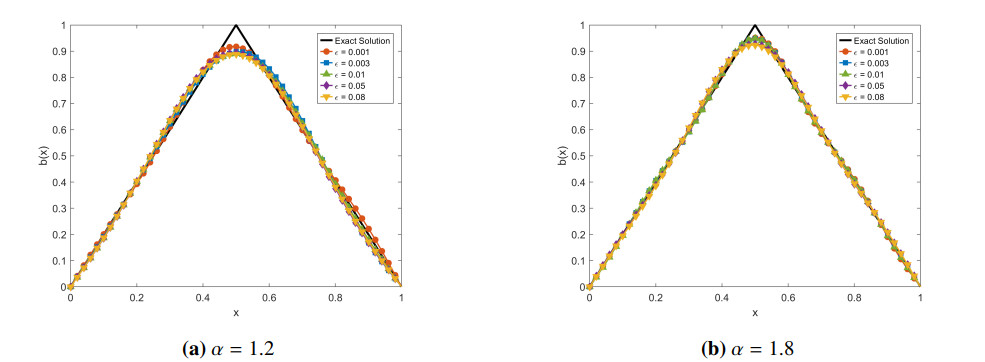
Numerical reconstructions for Example 4 under various noise levels with $ \alpha = 1.2 $ and $ \alpha = 1.8 $
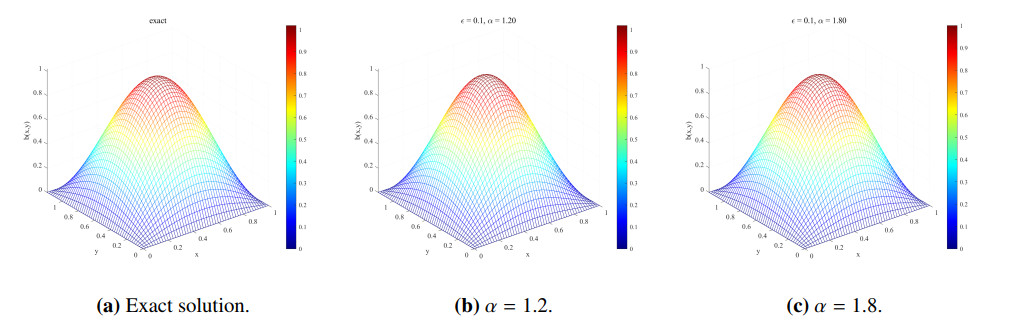
Exact and numerical solutions for Example 5
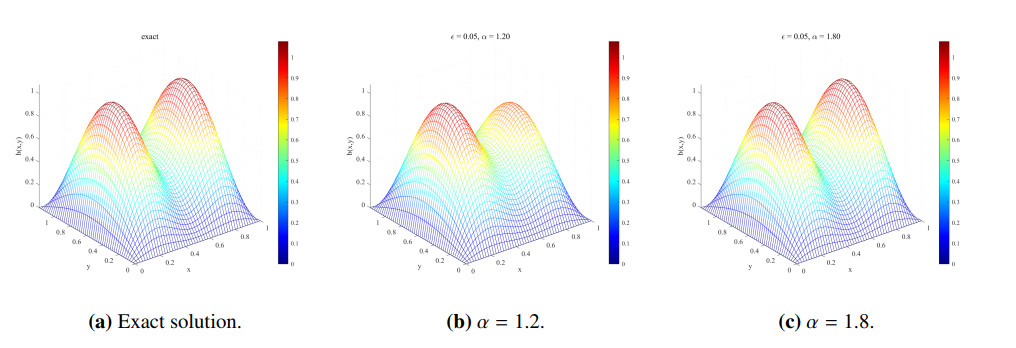
Exact and numerical solutions for Example 6




 DownLoad: