Threshold-based pest management produces discontinuous dynamics in which both pest density and natural-enemy abundance determine the active control regime. We investigated how fear induced by natural enemies affects equilibria and sliding transitions in a two-threshold Filippov pest–natural-enemy model incorporating a strong Allee effect. Two analytical reductions characterize the influence of fear. In the no-control and reduced-dose regimes, the Jacobian trace at a positive equilibrium admits a factorization whose numerator is independent of the fear intensity. Consequently, away from the degenerate case, varying fear does not change the local stability of these equilibria or induce a Hopf bifurcation within either smooth regime. In the pesticide-and-release regime, equilibrium existence, multiplicity, and determinant sign are characterized by a scalar level function. A Sturm sequence certifies exactly two equilibria for the baseline parameters, one stable and one saddle. Under the stated existence condition, these equilibria persist up to a unique terminal fear threshold, although the associated tangency need not be unique. On the horizontal switching manifold, the pseudo-equilibrium moves monotonically under suitable conditions and undergoes a boundary-equilibrium collision with the reduced-dose equilibrium. Numerical simulations support the analytical thresholds and illustrate distinct terminal outcomes without establishing global basins. These results show that fear can reshape equilibrium admissibility and sliding dynamics even when smooth local stability remains unchanged. The fear factor also slows negative growth below the Allee threshold; the principal stability conclusions concern the region above that threshold and do not depend on this low-density behavior.
Citation: Chenxi Wang, Dan Jin, Ruizhi Yang. Fear effects on equilibrium and sliding transitions in a two-threshold Filippov pest–natural-enemy model[J]. Electronic Research Archive, 2027, 35(1): 100-133. doi: 10.3934/era.2027004
Threshold-based pest management produces discontinuous dynamics in which both pest density and natural-enemy abundance determine the active control regime. We investigated how fear induced by natural enemies affects equilibria and sliding transitions in a two-threshold Filippov pest–natural-enemy model incorporating a strong Allee effect. Two analytical reductions characterize the influence of fear. In the no-control and reduced-dose regimes, the Jacobian trace at a positive equilibrium admits a factorization whose numerator is independent of the fear intensity. Consequently, away from the degenerate case, varying fear does not change the local stability of these equilibria or induce a Hopf bifurcation within either smooth regime. In the pesticide-and-release regime, equilibrium existence, multiplicity, and determinant sign are characterized by a scalar level function. A Sturm sequence certifies exactly two equilibria for the baseline parameters, one stable and one saddle. Under the stated existence condition, these equilibria persist up to a unique terminal fear threshold, although the associated tangency need not be unique. On the horizontal switching manifold, the pseudo-equilibrium moves monotonically under suitable conditions and undergoes a boundary-equilibrium collision with the reduced-dose equilibrium. Numerical simulations support the analytical thresholds and illustrate distinct terminal outcomes without establishing global basins. These results show that fear can reshape equilibrium admissibility and sliding dynamics even when smooth local stability remains unchanged. The fear factor also slows negative growth below the Allee threshold; the principal stability conclusions concern the region above that threshold and do not depend on this low-density behavior.

| [1] |
A. F. Filippov, Differential Equations with Discontinuous Righthand Sides, Kluwer Academic Publishers, Dordrecht, 1988. https://doi.org/10.1007/978-94-015-7793-9 |
| [2] |
Y. A. Kuznetsov, S. Rinaldi, A. Gragnani, One-parameter bifurcations in planar Filippov systems, Int. J. Bifurcation Chaos, 13 (2003), 2157–2188. https://doi.org/10.1142/S0218127403007874 doi: 10.1142/S0218127403007874
|
| [3] |
M. di Bernardo, C. J. Budd, A. R. Champneys, P. Kowalczyk, A. B. Nordmark, G. Olivar Tost, et al., Bifurcations in nonsmooth dynamical systems, SIAM Rev., 50 (2008), 629–701. https://doi.org/10.1137/050625060 doi: 10.1137/050625060
|
| [4] |
K. S. Andrade, O. M. L. Gomide, D. D. Novaes, Bifurcation diagrams of global connections in Filippov systems, Nonlinear Anal. Hybrid Syst., 50 (2023), 101397. https://doi.org/10.1016/j.nahs.2023.101397 doi: 10.1016/j.nahs.2023.101397
|
| [5] |
D. J. W. Simpson, The stability of boundary equilibria of three-dimensional Filippov systems, Nonlinear Anal. Hybrid Syst., 62 (2026), 101785. https://doi.org/10.1016/j.nahs.2026.101785 doi: 10.1016/j.nahs.2026.101785
|
| [6] |
S. Tang, J. Liang, Y. Xiao, R. A. Cheke, Sliding bifurcations of Filippov two-stage pest control models with economic thresholds, SIAM J. Appl. Math., 72 (2012), 1061–1080. https://doi.org/10.1137/110847020 doi: 10.1137/110847020
|
| [7] |
Y. Zhang, Y. Xiao, Global dynamics for a Filippov epidemic system with imperfect vaccination, Nonlinear Anal. Hybrid Syst., 38 (2020), 100932. https://doi.org/10.1016/j.nahs.2020.100932 doi: 10.1016/j.nahs.2020.100932
|
| [8] |
H. Wang, Y. Xiao, C. Xiang, S. R. Smith, Classification of planar Filippov systems with a delayed threshold: applications to infectious disease transmission dynamics, Nonlinear Anal. Hybrid Syst., 61 (2026), 101711. https://doi.org/10.1016/j.nahs.2026.101711 doi: 10.1016/j.nahs.2026.101711
|
| [9] |
S. Tang, Y. Xiao, L. Chen, R. A. Cheke, Integrated pest management models and their dynamical behaviour, Bull. Math. Biol., 67 (2005), 115–135. https://doi.org/10.1016/j.bulm.2004.06.005 doi: 10.1016/j.bulm.2004.06.005
|
| [10] |
T. Zhao, Y. Xiao, R. J. Smith, Non-smooth plant disease models with economic thresholds, Math. Biosci., 241 (2013), 34–48. https://doi.org/10.1016/j.mbs.2012.09.005 doi: 10.1016/j.mbs.2012.09.005
|
| [11] |
B. Kang, X. Hou, B. Liu, Threshold control strategy for a Filippov model with group defense of pests and a constant-rate release of natural enemies, Math. Biosci. Eng., 20 (2023), 12076–12092. https://doi.org/10.3934/mbe.2023537 doi: 10.3934/mbe.2023537
|
| [12] |
W. Li, Y. Chen, L. Huang, J. Wang, Global dynamics of a Filippov predator–prey model with two thresholds for integrated pest management, Chaos Solitons Fractals, 157 (2022), 111881. https://doi.org/10.1016/j.chaos.2022.111881 doi: 10.1016/j.chaos.2022.111881
|
| [13] |
L. Y. Zanette, A. F. White, M. C. Allen, M. Clinchy, Perceived predation risk reduces the number of offspring songbirds produce per year, Science, 334 (2011), 1398–1401. https://doi.org/10.1126/science.1210908 doi: 10.1126/science.1210908
|
| [14] |
X. Wang, L. Zanette, X. Zou, Modelling the fear effect in predator–prey interactions, J. Math. Biol., 73 (2016), 1179–1204. https://doi.org/10.1007/s00285-016-0989-1 doi: 10.1007/s00285-016-0989-1
|
| [15] |
M. Hu, C. Xiang, B. Chu, Dynamic behaviors and bifurcation analysis of a three-dimensional Filippov ecosystem with fear effect, Math. Methods Appl. Sci., 48 (2025), 6607–6623. https://doi.org/10.1002/mma.10699 doi: 10.1002/mma.10699
|
| [16] |
P. Panday, N. Pal, S. Samanta, J. Chattopadhyay, Stability and bifurcation analysis of a three-species food chain model with fear, Int. J. Bifurcation Chaos, 28 (2018), 1850009. https://doi.org/10.1142/S0218127418500098 doi: 10.1142/S0218127418500098
|
| [17] |
A. Janssen, P. C. J. van Rijn, Pesticides do not significantly reduce arthropod pest densities in the presence of natural enemies, Ecol. Lett., 24 (2021), 2010–2024. https://doi.org/10.1111/ele.13819 doi: 10.1111/ele.13819
|
| [18] |
F. Wang, R. Yang, X. Zhang, Turing patterns in a predator–prey model with double Allee effect, Math. Comput. Simul., 220 (2024), 170–191. https://doi.org/10.1016/j.matcom.2024.01.015 doi: 10.1016/j.matcom.2024.01.015
|
| [19] |
X. Kong, R. Yang, Dynamics analysis of a Filippov Lymantria dispar–Great tit model with double Allee effects and two-thresholds control, Math. Comput. Simul., 246 (2026), 25–43. https://doi.org/10.1016/j.matcom.2026.01.028 doi: 10.1016/j.matcom.2026.01.028
|
| [20] |
A. M. Liebhold, P. C. Tobin, Population ecology of insect invasions and their management, Annu. Rev. Entomol., 53 (2008), 387–408. https://doi.org/10.1146/annurev.ento.52.110405.091401 doi: 10.1146/annurev.ento.52.110405.091401
|
| [21] |
P. C. Tobin, L. Berec, A. M. Liebhold, Exploiting Allee effects for managing biological invasions, Ecol. Lett., 14 (2011), 615–624. https://doi.org/10.1111/j.1461-0248.2011.01614.x doi: 10.1111/j.1461-0248.2011.01614.x
|
| [22] |
J. L. Rocha, A. K. Taha, D. Fournier-Prunaret, Transcritical and Neimark–Sacker bifurcations of a discrete predator–prey model of $\gamma$-Ricker type with double Allee effect in the prey population, Commun. Nonlinear Sci. Numer. Simul., 154 (2026), 109543. https://doi.org/10.1016/j.cnsns.2025.109543 doi: 10.1016/j.cnsns.2025.109543
|
| [23] |
D. S. Boukal, L. Berec, Single-species models of the Allee effect: extinction boundaries, sex ratios and mate encounters, J. Theor. Biol., 218 (2002), 375–394. https://doi.org/10.1006/jtbi.2002.3084 doi: 10.1006/jtbi.2002.3084
|
| [24] |
J. L. Rocha, D. Fournier-Prunaret, A. K. Taha, Strong and weak Allee effects and chaotic dynamics in Richards' growths, Discrete Contin. Dyn. Syst. Ser. B, 18 (2013), 2397–2425. https://doi.org/10.3934/dcdsb.2013.18.2397 doi: 10.3934/dcdsb.2013.18.2397
|
| [25] |
A. A. Arafa, S. A. A. Hamdallah, S. Tang, Y. Xu, G. M. Mahmoud, Dynamics analysis of a Filippov pest control model with time delay, Commun. Nonlinear Sci. Numer. Simul., 101 (2021), 105865. https://doi.org/10.1016/j.cnsns.2021.105865 doi: 10.1016/j.cnsns.2021.105865
|
| [26] |
H. Wang, Y. Yang, Dynamics analysis of a non-smooth Filippov pest–natural enemy system with time delay, Nonlinear Dyn., 111 (2023), 9681–9698. https://doi.org/10.1007/s11071-023-08332-x doi: 10.1007/s11071-023-08332-x
|
| [27] |
Y. Liu, Y. Yang, Dynamics and bifurcation analysis of a delay non-smooth Filippov Leslie–Gower prey–predator model, Nonlinear Dyn., 111 (2023), 18541–18557. https://doi.org/10.1007/s11071-023-08789-w doi: 10.1007/s11071-023-08789-w
|
| [28] |
X. Zhang, S. Tang, Existence of multiple sliding segments and bifurcation analysis of Filippov prey–predator model, Appl. Math. Comput., 239 (2014), 265–284. https://doi.org/10.1016/j.amc.2014.04.098 doi: 10.1016/j.amc.2014.04.098
|
| [29] |
W. Li, Bifurcation analysis of a Filippov predator–prey model with two thresholds, Nonlinear Dyn., 112 (2024), 9639–9656. https://doi.org/10.1007/s11071-024-09527-6 doi: 10.1007/s11071-024-09527-6
|
| [30] |
S. A. A. Hamdallah, A. A. Arafa, Stability analysis of Filippov prey–predator model with fear effect and prey refuge, J. Appl. Math. Comput., 70 (2024), 73–102. https://doi.org/10.1007/s12190-023-01934-z doi: 10.1007/s12190-023-01934-z
|
| [31] |
W. Sun, Z. Xiang, Dynamical analysis of a Filippov pest–natural enemy model incorporating fear and prey refuge, Electron. Res. Arch., 34 (2026), 7362–7391. https://doi.org/10.3934/era.2026318 doi: 10.3934/era.2026318
|
| [32] |
L. Huang, W. Qin, S. Chen, Non-smooth dynamics of a Filippov predator–prey ecological model with antipredator behavior, Adv. Contin. Discrete Models, 2024 (2024), 13. https://doi.org/10.1186/s13662-024-03808-5 doi: 10.1186/s13662-024-03808-5
|
| [33] |
X. Jiao, L. Liu, X. Yu, Rich dynamics of a reaction–diffusion Filippov Leslie–Gower predator–prey model with time delay and discontinuous harvesting, Math. Comput. Simul., 228 (2025), 339–361. https://doi.org/10.1016/j.matcom.2024.09.022 doi: 10.1016/j.matcom.2024.09.022
|
| [34] |
J. Lv, J. Li, The delayed reaction–diffusion Filippov system with threshold control: modeling and analysis of plateau pika–vegetation dynamics, Commun. Nonlinear Sci. Numer. Simul., 152 (2026), 109366. https://doi.org/10.1016/j.cnsns.2025.109366 doi: 10.1016/j.cnsns.2025.109366
|
| [35] |
Z. Zhang, R. Yang, Dynamical analysis of a reaction–diffusion Filippov food chain model with threshold control, Physica D, 496 (2026), 135325. https://doi.org/10.1016/j.physd.2026.135325 doi: 10.1016/j.physd.2026.135325
|
| [36] |
P. Miao, J. Duan, D. Li, J. Xie, C. Grebogi, Existence and destruction of tori in a discontinuous oscillator under quasi-periodic excitations, Physica D, 481 (2025), 134804. https://doi.org/10.1016/j.physd.2025.134804 doi: 10.1016/j.physd.2025.134804
|
| [37] |
J. Duan, Z. Wei, D. Li, H. Su, C. Grebogi, Symbolic dynamics for a kinds of piecewise smooth maps, Discrete Contin. Dyn. Syst. Ser. S, 17 (2024), 2778–2787. https://doi.org/10.3934/dcdss.2024042 doi: 10.3934/dcdss.2024042
|
| [38] |
J. Duan, Z. Wei, G. Li, D. Li, C. Grebogi, Strange nonchaotic attractors in a class of quasiperiodically forced piecewise smooth systems, Nonlinear Dyn., 112 (2024), 12565–12577. https://doi.org/10.1007/s11071-024-09678-6 doi: 10.1007/s11071-024-09678-6
|
Figures(10) / Tables(10)
Chenxi Wang, Dan Jin, Ruizhi Yang. Fear effects on equilibrium and sliding transitions in a two-threshold Filippov pest–natural-enemy model[J]. Electronic Research Archive, 2027, 35(1): 100-133. doi: 10.3934/era.2027004

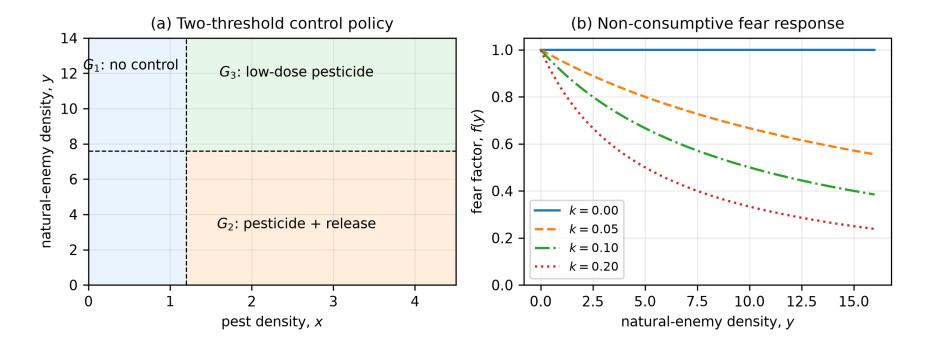
(a) Two-threshold control regions and the three active vector fields. (b) The decreasing fear factor $f(y) = 1/(1+ky)$ for several values of the fear intensity
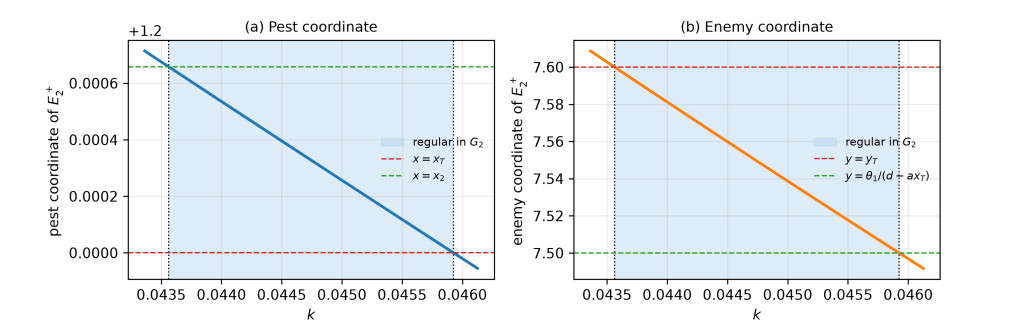
Regular window of the upper $F_2$ equilibrium for the baseline parameters. (a) The pest coordinate decreases from the horizontal switching boundary to the vertical switching boundary. (b) The enemy coordinate decreases from $y_T$ to $\theta_1/(d-a\, x_T)$. The shaded interval marks the values of $k$ for which the upper root lies in $G_2$
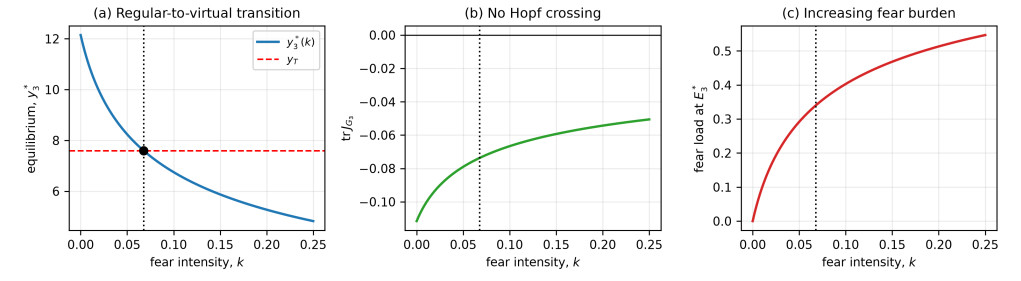
Fear changes the $G_3$ equilibrium. (a) $y_3^*(k)$ decreases and reaches $y_T$ at $k_c\approx0.0676$. (b) The trace remains negative over the displayed interval, consistent with (3.10). (c) The fear load $L_3^*(k)$ increases with $k$
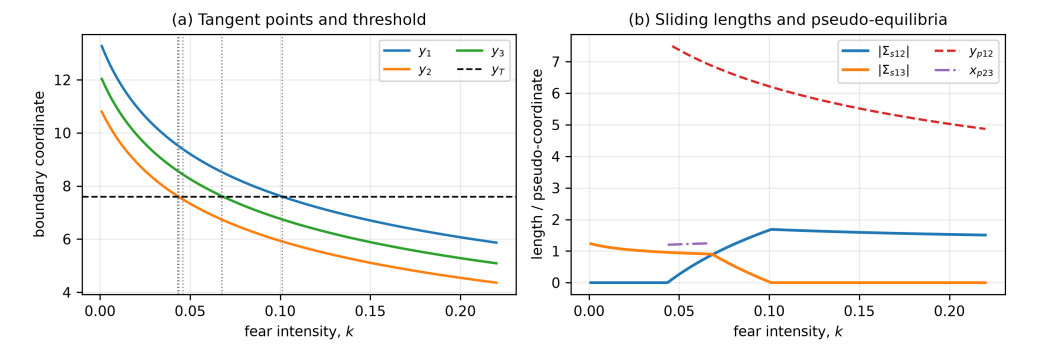
Fear dependence of the sliding geometry. (a) The tangent coordinates $y_1, y_2, y_3$ decrease with $k$. (b) Lengths of the vertical sliding intervals and the admissible pseudo-coordinates. The $\Sigma_{23}$ pseudo-equilibrium is an interior point of the sliding interval only between $k_{23}^{\mathrm{left}}$ and $k_c$
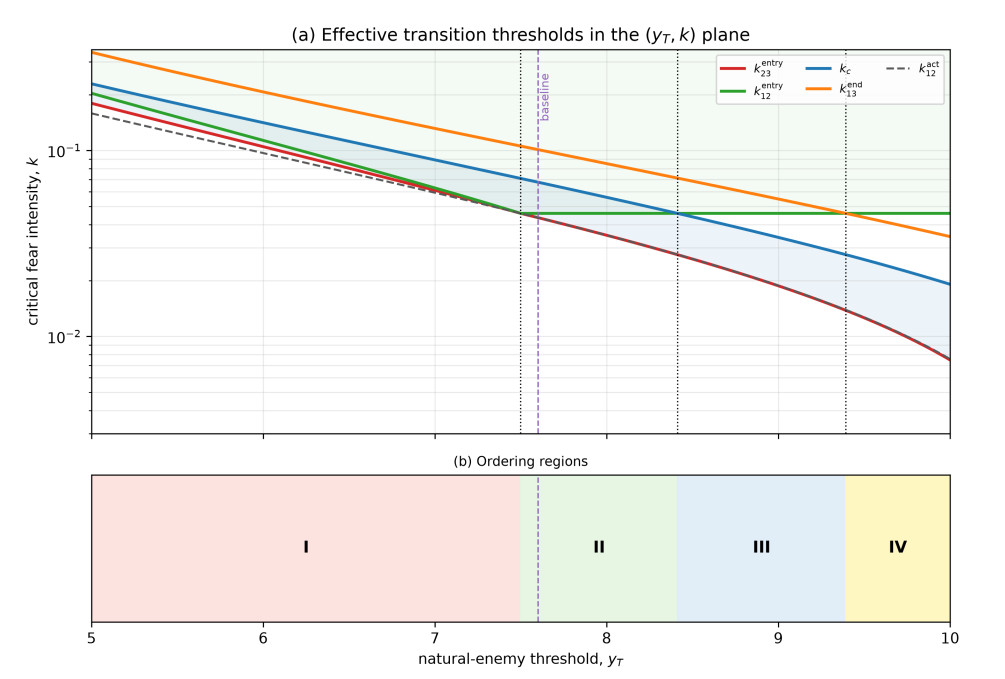
Numerically identified ordering regions for the baseline parameters and $5\le y_T\le10$. (a) Effective entry thresholds $k_{12}^{\mathrm{entry}}$, $k_{23}^{\mathrm{entry}}$, the boundary value $k_c$, the $\Sigma_{13}$ endpoint $k_{13}^{\mathrm{end}}$, and the sliding activation value $k_{12}^{\mathrm{act}}$. The shaded band shows the interior interval of $P_{23}$. (b) The scan indicates four regions separated by $y_T\approx7.5$, $8.412736$, and $9.392716$. The baseline is $y_T = 7.6$. The first boundary, $y_T = 7.5$, follows analytically from $x_2 = x_T$; the other two boundaries are numerical estimates
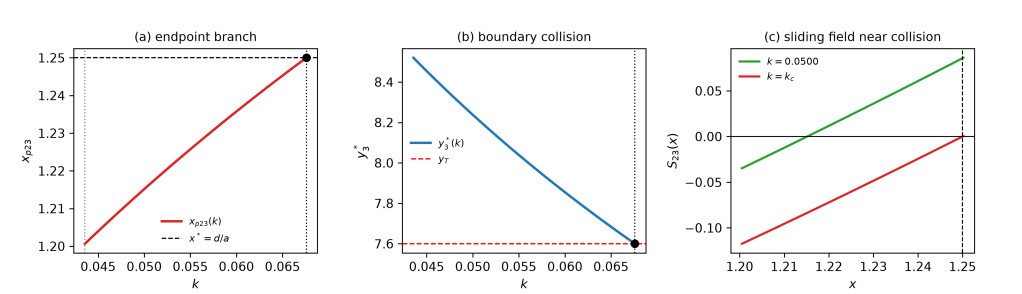
Endpoint collision on $\Sigma_{23}$
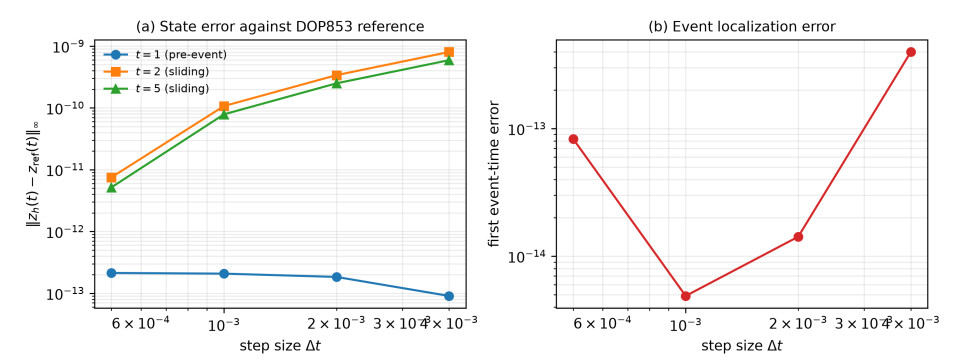
State and event-time errors against a high-accuracy MATLAB integration of the same equations
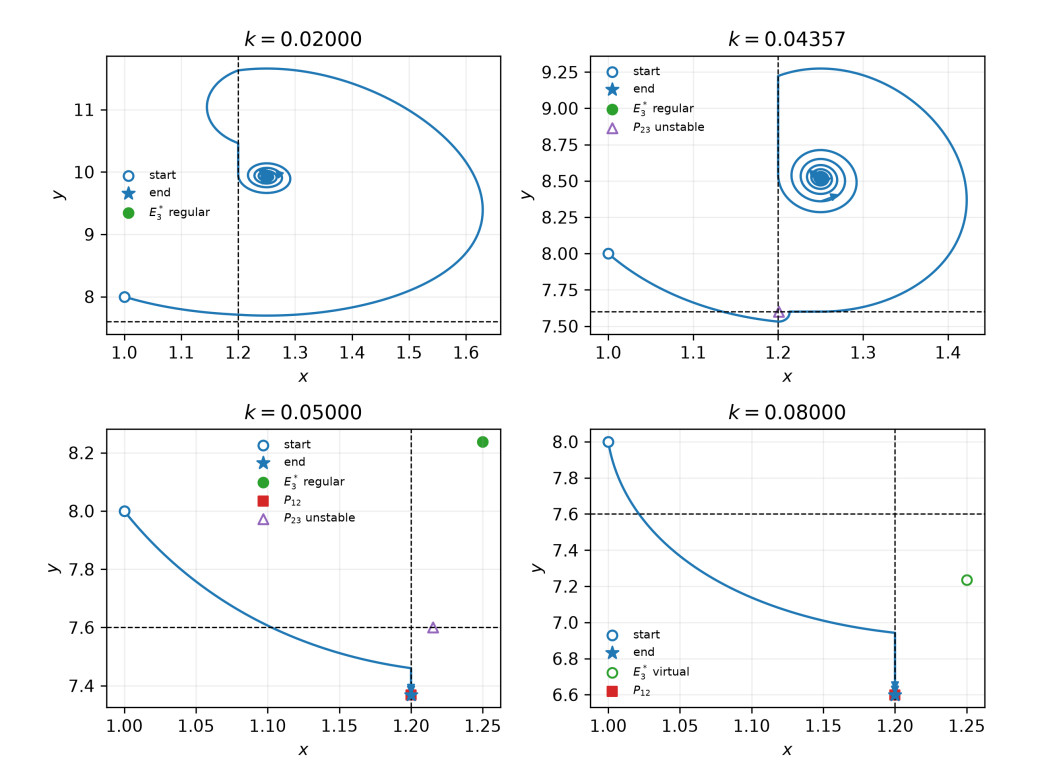
Representative trajectories from $(x_0, y_0) = (1, 8)$ over $0\le t\le100$. Time increases along each trajectory. Open circles mark the initial state, stars mark the terminal state, and arrows show the direction of motion. Filled equilibrium symbols denote regular states; open symbols denote virtual states. The threshold lines are $x = x_T$ and $y = y_T$. The panels show trajectories ending near $E_3^*$ or the attracting $\Sigma_{12}$ pseudo-equilibrium. When $k>k_c$, $E_3^*$ is virtual and is shown only as a reference point
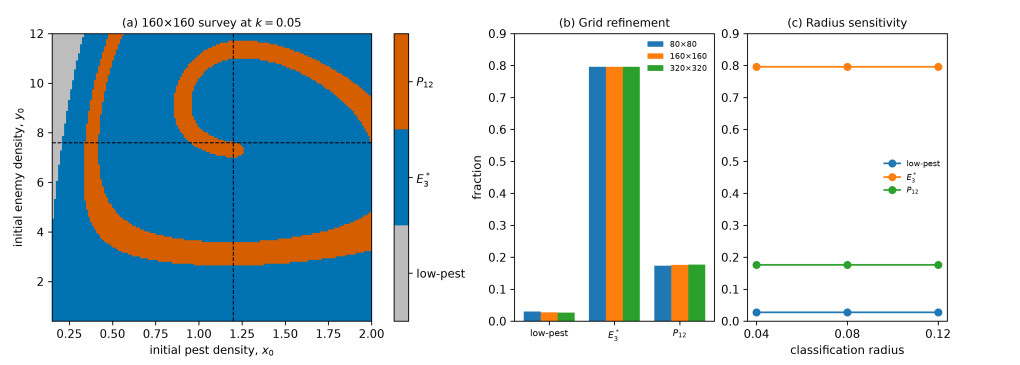
(a) Finite-grid outcome survey at $k = 0.05$ on a $160\, \times\, 160$ grid. (b) Fractions on $80\, \times\, 80$, $160\, \times\, 160$, and $320\, \times\, 320$ grids. (c) Sensitivity to the classification radius. The panel reports terminal-state categories under the rule in the text
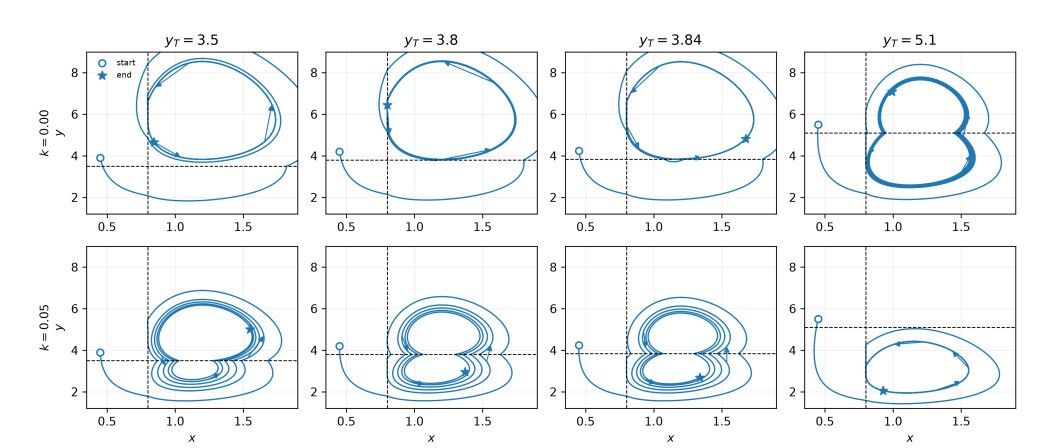
Trajectories in the secondary scenario over $0\le t\le100$. Top row: $k = 0$. Bottom row: $k = 0.05$. Columns: $y_T = 3.5, 3.8, 3.84, 5.1$. Time increases along each trajectory; open circles mark the initial state, stars mark the terminal state, and arrows show the direction of motion. Dashed lines mark the switching thresholds. Periodic orbits are not classified




 DownLoad: