In this paper, three structure-preserving global bidiagonalization algorithms are presented for solving large-scale quaternion linear systems with multiple right-hand sides, namely the global quaternion least-squares QR algorithm (Gl-QLSQR), the global quaternion residual-reducing least-squares QR algorithm (Gl-QRRLSQR), and the global quaternion oblique projection algorithm (Gl-QLSOR). All three algorithms are based on the Golub–Kahan–Lanczos bidiagonalization theory, by which the original quaternion matrix is reduced to lower bidiagonal form, and a concise recursive formula is derived to generate the sequence of approximate solutions $ \{X_k\} $. All matrix–matrix products and inner products are carried out on the first block column of the real representation, so that the full real counterpart is never formed, which theoretically reduces the arithmetic cost by about three quarters. We also present the convergence analysis of the proposed methods and show the applicability of all three methods to the quaternion Sylvester matrix equation. Numerical experiments on quaternion least-squares problems and color image deblurring problems validate the feasibility and effectiveness of the proposed algorithms.
Citation: Jingwen Liu, Shuyang Chen, Hongxiu Zhong. Global bidiagonalization algorithms for quaternion linear systems with multiple right-hand sides[J]. Electronic Research Archive, 2027, 35(1): 45-68. doi: 10.3934/era.2027002
In this paper, three structure-preserving global bidiagonalization algorithms are presented for solving large-scale quaternion linear systems with multiple right-hand sides, namely the global quaternion least-squares QR algorithm (Gl-QLSQR), the global quaternion residual-reducing least-squares QR algorithm (Gl-QRRLSQR), and the global quaternion oblique projection algorithm (Gl-QLSOR). All three algorithms are based on the Golub–Kahan–Lanczos bidiagonalization theory, by which the original quaternion matrix is reduced to lower bidiagonal form, and a concise recursive formula is derived to generate the sequence of approximate solutions $ \{X_k\} $. All matrix–matrix products and inner products are carried out on the first block column of the real representation, so that the full real counterpart is never formed, which theoretically reduces the arithmetic cost by about three quarters. We also present the convergence analysis of the proposed methods and show the applicability of all three methods to the quaternion Sylvester matrix equation. Numerical experiments on quaternion least-squares problems and color image deblurring problems validate the feasibility and effectiveness of the proposed algorithms.

| [1] |
W. R. Hamilton, Elements of Quaternions, Longmans, Green, and Company, 1866. |
| [2] |
L. Rodman, Topics in Quaternion Linear Algebra, Princeton University Press, 2014. |
| [3] |
Z. Jia, M. K. Ng, G. Song, Lanczos method for large-scale quaternion singular value decomposition, Numerical Algorithms, 82 (2019), 699–717. https://doi.org/10.1007/s11075-018-0621-0 doi: 10.1007/s11075-018-0621-0
|
| [4] |
F. Zhang, M. Wei, Y. Li, J. Zhao, Special least squares solutions of the quaternion matrix equation $AX = B$ with applications, Appl. Math. Comput., 270 (2015), 425–433. https://doi.org/10.1016/j.amc.2015.08.046 doi: 10.1016/j.amc.2015.08.046
|
| [5] |
P. Ginzberg, Quaternion Matrices: Statistical Properties and Applications to Signal Processing and Wavelets, Ph.D. thesis, Imperial College London, 2013. |
| [6] |
S. L. Adler, Quaternionic Quantum Mechanics and Quantum Fields, Oxford University Press, 1995. |
| [7] |
Y. Guan, M. T. Chu, D. Chu, SVD-based algorithms for the best rank-1 approximation of a symmetric tensor, SIAM J. Matrix Anal. Appl., 39 (2018), 1095–1115. https://doi.org/10.1137/17M1136699 doi: 10.1137/17M1136699
|
| [8] |
Z. Jia, M. K. Ng, G. Song, Robust quaternion matrix completion with applications to image inpainting, Numer. Linear Algebra Appl., 26 (2019), e2245. https://doi.org/10.1002/nla.2245 doi: 10.1002/nla.2245
|
| [9] |
G. Fan, H. Zhong, Block Golub–Kahan–Lanczos algorithms for quaternion singular value decomposition, Numerical Algorithms, (2026), 1–20. https://doi.org/10.1007/s11075-026-02320-z |
| [10] |
L. Guo, M. Zhu, X. Ge, Reduced biquaternion canonical transform, convolution and correlation, Signal Process., 91 (2011), 2147–2153. https://doi.org/10.1016/j.sigpro.2011.03.017 doi: 10.1016/j.sigpro.2011.03.017
|
| [11] |
T. Isokawa, H. Nishimura, N. Matsui, Commutative quaternion and multistate Hopfield neural networks, in The 2010 International Joint Conference on Neural Networks (IJCNN), IEEE, (2010), 1–6. https://doi.org/10.1109/IJCNN.2010.5596736 |
| [12] |
A. El Guennouni, K. Jbilou, H. Sadok, The block Lanczos method for linear systems with multiple right-hand sides, Appl. Numer. Math., 51 (2004), 243–256. https://doi.org/10.1016/j.apnum.2004.04.001 doi: 10.1016/j.apnum.2004.04.001
|
| [13] |
V. Simoncini, E. Gallopoulos, Convergence properties of block GMRES and matrix polynomials, Linear Algebra Appl., 247 (1996), 97–119. https://doi.org/10.1016/0024-3795(95)00093-3 doi: 10.1016/0024-3795(95)00093-3
|
| [14] |
R. W. Freund, M. Malhotra, A block QMR algorithm for non-Hermitian linear systems with multiple right-hand sides, Linear Algebra Appl., 254 (1997), 119–157. https://doi.org/10.1016/S0024-3795(96)00529-0 doi: 10.1016/S0024-3795(96)00529-0
|
| [15] |
K. Jbilou, A. Messaoudi, H. Sadok, Global FOM and GMRES algorithms for matrix equations, Appl. Numer. Math., 31 (1999), 49–63. https://doi.org/10.1016/S0168-9274(98)00094-4 doi: 10.1016/S0168-9274(98)00094-4
|
| [16] |
Z. Jia, M. K. Ng, Structure preserving quaternion generalized minimal residual method, SIAM J. Matrix Anal. Appl., 42 (2021), 616–634. https://doi.org/10.1137/20M133751X doi: 10.1137/20M133751X
|
| [17] |
T. Li, Q. Wang, Structure preserving quaternion full orthogonalization method with applications, Numer. Linear Algebra Appl., 30 (2023), e2495. https://doi.org/10.1002/nla.2495 doi: 10.1002/nla.2495
|
| [18] |
T. Li, Q. Wang, X. Zhang, Gl-QFOM and Gl-QGMRES: two efficient algorithms for quaternion linear systems with multiple right-hand sides, Numer. Linear Algebra Appl., 32 (2025), e70008. https://doi.org/10.1002/nla.70008 doi: 10.1002/nla.70008
|
| [19] |
M. Wang, Algorithm Q-LSQR for the least squares problem in quaternionic quantum theory, Comput. Phys. Commun., 181 (2010), 1047–1050. https://doi.org/10.1016/j.cpc.2010.02.011 doi: 10.1016/j.cpc.2010.02.011
|
| [20] |
S. Ling, Z. Jia, Matrix iterative algorithms for least-squares problem in quaternionic quantum theory, Int. J. Comput. Math., 90 (2013), 727–745. https://doi.org/10.1080/00207160.2012.739684 doi: 10.1080/00207160.2012.739684
|
| [21] |
F. Toutounian, S. Karimi, Global least squares method (Gl-LSQR) for solving general linear systems with several right-hand sides, Appl. Math. Comput., 178 (2006), 452–460. https://doi.org/10.1016/j.amc.2005.11.065 doi: 10.1016/j.amc.2005.11.065
|
| [22] |
G. Golub, W. Kahan, Calculating the singular values and pseudo-inverse of a matrix, J. Soc. Ind. Appl. Math. Ser. B, 2 (1965), 205–224. https://doi.org/10.1137/0702016 doi: 10.1137/0702016
|
| [23] |
M. Wei, Y. Li, F. Zhang, J. Zhao, Quaternion Matrix Computations, Nova Science Publishers, 2018. |
| [24] |
Y. Saad, Iterative Methods for Sparse Linear Systems, SIAM, 2003. |
| [25] |
C. C. Paige, M. A. Saunders, LSQR: an algorithm for sparse linear equations and sparse least squares, ACM Trans. Math. Software, 8 (1982), 43–71. https://doi.org/10.1145/355984.355989 doi: 10.1145/355984.355989
|
| [26] |
Z. He, Q. Wang, Y. Zhang, A system of quaternary coupled Sylvester-type real quaternion matrix equations, Automatica, 87 (2018), 25–31. https://doi.org/10.1016/j.automatica.2017.09.008 doi: 10.1016/j.automatica.2017.09.008
|
| [27] |
T. A. Davis, Y. Hu, The University of Florida sparse matrix collection, ACM Trans. Math. Software, 38 (2011), 1–25. https://doi.org/10.1145/2049662.2049663 doi: 10.1145/2049662.2049663
|
| [28] |
Z. Wang, A. C. Bovik, H. R. Sheikh, E. P. Simoncelli, Image quality assessment: from error visibility to structural similarity, IEEE Trans. Image Process., 13 (2004), 600–612. https://doi.org/10.1109/TIP.2003.819861 doi: 10.1109/TIP.2003.819861
|
| [29] |
A. Bouhamidi, R. Enkhbat, K. Jbilou, Conditional gradient Tikhonov method for a convex optimization problem in image restoration, J. Comput. Appl. Math., 255 (2014), 580–592. https://doi.org/10.1016/j.cam.2013.06.011 doi: 10.1016/j.cam.2013.06.011
|
| [30] |
J. Li, W. Li, R. Huang, An efficient method for solving a matrix least squares problem over a matrix inequality constraint, Comput. Optim. Appl., 63 (2016), 393–423. https://doi.org/10.1007/s10589-015-9783-z doi: 10.1007/s10589-015-9783-z
|
Figures(3) / Tables(6)
Jingwen Liu, Shuyang Chen, Hongxiu Zhong. Global bidiagonalization algorithms for quaternion linear systems with multiple right-hand sides[J]. Electronic Research Archive, 2027, 35(1): 45-68. doi: 10.3934/era.2027002

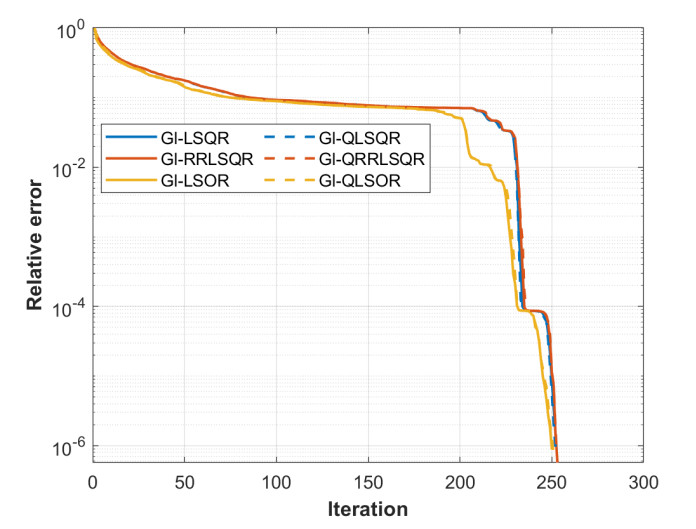
Convergence curves of Example 5.1 with BCSPWR03
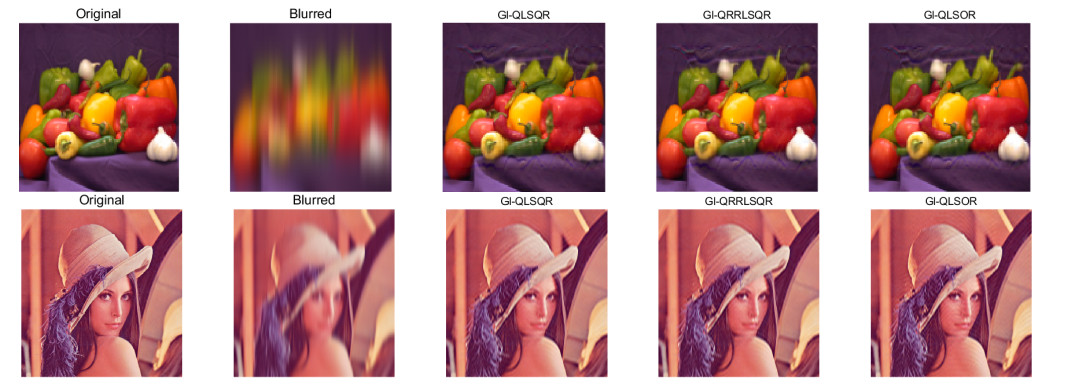
Left to right: The original images, blurred images, and deblurred images obtained by Gl-QLSQR, Gl-QRRLSQR, and Gl-QLSOR, respectively
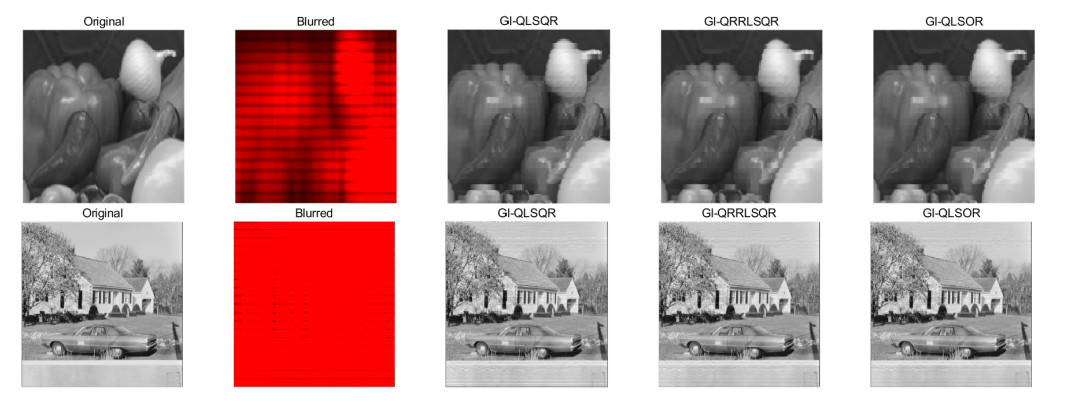
Left to right: The original images, blurred images, and deblurred images obtained by Gl-QLSQR, Gl-QRRLSQR, and Gl-QLSOR, respectively




 DownLoad: