Financial microservices database systems need the transactional guarantees of the relational database, but at the same time, they should ensure the low latency of real-time services. A typical way to resolve such issues is developing a hybrid database model that integrates an in-memory database to compliment the relational database. In many cases, the level of performance increase is neither precisely estimated, nor is the mechanism of this increase explained. This research article examined both issues for a transaction-based microservice running on Amazon elastic container service by comparing the performance between the PostgreSQL-only database setup and the hybrid PostgreSQL + Redis database setup. Both setups were tested under closed user load of 5, 20, and 50 concurrent users generated with Locust. A unified performance model with normalized throughput, mean response time, and failure rate is introduced. The hybrid setup achieved high-performance at all load levels including the highest load of 50 concurrent users. At 50 concurrent users, the throughput grown from 20.37 RPS to 23.40 RPS, and mean response time drops from 469.99 ms to 158.48 ms, while the failure rate is reduced sixfold, from 0.13% to 0.02%. Although the percentile analysis resulted in recurring tail latency jumps in both PostgreSQL-only and hybrid setups, these were less pronounced in the case of the hybrid setup. The analysis of failures proves that PostgreSQL-only failures are caused by connection pool overflow. Using Little's Law, the mean connection demand was calculated to be 9.6 connections for PostgreSQL-only against 3.7 connections for the hybrid, and 48% against 19% for the pool maximum. The research findings prove that PostgreSQL-only mean connection time decreased through the integrated cache in the hybrid setup, which increases financial microservices database systems performance and overall FinTech solutions capability.
Citation: Hisham AbouGrad, Emmanuel Iyahen. Hybrid database for cloud microservice architecture to enhance real-time financial technology systems' performance[J]. Electronic Research Archive, 2026, 34(12): 9462-9484. doi: 10.3934/era.2026397
Financial microservices database systems need the transactional guarantees of the relational database, but at the same time, they should ensure the low latency of real-time services. A typical way to resolve such issues is developing a hybrid database model that integrates an in-memory database to compliment the relational database. In many cases, the level of performance increase is neither precisely estimated, nor is the mechanism of this increase explained. This research article examined both issues for a transaction-based microservice running on Amazon elastic container service by comparing the performance between the PostgreSQL-only database setup and the hybrid PostgreSQL + Redis database setup. Both setups were tested under closed user load of 5, 20, and 50 concurrent users generated with Locust. A unified performance model with normalized throughput, mean response time, and failure rate is introduced. The hybrid setup achieved high-performance at all load levels including the highest load of 50 concurrent users. At 50 concurrent users, the throughput grown from 20.37 RPS to 23.40 RPS, and mean response time drops from 469.99 ms to 158.48 ms, while the failure rate is reduced sixfold, from 0.13% to 0.02%. Although the percentile analysis resulted in recurring tail latency jumps in both PostgreSQL-only and hybrid setups, these were less pronounced in the case of the hybrid setup. The analysis of failures proves that PostgreSQL-only failures are caused by connection pool overflow. Using Little's Law, the mean connection demand was calculated to be 9.6 connections for PostgreSQL-only against 3.7 connections for the hybrid, and 48% against 19% for the pool maximum. The research findings prove that PostgreSQL-only mean connection time decreased through the integrated cache in the hybrid setup, which increases financial microservices database systems performance and overall FinTech solutions capability.

| [1] |
G. Kou, Y. Lu, FinTech: A literature review of emerging financial technologies and applications, Financ. Innovation, 11 (2025), 1. https://doi.org/10.1186/s40854-024-00668-6 doi: 10.1186/s40854-024-00668-6
|
| [2] |
J. Thönes, Microservices, IEEE software, 32 (2015), 116. https://doi.org/10.1109/MS.2015.11 doi: 10.1109/MS.2015.11
|
| [3] |
M. Soni, V. Jyotinagar, SQL vs NoSQL databases for microservices: A comparative survey, in 2023 2nd International Conference on Edge Computing and Applications (ICECAA), (2023), 17–22. https://doi.org/10.1109/ICECAA58104.2023.10212190 |
| [4] |
R. Laigner, Y. Zhou, M. A. Vaz Salles, Y. Liu, M. Kalinowski, Data management in microservices: State of the practice, challenges, and research directions, in Proceedings of the VLDB Endowment, 14 (2021), 3348–3361. https://doi.org/10.14778/3484224.3484232 doi: 10.14778/3484224.3484232
|
| [5] |
D. Mahajan, C. Blakeney, Z. Zong, Improving the energy efficiency of relational and NoSQL databases via query optimizations, Sustainable Comput. Inf. Syst., 22 (2019), 120–133. https://doi.org/10.1016/j.suscom.2019.01.017 doi: 10.1016/j.suscom.2019.01.017
|
| [6] |
H. AbouGrad, E. Iyahen, S. Alsaid, Cloud-based hybrid-database architecture: Optimising FinTech real-time AWS elastic container microservices database system performance, in 6th International Mobile, Intelligent, and Ubiquitous Computing Conference (MIUCC-26), (2026), 1–6. |
| [7] |
N. Pantelic, L. Matic, L. Jakovljevic, S. Eric, M. Eric, M. Stefanović, et al., Benchmarking SQL and NoSQL persistence in microservices under variable workloads, Future Internet, 18 (2026), 53. https://doi.org/10.3390/fi18010053 doi: 10.3390/fi18010053
|
| [8] |
R. Cattell, Scalable SQL and NoSQL data stores, ACM SIGMOD Record, 39 (2011), 12–27. https://doi.org/10.1145/1978915.1978919 doi: 10.1145/1978915.1978919
|
| [9] |
R. Hecht, S. Jablonski, NoSQL evaluation: A use case oriented survey, in 2011 International Conference on Cloud and Service Computing, (2011), 336–341. https://doi.org/10.1109/CSC.2011.6138544 |
| [10] |
S. Ionescu, V. Diaconita, A. Radu, Engineering sustainable data architectures for modern financial institutions, Electronics, 14 (2025), 1650. https://doi.org/10.3390/electronics14081650 doi: 10.3390/electronics14081650
|
| [11] |
A. A. E. Alflahi, M. A. Y. Mohammed, A. Alsammani, A scalable transaction management framework for consistent document-oriented NoSQL databases, Inf. Syst., 140 (2026), 102719. https://doi.org/10.1016/j.is.2026.102719 doi: 10.1016/j.is.2026.102719
|
| [12] |
A. Rao, D. Khankhoje, U. Namdev, C. Bhadane, D. Dongre, Insights into NoSQL databases using financial data: A comparative analysis, Proc. Comput. Sci., 215 (2022), 8–23. https://doi.org/10.1016/j.procs.2022.12.002 doi: 10.1016/j.procs.2022.12.002
|
| [13] |
D. Jawale, S. Shelke, S. Yadav, Analyzing the impact of database architecture on performance: SQL vs NoSQL, Int. J. Math. Comput. Res., 14 (2026), 61–65. https://doi.org/10.47191/ijmcr/v14iSPC3.13 doi: 10.47191/ijmcr/v14iSPC3.13
|
| [14] |
A. E. Topcu, A. M. Rmis, Y. I. Alzoubi, A. O. Çibikdiken, D. Chowdhury, E. Elbasi, et al., Evaluating the performance of NoSQL databases for big data in cloud computing environments, HighTech Innovation J., 6 (2025), 808–830. https://doi.org/10.28991/HIJ-2025-06-03-05 doi: 10.28991/HIJ-2025-06-03-05
|
| [15] |
H. AbouGrad, A. Shabarshov, M. Yegamati, B. A. Romo, M. S. Sharif, Cloud databased contactless mobile payment system framework: An asymmetric encryption secured financial transactions model, Sci. J. Res. Rev., 4 (2026), 1–16. https://doi.org/10.33552/SJRR.2026.04.000600 doi: 10.33552/SJRR.2026.04.000600
|
| [16] |
A. K. Bayya, Data-driven predictive analytics and decision- making in fintech using MongoDB and high-throughput data pipelines, Int. J. Algorithms Design Anal. Rev., 3 (2025). |
| [17] |
N. Bagam, Implementing scalable data architecture for financial institutions, Stallion J. Multidiscip. Assoc. Res. Stud., 2 (2023), 27–40. https://doi.org/10.55544/sjmars.2.3.5 doi: 10.55544/sjmars.2.3.5
|
| [18] |
S. Ionescu, V. Diaconita, Transforming financial decision-making: The interplay of AI, cloud computing and advanced data management technologies, Int. J. Comput. Commun. Control, 18 (2023), 5735. https://doi.org/10.15837/ijccc.2023.6.5735 doi: 10.15837/ijccc.2023.6.5735
|
| [19] |
D. T. Absari, A. Djunaidy, T. D. Susanto, Design science research methodology concept and its application in the development of online community communication system for Selotapak Village, in 2022 9th International Conference on Information Technology, Computer, and Electrical Engineering (ICITACEE), (2022), 236–241. https://doi.org/10.1109/ICITACEE55701.2022.9924092 |
| [20] |
Locust, Locust Documentation, 2026. Available from: https://docs.locust.io/. |
| [21] |
A. T. Kabakus, R. Kara, A performance evaluation of in-memory databases, J. King Saud Univ. Comput. Inf. Sci., 29 (2017), 520–525. https://doi.org/10.1016/j.jksuci.2016.06.007 doi: 10.1016/j.jksuci.2016.06.007
|
| [22] |
Amazon Web Services, What is Amazon Elastic Container Service? 2026. Available from: https://docs.aws.amazon.com/AmazonECS/latest/developerguide/Welcome.html. |
| [23] |
Amazon Web Service, What is Amazon VPC? 2026. Available from: https://docs.aws.amazon.com/vpc/latest/userguide/what-is-amazon-vpc.html. |
| [24] |
Amazon Web Services, What is Amazon ElastiCache? 2026. Available from: https://docs.aws.amazon.com/AmazonElastiCache/latest/red-ug/WhatIs.html. |
| [25] |
J. D. C. Little, A proof for the queuing formula: L = λW, Oper. Res., 9 (1961), 383–387. https://doi.org/10.1287/opre.9.3.383 doi: 10.1287/opre.9.3.383
|
| [26] |
The PostgreSQL Global Development Group, WAL Configuration, 2026. Available from: https://www.postgresql.org/docs/current/wal-configuration.html. |
| [27] |
The PostgreSQL Global Development Group, Routine Vacuuming, 2026. Available from: https://www.postgresql.org/docs/current/routine-vacuuming.html#AUTOVACUUM. |



Figures(9) / Tables(6)
Hisham AbouGrad, Emmanuel Iyahen. Hybrid database for cloud microservice architecture to enhance real-time financial technology systems' performance[J]. Electronic Research Archive, 2026, 34(12): 9462-9484. doi: 10.3934/era.2026397

Overall HDB model's system architecture
RDBMS-only database setup and configurations
RDBMS with the Redis database setup and configurations
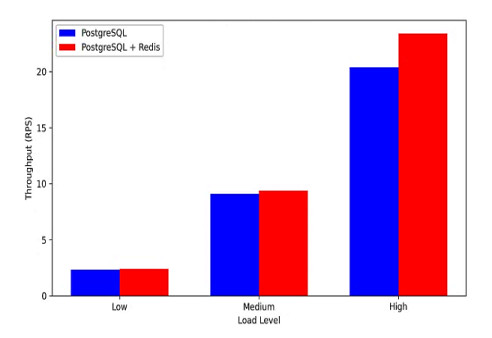
Throughput vs. Load
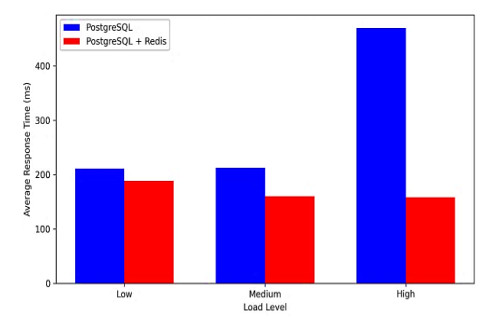
Response time vs. Load
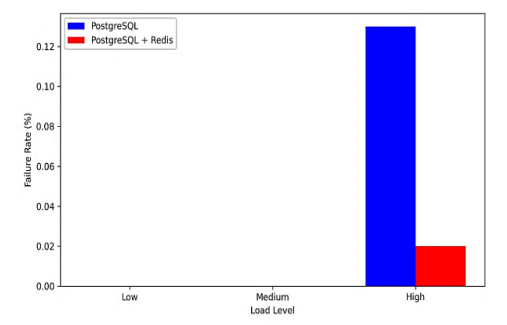
Failure rate vs. Load
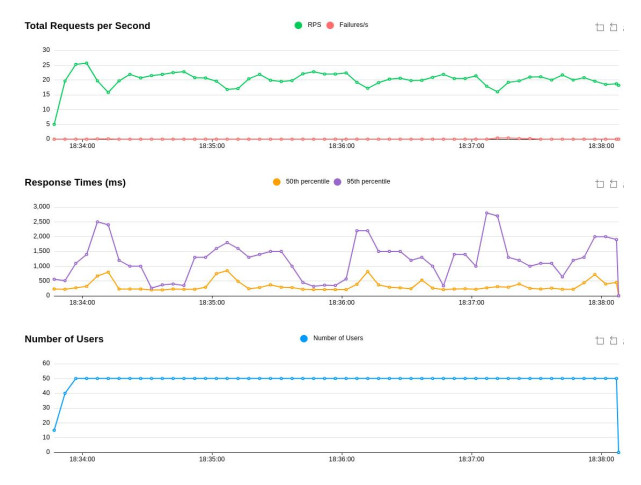
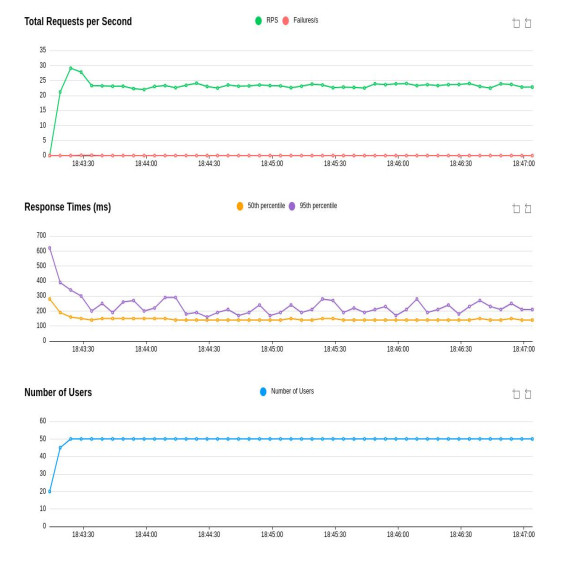
Locust performance charts: RDBMS-only
Locust performance charts: Hybrid
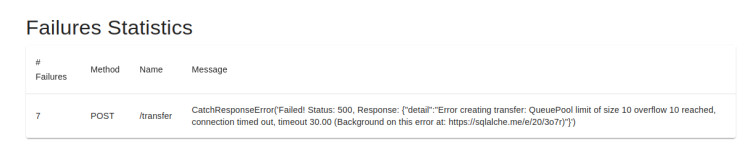
Locust-reported QueuePool exhaustion error, showing the Test 3 failure rate of RDBMS-only




 DownLoad: