Selecting representative protein mutations is an important problem in computational structural biology, where the objective is to identify a small subset of variants that captures relevant variation within a larger mutation set. Existing approaches frequently rely on individual mutation scores, predefined similarity measures, or application-specific optimization objectives, leaving open the question of whether representative selection can instead be constructed directly from a mathematical representation of modeled mutation-induced perturbations. In this work, we introduced a geometry-induced variational framework based on an operator representation of modeled mutation-induced perturbations. Each mutation was represented as a perturbation of the graph Laplacian of a common wild-type residue interaction network, embedding all candidates into a symmetric operator space endowed with the Hilbert–Schmidt structure. For a prescribed subset cardinality, the resulting perturbation magnitudes and pairwise operator distances defined a variational objective that balances deviation from the wild-type reference with geometric diversity. This formulation admitted exact binary quadratic, quadratic unconstrained binary optimization (QUBO), and Ising representations, whose data-dependent coefficients were inherited directly from the operator-derived quantities once the underlying modeling choices had been fixed. The framework was evaluated on fourteen KRAS protein missense mutations. The resulting operator configuration exhibited a structured geometry, and the variational criterion produced representative subsets with improved coverage of the induced mutation space relative to perturbation-magnitude ranking alone. Robustness was examined across different subset cardinalities, diversity weights, connectivity normalizations, and alternative residue-interaction-network constructions. The exact variational, QUBO, and Ising formulations were numerically verified to recover consistent solutions, while fixed-cardinality simulated annealing and a cardinality-preserving quantum approximate optimization algorithm with an XY mixer (XY-QAOA) were evaluated as alternative optimization backends for the same induced objective.
Citation: Álvaro Michelena, Roberto Casado, Esteban Jove, J. M. Corchado, José-Luis Calvo-Rolle. From mutation operator geometry to Ising Hamiltonians: A variational framework for representative mutation selection[J]. Electronic Research Archive, 2026, 34(12): 9485-9518. doi: 10.3934/era.2026398
Selecting representative protein mutations is an important problem in computational structural biology, where the objective is to identify a small subset of variants that captures relevant variation within a larger mutation set. Existing approaches frequently rely on individual mutation scores, predefined similarity measures, or application-specific optimization objectives, leaving open the question of whether representative selection can instead be constructed directly from a mathematical representation of modeled mutation-induced perturbations. In this work, we introduced a geometry-induced variational framework based on an operator representation of modeled mutation-induced perturbations. Each mutation was represented as a perturbation of the graph Laplacian of a common wild-type residue interaction network, embedding all candidates into a symmetric operator space endowed with the Hilbert–Schmidt structure. For a prescribed subset cardinality, the resulting perturbation magnitudes and pairwise operator distances defined a variational objective that balances deviation from the wild-type reference with geometric diversity. This formulation admitted exact binary quadratic, quadratic unconstrained binary optimization (QUBO), and Ising representations, whose data-dependent coefficients were inherited directly from the operator-derived quantities once the underlying modeling choices had been fixed. The framework was evaluated on fourteen KRAS protein missense mutations. The resulting operator configuration exhibited a structured geometry, and the variational criterion produced representative subsets with improved coverage of the induced mutation space relative to perturbation-magnitude ranking alone. Robustness was examined across different subset cardinalities, diversity weights, connectivity normalizations, and alternative residue-interaction-network constructions. The exact variational, QUBO, and Ising formulations were numerically verified to recover consistent solutions, while fixed-cardinality simulated annealing and a cardinality-preserving quantum approximate optimization algorithm with an XY mixer (XY-QAOA) were evaluated as alternative optimization backends for the same induced objective.

| [1] |
M. Soskine, D. S. Tawfik, Mutational effects and the evolution of new protein functions, Nat. Rev. Genet., 11 (2010), 572–582. https://doi.org/10.1038/nrg2808 doi: 10.1038/nrg2808
|
| [2] |
N. Tokuriki, D. S. Tawfik, Protein dynamism and evolvability, Science, 324 (2009), 203–207. https://doi.org/10.1126/science.1169375 doi: 10.1126/science.1169375
|
| [3] |
K. J. Karczewski, L. C. Francioli, G. Tiao, B. B. Cummings, J. Alföldi, Q. Wang, et al., The mutational constraint spectrum quantified from variation in 141,456 humans, Nature, 581 (2020), 434–443. https://doi.org/10.1038/s41586-020-2308-7 doi: 10.1038/s41586-020-2308-7
|
| [4] |
W. Xu, A. Li, Y. Zhao, Y. Peng, Decoding the effects of mutation on protein interactions using machine learning, Biophys. Rev., 6 (2025), 011307. https://doi.org/10.1063/5.0249920 doi: 10.1063/5.0249920
|
| [5] |
Q. Pan, T. B. Nguyen, D. B. Ascher, D. E. V. Pires, Systematic evaluation of computational tools to predict the effects of mutations on protein stability in the absence of experimental structures, Briefings Bioinf., 23 (2022), bbac025. https://doi.org/10.1093/bib/bbac025 doi: 10.1093/bib/bbac025
|
| [6] |
P. C. Ng, S. Henikoff, SIFT: Predicting amino acid changes that affect protein function, Nucleic Acids Res., 31 (2003), 3812–3814. https://doi.org/10.1093/nar/gkg509 doi: 10.1093/nar/gkg509
|
| [7] |
I. Adzhubei, D. M. Jordan, S. R. Sunyaev, Predicting functional effect of human missense mutations using PolyPhen-2, Curr. Protoc. Hum. Genet., 76 (2013), 7.20.1–7.20.41. https://doi.org/10.1002/0471142905.hg0720s76 doi: 10.1002/0471142905.hg0720s76
|
| [8] |
J. Schymkowitz, J. Borg, F. Stricher, R. Nys, F. Rousseau, L. Serrano, The FoldX web server: an online force field, Nucleic Acids Res., 33 (2005), W382–W388. https://doi.org/10.1093/nar/gki387 doi: 10.1093/nar/gki387
|
| [9] |
T. Preeprem, G. Gibson, SDS, a structural disruption score for assessment of missense variant deleteriousness, Front. Genet., 5 (2014), 82. https://doi.org/10.3389/fgene.2014.00082 doi: 10.3389/fgene.2014.00082
|
| [10] |
L. Di Paola, M. De Ruvo, P. Paci, D. Santoni, A. Giuliani, Protein contact networks: an emerging paradigm in chemistry, Chem. Rev., 113 (2013), 1598–1613. https://doi.org/10.1021/cr3002356 doi: 10.1021/cr3002356
|
| [11] |
Y. Liu, W. S. B. Yeung, P. C. N. Chiu, D. Cao, Computational approaches for predicting variant impact: An overview from resources, principles to applications, Front. Genet., 13 (2022), 981005. https://doi.org/10.3389/fgene.2022.981005 doi: 10.3389/fgene.2022.981005
|
| [12] |
M. J. Meyer, R. Lapcevic, A. E. Romero, M. Yoon, J. Das, J. F. Beltrán, et al., mutation3D: cancer gene prediction through atomic clustering of coding variants in the structural proteome, Hum. Mutat., 37 (2016), 447–456. https://doi.org/10.1002/humu.22963 doi: 10.1002/humu.22963
|
| [13] |
D. Yehorova, B. Di Geronimo, M. Robinson, P. M. Kasson, S. C. L. Kamerlin, Using residue interaction networks to understand protein function and evolution and to engineer new proteins, Curr. Opin. Struct. Biol., 89 (2024), 102922. https://doi.org/10.1016/j.sbi.2024.102922 doi: 10.1016/j.sbi.2024.102922
|
| [14] |
M. W. Libbrecht, J. A. Bilmes, W. S. Noble, Choosing non-redundant representative subsets of protein sequence data sets using submodular optimization, Proteins Struct. Funct. Bioinf., 86 (2018), 454–466. https://doi.org/10.1002/prot.25461 doi: 10.1002/prot.25461
|
| [15] |
D. De Santis, S. Tirone, S. Marmi, V. Giovannetti, Optimized QUBO formulation methods for quantum computing, Quantum Sci. Technol., 11 (2026), 015056. https://doi.org/10.1088/2058-9565/ae3b70 doi: 10.1088/2058-9565/ae3b70
|
| [16] |
A. Abbas, A. Ambainis, B. Augustino, A. Bärtschi, H. Buhrman, C. Coffrin, et al., Challenges and opportunities in quantum optimization, Nat. Rev. Phys., 6 (2024), 718–735. https://doi.org/10.1038/s42254-024-00770-9 doi: 10.1038/s42254-024-00770-9
|
| [17] |
F. A. Quinton, P. A. S. Myhr, M. Barani, P. C. del Granado, H. Zhang, Quantum annealing applications, challenges and limitations for optimisation problems compared to classical solvers, Sci. Rep., 15 (2025), 12733. https://doi.org/10.1038/s41598-025-96220-2 doi: 10.1038/s41598-025-96220-2
|
| [18] |
S. Yarkoni, E. Raponi, T. Bäck, S. Schmitt, Quantum annealing for industry applications: introduction and review, Rep. Prog. Phys., 85 (2022), 104001. https://doi.org/10.1088/1361-6633/ac8c54 doi: 10.1088/1361-6633/ac8c54
|
| [19] |
K. Blekos, D. Brand, A. Ceschini, C. H. Chou, R. H. Li, K. Pandya, et al., A review on quantum approximate optimization algorithm and its variants, Phys. Rep., 1068 (2024), 1–66. https://doi.org/10.1016/j.physrep.2024.03.002 doi: 10.1016/j.physrep.2024.03.002
|
| [20] |
B. Simon, Operator Theory: A Comprehensive Course in Analysis, Part 4, American Mathematical Society, 2015. https://doi.org/10.1090/simon/004 |
| [21] |
S. Kirkpatrick, C. D. Gelatt Jr., M. P. Vecchi, Optimization by simulated annealing, Science, 220 (1983), 671–680. https://doi.org/10.1126/science.220.4598.671 doi: 10.1126/science.220.4598.671
|
| [22] |
W. Liu, J. Cheng, Y. Ma, X. Li, X. Li, Quantum alternating operator ansatz with block-ring mixer and hot-start strategy for graph edit distance problem, Quantum Mach. Intell., 8 (2026), 91. https://doi.org/10.1007/s42484-026-00436-y doi: 10.1007/s42484-026-00436-y
|
| [23] |
E. Maiorino, A. Rizzi, A. Sadeghian, A. Giuliani, Spectral reconstruction of protein contact networks, Physica A, 471 (2017), 804–817. https://doi.org/10.1016/j.physa.2016.12.046 doi: 10.1016/j.physa.2016.12.046
|
| [24] |
D. A. Spielman, Spectral graph theory, in Combinatorial Scientific Computing, CRC Press, (2012), 495–524. |
| [25] |
F. R. K. Chung, Spectral Graph Theory, CBMS Regional Conference Series in Mathematics, American Mathematical Society, 92 (1997). https://doi.org/10.1090/cbms/092 |
| [26] |
J. Kyte, R. F. Doolittle, A simple method for displaying the hydropathic character of a protein, J. Mol. Biol., 157 (1982), 105–132. https://doi.org/10.1016/0022-2836(82)90515-0 doi: 10.1016/0022-2836(82)90515-0
|
| [27] |
T. S. Lee, S. J. Potts, M. J. McGinniss, C. M. Strom, Multiple property tolerance analysis for the evaluation of missense mutations, Evol. Bioinf., 2 (2006). https://doi.org/10.1177/117693430600200019 doi: 10.1177/117693430600200019
|
| [28] |
S. S. Li, Z. M. Liu, J. Li, Y. B. Ma, Z. Y. Dong, J. W. Hou, et al., Prediction of mutation-induced protein stability changes based on the geometric representations learned by a self-supervised method, BMC Bioinf., 25 (2024), 282. https://doi.org/10.1186/s12859-024-05876-6 doi: 10.1186/s12859-024-05876-6
|
| [29] |
R. A. Horn, C. R. Johnson, Matrix Analysis, $2^{nd}$ edition, Cambridge University Press, Cambridge, 2012. https://doi.org/10.1017/CBO9781139020411 |
| [30] |
G. Yuan, B. Ghanem, An exact penalty method for binary optimization based on MPEC formulation, in Proceedings of the AAAI Conference on Artificial Intelligence, 31 (2017), 2867–2875. https://doi.org/10.1609/aaai.v31i1.10795 |
| [31] |
F. Glover, G. Kochenberger, R. Hennig, Y. Du, Quantum bridge analytics I: a tutorial on formulating and using QUBO models, Ann. Oper. Res., 314 (2022), 141–183. https://doi.org/10.1007/s10479-022-04634-2 doi: 10.1007/s10479-022-04634-2
|
| [32] |
A. Lucas, Ising formulations of many NP problems, Front. Phys., 2 (2014), 5. https://doi.org/10.3389/fphy.2014.00005 doi: 10.3389/fphy.2014.00005
|
| [33] |
L. Nagpal, A. Kumar, S. R. Hassan, Mapping of fermionic lattice models for Ising solvers, Sci. Rep., 16 (2026), 16249. https://doi.org/10.1038/s41598-026-44886-7 doi: 10.1038/s41598-026-44886-7
|
| [34] |
A. Glos, A. Krawiec, Z. Zimborás, Space-efficient binary optimization for variational quantum computing, npj Quantum Inf., 8 (2022), 39. https://doi.org/10.1038/s41534-022-00546-y doi: 10.1038/s41534-022-00546-y
|
| [35] |
C. C. McGeoch, Adiabatic Quantum Computation and Quantum Annealing: Theory and Practice, Springer Nature, Cham, 2014. https://doi.org/10.1007/978-3-031-02518-1 |
| [36] |
S. Morita, H. Nishimori, Mathematical foundation of quantum annealing, J. Math. Phys., 49 (2008), 125210. https://doi.org/10.1063/1.2995837 doi: 10.1063/1.2995837
|
| [37] |
J. C. Hunter, D. Gurbani, S. B. Ficarro, M. A. Carrasco, S. M. Lim, H. G. Choi, et al., In situ selectivity profiling and crystal structure of SML-8-73-1, an active site inhibitor of oncogenic K-Ras G12C, Proc. Natl. Acad. Sci. U.S.A., 111 (2014), 8895–8900. https://doi.org/10.1073/pnas.1404639111 doi: 10.1073/pnas.1404639111
|
| [38] |
K. M. Haigis, KRAS alleles: the devil is in the detail, Trends Cancer, 3 (2017), 686–697. https://doi.org/10.1016/j.trecan.2017.08.006 doi: 10.1016/j.trecan.2017.08.006
|
Figures(15) / Tables(4)
Álvaro Michelena, Roberto Casado, Esteban Jove, J. M. Corchado, José-Luis Calvo-Rolle. From mutation operator geometry to Ising Hamiltonians: A variational framework for representative mutation selection[J]. Electronic Research Archive, 2026, 34(12): 9485-9518. doi: 10.3934/era.2026398

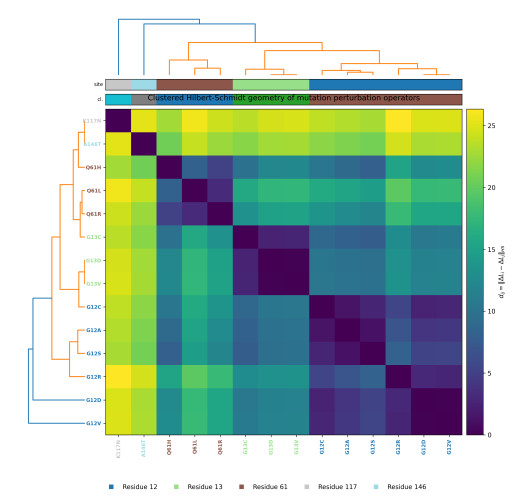
Pairwise Hilbert-Schmidt distance matrix between mutation perturbation operators together with hierarchical clustering. The distance matrix exhibits coherent geometric neighborhoods. A silhouette-based analysis selects five clusters, corresponding in the present dataset to the G12, G13, and Q61 mutation families together with separate K117N and A146T groups
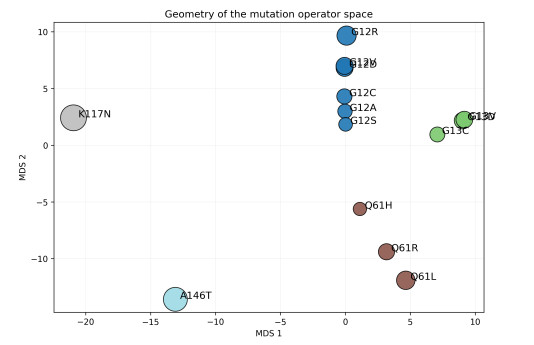
Two-dimensional MDS visualization of the mutation operator space constructed from Hilbert–Schmidt distances. Colors denote mutation sites and marker sizes are proportional to the perturbation magnitude $ V_i = \operatorname{Tr}(\Delta L_i^2) $
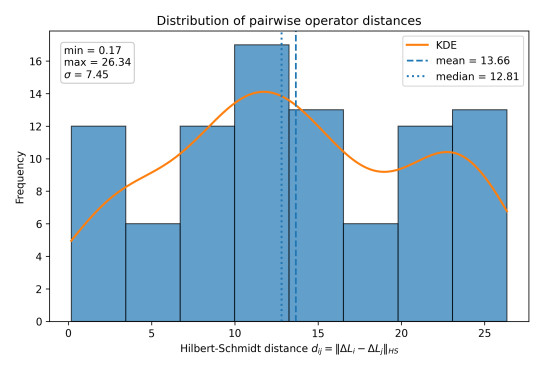
Distribution of pairwise Hilbert-Schmidt distances between mutation perturbation operators. The broad observed range shows that the induced operator geometry contains substantial variation in pairwise separation
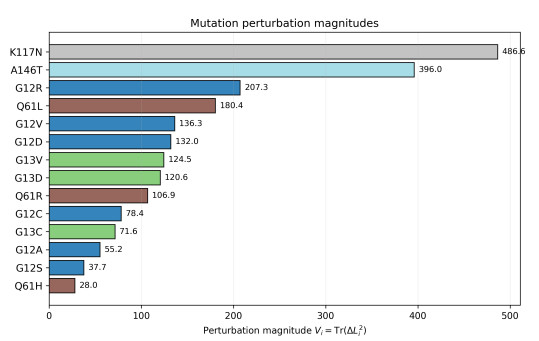
Ranking of mutation perturbation magnitudes $ V_i = \operatorname{Tr}(\Delta L_i^2) $. The substantial variability across mutations provides the individual-magnitude component of the variational criterion, complementary to the pairwise operator distances
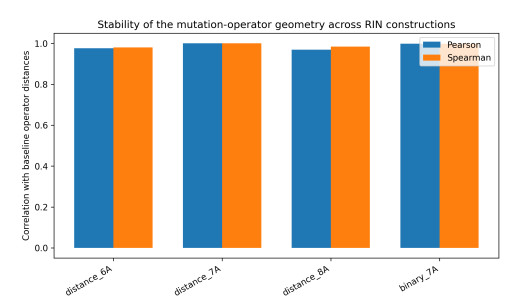
Sensitivity of the mutation-operator geometry to alternative RIN constructions. Pearson and Spearman correlations are computed between the complete set of pairwise Hilbert–Schmidt distances obtained for each RIN construction and those of the main $ 7\, $Å distance-weighted representation. The high correlations observed for the $ 6\, $Å, $ 8\, $Å, and binary $ 7\, $Å alternatives indicate that the global operator-space organization is stable across the tested network definitions, while not implying exact invariance
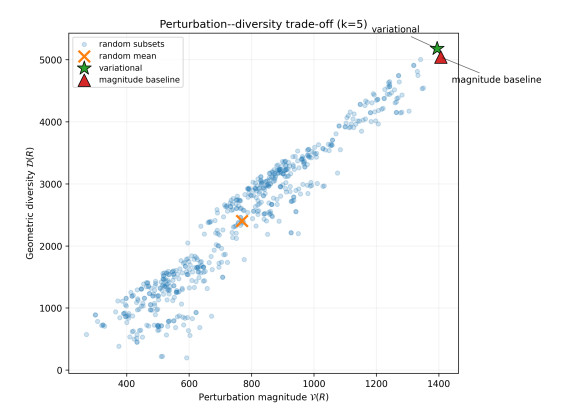
Perturbation magnitude $ \mathcal{V}(R) $ versus geometric diversity $ \mathcal{D}(R) $ for representative subsets of cardinality $ k = 5 $. Randomly sampled subsets provide the background distribution of feasible solutions, while the perturbation-magnitude baseline and the exact variational optimum are highlighted
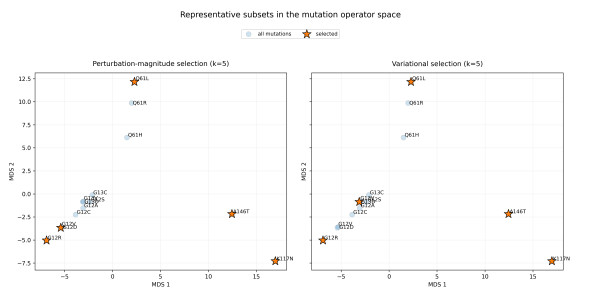
Comparison of the representative subsets obtained from the perturbation-magnitude baseline and the geometry-induced variational criterion for $ k = 5 $. Selected mutations are indicated on the common MDS representation of the operator configuration. The variational solution replaces G12V with G13V, reducing local redundancy and extending coverage to the G13 operator-space neighborhood
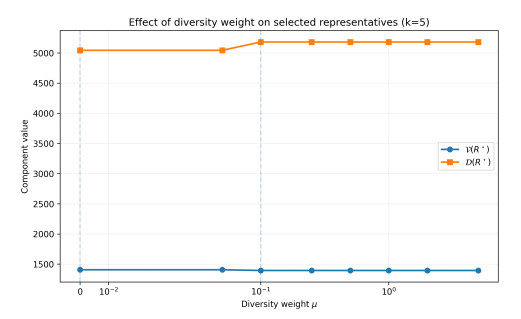
Evolution of the perturbation-magnitude and geometric-diversity components of the optimal $ k = 5 $ subset as a function of the diversity weight $ \mu $. A change in the optimal composition occurs between $ \mu = 0.05 $ and $ \mu = 0.10 $, after which both components remain constant over the tested range
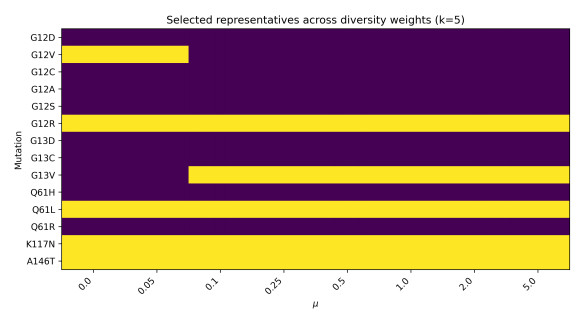
Representative mutations selected for $ k = 5 $ across the tested values of the diversity parameter $ \mu $. The magnitude-only composition is retained for $ \mu\leq0.05 $, whereas the geometry-aware subset remains unchanged from $ \mu = 0.10 $ to $ 5 $
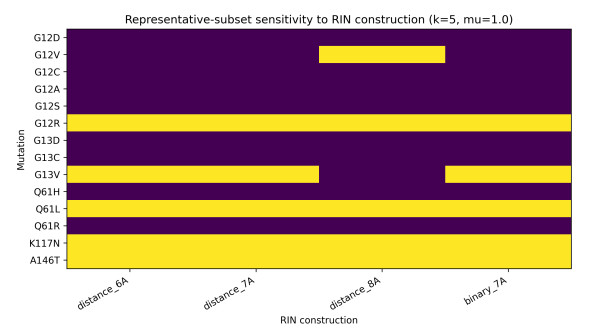
Sensitivity of the representative subset to the RIN construction for $ k = 5 $ and $ \mu = 1 $. Highlighted cells indicate selected mutations under each network definition. G12R, Q61L, K117N, and A146T are retained across all tested constructions, whereas the fifth representative changes from G13V to G12V for the denser $ 8\, $Å distance-weighted network
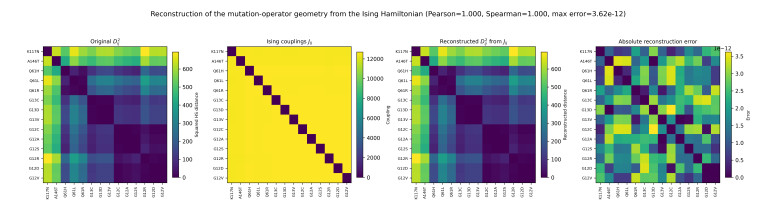
Numerical consistency check of the analytical reconstruction of the mutation-operator geometry from the Ising Hamiltonian. Left: Squared Hilbert–Schmidt distance matrix $ D_{ij} $ computed from the mutation perturbation operators. Middle-left: Ising coupling matrix obtained from the QUBO formulation. Middle-right: Squared-distance matrix $ \widehat{D}_{ij} $ reconstructed from the Ising couplings using the analytical affine relation. Right: Absolute reconstruction error. The reconstructed matrix agrees with the original one up to numerical precision, with Pearson and Spearman correlations equal to $ 1.000 $ and a maximum absolute error of $ 3.62\times10^{-12} $
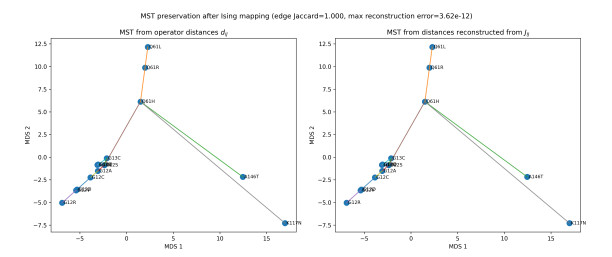
Minimum spanning trees obtained from the original Hilbert–Schmidt distances $ d_{ij} $ (left) and from the distances reconstructed from the Ising couplings (right). The two trees contain the same 13 edges, yielding an edge Jaccard similarity of $ 1.000 $
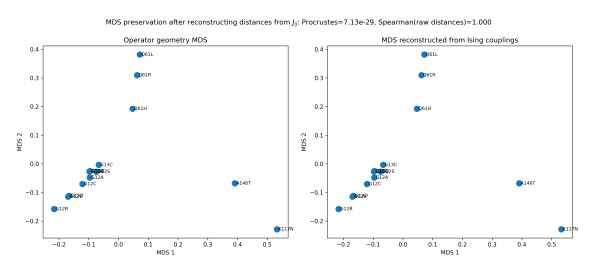
Comparison between the two-dimensional MDS embedding obtained from the original Hilbert–Schmidt distances (left) and the corresponding embedding obtained from distances reconstructed from the Ising couplings (right). The embeddings agree up to numerical precision, with a Procrustes disparity of $ 7.13\times10^{-29} $ and Pearson and Spearman correlations of the embedding distances equal to $ 1.000 $
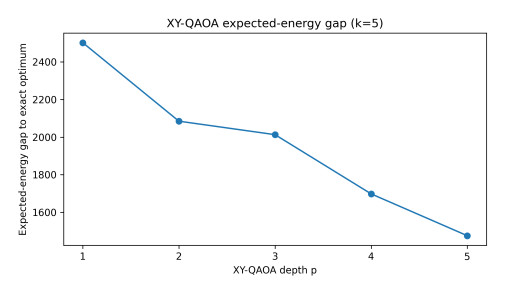
Expected-energy gap of the fixed-cardinality XY-QAOA state relative to the exact optimum for circuit depths $ p = 1, \ldots, 5 $. Under the nested warm-start optimization protocol, the gap decreases from $ 2502.056 $ at $ p = 1 $ to $ 1475.848 $ at $ p = 5 $, corresponding to an approximately $ 41\% $ reduction
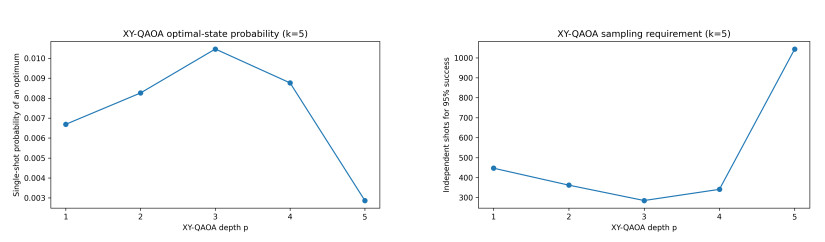
Sampling diagnostics for fixed-cardinality XY-QAOA as a function of circuit depth. Left: Single-shot probability $ P_{\mathrm{opt}} $ assigned to the exact optimum. Right: The number of independent shots required to obtain the optimum with at least $ 95\% $ probability. In contrast to the expected-energy gap, these sampling diagnostics are non-monotonic with depth, showing that improvement of the expectation value does not necessarily imply increased probability mass on the exact optimum




 DownLoad: