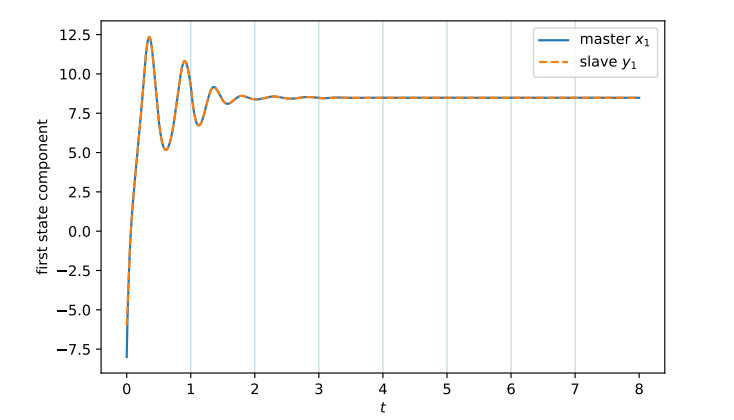
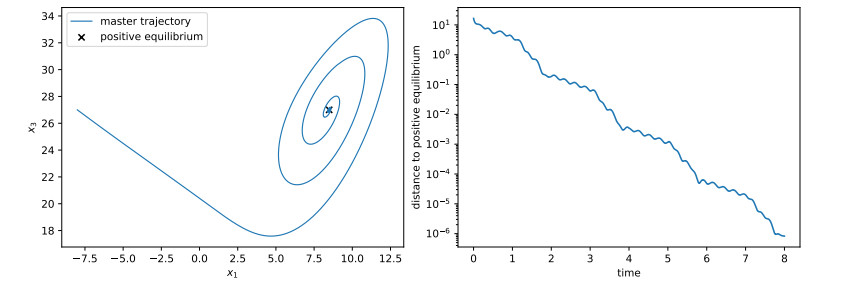
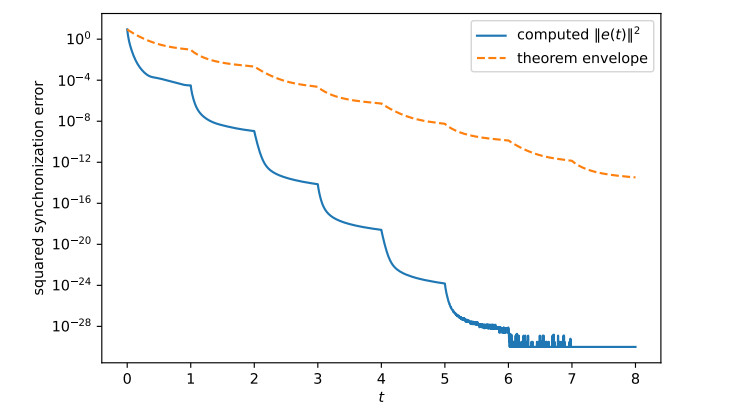
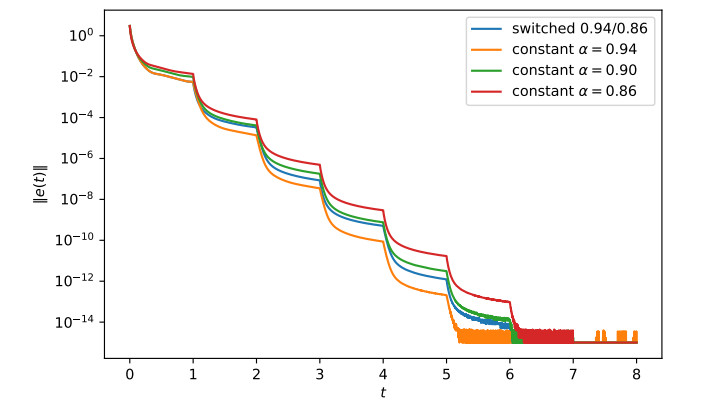
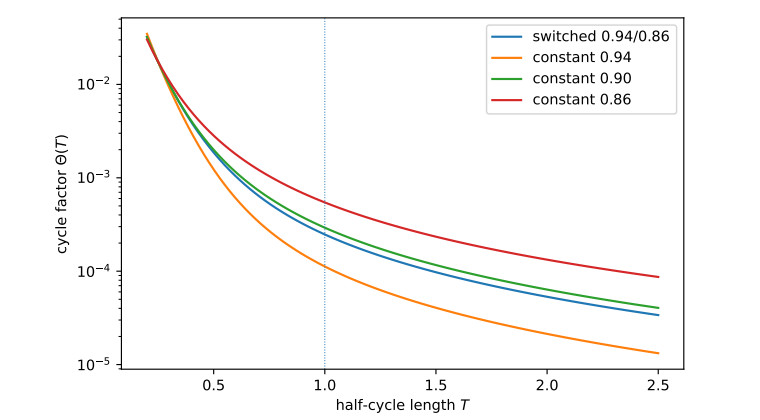
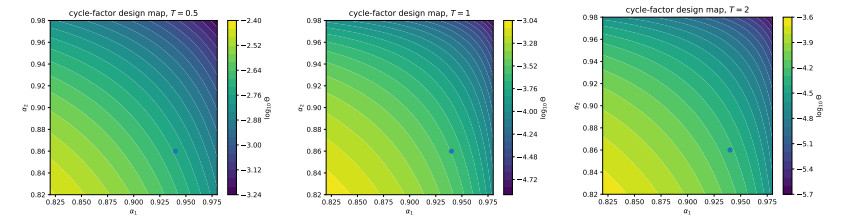
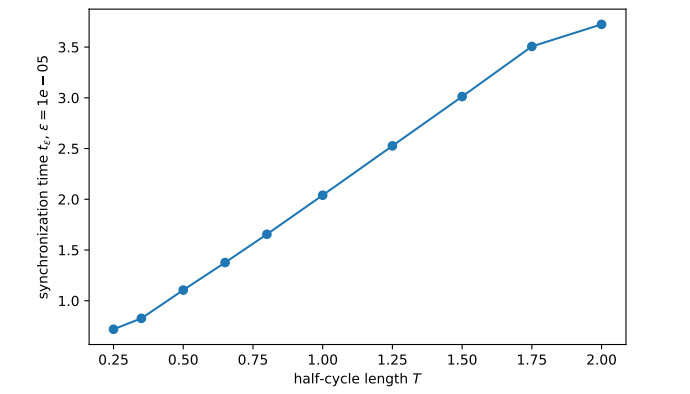
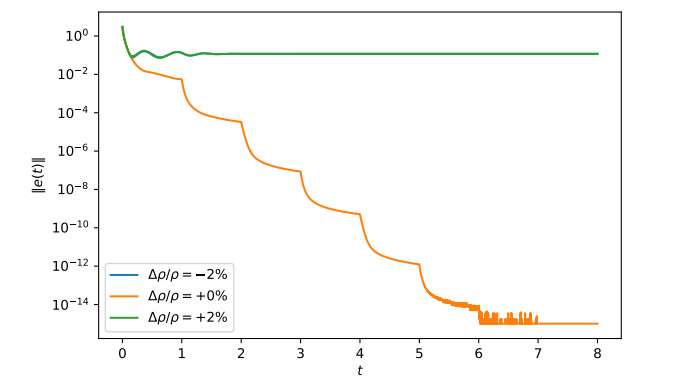
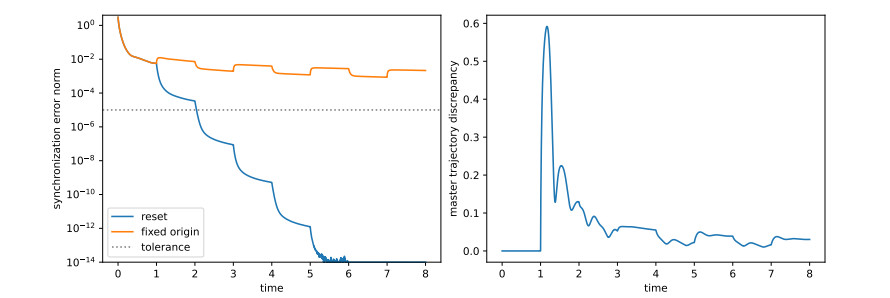
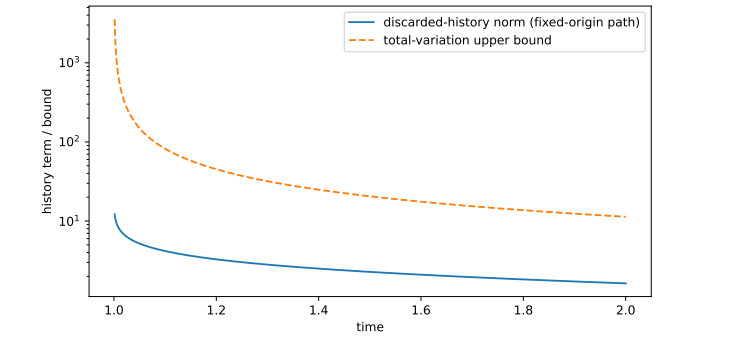
We study the synchronization of piecewise-constant-order Caputo systems whose lower terminal is reset at prescribed times. Under linear feedback, a computable dissipativity margin yields an error bound consisting of one Mittag-Leffler factor per completed reset interval. The argument combines standard local Caputo inequalities with continuous endpoint matching; periodic schedules give an explicit cycle factor and a physical-time decay envelope. We also quantify the difference between resetting and retaining memory: A total-variation estimate controls the integrated omitted history and the resulting trajectory discrepancy. An exact scalar example shows that refining the reset mesh need not approximate a fixed-origin equation. A conditional bounded-region Lorenz result gives explicit sufficient gains. Matched-grid computations with identical gains and order schedules compare reset and fixed-origin models and include step refinement and discarded-history diagnostics. In the alternating $ 0.94/0.86 $ benchmark with unit dwell, the reset model reaches a $ 10^{-5} $ error near $ t = 2.04 $, whereas the fixed-origin error is approximately $ 2.15\times10^{-3} $ at $ t = 8 $. The reset master approaches an equilibrium over this horizon. These results concern synchronization under prescribed memory reinitialization; they establish neither chaotic dynamics nor a general performance advantage for a fixed-memory plant.
Citation: Lateef Ahmad Wani, Sajad Ahmad Sheikh. Adaptive memory switching for chaos synchronization in variable-order fractional dynamical systems[J]. Electronic Research Archive, 2026, 34(12): 9066-9093. doi: 10.3934/era.2026382
We study the synchronization of piecewise-constant-order Caputo systems whose lower terminal is reset at prescribed times. Under linear feedback, a computable dissipativity margin yields an error bound consisting of one Mittag-Leffler factor per completed reset interval. The argument combines standard local Caputo inequalities with continuous endpoint matching; periodic schedules give an explicit cycle factor and a physical-time decay envelope. We also quantify the difference between resetting and retaining memory: A total-variation estimate controls the integrated omitted history and the resulting trajectory discrepancy. An exact scalar example shows that refining the reset mesh need not approximate a fixed-origin equation. A conditional bounded-region Lorenz result gives explicit sufficient gains. Matched-grid computations with identical gains and order schedules compare reset and fixed-origin models and include step refinement and discarded-history diagnostics. In the alternating $ 0.94/0.86 $ benchmark with unit dwell, the reset model reaches a $ 10^{-5} $ error near $ t = 2.04 $, whereas the fixed-origin error is approximately $ 2.15\times10^{-3} $ at $ t = 8 $. The reset master approaches an equilibrium over this horizon. These results concern synchronization under prescribed memory reinitialization; they establish neither chaotic dynamics nor a general performance advantage for a fixed-memory plant.

| [1] | I. Podlubny, Fractional Differential Equations, Academic Press, San Diego, 1999. |
| [2] | K. Diethelm, The Analysis of Fractional Differential Equations, Springer, Berlin, 2010. |
| [3] | A. A. Kilbas, H. M. Srivastava, J. J. Trujillo, Theory and Applications of Fractional Differential Equations, Elsevier, Amsterdam, 2006. |
| [4] |
L. M. Pecora, T. L. Carroll, Synchronization in chaotic systems, Phys. Rev. Lett., 64 (1990), 821. https://doi.org/10.1103/PhysRevLett.64.821 doi: 10.1103/PhysRevLett.64.821

|
| [5] | I. Petráš, Fractional-Order Nonlinear Systems: Modeling, Analysis and Simulation, Springer, Berlin, 2011. https://doi.org/10.1007/978-3-642-18101-6 |
| [6] |
F. Zhang, G. Chen, C. Li, J. Kurths, Chaos synchronization in fractional differential systems, Philos. Trans. R. Soc. A, 371 (2013), 20120155. http://doi.org/10.1098/rsta.2012.0155 doi: 10.1098/rsta.2012.0155
|
| [7] |
Y. Li, Y. Chen, I. Podlubny, Stability of fractional-order nonlinear dynamic systems: Lyapunov direct method and generalized mittag-leffler stability, Comput. Math. Appl., 59 (2010), 1810–1821. https://doi.org/10.1016/j.camwa.2009.08.019 doi: 10.1016/j.camwa.2009.08.019
|
| [8] |
N. Aguila-Camacho, M. A. Duarte-Mermoud, J. A. Gallegos, Lyapunov functions for fractional order systems, Commun. Nonlinear Sci. Numer. Simul., 19 (2014), 2951–2957. https://doi.org/10.1016/j.cnsns.2014.01.022 doi: 10.1016/j.cnsns.2014.01.022
|
| [9] |
S. G. Samko, B. Ross, Integration and differentiation to a variable fractional order, Integr. Transforms Special Funct., 1 (1993), 277–300. https://doi.org/10.1080/10652469308819027 doi: 10.1080/10652469308819027
|
| [10] |
C. F. M. Coimbra, Mechanics with variable-order differential operators, Ann. Phys., 515 (2003), 692–703. https://doi.org/10.1002/andp.200351511-1203 doi: 10.1002/andp.200351511-1203
|
| [11] |
H. Sun, A. Chang, Y. Zhang, W. Chen, A review on variable-order fractional differential equations: mathematical foundations, physical models, numerical methods and applications, Fract. Calc. Appl. Anal., 22 (2019), 27–59. https://doi.org/10.1515/fca-2019-0003 doi: 10.1515/fca-2019-0003
|
| [12] |
Y. Xu, Z. He, Synchronization of variable-order fractional financial system via active control method, Cent. Eur. J. Phys., 11 (2013), 824–835. https://doi.org/10.2478/s11534-013-0237-x doi: 10.2478/s11534-013-0237-x
|
| [13] | J. J. Pérez-Díaz, E. Zambrano-Serrano, A. E. Loya-Cabrera, O. E. Cervantes-García, J. R. Rodríguez-Cruz, M. A. Platas-Garza, et al., Synchronization between a class of variable-order fractional hyperjerk chaotic systems, Computación y Sistemas, 27 (2023), 345–355. https://doi.org/10.13053/CyS-27-2-4068 |
| [14] |
L. Chen, C. Liu, A. M. Lopes, Y. Lin, Y. Liu, Y. Q. Chen, LMI synchronization conditions for variable fractional-order one-sided lipschitz chaotic systems with gain fluctuations, Chaos, Solitons Fractals, 189 (2024), 115695. https://doi.org/10.1016/j.chaos.2024.115695 doi: 10.1016/j.chaos.2024.115695
|
| [15] |
R. Kiruthika, A. Manivannan, Robust sampled-data synchronization of chaotic fractional variable order neural networks with time delays, Eur. Phys. J. Spec. Top., 234 (2025), 1645–1658. https://doi.org/10.1140/epjs/s11734-024-01242-y doi: 10.1140/epjs/s11734-024-01242-y
|
| [16] |
Y. Sun, Y. Chen, B. Wang, C. Ma, A novel adaptive predefined-time sliding mode control scheme for synchronizing fractional order chaotic systems, Chaos, Solitons Fractals, 189 (2024), 115610. https://doi.org/10.1016/j.chaos.2024.115610 doi: 10.1016/j.chaos.2024.115610
|
| [17] |
K. I. A. Ahmed, H. D. S. Adam, N. Almutairi, S. Saber, Analytical solutions for a class of variable-order fractional liu system under time-dependent variable coefficients, Results Phys., 56 (2024), 107311. https://doi.org/10.1016/j.rinp.2023.107311 doi: 10.1016/j.rinp.2023.107311
|
| [18] |
R. Allogmany, N. A. Almuallem, R. D. Alsemiry, M. A. Abdoon, Exploring chaos in fractional order systems: a study of constant and variable-order dynamics, Symmetry, 17 (2025), 605. https://doi.org/10.3390/sym17040605 doi: 10.3390/sym17040605
|
| [19] |
Z. Tang, S. He, H. Wang, K. Sun, Z. Yao, X. Wu, A novel variable-order fractional chaotic map and its dynamics, Chin. Phys. B, 33 (2024), 030503. https://doi.org/10.1088/1674-1056/ad1a93 doi: 10.1088/1674-1056/ad1a93
|
| [20] |
H. Ait Mohammed, M. E. H. Mezabia, B. Tellab, A. Amara, H. Emadifar, Analysis of caputo fractional variable order multi-point initial value problems: existence, uniqueness, and stability, Boundary Value Probl., 2024 (2024), 127. https://doi.org/10.1186/s13661-024-01943-2 doi: 10.1186/s13661-024-01943-2
|
| [21] |
M. S. Souid, S. Sabit, Z. Bouazza, K. Sitthithakerngkiet, A study of caputo fractional differential equations of variable order via darbo's fixed point theorem and kuratowski measure of noncompactness, AIMS Math., 10 (2025), 15410–15432. https://doi.org/10.3934/math.2025691 doi: 10.3934/math.2025691
|
| [22] |
G. C. Wu, Z. G. Deng, D. Baleanu, D. Q. Zeng, New variable-order fractional chaotic systems for fast image encryption, Chaos, 29 (2019), 083103. https://doi.org/10.1063/1.5096645 doi: 10.1063/1.5096645
|
| [23] |
R. Li, H. Wu, J. Cao, Event-triggered synchronization in networks of variable-order fractional piecewise-smooth systems with short memory, IEEE Trans. Syst. Man Cybern.: Syst., 53 (2023), 588–598. https://doi.org/10.1109/TSMC.2022.3185163 doi: 10.1109/TSMC.2022.3185163
|
| [24] |
H. Pollard, The completely monotonic character of the mittag-leffler function $e_{\alpha}(-x)$, Bull. Am. Math. Soc., 54 (1948), 1115–1116. https://doi.org/10.1090/S0002-9904-1948-09132-7 doi: 10.1090/S0002-9904-1948-09132-7
|
| [25] |
Y. Luchko, Maximum principle for the generalized time-fractional diffusion equation, J. Math. Anal. Appl., 351 (2009), 218–223. https://doi.org/10.1016/j.jmaa.2008.10.018 doi: 10.1016/j.jmaa.2008.10.018
|
| [26] |
K. Diethelm, N. J. Ford, A. D. Freed, A predictor-corrector approach for the numerical solution of fractional differential equations, Nonlinear Dyn., 29 (2002), 3–22. https://doi.org/10.1023/A:1016592219341 doi: 10.1023/A:1016592219341
|
| [27] |
Y. Lin, C. Xu, Finite difference/spectral approximations for the time-fractional diffusion equation, J. Comput. Phys., 225 (2007), 1533–1552. https://doi.org/10.1016/j.jcp.2007.02.001 doi: 10.1016/j.jcp.2007.02.001
|
Figures(10) / Tables(9)
Lateef Ahmad Wani, Sajad Ahmad Sheikh. Adaptive memory switching for chaos synchronization in variable-order fractional dynamical systems[J]. Electronic Research Archive, 2026, 34(12): 9066-9093. doi: 10.3934/era.2026382





 DownLoad: