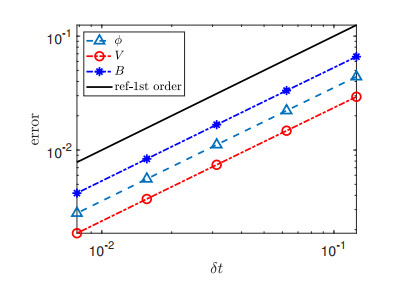
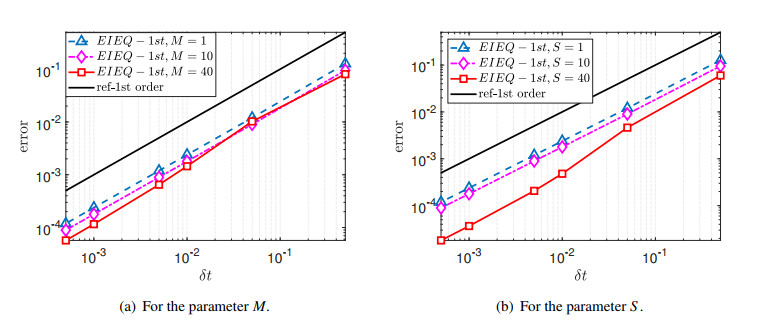
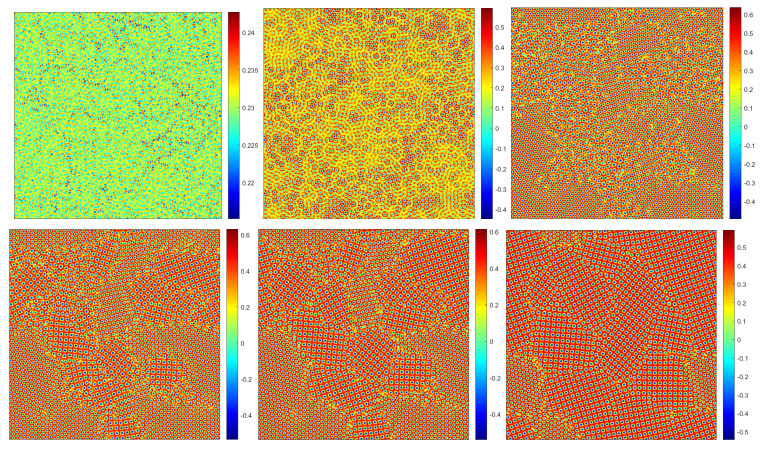
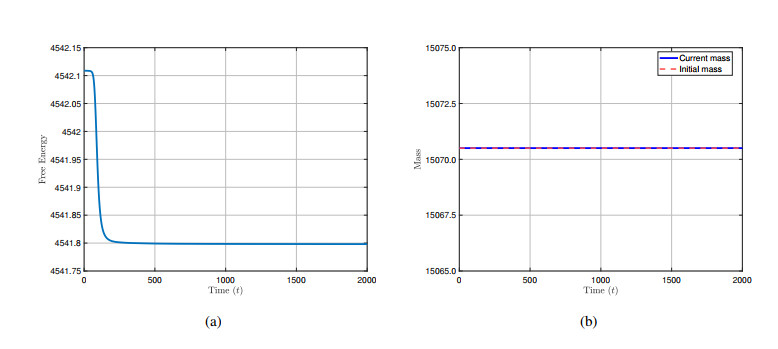
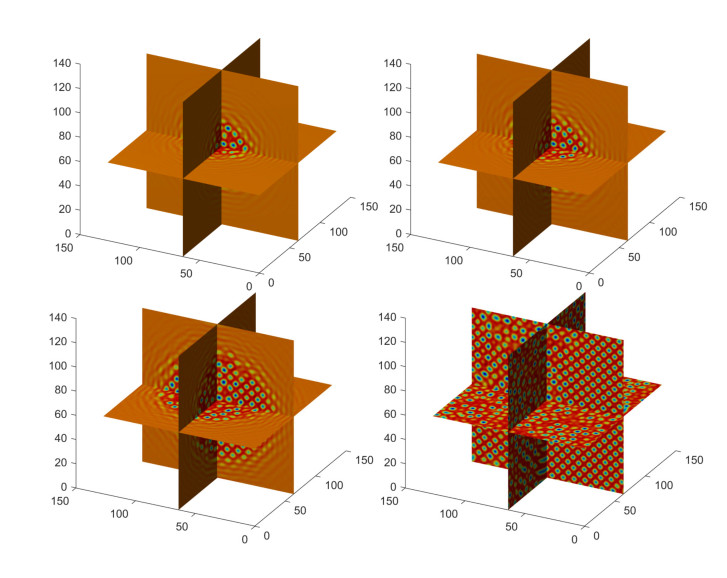
The phase-field crystal (PFC) model is widely used to describe atomic-scale crystalline patterns on diffusive time scales and to study the long-time evolution of microstructures. From the viewpoint of computational fluid dynamics, the standard two-mode PFC formulation for face-centered cubic ordering (PFC–FCC model) can be regarded as a high-order phase-field model for solid–liquid phase transitions, in which the motion of diffuse solid–liquid and grain boundaries is encoded in the evolution of a conserved order parameter. In this work, we constructed a linear, fully decoupled time-discretization scheme for the PFC-FCC system based on the explicit Invariant Energy Quadratization (EIEQ) approach. The scheme requires only the solution of constant-coefficient elliptic problems at each time step, making it well suited for fast solvers in large-scale simulations. We proved unique solvability, unconditional energy stability, and a rigorous optimal first-order a priori error estimate under suitable regularity assumptions, relying on a uniform $ L^{\infty} $-bound for the discrete density to control the nonlinear terms. Numerical tests with a manufactured solution confirmed the predicted convergence rate, while two- and three-dimensional simulations of solidification and crystallization with moving crystalline interfaces illustrated the stability, energy-dissipation property, and effectiveness of the EIEQ-based scheme as a numerical tool for long-time simulations of FCC/BCC pattern selection.
Citation: Lianghong Yuan, Haoyuan Wu, Yu Chen, Jun Zhang, Xiaofeng Yang. Energy-stable EIEQ time discretization for the PFC–FCC model: Convergence analysis and applications to crystal growth[J]. Electronic Research Archive, 2026, 34(5): 3223-3250. doi: 10.3934/era.2026145
The phase-field crystal (PFC) model is widely used to describe atomic-scale crystalline patterns on diffusive time scales and to study the long-time evolution of microstructures. From the viewpoint of computational fluid dynamics, the standard two-mode PFC formulation for face-centered cubic ordering (PFC–FCC model) can be regarded as a high-order phase-field model for solid–liquid phase transitions, in which the motion of diffuse solid–liquid and grain boundaries is encoded in the evolution of a conserved order parameter. In this work, we constructed a linear, fully decoupled time-discretization scheme for the PFC-FCC system based on the explicit Invariant Energy Quadratization (EIEQ) approach. The scheme requires only the solution of constant-coefficient elliptic problems at each time step, making it well suited for fast solvers in large-scale simulations. We proved unique solvability, unconditional energy stability, and a rigorous optimal first-order a priori error estimate under suitable regularity assumptions, relying on a uniform $ L^{\infty} $-bound for the discrete density to control the nonlinear terms. Numerical tests with a manufactured solution confirmed the predicted convergence rate, while two- and three-dimensional simulations of solidification and crystallization with moving crystalline interfaces illustrated the stability, energy-dissipation property, and effectiveness of the EIEQ-based scheme as a numerical tool for long-time simulations of FCC/BCC pattern selection.

| [1] |
K. R. Elder, M. Grant, Modeling elastic and plastic deformations in nonequilibrium processing using phase-field crystals, Phys. Rev. E, 70 (2004), 051605. https://doi.org/10.1103/PhysRevE.70.051605 doi: 10.1103/PhysRevE.70.051605

|
| [2] |
K. R. Elder, M. Katakowski, M. Haataja, M. Grant, Modeling elasticity in crystal growth, Phys. Rev. Lett., 88 (2002), 245701. https://doi.org/10.1103/PhysRevLett.88.245701 doi: 10.1103/PhysRevLett.88.245701
|
| [3] |
H. Emmerich, H. Löwen, R. Wittkowski, T. Gruhn, G. I. Tóth, G. Tegze, et al., Phase-field-crystal models for condensed matter dynamics on atomic length and diffusive time scales: An overview, Adv. Phys., 61 (2012), 665–743. https://doi.org/10.1080/00018732.2012.737555 doi: 10.1080/00018732.2012.737555
|
| [4] |
Z. Guan, V. Heinonen, J. Lowengrub, C. Wang, S. Wise, An energy stable, hexagonal finite difference scheme for the 2D phase field crystal amplitude equations, J. Comput. Phys., 321 (2016), 1026–1054. https://doi.org/10.1016/j.jcp.2016.06.007 doi: 10.1016/j.jcp.2016.06.007
|
| [5] |
Y. Li, C. Luo, B. Xia, J. Kim, An efficient linear second order unconditionally stable direct discretization method for the phase-field crystal equation on surfaces, Appl. Math. Model., 67 (2019), 477–490. https://doi.org/10.1016/j.apm.2018.11.012 doi: 10.1016/j.apm.2018.11.012
|
| [6] |
M. Dehghan, V. Mohammadi, The numerical simulation of the phase field crystal (PFC) and modified phase field crystal (MPFC) models via global and local meshless methods, Comput. Methods Appl. Mech. Eng., 298 (2016), 453–484. https://doi.org/10.1016/j.cma.2015.09.018 doi: 10.1016/j.cma.2015.09.018
|
| [7] |
M. Wang, Q. Huang, C. Wang, A second order accurate scalar auxiliary variable (SAV) numerical method for the square phase field crystal equation, J. Sci. Comput., 88 (2021), 33. https://doi.org/10.1007/s10915-021-01487-y doi: 10.1007/s10915-021-01487-y
|
| [8] |
J. Yang, J. Kim, Numerical approximation of the square phase-field crystal dynamics on the three-dimensional objects, J. Comput. Phys., 471 (2022), 111652. https://doi.org/10.1016/j.jcp.2022.111652 doi: 10.1016/j.jcp.2022.111652
|
| [9] |
K. Wu, A. Adland, A. Karma, Phase-field-crystal model for fcc ordering, Phys. Rev. E, 81 (2010), 061601. https://doi.org/10.1103/PhysRevE.81.061601 doi: 10.1103/PhysRevE.81.061601
|
| [10] |
G. I. Tóth, G. Tegze, T. Pusztai, G. Tóth, L. Gránásy, Polymorphism, crystal nucleation and growth in the phase-field crystal model in 2d and 3d, J. Phys.: Condens. Matter, 22 (2010), 364101. https://doi.org/10.1088/0953-8984/22/36/364101 doi: 10.1088/0953-8984/22/36/364101
|
| [11] |
S. Tang, R. Backofen, J. Wang, Y. Zhou, A. Voigt, Y. Yu, Three-dimensional phase-field crystal modeling of fcc and bcc dendritic crystal growth, J. Cryst. Growth, 334 (2011), 146–152. https://doi.org/10.1016/j.jcrysgro.2011.08.027 doi: 10.1016/j.jcrysgro.2011.08.027
|
| [12] |
E. Asadi, M. A. Zaeem, Quantifying a two-mode phase-field crystal model for bcc metals at melting point, Comput. Mater. Sci., 105 (2015), 101–109. https://doi.org/10.1016/j.commatsci.2015.03.051 doi: 10.1016/j.commatsci.2015.03.051
|
| [13] |
E. Asadi, M. A. Zaeem, A modified two-mode phase-field crystal model applied to face-centered cubic and body-centered cubic orderings, Comput. Mater. Sci., 105 (2015), 110–113. https://doi.org/10.1016/j.commatsci.2015.04.004 doi: 10.1016/j.commatsci.2015.04.004
|
| [14] |
V. Ankudinov, P. K. Galenko, The diagram of phase-field crystal structures: An influence of model parameters in a two-mode approximation, IOP Conf. Ser.: Mater. Sci. Eng., 192 (2017), 012019. https://doi.org/10.1088/1757-899X/192/1/012019 doi: 10.1088/1757-899X/192/1/012019
|
| [15] |
E. Asadi, M. A. Zaeem, Quantitative phase-field crystal modeling of solid-liquid interfaces for FCC metals, Comput. Mater. Sci., 127 (2017), 236–243. https://doi.org/10.1016/j.commatsci.2016.11.005 doi: 10.1016/j.commatsci.2016.11.005
|
| [16] |
S. M. Wise, C. Wang, J. S. Lowengrub, An energy-stable and convergent finite-difference scheme for the phase field crystal equation, SIAM J. Numer. Anal., 47 (2009), 2269–2288. https://doi.org/10.1137/080738143 doi: 10.1137/080738143
|
| [17] |
A. Baskaran, J. S. Lowengrub, C. Wang, S. M. Wise, Convergence analysis of a second order convex splitting scheme for the modified phase field crystal equation, SIAM J. Numer. Anal., 51 (2013), 2851–2873. https://doi.org/10.1137/120880677 doi: 10.1137/120880677
|
| [18] |
Q. Li, N. Cui, S. Zheng, L. Mei, A new Allen-Cahn type two-model phase-field crystal model for fcc ordering and its numerical approximation, Appl. Math. Lett., 132 (2022), 108211. https://doi.org/10.1016/j.aml.2022.108211 doi: 10.1016/j.aml.2022.108211
|
| [19] |
Z. Tan, L. Chen, J. Yang, Generalized Allen-Cahn-type phase-field crystal model with FCC ordering structure and its conservative high-order accurate algorithm, Comput. Phys. Commun., 286 (2023), 108656. https://doi.org/10.1016/j.cpc.2023.108656 doi: 10.1016/j.cpc.2023.108656
|
| [20] |
Y. Ye, X. Feng, L. Qian, A second-order strang splitting scheme for the generalized Allen-Cahn type phase-field crystal model with FCC ordering structure, Commun. Nonlinear Sci. Numer. Simul., 137 (2024), 108143. https://doi.org/10.1016/j.cnsns.2024.108143 doi: 10.1016/j.cnsns.2024.108143
|
| [21] |
X. Yang, D. Han, Linearly first- and second-order, unconditionally energy stable schemes for the phase field crystal equation, J. Comput. Phys., 330 (2017), 1116–1134. https://doi.org/10.1016/j.jcp.2016.10.020 doi: 10.1016/j.jcp.2016.10.020
|
| [22] |
Z. Zhang, X. Yang, On efficient numerical schemes for a two-mode phase field crystal model with face-centered-cubic (FCC) ordering structure, Appl. Numer. Math., 146 (2019), 13–37. https://doi.org/10.1016/j.apnum.2019.06.017 doi: 10.1016/j.apnum.2019.06.017
|
| [23] |
Y. Ye, Q. Li, L. Mei, W. Wang, A variable-step, structure-preserving and linear fully discrete scheme for the two-mode phase-field crystal model with face-centered-cubic ordering, Commun. Nonlinear Sci. Numer. Simul., 146 (2025), 108766. https://doi.org/10.1016/j.cnsns.2025.108766 doi: 10.1016/j.cnsns.2025.108766
|
| [24] |
Z. Xu, X. Yang, H. Zhang, Z. Xie, Efficient and linear schemes for anisotropic Cahn–Hilliard model using the Stabilized-Invariant Energy Quadratization (S-IEQ) approach, Comput. Phys. Commun., 238 (2019), 36–49. https://doi.org/10.1016/j.cpc.2018.12.019 doi: 10.1016/j.cpc.2018.12.019
|
| [25] |
J. Zhang, X. Yang, Unconditionally energy stable large time stepping method for the L2-gradient flow based ternary phase-field model with precise nonlocal volume conservation, Comput. Methods Appl. Mech. Eng., 361 (2020), 112743. https://doi.org/10.1016/j.cma.2019.112743 doi: 10.1016/j.cma.2019.112743
|
| [26] |
J. Zhang, C. Chen, X. Yang, A novel decoupled and stable scheme for an anisotropic phase-field dendritic crystal growth model, Appl. Math. Lett., 95 (2019), 122–129. https://doi.org/10.1016/j.aml.2019.03.029 doi: 10.1016/j.aml.2019.03.029
|
| [27] |
G. D. Zhang, X. He, X. Yang, Decoupled, linear, and unconditionally energy stable fully discrete finite element numerical scheme for a two-phase ferrohydrodynamics model, SIAM J. Sci. Comput., 43 (2021), B167–B193. https://doi.org/10.1137/19M1288280 doi: 10.1137/19M1288280
|
| [28] |
X. Yang, Linear, first and second-order, unconditionally energy stable numerical schemes for the phase field model of homopolymer blends, J. Comput. Phys., 327 (2016), 294–316. https://doi.org/10.1016/j.jcp.2016.09.029 doi: 10.1016/j.jcp.2016.09.029
|
| [29] |
X. Yang, X. He, Numerical approximations of flow coupled binary phase field crystal system: Fully discrete finite element scheme with second-order temporal accuracy and decoupling structure, J. Comput. Phys., 467 (2022), 111448. https://doi.org/10.1016/j.jcp.2022.111448 doi: 10.1016/j.jcp.2022.111448
|
| [30] |
J. Zhang, F. Song, X. Yang, Y. Zhang, Error analysis of the explicit-invariant energy quadratization (EIEQ) numerical scheme for solving the Allen-Cahn equation, J. Comput. Appl. Math., 457 (2025), 116224. https://doi.org/10.1016/j.cam.2024.116224 doi: 10.1016/j.cam.2024.116224
|
Figures(5)
Lianghong Yuan, Haoyuan Wu, Yu Chen, Jun Zhang, Xiaofeng Yang. Energy-stable EIEQ time discretization for the PFC–FCC model: Convergence analysis and applications to crystal growth[J]. Electronic Research Archive, 2026, 34(5): 3223-3250. doi: 10.3934/era.2026145





 DownLoad: