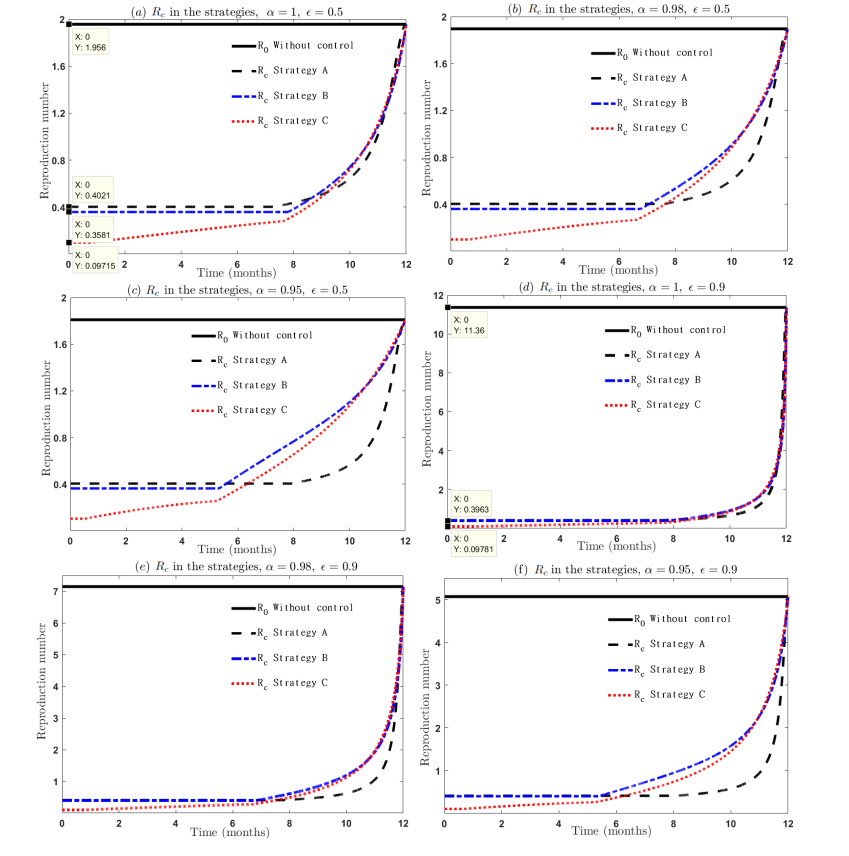
A fractional-order model (FOM) was developed to investigate plant disease transmission (PDT) through a system of dimensionally consistent fractional differential equations (FDEs) with the Caputo derivative. The model's well-posedness was established by proving existence and uniqueness of solutions via a fixed-point theory and the contraction mapping principle. Positivity, boundedness, and the equilibrium points (EPs) of the system were then characterized, followed by an analysis of their local and global stability using the Routh-Hurwitz criteria and LaSalle's invariance principle. The control reproduction number ($ R_c $) was derived using the next-generation matrix method, and a sensitivity analysis highlighted the parameters most influential to disease spread. A fractional optimal control problem (FOCP) incorporating preventive and curative time-dependent interventions was formulated, and necessary optimality conditions (NOCs) were obtained through a kind of Pontryagin's maximum principle (PMP). The resulting optimality system was solved numerically using a forward-backward sweep method (FBSM) based on the fractional Euler scheme, enabling the evaluation of control strategies. Three optimal intervention strategies emerged, each shaping the epidemic trajectory differently depending on the distinguishing parameter $ \varepsilon $ in the two-stage transmission process. Numerical simulations depicted the behavior of $ R_c $ across different $ \varepsilon $ and fractional order $ \alpha $, while tabulated objective functional values exhibited the efficacy of the proposed controls. Overall, the framework offered practical insights for mitigating and potentially eliminating plant epidemics under diverse control strategies.
Citation: Ismail Gad Ameen, Saud Owyed, Yasmeen Ahmed Gaber, Hegagi Mohamed Ali. Dynamics and optimal control of a fractional-order plant disease model[J]. Electronic Research Archive, 2026, 34(5): 3112-3144. doi: 10.3934/era.2026141
A fractional-order model (FOM) was developed to investigate plant disease transmission (PDT) through a system of dimensionally consistent fractional differential equations (FDEs) with the Caputo derivative. The model's well-posedness was established by proving existence and uniqueness of solutions via a fixed-point theory and the contraction mapping principle. Positivity, boundedness, and the equilibrium points (EPs) of the system were then characterized, followed by an analysis of their local and global stability using the Routh-Hurwitz criteria and LaSalle's invariance principle. The control reproduction number ($ R_c $) was derived using the next-generation matrix method, and a sensitivity analysis highlighted the parameters most influential to disease spread. A fractional optimal control problem (FOCP) incorporating preventive and curative time-dependent interventions was formulated, and necessary optimality conditions (NOCs) were obtained through a kind of Pontryagin's maximum principle (PMP). The resulting optimality system was solved numerically using a forward-backward sweep method (FBSM) based on the fractional Euler scheme, enabling the evaluation of control strategies. Three optimal intervention strategies emerged, each shaping the epidemic trajectory differently depending on the distinguishing parameter $ \varepsilon $ in the two-stage transmission process. Numerical simulations depicted the behavior of $ R_c $ across different $ \varepsilon $ and fractional order $ \alpha $, while tabulated objective functional values exhibited the efficacy of the proposed controls. Overall, the framework offered practical insights for mitigating and potentially eliminating plant epidemics under diverse control strategies.

| [1] |
J. B. Ristaino, P. K. Anderson, D. P. Bebber, K. A. Brauman, N. J. Cunniffe, N. V. Fedoroff, et al., The persistent threat of emerging plant disease pandemics to global food security, Proc. Natl. Acad. Sci. U.S.A., 118 (2021), e2022239118. https://doi.org/10.1073/pnas.2022239118 doi: 10.1073/pnas.2022239118

|
| [2] |
D. M. Rizzo, M. Lichtveld, J. A. K. Mazet, E. Togami, S. A. Miller, Plant health and its effects on food safety and security in a One Health framework: Four case studies, One Health Outlook, 3 (2021), 1–9. https://doi.org/10.1186/s42522-021-00038-7 doi: 10.1186/s42522-021-00038-7
|
| [3] |
X. Zhang, X. Dong, Life-or-death decisions in plant immunity, Curr. Opin. Immunol., 75 (2022), 102169. https://doi.org/10.1016/j.coi.2022.102169 doi: 10.1016/j.coi.2022.102169
|
| [4] |
S. Hou, Y. Yang, D. Wu, C. Zhang, Plant immunity: Evolutionary insights from PBS1, Pto, and RIN4, Plant Signaling Behav., 6 (2011), 794–799. https://doi.org/10.4161/psb.6.6.15143 doi: 10.4161/psb.6.6.15143
|
| [5] |
M. S. Sisterson, D. C. Stenger, Roguing with replacement in perennial crops: Conditions for successful disease management, Phytopathology, 103 (2013), 117–128. https://doi.org/10.1094/PHYTO-05-12-0101-R doi: 10.1094/PHYTO-05-12-0101-R
|
| [6] |
F. Nakasuji, S. Miyai, V. Kawamoto, K. Kiritani, Mathematical epidemiology of rice dwarf virus transmitted by green rice leafhoppers: A differential equation model, J. Appl. Ecol., 22 (1985), 839–847. https://doi.org/10.2307/2403233 doi: 10.2307/2403233
|
| [7] |
N. Anggriani, N. Istifadah, M. Hanifah, A. Supriatna, A mathematical model of protectant and curative fungicide application and its stability analysis, IOP Conf. Ser.: Earth Environ. Sci., 31 (2016), 012014. https://doi.org/10.1088/1755-1315/31/1/012014 doi: 10.1088/1755-1315/31/1/012014
|
| [8] |
N. Anggriani, M. Ndii, D. Arumi, N. Istifadah, A. Supriatna, Mathematical model for plant disease dynamics with curative and preventive treatments, AIP Conf. Proc., 2043 (2018), 020016. https://doi.org/10.1063/1.5080035 doi: 10.1063/1.5080035
|
| [9] |
N. Anggriani, M. Ndii, N. Istifadah, A. Supriatna, Disease dynamics with curative and preventive treatments in a two-stage plant disease model, AIP Conf. Proc., 2043 (2018), 020010. https://doi.org/10.1063/1.5080029 doi: 10.1063/1.5080029
|
| [10] | J. Van der Plank, Plant Diseases: Epidemics and Control, Academic Press, New York, 1963. |
| [11] |
H. M. Ali, I. Ameen, Y. A. Gaber, The effect of curative and preventive optimal control measures on a fractional order plant disease model, Math. Comput. Simul., 220 (2024), 496–515. https://doi.org/10.1016/j.matcom.2024.02.009 doi: 10.1016/j.matcom.2024.02.009
|
| [12] |
H. M. Srivastava, V. P. Dubey, R. Kumar, J. Singh, D. Kumar, D. Baleanu, An efficient computational approach for a fractional-order biological population model with carrying capacity, Chaos Solitons Fractals, 138 (2020), 109880. https://doi.org/10.1016/j.chaos.2020.109880 doi: 10.1016/j.chaos.2020.109880
|
| [13] |
L. Frunzo, R. Garra, A. Giusti, V. Luongo, Modeling biological systems with an improved fractional Gompertz law, Commun. Nonlinear Sci. Numer. Simul., 74 (2019), 260–267. https://doi.org/10.1016/j.cnsns.2019.03.024 doi: 10.1016/j.cnsns.2019.03.024
|
| [14] |
J. Singh, D. Kumar, Z. Hammouch, A. Atangana, A fractional epidemiological model for computer viruses pertaining to a new fractional derivative, Appl. Math. Comput., 316 (2018), 504–515. https://doi.org/10.1016/j.amc.2017.08.048 doi: 10.1016/j.amc.2017.08.048
|
| [15] |
S. Maiti, S. Shaw, G. C. Shit, Caputo-Fabrizio fractional order model on MHD blood flow with heat and mass transfer through a porous vessel in the presence of thermal radiation, Physica A, 540 (2020), 123149. https://doi.org/10.1016/j.physa.2019.123149 doi: 10.1016/j.physa.2019.123149
|
| [16] | S. Chakraverty, R. M. Jena, S. K. Jena, Computational Fractional Dynamical Systems: Fractional Differential Equations and Applications, John Wiley & Sons, 2022. |
| [17] |
V. E. Tarasov, Non-linear macroeconomic models of growth with memory, Mathematics, 8 (2020), 2078. https://doi.org/10.3390/math8112078 doi: 10.3390/math8112078
|
| [18] | V. E. Tarasov, No nonlocality, no fractional derivative, Commun. Nonlinear Sci. Numer. Simul., 62 (2018), 157–163. https://doi.org/10.1016/j.cnsns.2018.02.019 |
| [19] |
W. Gao, X. Tian, R. Shi, Dynamic analysis and optimal control of a fractional order predator-prey model with economic threshold, Electron. Res. Arch., 33 (2025), 4529–4558. https://doi.org/10.3934/era.2025205 doi: 10.3934/era.2025205
|
| [20] |
A. Jan, S. Boulaaras, F. A. Abdullah, R. Jan, Dynamical analysis, infections in plants, and preventive policies utilizing the theory of fractional calculus, Eur. Phys. J. Spec. Top., 232 (2023), 2497–2512. https://doi.org/10.1140/epjs/s11734-023-00926-1 doi: 10.1140/epjs/s11734-023-00926-1
|
| [21] |
Q. Dai, L. Guo, Modeling and optimal control analysis of age-structured Brucellosis under environmental transmission with vaccination and culling, Electron. Res. Arch., 33 (2025), 5100–5132. https://doi.org/10.3934/era.2025229 doi: 10.3934/era.2025229
|
| [22] |
R. Alharbi, R. Jan, S. Alyobi, Y. Altayeb, Z. Khan, Mathematical modeling and stability analysis of the dynamics of monkeypox via fractional-calculus, Fractals, 30 (2022), 2240266. https://doi.org/10.1142/S0218348X22402666 doi: 10.1142/S0218348X22402666
|
| [23] |
A. Coronel, F. Huancas, C. Isoton, A. Tello, Optimal control problem and reaction identification term for carrier-borne epidemic spread with a general infection force and diffusion, Electron. Res. Arch., 33 (2025), 4435–4467. https://doi.org/10.3934/era.2025202 doi: 10.3934/era.2025202
|
| [24] |
R. Mukhtar, C. Y. Chang, M. A. Z. Raja, N. I. Chaudhary, C. M. Shu, Novel nonlinear fractional order Parkinson's disease model for brain electrical activity rhythms: Intelligent adaptive Bayesian networks, Chaos Solitons Fractals, 180 (2024), 114557. https://doi.org/10.1016/j.chaos.2024.114557 doi: 10.1016/j.chaos.2024.114557
|
| [25] | L. S. Pontryagin, The Mathematical Theory of Optimal Processes, Gordon and Breach Science Publishers, 1986. |
| [26] |
I. Ameen, D. Baleanu, H. M. Ali, Different strategies to confront maize streak disease based on fractional optimal control formulation, Chaos Solitons Fractals, 164 (2022), 112699. https://doi.org/10.1016/j.chaos.2022.112699 doi: 10.1016/j.chaos.2022.112699
|
| [27] |
H. M. Ali, I. Ameen, Stability and optimal control analysis for studying the transmission dynamics of a fractional-order MSV epidemic model, J. Comput. Appl. Math., 434 (2023), 115352. https://doi.org/10.1016/j.cam.2023.115352 doi: 10.1016/j.cam.2023.115352
|
| [28] |
H. M. Ali, I. Ameen, Save the pine forests of wilt disease using a fractional optimal control strategy, Chaos Solitons Fractals, 132 (2020), 109554. https://doi.org/10.1016/j.chaos.2019.109554 doi: 10.1016/j.chaos.2019.109554
|
| [29] |
R. Jan, N. N. A. Razak, S. Boulaaras, Z. U. Rehman, S. Bahramand, Mathematical analysis of the transmission dynamics of viral infection with effective control policies via fractional derivative, Nonlinear Eng., 12 (2023), 20220342. https://doi.org/10.1515/nleng-2022-0342 doi: 10.1515/nleng-2022-0342
|
| [30] |
H. M. Ali, I. Ameen, Optimal control strategies of a fractional-order model for Zika virus infection involving various transmissions, Chaos Solitons Fractals, 146 (2021), 110864. https://doi.org/10.1016/j.chaos.2021.110864 doi: 10.1016/j.chaos.2021.110864
|
| [31] |
I. Ameen, D. Baleanu, H. M. Ali, An efficient algorithm for solving the fractional optimal control of SIRV epidemic model with a combination of vaccination and treatment, Chaos Solitons Fractals, 137 (2020), 109892. https://doi.org/10.1016/j.chaos.2020.109892 doi: 10.1016/j.chaos.2020.109892
|
| [32] |
A. M. A. El-Sayed, S. Z. Rida, Y. A. Gaber, Dynamical of curative and preventive treatments in a two-stage plant disease model of fractional order, Chaos Solitons Fractals, 137 (2020), 109879. https://doi.org/10.1016/j.chaos.2020.109879 doi: 10.1016/j.chaos.2020.109879
|
| [33] | I. Podlubny, Fractional Differential Equations, Mathematics in Science and Engineering, Academic Press, San Diego, CA, 1999. |
| [34] | D. Baleanu, K. Diethelm, E. Scalas, J. J. Trujillo, Fractional Calculus: Models and Numerical Methods, Series on Complexity, Nonlinearity and Chaos, World Scientific, 2012. |
| [35] |
I. Ameen, M. Hidan, Z. Mostefaoui, H. M. Ali, Fractional optimal control with fish consumption to prevent the risk of coronary heart disease, Complexity, 2020 (2020), 9823753. https://doi.org/10.1155/2020/9823753 doi: 10.1155/2020/9823753
|
| [36] | K. Diethelm, The Analysis of Fractional Differential Equations: An Application-Oriented Exposition Using Operators of Caputo Type, Springer, 2010. https://doi.org/10.1007/978-3-642-14574-2 |
| [37] | V. Dafardar-Gejji, Fractional Calculus and Fractional Differential Equations, Springer, 2019. https://doi.org/10.1007/978-981-13-9227-6 |
| [38] |
M. S. Tavazoei, M. Haeri, Chaotic attractors in incommensurate fractional order systems, Physica D, 237 (2008), 2628–2637. https://doi.org/10.1016/j.physd.2008.03.037 doi: 10.1016/j.physd.2008.03.037
|
| [39] | N. Anggriani, D. Arumi, E. Hertini, N. Istifadah, A. Supriatna, Dynamical analysis of plant disease model with roguing, replanting and preventive treatment, in 4th ICRIEMS proceedings 978-602-74529-2-3, The Faculty Of Mathematics And Natural Sciences, Yogyakarta State University, 2017. |
| [40] |
M. S. Chan, M. J. Jeger, An analytical model of plant virus disease dynamics with roguing and replanting, J. Appl. Ecol., 31 (1994), 413–427. https://doi.org/10.2307/2404439 doi: 10.2307/2404439
|
| [41] |
E. Venturino, P. K. Roy, F. Al Basir, A. Datta, A model for the control of the mosaic virus disease in jatropha curcas plantations, Energy Ecol. Environ., 1 (2016), 360–369. https://doi.org/10.1007/s40974-016-0033-8 doi: 10.1007/s40974-016-0033-8
|
| [42] |
T. Sardar, S. Rana, S. Bhattacharya, K. Al-khaled, J. Chattopadhya, A generic model for a single strain mosquito-transmitted disease with memory on the host and the vector, Math. Biosci., 2015 (2015), 18–36. https://doi.org/10.1016/j.mbs.2015.01.009 doi: 10.1016/j.mbs.2015.01.009
|
| [43] |
O. Diekmann, J. A. P. Heesterbeek, M. G. Roberts, The construction of next-generation matrices for compartmental epidemic models, J. R. Soc. Interface, 7 (2010), 873–885. https://doi.org/10.1098/rsif.2009.0386 doi: 10.1098/rsif.2009.0386
|
| [44] |
P. van den Driessche, J. Watmough, Reproduction numbers and sub-threshold endemic equilibria for compartmental models of disease transmission, Math. Biosci., 180 (2002), 29–48. https://doi.org/10.1016/S0025-5564(02)00108-6 doi: 10.1016/S0025-5564(02)00108-6
|
| [45] | G. J. Olsder, J. W. van der Woude, Mathematical Systems Theory, third edition, VSSD, 2005. |
| [46] |
J. P. C. dos Santos, E. Monteiro, G. B. Vieira, Global stability of fractional SIR epidemic model, Proc. Ser. Braz. Soc. Appl. Comput. Math., 5 (2017), 1–7. https://doi.org/10.5540/03.2017.005.01.0019 doi: 10.5540/03.2017.005.01.0019
|
| [47] |
J. Huo, H. Zhao, L. Zhu, The effect of vaccines on backward bifurcation in a fractional order HIV model, Nonlinear Anal. Real World Appl., 26 (2015), 289–305. https://doi.org/10.1016/j.nonrwa.2015.05.014 doi: 10.1016/j.nonrwa.2015.05.014
|
| [48] |
N. Chitnis, J. M. Hyman, J. M. Cushing, Determining important parameters in the spread of malaria through the sensitivity analysis of a mathematical model, Bull. Math. Biol., 70 (2008), 1272–1296. https://doi.org/10.1007/s11538-008-9299-0 doi: 10.1007/s11538-008-9299-0
|
| [49] |
S. A. Pedro, H. Rwezaura, J. M. Tchuenche, Time-varying sensitivity analysis of an influenza model with interventions, Int. J. Biomath., 15 (2022), 2150098. https://doi.org/10.1142/S1793524521500984 doi: 10.1142/S1793524521500984
|
| [50] |
H. M. Ali, F. L. Pereira, S. M. A. Gama, A new approach to the Pontryagin maximum principle for nonlinear fractional optimal control problems, Math. Methods Appl. Sci., 39 (2016), 3640–3649. https://doi.org/10.1002/mma.3811 doi: 10.1002/mma.3811
|
| [51] |
A. B. Salati, M. Shamsi, D. F. M. Torres, Direct transcription methods based on fractional integral approximation formulas for solving nonlinear fractional optimal control problems, Commun. Nonlinear Sci. Numer. Simul., 67 (2019), 334–350. https://doi.org/10.1016/j.cnsns.2018.05.011 doi: 10.1016/j.cnsns.2018.05.011
|
| [52] |
S. Nemati, P. M. Nemati, D. F. M. Torres, A numerical approach for solving fractional optimal control problems using modified hat functions, Commun. Nonlinear Sci. Numer. Simul., 78 (2019), 104849. https://doi.org/10.1016/j.cnsns.2019.104849 doi: 10.1016/j.cnsns.2019.104849
|
| [53] |
M. S. Ali, M. K. Almoaeet, B. Albuohimad, An indirect spectral collocation method based on shifted Jacobi functions for solving some class of fractional optimal control problems, J. Phys. Conf. Ser., 1818 (2021), 012129. https://doi.org/10.1088/1742-6596/1818/1/012129 doi: 10.1088/1742-6596/1818/1/012129
|
| [54] | P. Drag, K. Styczen, M. Kwiatkowska, A. Szczurek, A review on the direct and indirect methods for solving optimal control problems with differential-algebraic constraints, in Recent Advances in Computational Optimization, 610 (2016), 91–105. https://doi.org/10.1007/978-3-319-21133-6_6 |
| [55] |
H. Kheiri, M. Jafari, Stability analysis of a fractional order model for the HIV/AIDS epidemic in a patchy environment, J. Comput. Appl. Math., 346 (2019), 323–339. https://doi.org/10.1016/j.cam.2018.06.055 doi: 10.1016/j.cam.2018.06.055
|
Figures(8) / Tables(4)
Ismail Gad Ameen, Saud Owyed, Yasmeen Ahmed Gaber, Hegagi Mohamed Ali. Dynamics and optimal control of a fractional-order plant disease model[J]. Electronic Research Archive, 2026, 34(5): 3112-3144. doi: 10.3934/era.2026141





 DownLoad: