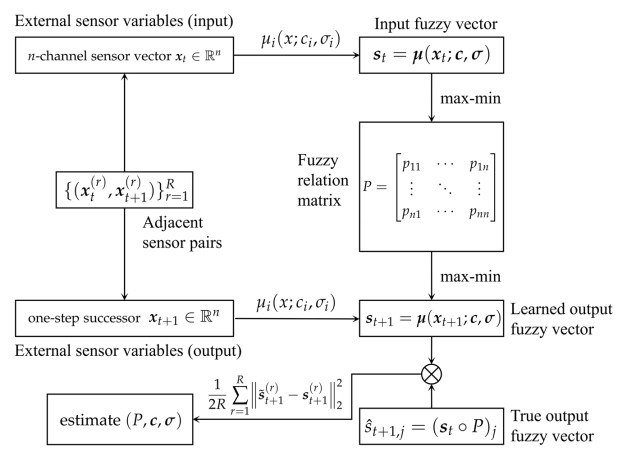
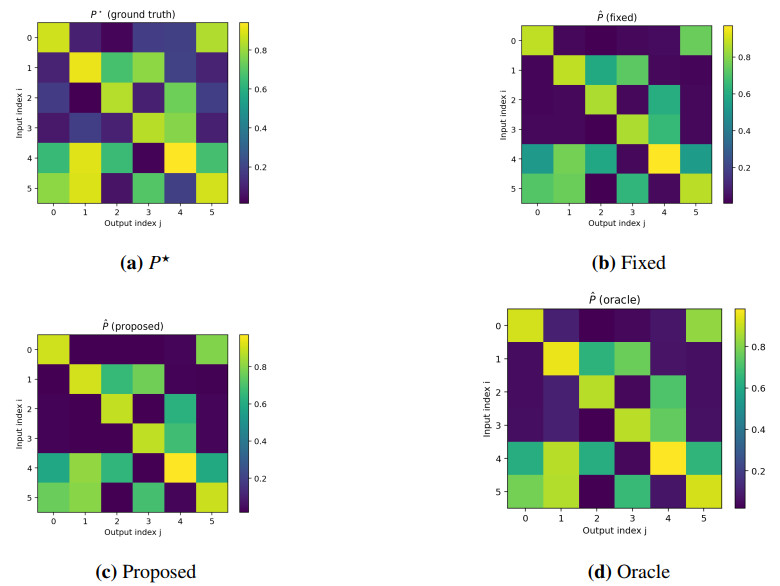
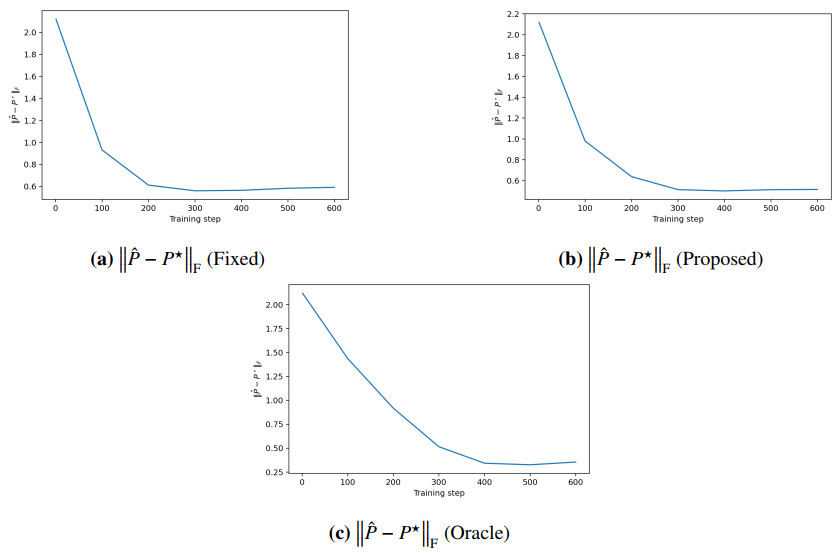
Fuzzy relation matrices are a core representation mechanism in fuzzy inference and fuzzy system modeling, yet practical data are often raw multichannel sensor readings rather than pre-defined input/output fuzzy vectors. We develop an end-to-end supervised learning framework that (i) maps sensor readings to fuzzy vectors via per-channel Gaussian fuzzification and (ii) learns a max-min fuzzy relation matrix from adjacent-time sensor pairs. To overcome the nonsmooth max-min composition, we introduce a differentiable softmax/softmin surrogate with temperature annealing and derive a stochastic-gradient training procedure that jointly optimizes the relation matrix and fuzzifier parameters. Experiments on structured synthetic sensor streams show stable convergence and improved structure recovery over a fixed (data-driven) fuzzifier baseline while approaching an oracle fuzzifier.
Citation: Xiefei He, Tao Yu, Zicong He, Shi'an Wang. Learning input-output fuzzy matrices from sensor data via Gaussian fuzzification[J]. Electronic Research Archive, 2026, 34(5): 3093-3111. doi: 10.3934/era.2026140
Fuzzy relation matrices are a core representation mechanism in fuzzy inference and fuzzy system modeling, yet practical data are often raw multichannel sensor readings rather than pre-defined input/output fuzzy vectors. We develop an end-to-end supervised learning framework that (i) maps sensor readings to fuzzy vectors via per-channel Gaussian fuzzification and (ii) learns a max-min fuzzy relation matrix from adjacent-time sensor pairs. To overcome the nonsmooth max-min composition, we introduce a differentiable softmax/softmin surrogate with temperature annealing and derive a stochastic-gradient training procedure that jointly optimizes the relation matrix and fuzzifier parameters. Experiments on structured synthetic sensor streams show stable convergence and improved structure recovery over a fixed (data-driven) fuzzifier baseline while approaching an oracle fuzzifier.

| [1] | L. A. Zadeh, Fuzzy sets, Inf. Control, 8 (1965), 338–353. https://doi.org/10.1016/S0019-9958(65)90241-X |
| [2] |
L. A. Zadeh, Fuzzy sets as a basis for a theory of possibility, Fuzzy Sets Syst., 1 (1978), 3–28. https://doi.org/10.1016/0165-0114(78)90029-5 doi: 10.1016/0165-0114(78)90029-5

|
| [3] |
M. Ye, N. Wang, X. Yu, X. Wang, W. Liu, Supervised learning fuzzy matrix based on input-output fuzzy vectors, Axioms, 14 (2025), 126. https://doi.org/10.3390/axioms14020126 doi: 10.3390/axioms14020126
|
| [4] |
H. Ying, F. Lin, Self-learning fuzzy automaton with input and output fuzzy sets for system modelling, IEEE Trans. Emerging Top. Comput. Intell., 7 (2023), 500–512. https://doi.org/10.1109/TETCI.2022.3192890 doi: 10.1109/TETCI.2022.3192890
|
| [5] |
H. Ying, F. Lin, Discrete-time finite fuzzy Markov chains realized through supervised learning stochastic fuzzy discrete event systems, IEEE Trans. Fuzzy Syst., 32 (2024), 6088–6100. https://doi.org/10.1109/TFUZZ.2024.3440184 doi: 10.1109/TFUZZ.2024.3440184
|
| [6] |
W. Liu, Q. He, Z. Li, Y. Li, Self-learning modeling in possibilistic model checking, IEEE Trans. Emerging Top. Comput. Intell., 8 (2024), 264–278. https://doi.org/10.1109/TETCI.2023.3300189 doi: 10.1109/TETCI.2023.3300189
|
| [7] | J. M. A. Moral, C. Castiello, L. Magdalena, C. Mencar, Explainable Fuzzy Systems: Paving the Way from Interpretable Fuzzy Systems to Explainable AI Systems, $1^{st}$ edition, Springer, 2021. https://doi.org/10.1007/978-3-030-71098-9 |
| [8] |
J. Cao, T. Zhou, S. Zhi, S. Lam, G. Ren, Y. Zhang, et al., Fuzzy inference system with interpretable fuzzy rules: Advancing explainable artificial intelligence for disease diagnosis–A comprehensive review, Inf. Sci., 662 (2024), 120212. https://doi.org/10.1016/j.ins.2024.120212 doi: 10.1016/j.ins.2024.120212
|
| [9] |
S. Xu, Smoothing method for minimax problems, Comput. Optim. Appl., 20 (2001), 267–279. https://doi.org/10.1023/A:1011211101714 doi: 10.1023/A:1011211101714
|
| [10] |
A. Tsoukalas, P. Parpas, B. Rustem, A smoothing algorithm for finite min-max-min problems, Optim. Lett., 3 (2009), 49–62. https://doi.org/10.1007/s11590-008-0090-9 doi: 10.1007/s11590-008-0090-9
|
| [11] |
L. Li, Z. Qiao, Y. Liu, Y. Chen, A convergent smoothing algorithm for training max-min fuzzy neural networks, Neurocomputing, 260 (2017), 404–410. https://doi.org/10.1016/j.neucom.2017.04.046 doi: 10.1016/j.neucom.2017.04.046
|
| [12] |
E. Sanchez, Resolution of Eigen fuzzy sets equations, Fuzzy Sets Syst., 1 (1978), 69–74. https://doi.org/10.1016/0165-0114(78)90033-7 doi: 10.1016/0165-0114(78)90033-7
|
| [13] |
B. De Baets, E. E. Kerre, A primer on solving fuzzy relational equations on the unit interval, Int. J. Uncertainty Fuzziness Knowl.-Based Syst., 2 (1994), 205–225. https://doi.org/10.1142/S021848859400016X doi: 10.1142/S021848859400016X
|
| [14] |
W. Bandler, L. J. Kohout, Semantics of implication operators and fuzzy relational products, Int. J. Man-Mach. Stud., 12 (1980), 89–116. https://doi.org/10.1016/S0020-7373(80)80055-1 doi: 10.1016/S0020-7373(80)80055-1
|
| [15] |
J. R. Jang, ANFIS: Adaptive-network-based fuzzy inference system, IEEE Trans. Syst. Man Cybern., 23 (1993), 665–685. https://doi.org/10.1109/21.256541 doi: 10.1109/21.256541
|
| [16] |
Y. Yan, D. Cheng, J. Feng, H. Li, J. Yue, Survey on applications of algebraic state space theory of logical systems to finite state machines, Sci. China Inf. Sci., 66 (2023), 111201. https://doi.org/10.1007/s11432-022-3538-4 doi: 10.1007/s11432-022-3538-4
|
| [17] |
W. Li, Y. Wei, W. Xu, General expression of knowledge granularity based on a fuzzy relation matrix, Fuzzy Sets Syst., 440 (2022), 149–163. https://doi.org/10.1016/j.fss.2022.01.007 doi: 10.1016/j.fss.2022.01.007
|
Figures(8) / Tables(1)
Xiefei He, Tao Yu, Zicong He, Shi'an Wang. Learning input-output fuzzy matrices from sensor data via Gaussian fuzzification[J]. Electronic Research Archive, 2026, 34(5): 3093-3111. doi: 10.3934/era.2026140





 DownLoad: