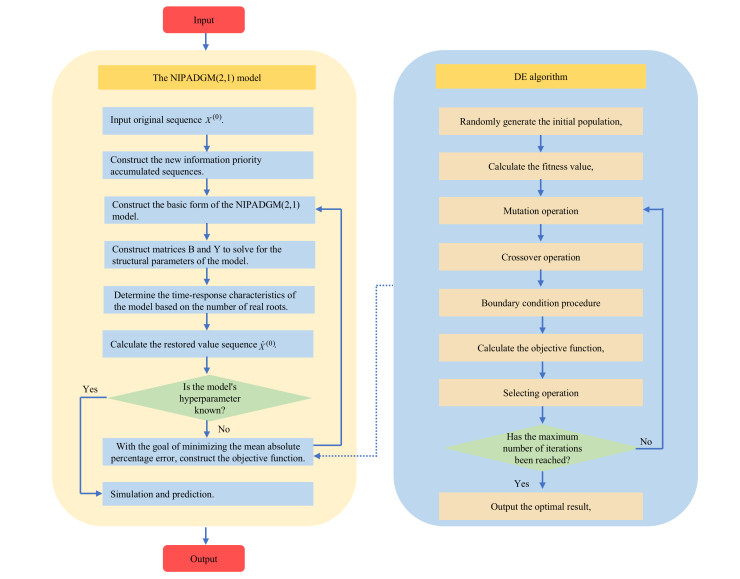
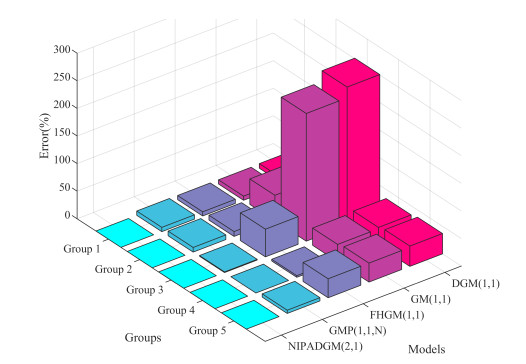
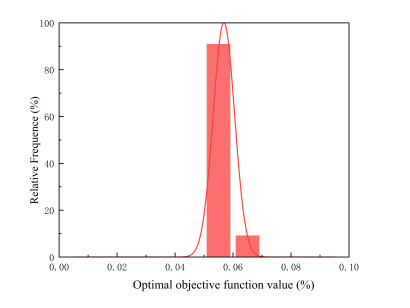
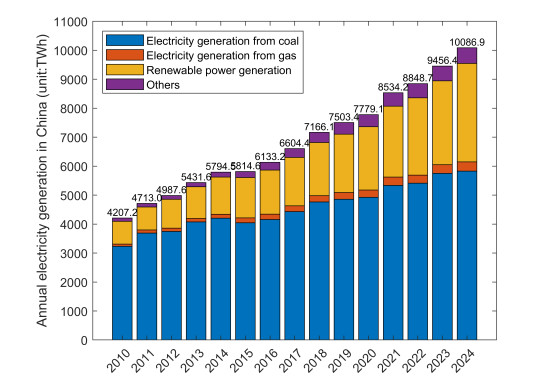
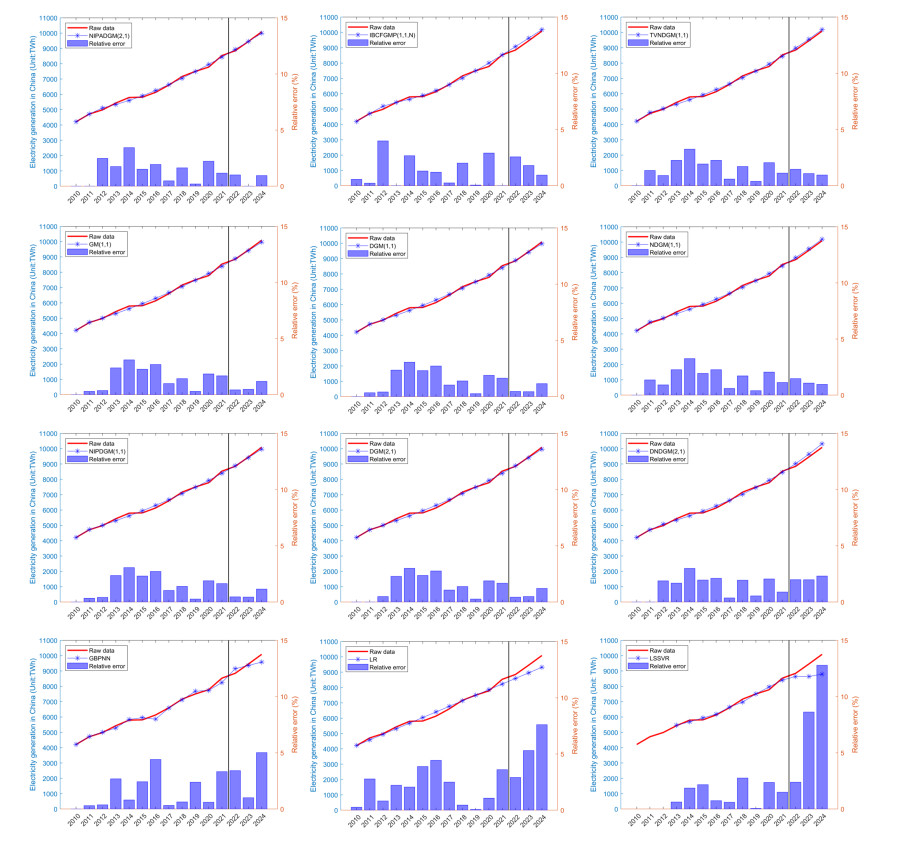
To effectively capture the nonlinear and complex patterns inherent in small-sample data, this paper proposed a novel self-adaptive second-order discrete grey model incorporating new information priority accumulation. The modeling mechanism and theoretical properties of the proposed model were systematically examined. To mitigate multicollinearity and enhance the stability of parameter estimation in small-sample contexts, Ridge regression regularization was strategically incorporated into the modeling framework. The computational efficiency of the parameter optimization was demonstrated through comparative benchmarking, which substantiated the superiority of the differential evolution algorithm over conventional methods. Furthermore, the model's robustness and stability were verified via Monte Carlo simulations and sensitivity analyses with varying training set proportions. The proposed model was applied to forecast China's total electricity generation as well as generation from specific energy sources. The results demonstrated that the proposed model achieves higher forecasting accuracy than benchmark models. Finally, the power generation across four modes from 2025 to 2030 was predicted and analyzed.
Citation: Shuangbing Guo, Wenhao Gong, Huanyu Zhou, Dian Li, Yuzhen Chen. A new information priority accumulation self-adaptive discrete grey second-order model and its application in electricity generation[J]. Electronic Research Archive, 2026, 34(5): 2974-3007. doi: 10.3934/era.2026135
To effectively capture the nonlinear and complex patterns inherent in small-sample data, this paper proposed a novel self-adaptive second-order discrete grey model incorporating new information priority accumulation. The modeling mechanism and theoretical properties of the proposed model were systematically examined. To mitigate multicollinearity and enhance the stability of parameter estimation in small-sample contexts, Ridge regression regularization was strategically incorporated into the modeling framework. The computational efficiency of the parameter optimization was demonstrated through comparative benchmarking, which substantiated the superiority of the differential evolution algorithm over conventional methods. Furthermore, the model's robustness and stability were verified via Monte Carlo simulations and sensitivity analyses with varying training set proportions. The proposed model was applied to forecast China's total electricity generation as well as generation from specific energy sources. The results demonstrated that the proposed model achieves higher forecasting accuracy than benchmark models. Finally, the power generation across four modes from 2025 to 2030 was predicted and analyzed.

| [1] |
J. W. Zeng, Z. Y. Chen, Y. J. Wang, R. Wang, Capacity, spatial patterns and benefits assessment of photovoltaic power under carbon neutrality goal in China, Sci. Technol. Rev., 42 (2024), 34–46. https://doi.org/10.3981/j.issn.1000-7857.2024.02.00233 doi: 10.3981/j.issn.1000-7857.2024.02.00233

|
| [2] |
Z. Y. Zhuo, N. Zhang, X. R. Xie, H. H. Li, C. Q. Kang, Key technologies and developing challenges of power system with high proportion of renewable energy, Autom. Electr. Power Syst., 45 (2021), 171–191. https://doi.org/10.7500/AEPS20200922001 doi: 10.7500/AEPS20200922001
|
| [3] |
G. Dudek, Pattern-based local linear regression models for short-term load forecasting, Electr. Power Syst. Res., 130 (2016), 139–147. https://doi.org/10.1016/j.epsr.2015.09.001 doi: 10.1016/j.epsr.2015.09.001
|
| [4] |
C. Y. Wang, Q. Q. Duan, K. Zhou, J. Yao, M. Su, Y. C. Fu, et al., A hybrid model for photovoltaic power prediction of bothconvolutional and long short-term memory neural networksoptimized by genetic algorithm, Acta Phys. Sin., 69 (2020), 149–155. https://doi.org/10.7498/aps.69.20191935 doi: 10.7498/aps.69.20191935
|
| [5] |
X. Luo, Z. J. Hu, Z. J. Ma, Z. Lv, Photovoltaic cluster power generation prediction based on hybrid deep learning, J. Southwest Univ. (Nat. Sci. Ed.), 47 (2025), 200–210. https://doi.org/10.13718/j.cnki.xdzk.2025.03.018 doi: 10.13718/j.cnki.xdzk.2025.03.018
|
| [6] |
A. Saxena, A nonlinear hyperbolic optimized grey model for market clearing price prediction: Analysis and case study, Sustainable Energy Grids Networks, 38 (2024), 101367. https://doi.org/10.1016/j.segan.2024.101367 doi: 10.1016/j.segan.2024.101367
|
| [7] |
L. Q. Huang, Q. Liao, H. R. Zhang, M. K. Jiang, J. Yan, Y. T. Liang, Forecasting power consumption with an activation function combined grey model: A case study of China, Int. J. Electr. Power Energy Syst., 130 (2021), 106977. https://doi.org/10.1016/J.IJEPES.2021.106977 doi: 10.1016/J.IJEPES.2021.106977
|
| [8] |
J. L. Deng, Control problems of grey systems, Syst. Control Lett., 1 (1982), 288–294. https://doi.org/10.1016/s0167-6911(82)80025-x doi: 10.1016/s0167-6911(82)80025-x
|
| [9] | D. Luo, X. Q. Qiao, Time-Delay TLDBGM (1, N) model with dynamic background value and its application, J. Grey Syst., 36 (2024), 63–78. |
| [10] |
M. L. Qiu, D. W. Li, Z. L. Luo, X. J. Yu. Huizhou GDP forecast based on fractional opposite-direction accumulating nonlinear grey bernoulli markov model, Electron. Res. Arch., 31 (2023), 947–960. https://doi.org/10.3934/era.2023047 doi: 10.3934/era.2023047
|
| [11] | Q. F. Xu, Y. J. Guan, Y. B. Xu, R. Wang, A new grey forecasting model with fractional order accumulation generation operation and its application in GDP forecasting, J. Grey Syst., 36 (2024), 70–79. |
| [12] |
C. Li, Q. Qi, A novel hybrid grey system forecasting model based on seasonal fluctuation characteristics for electricity consumption in primary industry, Energy, 287 (2024), 129585. https://doi.org/10.1016/j.energy.2023.129585 doi: 10.1016/j.energy.2023.129585
|
| [13] |
L. Xia, Y. Y. Ren, Y. H. Wang, Forecasting China's total renewable energy capacity using a novel dynamic fractional order discrete grey model, Expert Syst. Appl., 239 (2024), 122019. https://doi.org/10.1016/j.eswa.2023.122019 doi: 10.1016/j.eswa.2023.122019
|
| [14] |
W. Ba, B. J. Chen, Q. Li, Comprehensive evaluation method for traffic flow data quality based on grey correlation analysis and particle swarm optimization, J. Syst. Sci. Syst. Eng., 33 (2024), 106–128. https://doi.org/10.1007/s11518-023-5585-5 doi: 10.1007/s11518-023-5585-5
|
| [15] |
Q. Q. Shen, Y. G. Dang, Y. Cao, R. Q. Zhu, Improved grey Verhulst model based on new information priority fractional order accumulation, Syst. Eng. Theory Pract., 45 (2025), 539–553. https://doi.org/10.12011/SETP2023-2039 doi: 10.12011/SETP2023-2039
|
| [16] |
N. M. Xie, S. F. Liu, Discrete grey forecasting model and its optimization, Appl. Math. Modell., 33 (2008), 1173–1186. https://doi.org/10.1016/j.apm.2008.01.011 doi: 10.1016/j.apm.2008.01.011
|
| [17] |
S. L. Li, S. Y. Yang, B. Zeng, W. Meng, Y. Bai, Unbiased and adaptive of discrete grey prediction model and its application, Chin. J. Manage. Sci., 32 (2024), 149–160. https://doi.org/10.16381/j.cnki.issn1003-207x.2022.1937 doi: 10.16381/j.cnki.issn1003-207x.2022.1937
|
| [18] |
X. B. Yang, A note on discrete grey prediction model of inhomogeneous exponents and its application, Math. Pract. Theory, 54 (2024), 148–160. https://doi.org/10.20266/j.math.2024.11.011 doi: 10.20266/j.math.2024.11.011
|
| [19] |
D. Luo, B. L. Wei, A unified treatment approach for a class of discrete grey forecasting models and its application, Syst. Eng. Theory Pract., 39 (2019), 451–462. https://doi.org/10.12011/1000-6788-2017-1065-12 doi: 10.12011/1000-6788-2017-1065-12
|
| [20] |
Z. D. Xu, Y. G. Dang, D. L. Yang, Discrete grey forecasting model with fractional order polynomial and its application, Control Decis., 38 (2023), 3578–3584. https://doi.org/10.13195/j.kzyjc.2022.0080 doi: 10.13195/j.kzyjc.2022.0080
|
| [21] |
Y. P. Ding, Y. G. Dang, J. J. Wang. Adaptive multivariable grey prediction model driven by Euler polynomials and its application, Chin. J. Manage. Sci., 33 (2025), 185–199. https://doi.org/10.16381/j.cnki.issn1003-207x.2023.1297 doi: 10.16381/j.cnki.issn1003-207x.2023.1297
|
| [22] |
L. Xia, Y. Y. Ren, Y. H. Wang, Y. Y. Fu, K. Zhou. A novel dynamic structural adaptive multivariable grey model and its application in China's solar energy generation forecasting, Energy, 312 (2024), 133534. https://doi.org/10.1016/j.energy.2024.133534 doi: 10.1016/j.energy.2024.133534
|
| [23] |
W. J. Zhou, H. R. Zhang, Y. G. Dang, Z. X. Wang, New information priority accumulated grey discrete model and its application, Chin. J. Manage. Sci., 25 (2017), 140–148. https://doi.org/10.16381/j.cnki.issn1003-207x.2017.08.015 doi: 10.16381/j.cnki.issn1003-207x.2017.08.015
|
| [24] |
L. Xi, S. Ding, N. Xu, P. P. Xiong, Research on optimization of non-equidistant GM(1, 1) model based on the principle of new information priority, Control Decis., 34 (2019), 2221–2228. https://doi.org/10.13195/j.kzyjc.2018.0163 doi: 10.13195/j.kzyjc.2018.0163
|
| [25] |
L. F. Wu, S. F. Liu, L. G. Yao, S. L. Yan, D. L. Liu, Grey system model with the fractional order accumulation, Commun. Nonlinear Sci. Numer. Simul., 18 (2013), 1775–1785. https://doi.org/10.1016/j.cnsns.2012.11.017 doi: 10.1016/j.cnsns.2012.11.017
|
| [26] |
X. Ma, W. Q. Wu, B. Zeng, Y. Wang, X. X. Wu, The conformable fractional grey system model, ISA Trans., 96 (2020), 255–271. https://doi.org/10.1016/j.isatra.2019.07.009 doi: 10.1016/j.isatra.2019.07.009
|
| [27] | C. Yan, L. F. Wu, L. Y. Liu, K. Zhang, Fractional Hausdorff grey model and its properties, Chaos, Solitons Fractals, 138 (2020) 109915. https://doi.org/10.1016/j.chaos.2020.109915 |
| [28] | L. Xia, Y. H. Wang, Y. X. Han, K. Zhou, Y. Y. Ren, Y. Y. Fu, A novel time-varying non-homogeneous discrete grey model and its application in forecasting solar energy generation in total north America, J. Grey Syst., 37 (2025), 96–107. |
| [29] |
Y. Z. Chen, W. H. Gong, S. Z. Li, S. B. Guo, A novel conformable fractional-order accumulation grey model and its applications in forecasting energy consumption of China, Sci. Rep., 14 (2024), 31028. https://doi.org/10.1038/S41598-024-82128-W doi: 10.1038/S41598-024-82128-W
|
| [30] |
L. Zeng, A gray model for increasing sequences with nonhomogeneous index trends based on fractional‐order accumulation, Math. Methods Appl. Sci., 41 (2018), 3750–3763. https://doi.org/10.1002/mma.4862 doi: 10.1002/mma.4862
|
| [31] |
D. W. Li, M. L. Qiu, J. M. Jiang, S. P. Yang, The application of an optimized fractional order accumulated grey model with variable parameters in the total energy consumption of Jiangsu Province and the consumption level of Chinese residents, Electron. Res. Arch., 30 (2022), 798–812. https://doi.org/10.3934/era.2022042 doi: 10.3934/era.2022042
|
| [32] | S. Z. Li, S. B. Guo, Y. Z. Chen, Optimization and application of Hausdorff fractional grey prediction model, J. Henan Inst. Sci. Technol. (Nat. Sci. Ed.), 51 (2023), 76–84. |
| [33] |
Y. Z. Chen, S. Z. Li, S. B. Guo, A novel fractional hausdorff discrete grey model for forecasting the renewable energy consumption, J. Math., 2022 (2022), 8443619. https://doi.org/10.1155/2022/8443619 doi: 10.1155/2022/8443619
|
| [34] |
T. Su, Y. Wei, Direct discrete model of second order non-homogeneous sequence and application of grey prediction, Syst. Eng. Theory Pract., 40 (2020), 2450–2465. https://doi.org/10.12011/1000-6788-2019-2319-16 doi: 10.12011/1000-6788-2019-2319-16
|
| [35] |
L. Zeng, S. G. Luo, A discrete GM(2, 1) model with fractional-order accumulation and its application, J. Chongqing Normal Univ. (Nat. Sci.), 38 (2021), 73–80+2. https://doi.org/10.11721/cqnuj20210502 doi: 10.11721/cqnuj20210502
|
| [36] |
M. L. Cheng, Grey GM(2, 1) model with complex solution and its applications, Chin. J. Eng. Math., 40 (2023), 763–778. https://doi.org/10.3969/j.issn.1005-3085.2023.05.006 doi: 10.3969/j.issn.1005-3085.2023.05.006
|
| [37] |
N. Xu, Y. G. Dang, An optimized grey GM (2, 1) model and forecasting of highway subgrade settlement, Math. Probl. Eng., 2015 (2015), 606707. https://doi.org/10.1155/2015/606707 doi: 10.1155/2015/606707
|
| [38] |
L. W. Tang, Y. Y. Lu, The optimization of GM(2, 1) model based on parameter estimation of grade difference format, Syst. Eng. Theory Pract., 38 (2018), 502–508. https://doi.org/10.12011/1000-6788(2018)02-0502-07 doi: 10.12011/1000-6788(2018)02-0502-07
|
| [39] | L. Zeng, C. Liu, W. Z. Wu. A novel discrete GM (2, 1) model with a polynomial term for forecasting electricity consumption, Electr. Power Syst. Res. 214 (2023), 108926. https://doi.org/10.1016/j.epsr.2022.108926 |
| [40] |
S. J. Li, Y. Z. Miao, G. Y. Li, M. Ikram, A novel varistructure grey forecasting model with speed adaptation and its application, Math. Comput. Simul., 172 (2020), 45–70. https://doi.org/10.1016/j.matcom.2019.12.020 doi: 10.1016/j.matcom.2019.12.020
|
| [41] |
H. B. Zhou, G. R. Xiao, X. X. Lin, Y. H. Yin, Landslide hazard assessment method based on feature screening and differential evolution algorithm optimization, J. Geo-inf. Sci., 24 (2022), 2373–2388. https://doi.org/10.12082/dqxxkx.2022.220158 doi: 10.12082/dqxxkx.2022.220158
|
| [42] |
Y. F. Huang, C. N. Wang, H. S. Dang, S. T. Lai, Evaluating performance of the DGM (2, 1) model and its modified models, Appl. Sci., 6 (2016), 73. https://doi.org/10.3390/app6030073 doi: 10.3390/app6030073
|
| [43] |
P. P. Xiong, Y. R. Wu, C. W. Tan, W. J. Tong, K. Y. Yang, A novel discrete mulivariate grey forecasting model with ${{L}_{2}}$ regularization term, J. Syst. Sci. Math. Sci., 44 (2024), 1130–1146. https://doi.org/10.12341/jssms22406 doi: 10.12341/jssms22406
|
| [44] |
W. L. Zhang, S. F. Liu, L. Y. Liu, R. M. K. T. Rathnayaka, N. M. Xie, J. L. Du, A novel fractional-order discrete grey Gompertz model for analyzing the aging population in Jiangsu Province, China, Grey Syst. Theory Appl., 13 (2023), 544–557. https://doi.org/10.1108/GS-01-2023-0005 doi: 10.1108/GS-01-2023-0005
|
| [45] |
A. R. Jordehi, Enhanced leader PSO (ELPSO): A new PSO variant for solving global optimisation 660 problems, Appl. Soft Comput., 26 (2015), 401–417. https://doi.org/10.1016/j.asoc.2014.10.026 doi: 10.1016/j.asoc.2014.10.026
|
| [46] |
K. Dervis, G. Beyza, O. Celal, N. K. Karaboga, B. Gorkemli, C. Ozturk, et al., A comprehensive survey: artificial bee colony (ABC) algorithm and applications, Artif. Intell. Rev., 42 (2014), 21–57. https://doi.org/10.1007/s10462-012-9328-0 doi: 10.1007/s10462-012-9328-0
|
| [47] |
H. AL‐Tabtabai, A. Alex, Using genetic algorithms to solve optimization problems in construction, Eng. Constr. Archit. Manage., 6 (1999), 121–132. https://doi.org/10.1046/j.1365-232x.1999.00086.x doi: 10.1046/j.1365-232x.1999.00086.x
|
| [48] |
S. Mirjalili, A. Lewis, The whale optimization algorithm, Adv. Eng. Software, 95 (2016), 51–67. https://doi.org/10.1016/j.advengsoft.2016.01.008 doi: 10.1016/j.advengsoft.2016.01.008
|
| [49] |
S. Tian, C. W. Li, W. Huang, L. Wang, Forecasting method of highway freight volume based on GC-rBPNN model during COVID-19 epidemic, J. Guangxi Normal Univ. (Nat. Sci. Ed.), 39 (2021), 24–32. https://doi.org/10.16088/j.issn.1001-6600.2020102902 doi: 10.16088/j.issn.1001-6600.2020102902
|
| [50] |
I. Ilic, B. Görgülü, M. Cevik, M. G. Baydoğan, Explainable boosted linear regression for time series forecasting, Pattern Recognit., 120 (2021), 108144. https://doi.org/10.1016/j.patcog.2021.108144 doi: 10.1016/j.patcog.2021.108144
|
| [51] |
J. A. K. Suykens, J. Vandewalle, Least squares support vector machine classifiers, Neural Process. Lett., 9 (1999), 293–300. https://doi.org/10.1023/A:1018628609742 doi: 10.1023/A:1018628609742
|
Figures(5) / Tables(9)
Shuangbing Guo, Wenhao Gong, Huanyu Zhou, Dian Li, Yuzhen Chen. A new information priority accumulation self-adaptive discrete grey second-order model and its application in electricity generation[J]. Electronic Research Archive, 2026, 34(5): 2974-3007. doi: 10.3934/era.2026135





 DownLoad: