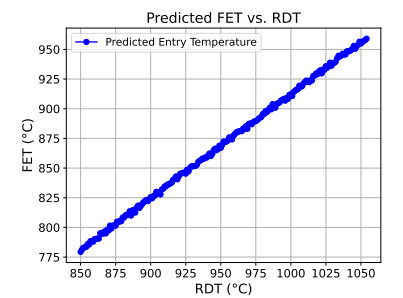
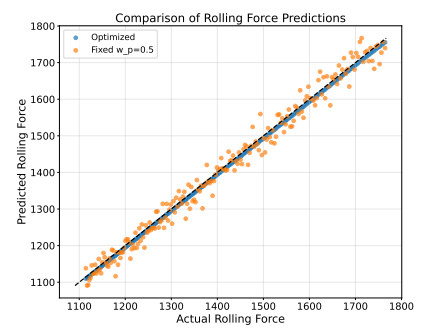
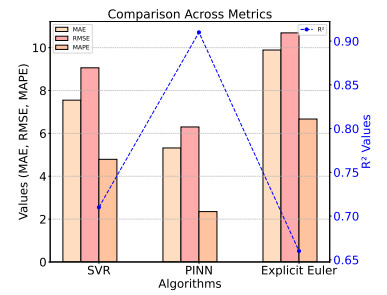
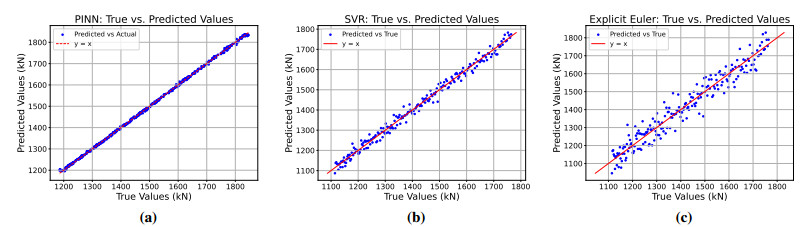
In the hot-rolled strip steel production process, the finishing entry temperature (FET) is directly related to the mechanical properties, microstructural uniformity, and surface quality of the steel, while also having a significant impact on energy consumption and carbon emissions. Traditional temperature measurement and prediction methods each have their limitations, such as large measurement errors, high computational complexity, or overfitting issues. To address these challenges, this paper proposes a finishing entry temperature-physics-informed neural network (FET-PINN) method that integrates rough delivery temperature (RDT) data with thermodynamic equations. First, by leveraging the advantage that the temperature in the RDT region more closely approximates the true billet temperature, an initial prediction of the FET was obtained via a FET-PINN model in conjunction with thermodynamic equations. Subsequently, to account for model errors, the fusion weight was calculated using a nonlinear least squares method, and a weighted averaging approach was employed to fuse this predicted value with the temperature computed from instrumentation measurements, thereby achieving a more accurate temperature estimation. Finally, considering the effect of FET on the subsequent rolling force, the paper evaluated the model comprehensively by comparing the predicted rolling force with the actual rolling force using the coefficient of determination ($ R^{2} $), root mean square error (RMSE), mean absolute error (MAE), and mean absolute percentage error (MAPE) as evaluation metrics. Experimental results demonstrated that the proposed method enhances the accuracy of temperature prediction and provides effective technical support for temperature control in hot rolling processes.
Citation: Shengyue Zong, Zhao Yang, Jinyan Li. Physics-informed neural network-based finishing entry temperature correction: A hybrid mechanistic and data-driven approach[J]. Electronic Research Archive, 2025, 33(10): 6322-6342. doi: 10.3934/era.2025279
In the hot-rolled strip steel production process, the finishing entry temperature (FET) is directly related to the mechanical properties, microstructural uniformity, and surface quality of the steel, while also having a significant impact on energy consumption and carbon emissions. Traditional temperature measurement and prediction methods each have their limitations, such as large measurement errors, high computational complexity, or overfitting issues. To address these challenges, this paper proposes a finishing entry temperature-physics-informed neural network (FET-PINN) method that integrates rough delivery temperature (RDT) data with thermodynamic equations. First, by leveraging the advantage that the temperature in the RDT region more closely approximates the true billet temperature, an initial prediction of the FET was obtained via a FET-PINN model in conjunction with thermodynamic equations. Subsequently, to account for model errors, the fusion weight was calculated using a nonlinear least squares method, and a weighted averaging approach was employed to fuse this predicted value with the temperature computed from instrumentation measurements, thereby achieving a more accurate temperature estimation. Finally, considering the effect of FET on the subsequent rolling force, the paper evaluated the model comprehensively by comparing the predicted rolling force with the actual rolling force using the coefficient of determination ($ R^{2} $), root mean square error (RMSE), mean absolute error (MAE), and mean absolute percentage error (MAPE) as evaluation metrics. Experimental results demonstrated that the proposed method enhances the accuracy of temperature prediction and provides effective technical support for temperature control in hot rolling processes.

| [1] |
J. Li, X. Wang, J. Zhao, Q. Yang, H. Qie, Predicting mechanical properties lower upper bound for cold-rolling strip by machine learning-based artificial intelligence, ISA Trans., 147 (2024), 328–336. https://doi.org/10.1016/j.isatra.2024.01.028 doi: 10.1016/j.isatra.2024.01.028

|
| [2] |
Y. Ji, S. Liu, M. Zhou, Z. Zhao, X. Guo, L. Qi, A machine learning and genetic algorithm-based method for predicting width deviation of hot-rolled strip in steel production systems, Inf. Sci., 589 (2022), 360–375. https://doi.org/10.1016/j.ins.2021.12.063 doi: 10.1016/j.ins.2021.12.063
|
| [3] |
S. X. Chen, Y. Li, J. Zou, Temperature control system modeling and simulation of finishing mill, Appl. Mech. Mater., 462 (2014), 519–524. https://doi.org/10.4028/www.scientific.net/AMM.462-463.519 doi: 10.4028/www.scientific.net/AMM.462-463.519
|
| [4] | H. Bo, Y. Zhang, Z. Fei, Q. Guo, J. Zhang, T. Yildirim, Temperature prediction for finish entry of hot strip mill based on data-driven, in 2020 39th Chinese Control Conference (CCC), IEEE, (2020), 2487–2493. https://doi.org/10.23919/CCC50068.2020.9188827 |
| [5] | C. Li, Z. Xia, H. Meng, J. Sun, The research on finish rolling temperature prediction based on deep belief network, in 2018 3rd International Conference on Mechanical, Control and Computer Engineering (ICMCCE), IEEE, (2018), 651–654. https://doi.org/10.1109/ICMCCE.2018.00144 |
| [6] |
G. Han, H. Li, J. Zhang, N. Kong, Y. Liu, X. You, et al., Prediction and analysis of rolling process temperature field for silicon steel in tandem cold rolling, Int. J. Adv. Manuf. Technol., 115 (2021), 1637–1655. https://doi.org/10.1007/s00170-021-06993-9 doi: 10.1007/s00170-021-06993-9
|
| [7] |
Z. Zhang, B. Wang, S. Yuan, Y. Li, J. Yu, T. Li, et al., Deep learning-based prediction framework of temperature control time for wide-thick slab hot rolling production, Expert Syst. Appl., 227 (2023), 120083. https://doi.org/10.1016/j.eswa.2023.120083 doi: 10.1016/j.eswa.2023.120083
|
| [8] |
S. A. Botnikov, O. S. Khlybov, A. N. Kostychev, Development of the metal temperature prediction model for steel-pouring and tundish ladles used at the casting and rolling complex, Metallurgist, 63 (2019), 792–803. https://doi.org/10.1007/s11015-019-00891-y doi: 10.1007/s11015-019-00891-y
|
| [9] |
J. A. Barrios, C. Villanueva, A. Cavazos, R. Colás, Fuzzy C-means rule generation for fuzzy entry temperature prediction in a hot strip mill, J. Iron. Steel Res. Int., 23 (2016), 116–123. https://doi.org/10.1016/S1006-706X(16)30022-X doi: 10.1016/S1006-706X(16)30022-X
|
| [10] |
G. M. Méndez, I. López-Juárez, M. A. Alcorta García, D. C. Martinez-Peon, P. N. Montes-Dorantes, The enhanced Wagner-Hagras OLS-BP hybrid algorithm for training IT3 NSFLS-1 for temperature prediction in HSM processes, Mathematics, 11 (2023), 4933. https://doi.org/10.3390/math11244933 doi: 10.3390/math11244933
|
| [11] |
J. A. Barrios, M. Torres-Alvarado, A. Cavazos, Neural, fuzzy and grey-box modelling for entry temperature prediction in a hot strip mill, Expert Syst. Appl., 39 (2012), 3374–3384. https://doi.org/10.1016/j.eswa.2011.09.025 doi: 10.1016/j.eswa.2011.09.025
|
| [12] |
Y. Sun, Q. Zhang, S. Raffoul, Physics-informed neural network for predicting hot-rolled steel temperatures during heating process, J. Eng. Res., 13 (2025), 1496–1504. https://doi.org/10.1016/j.jer.2024.02.011 doi: 10.1016/j.jer.2024.02.011
|
| [13] |
K. Zhang, Y. Wang, K. Peng, A hierarchical feature-fusion-based method for predicting the coiling temperature in a hot rolling mill process, Control Eng. Pract., 164 (2025), 106517. https://doi.org/10.1016/j.conengprac.2025.106517 doi: 10.1016/j.conengprac.2025.106517
|
| [14] |
B. Yang, L. Liu, H. Huang, Y. Wang, D. Li, Q. Yang, et al., A real-time temperature field prediction method for steel rolling heating furnaces based on graph neural networks, Int. J. Heat Mass Transfer, 235 (2024), 126220. https://doi.org/10.1016/j.ijheatmasstransfer.2024.126220 doi: 10.1016/j.ijheatmasstransfer.2024.126220
|
| [15] |
M. M. Almajid, M. O. Abu-Al-Saud, Prediction of porous media fluid flow using physics informed neural networks, J. Pet. Sci. Eng., 208 (2022), 109205. https://doi.org/10.1016/j.petrol.2021.109205 doi: 10.1016/j.petrol.2021.109205
|
| [16] |
H. Bolandi, G. Sreekumar, X. Li, N. Lajnef, V. N. Boddeti, Physics informed neural network for dynamic stress prediction, Appl. Intell., 53 (2023), 26313–26328. https://doi.org/10.1007/s10489-023-04923-8 doi: 10.1007/s10489-023-04923-8
|
| [17] |
H. Hu, L. Qi, X. Chao, Physics-informed Neural Networks (PINN) for computational solid mechanics: Numerical frameworks and applications, Thin-Walled Struct., 205 (2024), 112495. https://doi.org/10.1016/j.tws.2024.112495 doi: 10.1016/j.tws.2024.112495
|
| [18] |
C. Han, J. Zhang, Z. Tu, T. Ma, Pinn-afp: A novel cs curve estimation method for asphalt mixtures fatigue prediction based on physics-informed neural network, Constr. Build. Mater., 415 (2024), 135070. https://doi.org/10.1016/j.conbuildmat.2024.135070 doi: 10.1016/j.conbuildmat.2024.135070
|
| [19] |
M. B. Figueredo, M. de J. Ferreira, R. L. S. Monteiro, A. N. Silva, T. B. Murari, Hybrid PINN-LSTM model for river temperature prediction: A physics-informed deep learning approach, J. Comput. Commun., 13 (2025), 115–134. https://doi.org/10.4236/jcc.2025.136008 doi: 10.4236/jcc.2025.136008
|
| [20] |
S. Liao, T. Xue, J. Jeong, S. Webster, K. Ehmann, J. Cao, Hybrid thermal modeling of additive manufacturing processes using physics-informed neural networks for temperature prediction and parameter identification, Comput. Mech., 72 (2023), 499–512. https://doi.org/10.1007/s00466-022-02257-9 doi: 10.1007/s00466-022-02257-9
|
| [21] | X. Han, J. Li, L. Yuan, X. Zhang, W. Zhu, Y. Liu, et al., PINN and KAN temperature prediction of carbon Fiber/Epoxy composite materials irradiated by nuclear environment simulated intense heat fluxes, Ann. Nucl. Energy, 111454 (2025). https://doi.org/10.1016/j.anucene.2025.111454 |
| [22] |
S. Peng, S. Yang, B. Gao, W. Liu, F. Wang, Z. Tang, Prediction of 3D temperature field through single 2D temperature data based on transfer learning-based PINN model in laser-based directed energy deposition, J. Manuf. Process., 138 (2025), 140–156. https://doi.org/10.1016/j.jmapro.2025.02.015 doi: 10.1016/j.jmapro.2025.02.015
|
| [23] |
Z. Dong, X. Li, F. Luan, L. Meng, J. Ding, D. Zhang, Fusion of theory and data-driven model in hot plate rolling: A case study of rolling force prediction, Expert Syst. Appl., 245 (2024), 123047. https://doi.org/10.1016/j.eswa.2023.123047 doi: 10.1016/j.eswa.2023.123047
|
| [24] |
S. Shen, D. Guye, X. Ma, S. Yue, N. Armanfard, Multistep networks for roll force prediction in hot strip rolling mill, Mach. Learn. Appl., 7 (2022), 100245. https://doi.org/10.1016/j.mlwa.2021.100245 doi: 10.1016/j.mlwa.2021.100245
|
| [25] |
K. Nilpueng, P. Kaseethong, M. Mesgarpour, M. S. Shadloo, S. Wongwises, A novel temperature prediction method without using energy equation based on physics-informed neural network (PINN): A case study on plate-circular/square pin-fin heat sinks, Eng. Anal. Boundary Elem., 145 (2022), 404–417. https://doi.org/10.1016/j.enganabound.2022.09.032 doi: 10.1016/j.enganabound.2022.09.032
|
| [26] |
J. Hua, Y. Li, C. Liu, P. Wan, X. Liu, Physics-informed neural networks with weighted losses by uncertainty evaluation for accurate and stable prediction of manufacturing systems, IEEE Trans. Neural Networks Learn. Syst., 35 (2023), 11064–11076. https://doi.org/10.1109/TNNLS.2023.3247163 doi: 10.1109/TNNLS.2023.3247163
|
| [27] |
J. Soibam, I. Aslanidou, K. Kyprianidis, R. B. Fdhila, Inverse flow prediction using ensemble PINNs and uncertainty quantification, Int. J. Heat Mass Transfer, 226 (2024), 125480. https://doi.org/10.1016/j.ijheatmasstransfer.2024.125480 doi: 10.1016/j.ijheatmasstransfer.2024.125480
|
| [28] |
C. T. Kelley, Newton's method in mixed precision, SIAM Rev., 64 (2022), 191–211. https://doi.org/10.1137/20M1342902 doi: 10.1137/20M1342902
|
| [29] |
P. Yu, Y. Hu, Y. Wang, R. Jia, J. Guo, Optimal consensus control strategy for multi-agent systems under cyber attacks via a stackelberg game approach, IEEE Trans. Autom. Sci. Eng., 22 (2025), 18875–18888. https://doi.org/10.1109/TASE.2025.3591858 doi: 10.1109/TASE.2025.3591858
|
| [30] |
J. Guo, X. Wang, W. Xue, Y. Zhao, System identification with binary-valued observations under data tampering attacks, IEEE Trans. Autom. Control, 66 (2020), 3825–3832. https://doi.org/10.1109/TAC.2020.3029325 doi: 10.1109/TAC.2020.3029325
|
| [31] |
J. Guo, Q. Zhang, Y. Zhao, Identification of FIR Systems with binary-valued observations under replay attacks, Automatica, 172 (2025), 112001. https://doi.org/10.1016/j.automatica.2024.112001 doi: 10.1016/j.automatica.2024.112001
|
| [32] | R. Jia, T. Wang, W. Xue, J. Guo, Y. Zhao, Multi-time scale consensus algorithm of multi-agent systems with binary-valued data under tampering attacks, IEEE Trans. Ind. Inf., 2025 (2025). https://doi.org/10.1109/TI1.2025.3598451 |
| [33] | H. Li, Research on Rolling Process Control System and Models for Hot Strip Finishing Mills, Ph.D thesis, Northeastern University, 2008. |
| [34] |
D. Chen, Z. L. Li, Y. J. Li, G. Yuan, Research and application of model and control strategies for hot rolled strip cooling process based on ultra-fast cooling system, ISIJ Int., 60 (2020), 136–142. https://doi.org/10.2355/isijinternational.ISIJINT-2019-104 doi: 10.2355/isijinternational.ISIJINT-2019-104
|
Figures(10) / Tables(4)
Shengyue Zong, Zhao Yang, Jinyan Li. Physics-informed neural network-based finishing entry temperature correction: A hybrid mechanistic and data-driven approach[J]. Electronic Research Archive, 2025, 33(10): 6322-6342. doi: 10.3934/era.2025279





 DownLoad: