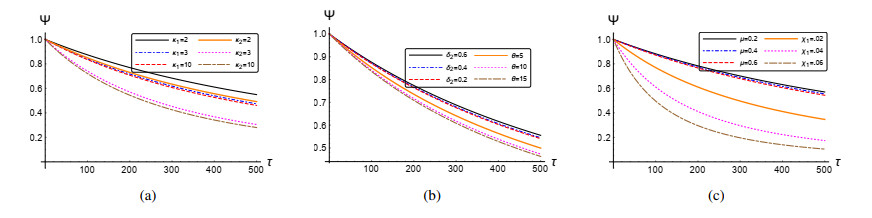
We utilize a fluid kinetic hybrid approach to analyze dust acoustic wave propagation in collisionless, unmagnetized dusty plasmas, specifically investigating how linear Landau damping effects in the ion population affect weakly nonlinear and weakly dispersive wave behavior. An electron-depleted plasma is considered, consisting of a cold fluid of negatively charged dust particles and two types of ions at different temperatures, modelled by a kappa-type distribution. Anticipating nonlinear solitary waves, a reductive perturbation technique is employed, leading to a nonlinear partial differential equation for the electrostatic potential in the form of a modified Korteweg–de Vries (mKdV) equation, featuring an additional term to account for linear Landau damping of the ions. The solitary wave's amplitude is found to decay with time. A parametric analysis is carried out of the impact of the plasma configuration on the Landau damping rate under the influence of this latter (Landau damping-related) term. The results of this work are highlighted in space plasma, such as that around Enceladus and Saturn's E ring, where the occurrence of Landau damping in combination with a nonthermal ion distribution may affect wave propagation significantly.
Citation: Abdulaziz H. Alharbi, M. S. J. Alzahrani, W. M. Moslem, I. S. Elkamash. Landau-damped dust-acoustic solitary waves in nonthermal plasmas[J]. Electronic Research Archive, 2025, 33(10): 6343-6374. doi: 10.3934/era.2025280
We utilize a fluid kinetic hybrid approach to analyze dust acoustic wave propagation in collisionless, unmagnetized dusty plasmas, specifically investigating how linear Landau damping effects in the ion population affect weakly nonlinear and weakly dispersive wave behavior. An electron-depleted plasma is considered, consisting of a cold fluid of negatively charged dust particles and two types of ions at different temperatures, modelled by a kappa-type distribution. Anticipating nonlinear solitary waves, a reductive perturbation technique is employed, leading to a nonlinear partial differential equation for the electrostatic potential in the form of a modified Korteweg–de Vries (mKdV) equation, featuring an additional term to account for linear Landau damping of the ions. The solitary wave's amplitude is found to decay with time. A parametric analysis is carried out of the impact of the plasma configuration on the Landau damping rate under the influence of this latter (Landau damping-related) term. The results of this work are highlighted in space plasma, such as that around Enceladus and Saturn's E ring, where the occurrence of Landau damping in combination with a nonthermal ion distribution may affect wave propagation significantly.

| [1] |
G. Livadiotis, Introduction to special section on origins and properties of kappa distributions: Statistical background and properties of kappa distributions in space plasmas, J. Geophys. Res.: Space Phys., 120 (2015), 1607–16D. https://doi.org/10.1002/2014JA020825 doi: 10.1002/2014JA020825

|
| [2] |
S. Perri, F. Pucci, F. Malara, G. Zimbardo, On the power-law distribution of pitch-angle scattering times in solar wind turbulence, Sol. Phys., 294 (2019), 34. https://doi.org/10.1007/s11207-019-1421-y doi: 10.1007/s11207-019-1421-y
|
| [3] |
S. M. Shaaban, M. Lazar, R. Schlickeiser, Electromagnetic ion cyclotron instability stimulated by the suprathermal ions in space plasmas: A quasi-linear approach, Phys. Plasma, 28 (2021), 022103. https://doi.org/10.1063/5.0035798 doi: 10.1063/5.0035798
|
| [4] |
M. Lemoine, M. A. Malkov, Power-law spectra from stochastic acceleration, Mon. Not. R. Astron. Soc., 499 (2020), 4972–4983. https://doi.org/10.1093/mnras/staa3131 doi: 10.1093/mnras/staa3131
|
| [5] |
N. Kumar, B. Reville, Nonthermal particle acceleration at highly oblique nonrelativistic shocks, Astrophys. J. Lett., 921 (2021), L14. https://doi.org/10.3847/2041-8213/ac30e0 doi: 10.3847/2041-8213/ac30e0
|
| [6] | M. Lazar, H. Fichtner, Kappa Distributions–From Observational Evidences via Controversial Predictions to a Consistent Theory of Nonequilibrium Plasmas, Cham: Springer International Publishing, (2021), 107–123. https://doi.org/10.1007/978-3-030-82623-9 |
| [7] | G. Livadiotis, Kappa Distributions: Theory and Applications in Plasmas, Elsevier, 20B. |
| [8] |
V. Vasyliunas, J. Geophys, A survey of low‐energy electrons in the evening sector of the magnetosphere with OGO 1 and OGO 3, J. Geophys. Res., 73 (1968), 2839–2884. https://doi.org/10.1029/JA073i009p02839 doi: 10.1029/JA073i009p02839
|
| [9] |
V. Pierrard, M. Lazar, Kappa distributions: theory and applications in space plasmas, Sol. Phys., 267 (2010), 153–174. https://doi.org/10.1007/s11207-010-9640-2 doi: 10.1007/s11207-010-9640-2
|
| [10] |
I. Kourakis, S. Sultana, M. A. Hellberg, Dynamical characteristics of solitary waves, shocks and envelope modes in kappa-distributed non-thermal plasmas: an overview, Plasma Phys. Controlled Fusion, 54 (2012), 124001. https://doi.org/10.1088/0741-3335/54/12/124001 doi: 10.1088/0741-3335/54/12/124001
|
| [11] |
I. S. Elkamash, I. Kourakis, Multispecies plasma expansion into vacuum: The role of secondary ions and suprathermal electrons, Phys. Rev. E, 94 (2016), 053202. https://doi.org/10.1103/PhysRevE.94.053202 doi: 10.1103/PhysRevE.94.053202
|
| [12] |
M. Lazar, V. Pierrard, S. M. Shaaban, H. Fichtner, S. Poedts, Dual Maxwellian-Kappa modeling of the solar wind electrons: new clues on the temperature of Kappa populations, Astron. Astrophys., 602 (2017), A44. https://doi.org/10.1051/0004-6361/201630194 doi: 10.1051/0004-6361/201630194
|
| [13] |
G. Slathia, R. Kaur, N. S. Saini, Interaction of ion acoustic multi-solitons in a magnetised superthermal plasma in the presence of dust, Chin. J. Phys., 89 (2024), 302–314. https://doi.org/10.1016/j.cjph.2024.03.029 doi: 10.1016/j.cjph.2024.03.029
|
| [14] |
P. S. Abishek, M. Michael, Ion-acoustic shock waves in a multi-ion plasma of Saturn's magnetosphere with superthermal electrons and ions, Phys. Plasma, 32 (2025), 042301. https://doi.org/10.1063/5.0255531 doi: 10.1063/5.0255531
|
| [15] |
R. Jahangir, S. Ali, B. Eliasson, Beam-driven electron-acoustic waves in auroral region of magnetosphere with superthermal trapped electrons, Phys. Fluids, 37 (2025), 027108. https://doi.org/10.1063/5.0249424 doi: 10.1063/5.0249424
|
| [16] | P. K. Shukla, A. A. Mamun, Introduction to Dusty Plasma Physics, CRC press, 2015. https://doi.org/10.1201/9781420034103 |
| [17] | F. Verheest, Waves in Dusty Space Plasmas, Springer Dordrecht, 2000. https://doi.org/10.1007/978-94-010-9945-5 |
| [18] |
R. Merlino, Dusty plasmas: from Saturn's rings to semiconductor processing devices, Adv. Phys.: X, 6 (2021), 1873859. https://doi.org/10.1080/23746149.2021.1873859 doi: 10.1080/23746149.2021.1873859
|
| [19] |
A. A. Mamun, The new physics of dust in plasmas, J. Phys. Conf. Ser., 1718 (2021), 012004. https://doi.org/10.1088/1742-6596/1718/1/012004 doi: 10.1088/1742-6596/1718/1/012004
|
| [20] | C. Y. Chang, ULSI Technology, McGraw-Hill, 1996. |
| [21] | D. M. Manos, D. L. Flamm, Plasma Etching: An Introduction, Academic Press, 1989. |
| [22] | M. A. Lieberman, A. J. Lichtenberg, Principles of Plasma Discharges and Materials Processing, John Wiley & Sons, 2005. https://doi.org/10.1002/0471724254 |
| [23] |
N. N. Rao, P. K. Shukla, M. Y. Yu, Dust-acoustic waves in dusty plasmas, Planet. Space Sci., 38 (1990), 543–546. https://doi.org/10.1016/0032-0633(90)90147-I doi: 10.1016/0032-0633(90)90147-I
|
| [24] | P. K. Shukla, V. P. Silin, Dust ion-acoustic wave, Phys. Scr., 45 (1992), 508. https://doi.org/10.1088/0031-8949/45/5/015 |
| [25] |
M. Rosenberg, R. L. Merlino, Ion-acoustic instability in a dusty negative ion plasma, Planet. Space Sci., 55 (2007), 1464–1469. https://doi.org/10.1016/j.pss.2007.04.012 doi: 10.1016/j.pss.2007.04.012
|
| [26] |
A. P. Misra, N. C. Adhikary, P. K. Shukla, Ion-acoustic solitary waves and shocks in a collisional dusty negative-ion plasma, Phys. Rev. E, 86 (2012), 056406. https://doi.org/10.1103/PhysRevE.86.056406 doi: 10.1103/PhysRevE.86.056406
|
| [27] |
I. S. Elkamash, I. Kourakis, Electrostatic shock structures in dissipative multi-ion dusty plasmas, Phys. Plasma, 25 (2018), 062104. https://doi.org/10.1063/1.5029322 doi: 10.1063/1.5029322
|
| [28] |
I. S. Elkamash, Electrostatic solitary structures in warm multi-ion dusty plasmas: The effect of an external magnetic field and nonthermal electrons, Phys. Plasma, 27 (2020), 022112. https://doi.org/10.1063/1.5139195 doi: 10.1063/1.5139195
|
| [29] |
S. K. Mishra, On the possibility of dust acoustic waves over sunlit lunar surface, Mon. Not. R. Astron. Soc., 503 (2021), 3965–3974. https://doi.org/10.1093/mnras/stab495 doi: 10.1093/mnras/stab495
|
| [30] |
B. T. Tsurutani, G. S. Lakhina, Some basic concepts of wave‐particle interactions in collisionless plasmas, Rev. Geophys., 35 (1997), 491–501. https://doi.org/10.1029/97RG02200 doi: 10.1029/97RG02200
|
| [31] |
A. Antoniazzi, G. D. Ninno, D. Fanelli, A. Guarino, S. Ruko, Wave-particle interaction: from plasma physics to the free-electron laser, J. Phys. Conf. Ser., 7 (2005), 143. https://doi.org/10.1088/1742-6596/7/1/012 doi: 10.1088/1742-6596/7/1/012
|
| [32] |
R. Koch, Wave–particle interactions in plasmas, Plasma Phys. Controlled Fusion, 48 (2006), B329. https://doi.org/10.1088/0741-3335/48/12B/S31 doi: 10.1088/0741-3335/48/12B/S31
|
| [33] |
A. P. Misra, G. Brodin, Wave-particle interactions in quantum plasmas, Rev. Mod. Plasma Phys., 6 (2022), 5. https://doi.org/10.1007/s41614-022-00063-7 doi: 10.1007/s41614-022-00063-7
|
| [34] | L. D. Landau, On the vibrations of the electronic plasma, in Collected Papers of L.D. Landau, (1965), 445–460. https://doi.org/10.1016/B978-0-08-010586-4.50066-3 |
| [35] |
E. Ott, R. Sudan, Nonlinear theory of ion acoustic waves with Landau damping, Phys. Fluids, 12 (1969), 2388–2394. https://doi.org/10.1063/1.1692358 doi: 10.1063/1.1692358
|
| [36] |
A. Bandyopadhyay, K. P. Das, Effect of Landau damping on ion-acoustic solitary waves in a magnetized nonthermal plasma with warm ions, Phys. Plasma, 9 (2002), 465–473. https://doi.org/10.1063/1.1427022 doi: 10.1063/1.1427022
|
| [37] |
A. Bandyopadhyay, K. P. Das, Effect of Landau damping on kinetic Alfven and ion-acoustic solitary waves in a magnetized nonthermal plasma with warm ions, Phys. Plasmas, 9 (2002), 3333–3340. https://doi.org/10.1063/1.1490132 doi: 10.1063/1.1490132
|
| [38] |
Y. Saitou, Y. Nakamura, Ion-acoustic soliton-like waves undergoing Landau damping, Phys. Lett. A, 343 (2005), 397–402. https://doi.org/10.1016/j.physleta.2005.06.035 doi: 10.1016/j.physleta.2005.06.035
|
| [39] |
S. Ghosh, R. Bharuthram, Ion acoustic solitary wave in electron-positron-ion plasma: effect of Landau damping, Astrophys. Space Sci., 331 (2011), 163–168. https://doi.org/10.1007/s10509-010-0443-6 doi: 10.1007/s10509-010-0443-6
|
| [40] |
A. Barman, A. P. Misra, Landau damping effects on dust-acoustic solitary waves in a dusty negative-ion plasma, Phys. Plasma, 21 (2014), 073708. https://doi.org/10.1063/1.4890571 doi: 10.1063/1.4890571
|
| [41] |
A. Barman, A. P. Misra, Effects of Landau damping on ion-acoustic solitary waves in a semiclassical plasma, Phys. Plasma, 24 (2017), 052116. https://doi.org/10.1063/1.4983308 doi: 10.1063/1.4983308
|
| [42] |
A. Sikdar, M. Khan, Effects of Landau damping on finite amplitude low-frequency nonlinear waves in a dusty plasma, J. Theor. Appl. Phys., 11 (2017), 137–142. https://doi.org/10.1007/s40094-017-0248-x doi: 10.1007/s40094-017-0248-x
|
| [43] |
Y. Ghai, N. S. Saini, B. Eliasson, Landau damping of dust acoustic solitary waves in nonthermal plasmas, Phys. Plasma, 25 (2018), 013704. https://doi.org/10.1063/1.5011005 doi: 10.1063/1.5011005
|
| [44] |
S. Dalui, A. Bandyopadhyay, Effect of Landau damping on ion acoustic solitary waves in a collisionless unmagnetized plasma consisting of nonthermal and isothermal electrons, Indian J. Phys., 95 (2021), 367–381. https://doi.org/10.1007/s12648-020-01731-5 doi: 10.1007/s12648-020-01731-5
|
| [45] |
A. Misra, D. Chatterjee, G. Brodin, Landau damping of electron-acoustic waves due to multi-plasmon resonances, Phys. Plasma, 28 (2021), 112102. https://doi.org/10.1063/5.0061716 doi: 10.1063/5.0061716
|
| [46] |
H. Mushtaq, K. Singh, S. Zaheer, I. Kourakis, Nonlinear ion-acoustic waves with Landau damping in non-Maxwellian space plasmas, Sci. Rep., 14 (2024), 13005. https://doi.org/10.1038/s41598-024-63773-7 doi: 10.1038/s41598-024-63773-7
|
| [47] |
J. E. Wahlund, M. Andre, A. I. E. Eriksson, M. Lundberg, M. W. Morooka, M. Shafq, et al., Detection of dusty plasma near the E-ring of Saturn, Planet. Space Sci., 57 (2009), 1795–1806. https://doi.org/10.1016/j.pss.2009.03.011 doi: 10.1016/j.pss.2009.03.011
|
| [48] | M. W. Morooka, J. E. Wahlund, A. I. Eriksson, W. M. Farrell, D. A. Gurnett, W. S. Kurth, et al., Dusty plasma in the vicinity of Enceladus, J. Geophys. Res.: Space Phys., 116 (2011). https://doi.org/10.1029/2011JA017038 |
| [49] |
D. T. Young, J. Berthelier, M. Blanc, J. L. Burch, A. J. Coates, R. Goldstein, et al., Cassini plasma spectrometer investigation, Space Sci. Rev., 114 (2004), 1–112. https://doi.org/10.1007/s11214-004-1406-4 doi: 10.1007/s11214-004-1406-4
|
| [50] |
D. A. Gurnett, W. S. Kurth, D. L. Kirchner, G. B. Hospodarsky, T. F. Averkamp, P. Zarka, et al., The Cassini radio and plasma wave investigation, Space Sci. Rev., 114 (2004), 395–463. https://doi.org/10.1007/s11214-004-1434-0 doi: 10.1007/s11214-004-1434-0
|
| [51] |
R. Srama, T. J. Ahrens, N. Altobelli, S. Auer, J. G. Bradley, M. Burton, et al., The Cassini cosmic dust analyzer, Space Sci. Rev., 114 (2004), 465–5C. https://doi.org/10.1007/s11214-004-1435-z doi: 10.1007/s11214-004-1435-z
|
| [52] |
C. C. Porco, P. Helfenstein, P. C. Thomas, A. P. Ingersoll, J. Wisdom, R. West, et al., Cassini observes the active south pole of Enceladus, Science, 311 (2006), 1393–1401. https://doi.org/10.1126/science.1123013 doi: 10.1126/science.1123013
|
| [53] |
M. K. Dougherty, K. K. Khurana, F. M. Neubauer, C. T. Russell, J. Saur, J. S. Leisner, et al., Identification of a dynamic atmosphere at Enceladus with the Cassini magnetometer, Science, 311 (2006), 1406–1409. https://doi.org/10.1126/science.1120985 doi: 10.1126/science.1120985
|
| [54] |
J. H. Waite, M. R. Combi, W. H. Ip, T. E. Cravens, R. L. McNutt, W. Kasprzak, et al., Cassini ion and neutral mass spectrometer: Enceladus plume composition and structure, Science, 311 (2006), 1419–1422. https://doi.org/10.1126/science.1121290 doi: 10.1126/science.1121290
|
| [55] |
R. L. Tokar, R. E. Johnson, M. F. Thomsen, D. H. Pontius, W. S. Kurth, F. J. Crary, et al., The interaction of the atmosphere of Enceladus with Saturn's plasma, Science, 311 (2006), 1409–1412. https://doi.org/10.1126/science.1121061 doi: 10.1126/science.1121061
|
| [56] |
F Spahn, J. Schmidt, N. Albers, M. Hörning, M. Makuch, M. Seiss, et al., Cassini dust measurements at Enceladus and implications for the origin of the E ring, Science, 311 (2006), 1416–14C. https://doi.org/10.1126/science.1121375 doi: 10.1126/science.1121375
|
| [57] |
G. Livadiotis, D. J. McComas, Understanding kappa distributions: A toolbox for space science and astrophysics, Space Sci. Rev., 175 (2013), 183–214. https://doi.org/10.1007/s11214-013-9982-9 doi: 10.1007/s11214-013-9982-9
|
Figures(3) / Tables(1)
Abdulaziz H. Alharbi, M. S. J. Alzahrani, W. M. Moslem, I. S. Elkamash. Landau-damped dust-acoustic solitary waves in nonthermal plasmas[J]. Electronic Research Archive, 2025, 33(10): 6343-6374. doi: 10.3934/era.2025280





 DownLoad: