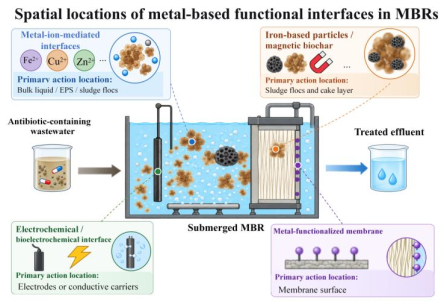
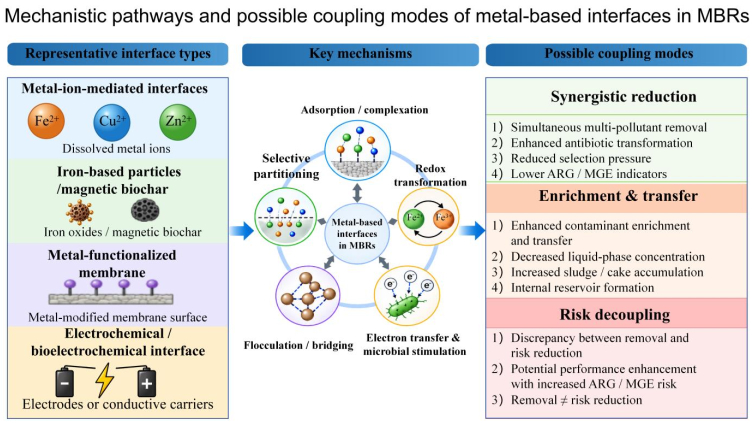
The coexistence of antibiotics, heavy metals, and antibiotic resistance genes (ARGs) in antibiotic-containing wastewater poses a coupled challenge for membrane bioreactors (MBRs): Treatment performance must improve without shifting environmental risk elsewhere in the system. In this review, we examined how metal-based functional interfaces influence antibiotic removal, membrane fouling, and antibiotic-resistance risks in MBRs. Metal ions, iron-based particles, functionalized membranes, and electrochemical or bioelectrochemical interfaces can enhance pollutant removal and operational stability through coagulation and adsorption, redox reactions, electron transfer, and regulation of membrane-surface interactions. However, lower concentrations of parent antibiotics or lower ARG abundances in the effluent do not necessarily reflect genuine degradation or reduced environmental risk. Pollutants and resistance determinants may accumulate in sludge, cake layers, and membrane biofilms, while metal-induced selection can favor co-resistance and cross-resistance and trigger co-regulatory responses. We proposed an integrated assessment framework that considers pollutant transformation, membrane operation, metal release, the spatial distribution of resistance determinants, and their potential for dissemination. This framework provides a basis for evaluating the long-term safety of metal-based functional interfaces in MBRs.
Citation: Zihao Liu, Mingchao Zhu, Shuping Li. Metal-based functional interfaces in membrane bioreactors for antibiotic-containing wastewater: Performance benefits and antibiotic resistance risks[J]. AIMS Environmental Science, 2026, 13(5): 936-975. doi: 10.3934/environsci.2026037
The coexistence of antibiotics, heavy metals, and antibiotic resistance genes (ARGs) in antibiotic-containing wastewater poses a coupled challenge for membrane bioreactors (MBRs): Treatment performance must improve without shifting environmental risk elsewhere in the system. In this review, we examined how metal-based functional interfaces influence antibiotic removal, membrane fouling, and antibiotic-resistance risks in MBRs. Metal ions, iron-based particles, functionalized membranes, and electrochemical or bioelectrochemical interfaces can enhance pollutant removal and operational stability through coagulation and adsorption, redox reactions, electron transfer, and regulation of membrane-surface interactions. However, lower concentrations of parent antibiotics or lower ARG abundances in the effluent do not necessarily reflect genuine degradation or reduced environmental risk. Pollutants and resistance determinants may accumulate in sludge, cake layers, and membrane biofilms, while metal-induced selection can favor co-resistance and cross-resistance and trigger co-regulatory responses. We proposed an integrated assessment framework that considers pollutant transformation, membrane operation, metal release, the spatial distribution of resistance determinants, and their potential for dissemination. This framework provides a basis for evaluating the long-term safety of metal-based functional interfaces in MBRs.

| [1] |
Baker-Austin C, Wright MS, Stepanauskas R, et al. (2006) Co-selection of antibiotic and metal resistance. Trends Microbiol 14: 176–182. https://doi.org/10.1016/j.tim.2006.02.006 doi: 10.1016/j.tim.2006.02.006

|
| [2] |
Seiler C, Berendonk TU (2012) Heavy metal driven co-selection of antibiotic resistance in soil and water bodies impacted by agriculture and aquaculture. Front Microbiol 3: 399. https://doi.org/10.3389/fmicb.2012.00399 doi: 10.3389/fmicb.2012.00399
|
| [3] |
Kümmerer K (2009) Antibiotics in the aquatic environment—A review—Part Ⅰ. Chemosphere 75: 417–434. https://doi.org/10.1016/j.chemosphere.2008.11.086 doi: 10.1016/j.chemosphere.2008.11.086
|
| [4] |
Yu T, Al-Dhabi NA, Xing W, et al. (2025) Highly efficient antibiotic decontamination and biotoxicity elimination with activity-stability considerations via encapsulated catalyst induced peroxymonosulfate activation. J Environ Manage 396: 128078. https://doi.org/10.1016/j.jenvman.2025.128078 doi: 10.1016/j.jenvman.2025.128078
|
| [5] |
Li X, Xing W, Al-Dhabi NA, et al. (2026) Encapsulated nanoconfined microenvironment and fluorine coordination boost selective peroxymonosulfate activation toward Co(Ⅳ) = O dominated high-efficiency pollutant degradation and biotoxicity abatement. Adv Funct Mater 36: e75641. https://doi.org/10.1002/adfm.75641 doi: 10.1002/adfm.75641
|
| [6] |
Zhu YG, Johnson TA, Su JQ, et al. (2013) Diverse and abundant antibiotic resistance genes in Chinese swine farms. P Natl Acad Sci USA 110: 3435–3440. https://doi.org/10.1073/pnas.1222743110 doi: 10.1073/pnas.1222743110
|
| [7] |
Michael I, Rizzo L, McArdell CS, et al. (2013) Urban wastewater treatment plants as hotspots for the release of antibiotics in the environment: A review. Water Res 47: 957–995. https://doi.org/10.1016/j.watres.2012.11.027 doi: 10.1016/j.watres.2012.11.027
|
| [8] |
Rizzo L, Manaia CM, Merlin C, et al. (2013) Urban wastewater treatment plants as hotspots for antibiotic resistant bacteria and genes spread into the environment: A review. Sci Total Environ 447: 345–360. https://doi.org/10.1016/j.scitotenv.2013.01.032 doi: 10.1016/j.scitotenv.2013.01.032
|
| [9] |
Karkman A, Do TT, Walsh F, et al. (2018) Antibiotic-resistance genes in waste water. Trends Microbiol 26: 220–228. https://doi.org/10.1016/j.tim.2017.09.005 doi: 10.1016/j.tim.2017.09.005
|
| [10] |
Ji X, Shen Q, Liu F, et al. (2012) Antibiotic resistance gene abundances associated with antibiotics and heavy metals in animal manures and agricultural soils adjacent to feedlots in Shanghai, China. J Hazard Mater 235–236: 178–185. https://doi.org/10.1016/j.jhazmat.2012.07.040 doi: 10.1016/j.jhazmat.2012.07.040
|
| [11] |
Radjenović J, Petrović M, Barceló D (2009) Fate and distribution of pharmaceuticals in wastewater and sewage sludge of the conventional activated sludge (CAS) and advanced membrane bioreactor (MBR) treatment. Water Res 43: 831–841. https://doi.org/10.1016/j.watres.2008.11.043 doi: 10.1016/j.watres.2008.11.043
|
| [12] |
Clara M, Strenn B, Kreuzinger N (2004) Carbamazepine as a possible anthropogenic marker in the aquatic environment: Investigations on the behaviour of carbamazepine in wastewater treatment and during groundwater infiltration. Water Res 38: 947–954. https://doi.org/10.1016/j.watres.2003.10.058 doi: 10.1016/j.watres.2003.10.058
|
| [13] | Hai FI, Yamamoto K, Lee CH (2014) Membrane biological reactors: Theory, modeling, design, management and applications to wastewater reuse. London: IWA Publishing. https://doi.org/10.2166/9781780401331 |
| [14] | Judd S (2011) The MBR book: Principles and applications of membrane bioreactors for water and wastewater treatment. 2 Eds., Oxford: Butterworth-Heinemann. |
| [15] |
Meng F, Chae SR, Drews A, et al. (2009) Recent advances in membrane bioreactors (MBRs): Membrane fouling and membrane material. Water Res 43: 1489–1512. https://doi.org/10.1016/j.watres.2008.12.044 doi: 10.1016/j.watres.2008.12.044
|
| [16] |
Zhu YJ, Wang YY, Zhou S, et al. (2018) Robust performance of a membrane bioreactor for removing antibiotic resistance genes exposed to antibiotics: Role of membrane foulants. Water Res 130: 139–150. https://doi.org/10.1016/j.watres.2017.11.067 doi: 10.1016/j.watres.2017.11.067
|
| [17] |
Zhang L, Bai R, Zhang J, et al. (2025) Fe3+ addition as a promising strategy to enhance the pollutant removal performance and mitigate the membrane fouling of a laboratory-scale membrane bioreactor treating sulfamethoxazole wastewater. Environ Res 274: 121284. https://doi.org/10.1016/j.envres.2025.121284 doi: 10.1016/j.envres.2025.121284
|
| [18] |
Madsen JS, Burmølle M, Hansen LH, et al. (2012) The interconnection between biofilm formation and horizontal gene transfer. FEMS Immunol Med Mic 65: 183–195. https://doi.org/10.1111/j.1574-695x.2012.00960.x doi: 10.1111/j.1574-695x.2012.00960.x
|
| [19] |
Wang Z, Wu Z, Tang S (2009) Extracellular polymeric substances (EPS) properties and their effects on membrane fouling in a submerged membrane bioreactor. Water Res 43: 2504–2512. https://doi.org/10.1016/j.watres.2009.02.026 doi: 10.1016/j.watres.2009.02.026
|
| [20] |
Jarusutthirak C, Amy G (2007) Understanding soluble microbial products (SMP) as a component of effluent organic matter (EfOM). Water Res 41: 2787–2793. https://doi.org/10.1016/j.watres.2007.03.005 doi: 10.1016/j.watres.2007.03.005
|
| [21] |
Maneewan P, Sajomsang W, Singto S, et al. (2021) Fouling mitigation in an anaerobic membrane bioreactor via membrane surface modification with tannic acid and copper. Environ Pollut 291: 118205. https://doi.org/10.1016/j.envpol.2021.118205 doi: 10.1016/j.envpol.2021.118205
|
| [22] |
Chen LL, Cheng PJ, Ye L, et al. (2020) Biological performance and fouling mitigation in the biochar-amended anaerobic membrane bioreactor (AnMBR) treating pharmaceutical wastewater. Bioresource Technol 302: 122805. https://doi.org/10.1016/j.biortech.2020.122805 doi: 10.1016/j.biortech.2020.122805
|
| [23] |
Liu WC, Xia RH, Ding XR, et al. (2022) Impacts of nano-zero-valent iron on antibiotic removal by anaerobic membrane bioreactor for swine wastewater treatment. J Membrane Sci 659: 120762. https://doi.org/10.1016/j.memsci.2022.120762 doi: 10.1016/j.memsci.2022.120762
|
| [24] |
Wang KM, Ma H, Shen YX, et al. (2023) Magnetic biochar derived from peanut shells facilitates antibiotic degradation and fouling control in anaerobic membrane bioreactor for antibiotic pharmaceutical wastewater treatment. J Water Process Eng 55: 104249. https://doi.org/10.1016/j.jwpe.2023.104249 doi: 10.1016/j.jwpe.2023.104249
|
| [25] |
Liu SJ, Wang N, Li Y, et al. (2025) Magnetic biochar-mediated iron reduction synergizes with microbial co-metabolism for enhanced adsorption and in-situ degradation of sulfamethoxazole. Chem Eng J 523: 168620. https://doi.org/10.1016/j.cej.2025.168620 doi: 10.1016/j.cej.2025.168620
|
| [26] | Zhu X, Yang X, Zang L, et al. (2023) Carbon nano-onions as artificial conductive pili enhanced chloramphenicol degradation in anaerobic membrane bioreactor but increased intI1 abundance. Water Res 242: 120263. |
| [27] |
Huang SJ, Shi XQ, Bi XJ, et al. (2019) Effect of ferric hydroxide on membrane fouling in membrane bioreactor treating pharmaceutical wastewater. Bioresource Technol 292: 121852. https://doi.org/10.1016/j.biortech.2019.121852 doi: 10.1016/j.biortech.2019.121852
|
| [28] |
Zhang J, Chua HC, Zhou J, et al. (2006) Factors affecting the membrane performance in submerged membrane bioreactors. J Membrane Sci 284: 54–66. https://doi.org/10.1016/j.memsci.2006.06.022 doi: 10.1016/j.memsci.2006.06.022
|
| [29] |
Yan L, Yin M, Jiao Y, et al. (2023) The presence of copper ions alters tetracycline removal pathway in aerobic granular sludge: Performance and mechanism. Bioresource Technol 385: 129446. https://doi.org/10.1016/j.biortech.2023.129446 doi: 10.1016/j.biortech.2023.129446
|
| [30] |
Sheng GP, Yu HQ, Li XY (2010) Extracellular polymeric substances (EPS) of microbial aggregates in biological wastewater treatment systems: A review. Biotechnol Adv 28: 882–894. https://doi.org/10.1016/j.biotechadv.2010.08.001 doi: 10.1016/j.biotechadv.2010.08.001
|
| [31] |
He HY, Xin XD, Qiu W, et al. (2022) Role of nano-Fe3O4 particle on improving membrane bioreactor (MBR) performance: Alleviating membrane fouling and microbial mechanism. Water Res 209: 117897. https://doi.org/10.1016/j.watres.2021.117897 doi: 10.1016/j.watres.2021.117897
|
| [32] |
Chen M, Xu J, Dai R, et al. (2019) Development of a moving-bed electrochemical membrane bioreactor to enhance removal of low-concentration antibiotic from wastewater. Bioresource Technol 293: 122022. https://doi.org/10.1016/j.biortech.2019.122022 doi: 10.1016/j.biortech.2019.122022
|
| [33] |
Xue Y, Cheng YF, Wang QR, et al. (2024) Simultaneous removal of ammonia nitrogen, sulfamethoxazole, and antibiotic resistance genes in self-corrosion microelectrolysis-enhanced counter-diffusion biofilm system. Bioresource Technol 412: 131399. https://doi.org/10.1016/j.biortech.2024.131399 doi: 10.1016/j.biortech.2024.131399
|
| [34] |
Li ZH, Yuan L, Yang CW, et al. (2022) Anaerobic electrochemical membrane bioreactor effectively mitigates antibiotic resistance genes proliferation under high antibiotic selection pressure. Environ Int 166: 107381. https://doi.org/10.1016/j.envint.2022.107381 doi: 10.1016/j.envint.2022.107381
|
| [35] |
Li ZH, Yuan L, Wang L, et al. (2022) Coexistence of silver ion and tetracycline at environmentally relevant concentrations greatly enhanced antibiotic resistance gene development in activated sludge bioreactor. J Hazard Mater 423: 127088. https://doi.org/10.1016/j.jhazmat.2021.127088 doi: 10.1016/j.jhazmat.2021.127088
|
| [36] |
Chen M, Ren L, Qi K, et al. (2020) Enhanced removal of pharmaceuticals and personal care products from real municipal wastewater using an electrochemical membrane bioreactor. Bioresource Technol 311: 123579. https://doi.org/10.1016/j.biortech.2020.123579 doi: 10.1016/j.biortech.2020.123579
|
| [37] |
Kinfu HH, Rahman MM (2023) Separation performance of membranes containing ultrathin surface coating of metal-polyphenol network. Membranes 13: 481. https://doi.org/10.3390/membranes13050481 doi: 10.3390/membranes13050481
|
| [38] |
Zhang XR, Guo Y, Wang TL, et al. (2020) Antibiofouling performance and mechanisms of a modified polyvinylidene fluoride membrane in an MBR for wastewater treatment: Role of silver@silica nanopollens. Water Res 176: 115749. https://doi.org/10.1016/j.watres.2020.115749 doi: 10.1016/j.watres.2020.115749
|
| [39] |
Zhou HM, Dai RB, Wang TL, et al. (2022) Enhancing stability of tannic acid-FeⅢ nanofiltration membrane for water treatment: Intercoordination by metal–organic framework. Environ Sci Technol 56: 17266–17277. https://doi.org/10.1021/acs.est.2c05048 doi: 10.1021/acs.est.2c05048
|
| [40] |
Yu SJ, Pang HW, Huang SY, et al. (2021) Recent advances in metal-organic framework membranes for water treatment: A review. Sci Total Environ 800: 149662. https://doi.org/10.1016/j.scitotenv.2021.149662 doi: 10.1016/j.scitotenv.2021.149662
|
| [41] |
Wu H, Xu XY, Shi L, et al. (2019) Manganese oxide integrated catalytic ceramic membrane for degradation of organic pollutants using sulfate radicals. Water Res 167: 115110. https://doi.org/10.1016/j.watres.2019.115110 doi: 10.1016/j.watres.2019.115110
|
| [42] |
Hirani RAK, Wu H, Asif AH, et al. (2023) Cobalt oxide functionalized ceramic membrane for 4-hydroxybenzoic acid degradation via peroxymonosulfate activation. J Hazard Mater 448: 130874. https://doi.org/10.1016/j.jhazmat.2023.130874 doi: 10.1016/j.jhazmat.2023.130874
|
| [43] |
Zang L, Yang XL, Xu H, et al. (2024) A novel integrated microbial fuel cell-membrane bioreactor (MFC-MBR) for controlling the spread of antibiotic and antibiotic resistance genes while simultaneously alleviating membrane fouling. Chem Eng J 487: 150578. https://doi.org/10.1016/j.cej.2024.150578 doi: 10.1016/j.cej.2024.150578
|
| [44] |
Li T, Yang XL, Qin CY, et al. (2024) Role of membrane fouling layer in microbial fuel cell-membrane bioreactor (MFC-MBR) for controlling sulfamethoxazole and corresponding resistance genes. J Environ Manage 366: 121876. https://doi.org/10.1016/j.jenvman.2024.121876 doi: 10.1016/j.jenvman.2024.121876
|
| [45] |
Zang L, Yang XL, Xu H, et al. (2023) Alleviating membrane fouling by enhanced bioelectricity generation via internal reflux of sludge mixed liquor in microbial fuel cell-membrane bioreactor (MFC-MBR) coupling system. J Membr Sci 673: 121495. https://doi.org/10.1016/j.memsci.2023.121495 doi: 10.1016/j.memsci.2023.121495
|
| [46] |
Chen P, Guo XY, Li SN, et al. (2021) A review of the bioelectrochemical system as an emerging versatile technology for reduction of antibiotic resistance genes. Environ Int 156: 106689. https://doi.org/10.1016/j.envint.2021.106689 doi: 10.1016/j.envint.2021.106689
|
| [47] |
Xue W, Li F, Zhou Q (2019) Degradation mechanisms of sulfamethoxazole and its induction of bacterial community changes and antibiotic resistance genes in a microbial fuel cell. Bioresource Technol 289: 121632. https://doi.org/10.1016/j.biortech.2019.121632 doi: 10.1016/j.biortech.2019.121632
|
| [48] |
Yan WF, Guo YY, Xiao Y, et al. (2018) The changes of bacterial communities and antibiotic resistance genes in microbial fuel cells during long-term oxytetracycline processing. Water Res 142: 105–114. https://doi.org/10.1016/j.watres.2018.05.047 doi: 10.1016/j.watres.2018.05.047
|
| [49] |
Flemming HC, Wingender J (2010) The biofilm matrix. Nat Rev Microbiol 8: 623–633. https://doi.org/10.1038/nrmicro2415 doi: 10.1038/nrmicro2415
|
| [50] |
Stefaniuk M, Oleszczuk P, Ok YS (2016) Review on nano zerovalent iron (nZVI): From synthesis to environmental applications. Chem Eng J 287: 618–632. https://doi.org/10.1016/j.cej.2015.11.046 doi: 10.1016/j.cej.2015.11.046
|
| [51] |
Ikuma K, Decho AW, Lau BLT (2015) When nanoparticles meet biofilms—Interactions guiding the environmental fate and accumulation of nanoparticles. Front Microbiol 6: 591. https://doi.org/10.3389/fmicb.2015.00591 doi: 10.3389/fmicb.2015.00591
|
| [52] |
Fulaz S, Vitale S, Quinn L, et al. (2019) Nanoparticle–biofilm interactions: The role of the EPS matrix. Trends Microbiol 27: 915–926. https://doi.org/10.1016/j.tim.2019.07.004 doi: 10.1016/j.tim.2019.07.004
|
| [53] |
Whitchurch CB, Tolker-Nielsen T, Ragas PC, et al. (2002) Extracellular DNA required for bacterial biofilm formation. Science 295: 1487. https://doi.org/10.1126/science.295.5559.1487 doi: 10.1126/science.295.5559.1487
|
| [54] |
Mulcahy H, Charron-Mazenod L, Lewenza S (2008) Extracellular DNA chelates cations and induces antibiotic resistance in Pseudomonas aeruginosa biofilms. PLoS Pathog 4: e1000213. https://doi.org/10.1371/journal.ppat.1000213 doi: 10.1371/journal.ppat.1000213
|
| [55] |
Sheng Z, Liu Y (2011) Effects of silver nanoparticles on wastewater biofilms. Water Res 45: 6039–6050. https://doi.org/10.1016/j.watres.2011.08.065 doi: 10.1016/j.watres.2011.08.065
|
| [56] |
Gao WJ, Lin HJ, Leung KT, et al. (2011) Structure of cake layer in a submerged anaerobic membrane bioreactor. J Membrane Sci 374: 110–120. https://doi.org/10.1016/j.memsci.2011.03.019 doi: 10.1016/j.memsci.2011.03.019
|
| [57] |
Matar GK, Bagchi S, Zhang K, et al. (2017) Membrane biofilm communities in full-scale membrane bioreactors are not randomly assembled and consist of a core microbiome. Water Res 123: 124–133. https://doi.org/10.1016/j.watres.2017.06.052 doi: 10.1016/j.watres.2017.06.052
|
| [58] |
Cheng QQ, Lee S, Ren XH, et al. (2024) Spatial variability of cake layer in membrane fouling of full-scale MBR: New insights and implications. J Environ Chem Eng 12: 114126. https://doi.org/10.1016/j.jece.2024.114126 doi: 10.1016/j.jece.2024.114126
|
| [59] |
Sun M, Yan L, Zhang L, et al. (2019) New insights into the rapid formation of initial membrane fouling after in-situ cleaning in a membrane bioreactor. Process Biochem 78: 108–113. https://doi.org/10.1016/j.procbio.2019.01.004 doi: 10.1016/j.procbio.2019.01.004
|
| [60] |
Navarro RR, Hori T, Inaba T, et al. (2016) High-resolution phylogenetic analysis of residual bacterial species of fouled membranes after NaOCl cleaning. Water Res 94: 166–175. https://doi.org/10.1016/j.watres.2016.02.044 doi: 10.1016/j.watres.2016.02.044
|
| [61] |
Wang H, Ma D, Shi W, et al. (2021) Formation of disinfection by-products during sodium hypochlorite cleaning of fouled membranes from membrane bioreactors. Front Env Sci Eng 15: 102. https://doi.org/10.1007/s11783-021-1389-3 doi: 10.1007/s11783-021-1389-3
|
| [62] |
Kappell AD, Kimbell LK, Seib MD, et al. (2018) Removal of antibiotic resistance genes in an anaerobic membrane bioreactor treating primary clarifier effluent at 20 ℃. Environ Sci-Wat Res 4: 1783–1793. https://doi.org/10.1039/C8EW00270C doi: 10.1039/C8EW00270C
|
| [63] |
Zarei-Baygi A, Smith AL (2021) Intracellular versus extracellular antibiotic resistance genes in the environment: Prevalence, horizontal transfer, and mitigation strategies. Bioresource Technol 319: 124181. https://doi.org/10.1016/j.biortech.2020.124181 doi: 10.1016/j.biortech.2020.124181
|
| [64] |
Zarei-Baygi A, Wang P, Harb M, et al. (2020) Membrane fouling inversely impacts intracellular and extracellular antibiotic resistance gene abundances in the effluent of an anaerobic membrane bioreactor. Environ Sci Technol 54: 12742–12751. https://doi.org/10.1021/acs.est.0c04787 doi: 10.1021/acs.est.0c04787
|
| [65] |
Harb M, Zarei-Baygi A, Wang P, et al. (2021) Antibiotic transformation in an anaerobic membrane bioreactor linked to membrane biofilm microbial activity. Environ Res 200: 111456. https://doi.org/10.1016/j.envres.2021.111456 doi: 10.1016/j.envres.2021.111456
|
| [66] |
Wang KM, Zhou LX, Meng SH, et al. (2023) Anaerobic membrane bioreactor for real antibiotic pharmaceutical wastewater treatment: Positive effect of fouling layer on antibiotics and antibiotic resistance genes removals. J Clean Prod 409: 137234. https://doi.org/10.1016/j.jclepro.2023.137234 doi: 10.1016/j.jclepro.2023.137234
|
| [67] |
Molin S, Tolker-Nielsen T (2003) Gene transfer occurs with enhanced efficiency in biofilms and induces enhanced stabilisation of the biofilm structure. Curr Opin Biotech 14: 255–261. https://doi.org/10.1016/s0958-1669(03)00036-3 doi: 10.1016/s0958-1669(03)00036-3
|
| [68] |
Song YM, Li Y, Li MY, et al. (2026) Fouling layer as a selective reservoir of antibiotic resistance genes: Enrichment and constrained mobility in a methylotrophic anaerobic membrane bioreactor. J Membrane Sci 752: 125633. https://doi.org/10.1016/j.memsci.2026.125633 doi: 10.1016/j.memsci.2026.125633
|
| [69] |
Stepanauskas R, Glenn TC, Jagoe CH, et al. (2005) Elevated microbial tolerance to metals and antibiotics in metal-contaminated industrial environments. Environ Sci Technol 39: 3671–3678. https://doi.org/10.1021/es048468f doi: 10.1021/es048468f
|
| [70] |
Wales AD, Davies RH (2015) Co-selection of resistance to antibiotics, biocides and heavy metals, and its relevance to foodborne pathogens. Antibiotics 4: 567–604. https://doi.org/10.3390/antibiotics4040567 doi: 10.3390/antibiotics4040567
|
| [71] |
Berendonk TU, Manaia CM, Merlin C, et al. (2015) Tackling antibiotic resistance: The environmental framework. Nat Rev Microbiol 13: 310–317. https://doi.org/10.1038/nrmicro3439 doi: 10.1038/nrmicro3439
|
| [72] |
Li LG, Xia Y, Zhang T (2017) Co-occurrence of antibiotic and metal resistance genes revealed in complete genome collection. ISME J 11: 651–662. https://doi.org/10.1038/ismej.2016.155 doi: 10.1038/ismej.2016.155
|
| [73] |
Pal C, Asiani K, Arya S, et al. (2017) Metal resistance and its association with antibiotic resistance. Adv Microb Physiol 70: 261–313. https://doi.org/10.1016/bs.ampbs.2017.02.001 doi: 10.1016/bs.ampbs.2017.02.001
|
| [74] |
Li AD, Li LG, Zhang T (2015) Exploring antibiotic resistance genes and metal resistance genes in plasmid metagenomes from wastewater treatment plants. Front Microbiol 6: 1025. https://doi.org/10.3389/fmicb.2015.01025 doi: 10.3389/fmicb.2015.01025
|
| [75] |
Li B, Qiu Y, Li J, et al. (2019) Removal of antibiotic resistance genes in four full-scale membrane bioreactors. Sci Total Environ 653: 112–119. https://doi.org/10.1016/j.scitotenv.2018.10.305 doi: 10.1016/j.scitotenv.2018.10.305
|
| [76] |
Le TH, Ng C, Tran NH, et al. (2018) Removal of antibiotic residues, antibiotic resistant bacteria and antibiotic resistance genes in municipal wastewater by membrane bioreactor systems. Water Res 145: 498–508. https://doi.org/10.1016/j.watres.2018.08.060 doi: 10.1016/j.watres.2018.08.060
|
| [77] |
Sun Y, Shen YX, Liang P, et al. (2016) Multiple antibiotic resistance genes distribution in ten large-scale membrane bioreactors for municipal wastewater treatment. Bioresource Technol 222: 100–106. https://doi.org/10.1016/j.biortech.2016.09.117 doi: 10.1016/j.biortech.2016.09.117
|
| [78] |
Sui Q, Jiang C, Zhang J, et al. (2018) Does the biological treatment or membrane separation reduce the antibiotic resistance genes from swine wastewater through a sequencing-batch membrane bioreactor treatment process. Environ Int 118: 274–281. https://doi.org/10.1016/j.envint.2018.06.008 doi: 10.1016/j.envint.2018.06.008
|
| [79] |
Stewart PS (2003) Diffusion in biofilms. J Bacteriol 185: 1485–1491. https://doi.org/10.1128/jb.185.5.1485-1491.2003 doi: 10.1128/jb.185.5.1485-1491.2003
|
| [80] |
Stewart PS, Franklin MJ (2008) Physiological heterogeneity in biofilms. Nat Rev Microbiol 6: 199–210. https://doi.org/10.1038/nrmicro1838 doi: 10.1038/nrmicro1838
|
| [81] |
Partridge SR, Kwong SM, Firth N, et al. (2018) Mobile genetic elements associated with antimicrobial resistance. Clin Microbiol Rev 31: e00088-17. https://doi.org/10.1128/cmr.00088-17 doi: 10.1128/cmr.00088-17
|
| [82] |
von Wintersdorff CJH, Penders J, van Niekerk JM, et al. (2016) Dissemination of antimicrobial resistance in microbial ecosystems through horizontal gene transfer. Front Microbiol 7: 173. https://doi.org/10.3389/fmicb.2016.00173 doi: 10.3389/fmicb.2016.00173
|
| [83] |
Yang D, Wang JF, Qiu ZG, et al. (2013) Horizontal transfer of antibiotic resistance genes in a membrane bioreactor. J Biotechnol 167: 441–447. https://doi.org/10.1016/j.jbiotec.2013.08.004 doi: 10.1016/j.jbiotec.2013.08.004
|
| [84] |
Larsson DGJ, Flach CF (2022) Antibiotic resistance in the environment. Nat Rev Microbiol 20: 257–269. https://doi.org/10.1038/s41579-021-00649-x doi: 10.1038/s41579-021-00649-x
|
| [85] |
Peltier E, Vincent J, Finn C, et al. (2010) Zinc-induced antibiotic resistance in activated sludge bioreactors. Water Res 44: 3829–3836. https://doi.org/10.1016/j.watres.2010.04.041 doi: 10.1016/j.watres.2010.04.041
|
| [86] |
Anes J, McCusker MP, Fanning S, et al. (2015) The ins and outs of RND efflux pumps in Escherichia coli. Front Microbiol 6: 587. https://doi.org/10.3389/fmicb.2015.00587 doi: 10.3389/fmicb.2015.00587
|
| [87] |
Nies DH (2003) Efflux-mediated heavy metal resistance in prokaryotes. FEMS Microbiol Rev 27: 313–339. https://doi.org/10.1016/s0168-6445(03)00048-2 doi: 10.1016/s0168-6445(03)00048-2
|
| [88] |
Liu C, Yan H, Sun Y, et al. (2021) Contribution of enrofloxacin and Cu2+ to the antibiotic resistance of bacterial community in a river biofilm. Environ Pollut 291: 118156. https://doi.org/10.1016/j.envpol.2021.118156 doi: 10.1016/j.envpol.2021.118156
|
| [89] |
Stewart PS, Costerton JW (2001) Antibiotic resistance of bacteria in biofilms. Lancet 358: 135–138. https://doi.org/10.1016/s0140-6736(01)05321-1 doi: 10.1016/s0140-6736(01)05321-1
|
| [90] |
Zheng J, Wang S, Gong Q, et al. (2024) Fate of antibiotic resistance genes and EPS defence mechanisms during simultaneous denitrification and methanogenesis, coupled with the biodegradation of multiple antibiotics under zinc stress. Water Res 261: 121996. https://doi.org/10.1016/j.watres.2024.121996 doi: 10.1016/j.watres.2024.121996
|
| [91] |
Wang P, Zarei-Baygi A, Delgado Vela J, et al. (2023) Metagenomic analysis of the antibiotic resistance risk between an aerobic and anaerobic membrane bioreactor. ACS EST Water 3: 1865–1873. https://doi.org/10.1021/acsestwater.2c00383 doi: 10.1021/acsestwater.2c00383
|
| [92] |
Silver S, Phung LT (2005) A bacterial view of the periodic table: Genes and proteins for toxic inorganic ions. J Ind Microbiol Biot 32: 587–605. https://doi.org/10.1007/s10295-005-0019-6 doi: 10.1007/s10295-005-0019-6
|
| [93] |
Gillings MR, Gaze WH, Pruden A, et al. (2015) Using the class 1 integron-integrase gene as a proxy for anthropogenic pollution. ISME J 9: 1269–1279. https://doi.org/10.1038/ismej.2014.226 doi: 10.1038/ismej.2014.226
|
| [94] |
Guerin E, Cambray G, Sanchez-Alberola N, et al. (2009) The SOS response controls integron recombination. Science 324: 1034. https://doi.org/10.1126/science.1172914 doi: 10.1126/science.1172914
|
| [95] |
Liu C, Li B, Wu B, et al. (2022) How heavy metal stress promotes dissemination of antibiotic resistance genes in the activated sludge process. J Hazard Mater 437: 129279. https://doi.org/10.1016/j.jhazmat.2022.129279 doi: 10.1016/j.jhazmat.2022.129279
|
| [96] |
Li H, Song HL, Xu H, et al. (2020) Effect of the coexposure of sulfadiazine, ciprofloxacin and zinc on the fate of antibiotic resistance genes, bacterial communities and functions in three-dimensional biofilm-electrode reactors. Bioresource Technol 296: 122290. https://doi.org/10.1016/j.biortech.2019.122290 doi: 10.1016/j.biortech.2019.122290
|
| [97] |
Trovó AG, Nogueira RFP, Agüera A, et al. (2009) Degradation of sulfamethoxazole in water by solar Photo-Fenton: Chemical and toxicological evaluation. Water Res 43: 3922–3931. https://doi.org/10.1016/j.watres.2009.04.006 doi: 10.1016/j.watres.2009.04.006
|
| [98] |
Dirany A, Efremova Aaron S, Oturan N, et al. (2011) Study of the toxicity of sulfamethoxazole and its degradation products in water by a bioluminescence method during application of the electro-Fenton treatment. Anal Bioanal Chem 400: 353–360. https://doi.org/10.1007/s00216-010-4441-x doi: 10.1007/s00216-010-4441-x
|
| [99] |
Zhu K, Qin WL, Gan YP, et al. (2023) Acceleration of Fe3+/Fe2+ cycle in garland-like MIL-101(Fe)/MoS2 nanosheets to promote peroxymonosulfate activation for sulfamethoxazole degradation. Chem Eng J 470: 144190. https://doi.org/10.1016/j.cej.2023.144190 doi: 10.1016/j.cej.2023.144190
|
| [100] |
Asif MB, Maqbool T, Zhang Z (2020) Electrochemical membrane bioreactors: State-of-the-art and future prospects. Sci Total Environ 741: 140233. https://doi.org/10.1016/j.scitotenv.2020.140233 doi: 10.1016/j.scitotenv.2020.140233
|
| [101] |
Shanableh A, Bhattacharjee S, Alani S, et al. (2021) Assessment of sulfamethoxazole removal by nanoscale zerovalent iron. Sci Total Environ 761: 143307. https://doi.org/10.1016/j.scitotenv.2020.143307 doi: 10.1016/j.scitotenv.2020.143307
|
| [102] |
Krawczyk K, Silvestri D, Nguyen NHA, et al. (2022) Enhanced degradation of sulfamethoxazole by a modified nano zero-valent iron with a β-cyclodextrin polymer: Mechanism and toxicity evaluation. Sci Total Environ 817: 152888. https://doi.org/10.1016/j.scitotenv.2021.152888 doi: 10.1016/j.scitotenv.2021.152888
|
| [103] |
Lee D, Kim S, Tang K, et al. (2021) Oxidative degradation of tetracycline by magnetite and persulfate: Performance, water matrix effect, and reaction mechanism. Nanomaterials 11: 2292. https://doi.org/10.3390/nano11092292 doi: 10.3390/nano11092292
|
| [104] |
Hou L, Wang L, Royer S, et al. (2016) Ultrasound-assisted heterogeneous Fenton-like degradation of tetracycline over a magnetite catalyst. J Hazard Mater 302: 458–467. https://doi.org/10.1016/j.jhazmat.2015.09.033 doi: 10.1016/j.jhazmat.2015.09.033
|
| [105] |
Hai H, Xing X, Li S, et al. (2020) Electrochemical oxidation of sulfamethoxazole in BDD anode system: Degradation kinetics, mechanisms and toxicity evaluation. Sci Total Environ 738: 139909. https://doi.org/10.1016/j.scitotenv.2020.139909 doi: 10.1016/j.scitotenv.2020.139909
|
| [106] |
Dickinson AW, Power A, Hansen MG, et al. (2019) Heavy metal pollution and co-selection for antibiotic resistance: A microbial palaeontology approach. Environ Int 132: 105117. https://doi.org/10.1016/j.envint.2019.105117 doi: 10.1016/j.envint.2019.105117
|
| [107] |
Manaia CM, Rocha J, Scaccia N, et al. (2018) Antibiotic resistance in wastewater treatment plants: Tackling the black box. Environ Int 115: 312–324. https://doi.org/10.1016/j.envint.2018.03.044 doi: 10.1016/j.envint.2018.03.044
|
| [108] |
Buta M, Hubeny J, Zieliński W, et al. (2021) Sewage sludge in agriculture—The effects of selected chemical pollutants and emerging genetic resistance determinants on the quality of soil and crops—A review. Ecotox Environ Safe 214: 112070. https://doi.org/10.1016/j.ecoenv.2021.112070 doi: 10.1016/j.ecoenv.2021.112070
|
| [109] |
Xie WY, McGrath SP, Su JQ, et al. (2016) Long-term impact of field applications of sewage sludge on soil antibiotic resistome. Environ Sci Technol 50: 12602–12611. https://doi.org/10.1021/acs.est.6b02138 doi: 10.1021/acs.est.6b02138
|
Figures(2) / Tables(8)

Zihao Liu, Mingchao Zhu, Shuping Li. Metal-based functional interfaces in membrane bioreactors for antibiotic-containing wastewater: Performance benefits and antibiotic resistance risks[J]. AIMS Environmental Science, 2026, 13(5): 936-975. doi: 10.3934/environsci.2026037





 DownLoad: