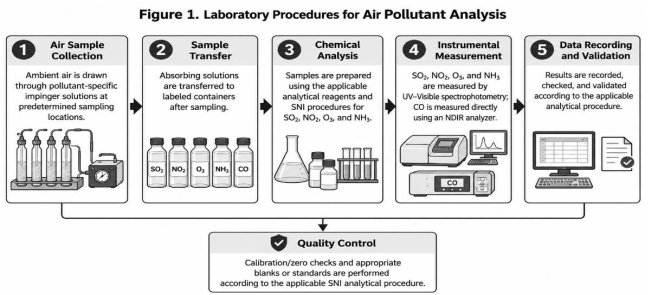
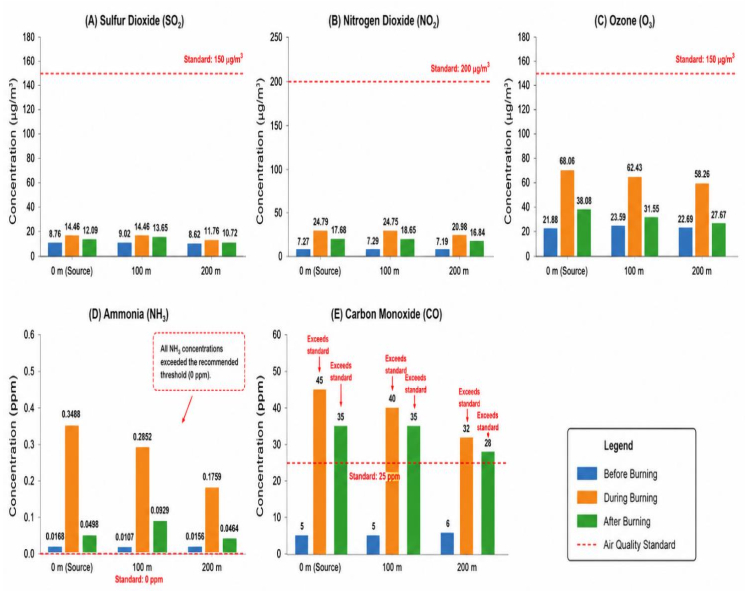
The destruction of narcotics evidence through open burning has the potential to generate air pollutants that adversely affect environmental quality and human health. Although this method is widely used for evidence disposal, limited studies have evaluated the characteristics of pollutant emissions and their environmental impacts. This study aimed to analyze the effects of air pollution resulting from the open burning of narcotics evidence in South Sulawesi and to identify mitigation strategies based on an industrial ecology approach. A field experimental study with a spatial–temporal design was conducted by measuring five air pollutants (SO2, NO2, O3, NH3, and CO) using an Impinger Gas Sampler. Measurements were performed at three observation periods (before, during, and after burning) and three monitoring distances (0,100, and 200 m). Differences in pollutant concentrations across observation periods were analyzed using the Friedman test, while simple linear regression was applied to evaluate the relationship between monitoring distance and pollutant concentrations. The Friedman test demonstrated significant differences in pollutant concentrations across observation periods (P < 0.05), with concentrations increasing markedly during burning and declining afterward, although remaining above baseline levels. Linear regression analysis revealed a strong negative relationship between distance and pollutant concentrations (R2 = 0.750 – 0.993), indicating that pollutant levels decreased with increasing distance. Dispersion modeling estimated that O3 and NO2 could travel approximately 1384 and 1337 m, respectively, whereas NH3 dispersed over approximately 412 m. These findings indicate that emissions from narcotics burning may affect both local and regional air quality. From an industrial ecology perspective, open burning is inconsistent with closed-loop system principles because it releases unmanaged atmospheric emissions. Open burning of narcotics evidence significantly contributes to air pollution and may impact surrounding communities beyond the burning site. The adoption of environmentally sustainable destruction technologies, such as controlled incineration equipped with emission filtration systems, is recommended to reduce pollutant emissions and support environmentally responsible evidence disposal.
Citation: Sudarianto, Sukri Palutturi, Hasmin. Environmental impact analysis of air pollution resulting from narcotics destruction in South Sulawesi[J]. AIMS Environmental Science, 2026, 13(5): 976-992. doi: 10.3934/environsci.2026038
The destruction of narcotics evidence through open burning has the potential to generate air pollutants that adversely affect environmental quality and human health. Although this method is widely used for evidence disposal, limited studies have evaluated the characteristics of pollutant emissions and their environmental impacts. This study aimed to analyze the effects of air pollution resulting from the open burning of narcotics evidence in South Sulawesi and to identify mitigation strategies based on an industrial ecology approach. A field experimental study with a spatial–temporal design was conducted by measuring five air pollutants (SO2, NO2, O3, NH3, and CO) using an Impinger Gas Sampler. Measurements were performed at three observation periods (before, during, and after burning) and three monitoring distances (0,100, and 200 m). Differences in pollutant concentrations across observation periods were analyzed using the Friedman test, while simple linear regression was applied to evaluate the relationship between monitoring distance and pollutant concentrations. The Friedman test demonstrated significant differences in pollutant concentrations across observation periods (P < 0.05), with concentrations increasing markedly during burning and declining afterward, although remaining above baseline levels. Linear regression analysis revealed a strong negative relationship between distance and pollutant concentrations (R2 = 0.750 – 0.993), indicating that pollutant levels decreased with increasing distance. Dispersion modeling estimated that O3 and NO2 could travel approximately 1384 and 1337 m, respectively, whereas NH3 dispersed over approximately 412 m. These findings indicate that emissions from narcotics burning may affect both local and regional air quality. From an industrial ecology perspective, open burning is inconsistent with closed-loop system principles because it releases unmanaged atmospheric emissions. Open burning of narcotics evidence significantly contributes to air pollution and may impact surrounding communities beyond the burning site. The adoption of environmentally sustainable destruction technologies, such as controlled incineration equipped with emission filtration systems, is recommended to reduce pollutant emissions and support environmentally responsible evidence disposal.

| [1] | Gent L, Paul R (2021) Air monitoring for illegal drugs including new psychoactive substances: A review of trends, techniques and thermal degradation products, Wiley, 13: 1078–1094. https://doi.org/10.1002/dta.3051 |
| [2] | Kadarmanta A, Bisnis E, Akuntansi P, et al. (2022) Dampak Penyalahgunaan Narkoba Terhadap Aspek Sosial Dan Ekonomi Di Wilayah Provinsi DKI Jakarta. BULL J Multidisiplin Ilmu 1: 729–735. Available from: https://journal.mediapublikasi.id/index.php/bullet/article/view/1019. |
| [3] |
Szyszkowicz M (2022) Urban ambient air pollution and substance use disorder. Air Qual Atmos Hlth 15AD : 1111–1120. https://doi.org/10.1007/s11869-022-01182-3 doi: 10.1007/s11869-022-01182-3

|
| [4] |
As'ari RM (2022) Hubungan Kadar PM2.5 dan PM10 Terhadap Keluhan Dyspnea Warga Desa Lakardowo, Kabupaten Mojokerto, Provinsi Jawa Timur. Environ Pollut J 2: 419–425. https://doi.org/10.58954/epj.v2i2.51 doi: 10.58954/epj.v2i2.51
|
| [5] |
Pratiwi YE, Taufik FF, Habibi J, et al. (2023) The impact of particulate matter on the respiratory system. J Respirasi 9: 237–245. https://doi.org/10.20473/jr.v9-I.3.2023.237-245 doi: 10.20473/jr.v9-I.3.2023.237-245
|
| [6] |
Hamid HA (2025) Ground-level ozone pollution in Malaysia: Descriptive analysis and classification using hierarchical clustering. Int J Res Innov Soc Sci 9: 5277–5283. https://dx.doi.org/10.47772/IJRISS.2025.909000426 doi: 10.47772/IJRISS.2025.909000426
|
| [7] |
Prahadi GD, Chandra EM, Ramdan A (2025) The execution of burning of seized narcotics goods in open space on environmental health from a rights perspective. J Law Polit Humanit 5: 2550–2559. https://doi.org/10.38035/jlph.v5i4.1353 doi: 10.38035/jlph.v5i4.1353
|
| [8] |
Gu Y, Fang T, Hung S, et al. (2024) Source emission contributions to particulate matter and ozone, and their health impacts in Southeast Asia. Environ Int 186: 1–12. https://doi.org/10.1016/j.envint.2024.108578 doi: 10.1016/j.envint.2024.108578
|
| [9] |
Fraccascia L, Giannoccaro I (2020) What, where, and how measuring industrial symbiosis: A reasoned taxonomy of relevant indicators. Resour Conserv Recy 157: 1–11. https://doi.org/10.1016/j.resconrec.2020.104799 doi: 10.1016/j.resconrec.2020.104799
|
| [10] |
Ernyasih E, Mallongi A, Daud A, et al. (2024) Health risk assessment through probabilistic sensitivity analysis of carbon monoxide and fine particulate transportation exposure. Glob J Environ Sci M 9: 933–950. https://doi.org/10.22034/gjesm.2023.04.18 doi: 10.22034/gjesm.2023.04.18
|
| [11] | Ivanov A, Gocheva-Illieva S, Stoimenova-Minova M (2024) Exploring SO2 air pollution in plovdiv through multivariate adaptive regression splines: A case study. J Phys Conf Ser 2910: 1–12. |
| [12] |
Bahramian M, Dylan P, Priyadarshini A (2024) Dynamic life cycle assessment of commercial and household food waste: A critical global review of emerging techniques. Sci Total Environ 921: 1–15. https://doi.org/10.1016/j.scitotenv.2024.170853 doi: 10.1016/j.scitotenv.2024.170853
|
| [13] | Adami G, Rossini M, Viapiana O, et al. (2021) Environmental air pollution is a predictor of poor response to biological drugs in chronic inflammatory arthritides. ACR Open Rheumatol 3: 451–456. |
| [14] |
Zambas-Adams P, Honeychurch KC (2022) Analytical approaches and trends in the determination of psychoactive drugs in air. Sci 4: 1–19. https://doi.org/10.3390/sci4010001 doi: 10.3390/sci4010001
|
| [15] | Mcalister S, Ou Y, Neff E, et al. (2016) The environmental footprint of morphine: A life cycle assessment from Opium Poppy farming to the packaged drug. BMJ Open 6: 1–9. |
| [16] |
Manisalidis I, Stavropoulou E, Stavropoulos A (2020) Environmental and health impacts of air pollution: A review. Front Public Health 8: 1–13. https://doi.org/10.3389/fpubh.2020.00014 doi: 10.3389/fpubh.2020.00014
|
| [17] |
Tomassini L, Lancia M, Gambelunghe A, et al. (2024) Exploring the nexus of climate change and substance abuse: A scoping review. Int J Environ Res 21: 1–12. https://doi.org/10.3390/ijerph21070896 doi: 10.3390/ijerph21070896
|
| [18] |
Roberts SL, Hayes F, Sletten T, et al. (2026) An ecosystem service impact assessment framework applicable to any chemical pollutant. Integr Environ Assess 1–12. https://doi.org/10.1093/inteam/vjag048 doi: 10.1093/inteam/vjag048
|
| [19] |
Mehmood K, Bao Y, Bibi S, et al. (2022) Contributions of open biomass burning and crop straw burning to air quality: Current research paradigm and future outlooks. Front Environ Sci 10: 1–15. https://doi.org/10.3389/fenvs.2022.852492 doi: 10.3389/fenvs.2022.852492
|
| [20] |
Wu S, Zhou X, Hu X, et al. (2025) Bibliometric analysis and review of global academic research on drug take-back programs. Healthcare 13: 1–31. https://doi.org/10.3390/healthcare13212711 doi: 10.3390/healthcare13212711
|
| [21] |
Athar A, Al A, Islam A, et al. (2023) Exploring the intravenous narcotics and controlled drugs wastage and their financial impact: A descriptive single-center study. Saudi Pharm J 31: 329–334. https://doi.org/10.1016/j.jsps.2022.12.012 doi: 10.1016/j.jsps.2022.12.012
|
| [22] |
Zahara SA, Rita A, Siregar S (2025) Analisis Mendalam Bahaya Polusi Udara dan Upaya Pencegahan Preventif yang Efektif. Antigen J Kesehat Masy dan Ilmu Gizi 3: 186–199. https://doi.org/10.57213/antigen.v3i3.732 doi: 10.57213/antigen.v3i3.732
|
| [23] | Dyana JS, Amelia RN, Amerys S, et al. (2025) Dampak Bahaya Pencemaran Udara Terhadap Kesehatan Masyarakat Di Perkotaan. J Ilm Wahana Pendidik 11: 132–140. |
| [24] |
Eckelman BMJ, Huang K, Lagasse R, et al. (2018) Health care pollution and public health damage in the united states: An update. Environ Health 39: 2071–2079. https://doi.org/10.1377/hlthaff.2020.01247 doi: 10.1377/hlthaff.2020.01247
|
| [25] |
Laiman V, Lo YC, Chen HC, et al. (2022) Ecotoxicology and environmental safety effects of antibiotics and metals on lung and intestinal microbiome Dysbiosis after sub-chronic lower-level exposure of air pollution in ageing rats. Ecotoxi Environ Safe 246: 1–11. https://doi.org/10.1016/j.ecoenv.2022.114164 doi: 10.1016/j.ecoenv.2022.114164
|
| [26] | Son E (2024) A review of air pollution and ethical consumption behavior due to fragrances. Environ Res Technol 7: 626–636. Available from: https://10.35208/ert.1453891. |
| [27] |
Vaudin P, Aug C, Just N, et al. (2022) When pharmaceutical drugs become environmental pollutants: Potential neural effects and underlying mechanisms. Environ Res 205: 1–14. https://doi.org/10.1016/j.envres.2021.112495 doi: 10.1016/j.envres.2021.112495
|
| [28] |
Tseng HY, Tsai YT, Su YS, et al. (2019) Drug concentrations in the air and their influencing factors in a pediatric intensive care unit. Aerosol Air Qual Res 24: 1–9. https://doi.org/10.4209/aaqr.230265 doi: 10.4209/aaqr.230265
|
| [29] |
Amin F, Rahman S (2026) A critical review of pharmaceutical pollutants in soil and air: Ecotoxicological impacts on animal, plant and microbial communities–Health hazards and waste management. Environ Pollut Manag 3: 70–87. https://doi.org/10.1016/j.epm.2025.11.001 doi: 10.1016/j.epm.2025.11.001
|
| [30] | Argaluza J, Domingo-Echaburu S, Orive G, et al. (2021) Environmental pollution with psychiatric drugs. World J Psychiatr 11: 791–804. |
| [31] |
Loima T, Yoon JY (2025) Microfluidic sensors integrated with smartphones for applications in forensics, agriculture, and environmental monitoring. Micromachines 16: 1–29. https://doi.org/10.3390/mi16070835 doi: 10.3390/mi16070835
|
| [32] |
Rusli T, Jonathan AK, Rinaldo M, et al. (2025) Pengaruh Lingkungan Terhadap Penyalahgunaan Narkoba dan Regulasinya Tami. JLEB 3: 972–982. https://doi.org/10.57235/jleb.v3i2.6709 doi: 10.57235/jleb.v3i2.6709
|
| [33] |
Tornevi A, Olstrup H, Forsberg B (2023) Increase in daily asthma medication sales in association with air pollution levels in Greater Stockholm. Environ Epidemiol 7: 1–15. https://doi.org/10.1097/EE9.0000000000000256 doi: 10.1097/EE9.0000000000000256
|
| [34] |
Xiang C, Li R, Liang A, et al. (2025) Analysis of air pollutants concentration variations and human impact by remote sensing: Implications for sustainable urban air quality management. Sustain Futures 10: 101019. https://doi.org/10.1016/j.sftr.2025.101019 doi: 10.1016/j.sftr.2025.101019
|
| [35] | Yusup Y, Sari RO, Sari RO (2024) Dampak Penyalahggunaan Narkotika dan Obat Obatan Terlarang Di Masyarakat, Atmos J Pendidikan, Bahasa, Sastra, Seni, Budaya, dan Sos Hum, 2: 42–47. https://doi.org/10.59024/atmosfer.v2i1.637 |
| [36] |
Zampelli S, Verna R (2025) Environmental pollution from pharmaceuticals. Life 15: 1–11. https://doi.org/10.3390/life15091341 doi: 10.3390/life15091341
|
Figures(2) / Tables(4)

Sudarianto, Sukri Palutturi, Hasmin. Environmental impact analysis of air pollution resulting from narcotics destruction in South Sulawesi[J]. AIMS Environmental Science, 2026, 13(5): 976-992. doi: 10.3934/environsci.2026038





 DownLoad: