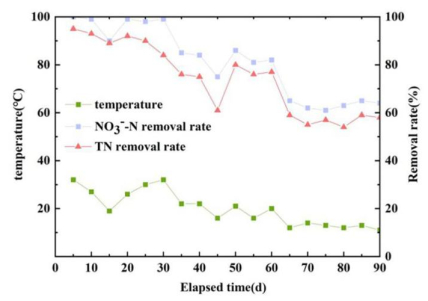
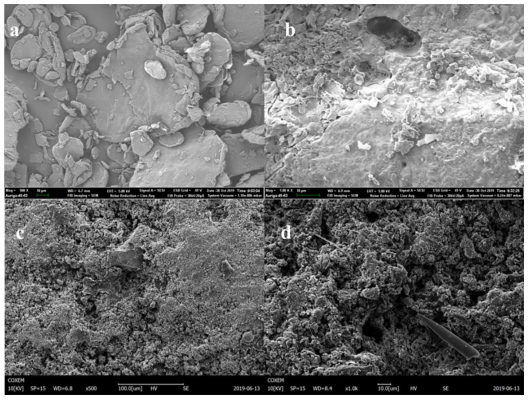
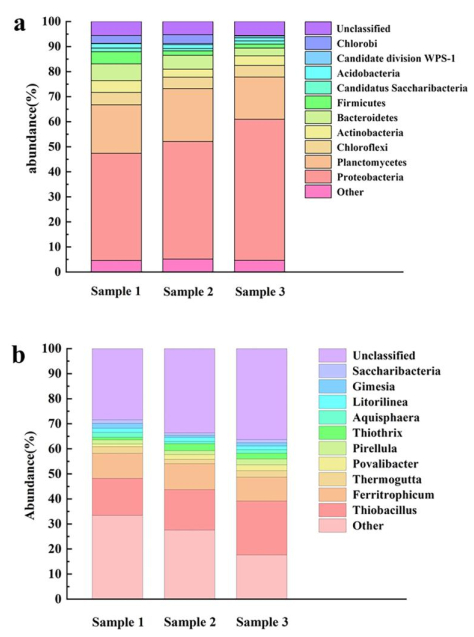
Autotrophic denitrification has garnered increasing attention as it eliminates the dependency on external organic carbon sources. Addressing the challenge of elevated nitrate levels in the tailwater of urban wastewater treatment plants (WWTPs), we proposed a sodium thiosulfate-siderite autotrophic denitrification (STSAD) biofilter for advanced nitrogen removal. The optimal operational parameters were an influent pH of 7.0, a temperature of 30℃, a hydraulic retention time (HRT) of 2 hours, and a sodium thiosulfate dosage equivalent to 1.5 times the theoretical requirement. Under these conditions, the system achieved a nitrate (NO3--N) removal rate of 100% and a total nitrogen (TN) removal efficiency exceeding 95%. Microbial analysis revealed significant biofilm enrichment on the ceramsite and siderite media, with Thiobacillus and Ferritrophicum identified as the predominant denitrifying genera. This ensured that effluent TN and COD levels comply with discharge standards.
Citation: Yong Chen, Xiaoli Wen, Geran Zhao, Chengcai Zhang. Autotrophic denitrification characteristics of urban wastewater treatment plant effluent driven by sodium thiosulfate siderite[J]. AIMS Environmental Science, 2026, 13(5): 917-935. doi: 10.3934/environsci.2026036
Autotrophic denitrification has garnered increasing attention as it eliminates the dependency on external organic carbon sources. Addressing the challenge of elevated nitrate levels in the tailwater of urban wastewater treatment plants (WWTPs), we proposed a sodium thiosulfate-siderite autotrophic denitrification (STSAD) biofilter for advanced nitrogen removal. The optimal operational parameters were an influent pH of 7.0, a temperature of 30℃, a hydraulic retention time (HRT) of 2 hours, and a sodium thiosulfate dosage equivalent to 1.5 times the theoretical requirement. Under these conditions, the system achieved a nitrate (NO3--N) removal rate of 100% and a total nitrogen (TN) removal efficiency exceeding 95%. Microbial analysis revealed significant biofilm enrichment on the ceramsite and siderite media, with Thiobacillus and Ferritrophicum identified as the predominant denitrifying genera. This ensured that effluent TN and COD levels comply with discharge standards.

| [1] |
Li X, Zou J, Zhang D, Xie L, et al. (2021) A new method for in-situ treatment of waste gas scrubbing liquid containing both NH3 and H2S based on sulfur autotrophic denitrification and partial nitrification-Anammox coupling system. Bioresource Technol 329: 124925. https://doi.org/10.1016/j.biortech.2021.124925 doi: 10.1016/j.biortech.2021.124925

|
| [2] |
Chen JF., Liu SN, Yan J, et al. (2017) Intensive removal efficiency and mechanisms of carbon and ammonium in municipal wastewater treatment plant tail water byozone oyster shells fix-bed bioreactor-membrane bioreactor combined system. Ecol Eng 101: 75–83. https://doi.org/10.1016/j.ecoleng.2016.11.029 doi: 10.1016/j.ecoleng.2016.11.029
|
| [3] |
Sun Y, Zhou P, Zhang N, Zhang Z, et al. (2021) Effects of matrix modification and bacteria amendment on the treatment efficiency of municipal tailwater pollutants by modified vertical flow constructed wetland. J Environ Manage 281: 111920. https://doi.org/10.1016/j.jenvman.2020.111920 doi: 10.1016/j.jenvman.2020.111920
|
| [4] |
Lehman SG, Badruzzaman M, Adham S, et al. (2008) Perchlorate and nitrate treatment by ion exchange integrated with biological brine treatment. Water Res 42: 969–976. https://doi.org/10.1016/j.watres.2007.09.011 doi: 10.1016/j.watres.2007.09.011
|
| [5] |
Sahinkaya E, Dursun N, Kilic A, et al. (2011) Simultaneous heterotrophic and sulfur-oxidizing autotrophic denitrification process for drinking water treatment: Control of sulfate production. Water Res 45: 6661–6667. https://doi.org/10.1016/j.watres.2011.09.056 doi: 10.1016/j.watres.2011.09.056
|
| [6] |
Wang Q, Gao Y, Huang H, et al. (2020) Does electrolysis facilitate simultaneous nitrogen removal and toxicity reduction of low C/N dyeing wastewater by sulfur-based denitrification biofilter? Sci Total Environ 722: 137898. https://doi.org/10.1016/j.scitotenv.2020.137898 doi: 10.1016/j.scitotenv.2020.137898
|
| [7] |
Li Y, Wang Y, Wan D, et al. (2020) Pilot-scale application of sulfur-limestone autotrophic denitrification biofilter for municipal tailwater treatment: Performance and microbial community structure. Bioresource Technol 300: 122682. https://doi.org/10.1016/j.biortech.2019.122682 doi: 10.1016/j.biortech.2019.122682
|
| [8] |
Ahmed Z, Kim SM, Kim IS, et al. (2012) Nitrification and denitrification using biofilters packed with sulfur and limestone at a pilot-scale municipal wastewater treatment plant. Environ Technol 33: 1271–1278. https://doi.org/10.1080/09593330.2011.619581 doi: 10.1080/09593330.2011.619581
|
| [9] |
Sahinkaya E, Dursun N. (2012) Sulfur-oxidizing autotrophic and mixotrophic denitrification processes for dr&inking water treatment: Elimination of excess sulfate production and alkalinity requirement. Chemosphere 89: 144–149. https://doi.org/10.1016/j.chemosphere.2012.05.029 doi: 10.1016/j.chemosphere.2012.05.029
|
| [10] |
Weber KA, Achenbach LA, Coates JD. (2006) Microorganisms pumping iron: anaerobic microbial iron oxidation and reduction. Nat Rev Microbiol 4: 752–764. https://doi.org/10.1038/nrmicro1490 doi: 10.1038/nrmicro1490
|
| [11] |
Yang Y, Chen T, Zhang X, et al. (2018) Simultaneous removal of nitrate and phosphate from wastewater by siderite based autotrophic denitrification. Chemosphere 199: 130–137. https://doi.org/10.1016/j.chemosphere.2018.02.014 doi: 10.1016/j.chemosphere.2018.02.014
|
| [12] |
Zhu TT, Cheng HY, Yang LH, et al. (2018) Coupled Sulfur and Iron (Ⅱ) Carbonate-Driven Autotrophic Denitrification for Significantly Enhanced Nitrate Removal. Environ SciTechnol 53: 1545–1554. https://doi.org/10.1021/acs.est.8b06865 doi: 10.1021/acs.est.8b06865
|
| [13] |
Wang W, Wei D, Li F, et al. (2019) Sulfur-siderite autotrophic denitrification system for simultaneous nitrate and phosphate removal: From feasibility to pilot experiments. Water Res 160: 52–59. https://doi.org/10.1016/j.watres.2019.05.054 doi: 10.1016/j.watres.2019.05.054
|
| [14] |
Di Capua F, Ahoranta SH, Papirio S, et al. (2016) Impacts of sulfur source and temperature on sulfur-driven denitrification by pure and mixed cultures of Thiobacillus. Process Biochem 51: 1576–1584. https://doi.org/10.1016/j.procbio.2016.06.010 doi: 10.1016/j.procbio.2016.06.010
|
| [15] |
Zhang TC, Zeng H (2006) Development of a Response Surface for Prediction of Nitrate Removal in Sulfur–Limestone Autotrophic Denitrification Fixed-Bed Reactors, J Environ Eng-Asce 132: 1068–1072. https://doi.org/10.1061/(ASCE)0733-9372(2006)132:9(1068) doi: 10.1061/(ASCE)0733-9372(2006)132:9(1068)
|
| [16] |
Chang M, Fan F, Zhang K, et al. (2023) Denitrification performance and mechanism of a novel sulfur-based fiber carrier fixed-bed reactor: Co-existence of sulfur-based autotrophic denitrification and endogenous denitrification. J Water Process Eng 53: 103618. https://doi.org/10.1016/j.jwpe.2023.103618 doi: 10.1016/j.jwpe.2023.103618
|
| [17] | XU WY (2024) Deciphering the denitrification performance and characterization of sulfur autotrophic denitrification community through metagenome: Jiangnan University, 2025. |
| [18] |
Kelly DP, Wood AP. (2000) Confirmation of Thiobacillus denitrificans as a species of the genus Thiobacillus, in the beta-subclass of the Proteobacteria, with strain NCIMB 9548 as the type strain. Int J Syst Evol Microbiol 50: 547–550. https://doi.org/10.1099/00207713-50-2-547 doi: 10.1099/00207713-50-2-547
|
| [19] |
Fan C, Zhou W, He S, et al. (2021) Sulfur transformation in sulfur autotrophic denitrification using thiosulfate as electron donor. Environ Pollut 268: 115708. https://doi.org/10.1016/j.envpol.2020.115708 doi: 10.1016/j.envpol.2020.115708
|
| [20] |
Nisola GM, Redillas MC, Cho E, et al. (2011) Comparison of reactive porous media for sulfur-oxidizing denitrification of high nitrate strength wastewater. Biochem Eng J 58: 79–86. https://doi.org/10.1016/j.bej.2011.08.016 doi: 10.1016/j.bej.2011.08.016
|
| [21] |
Khanongnuch R, Di Capua F, Lakaniemi AM, et al. (2018) Effect of N/S ratio on anoxic thiosulfate oxidation in a fluidized bed reactor: Experimental and artificial neural network model analysis. Process Biochem 68: 171–181. https://doi.org/10.1016/j.procbio.2018.02.018 doi: 10.1016/j.procbio.2018.02.018
|
| [22] |
Zhou W, Sun Y, Wu B, et al. (2011) Autotrophic denitrification for nitrate and nitrite removal using sulfur-limestone. J Environ Sci 23: 1761–1769. https://doi.org/10.1016/S1001-0742(10)60635-3 doi: 10.1016/S1001-0742(10)60635-3
|
| [23] | Qian ZM, Sun YL, Zhang XN, et al. (2023) Application of sulfur-based functional materials in advanced nitrogen removal for wastewater: Research progress and development tendency. Energy Environ Prot 37: 1–15. |
| [24] | HOU LN. (2022) Study on vertical flow constructed wetland with iron/manganese ore wood substrates for treatment of nitrogen-containing composite polluted wastewater: Jilin University, 2024. |
| [25] |
Chung J, Amin K, Kim S, et al. (2014) Autotrophic denitrification of nitrate and nitrite using thiosulfate as an electron donor. Water Res 58: 169–178. https://doi.org/10.1016/j.watres.2014.03.071 doi: 10.1016/j.watres.2014.03.071
|
| [26] |
Hao T, Wei L, Lu H, et al. (2013) Characterization of sulfate-reducing granular sludge in the SANI process, Water Res 47: 7042–7052. https://doi.org/10.1016/j.watres.2013.07.052 doi: 10.1016/j.watres.2013.07.052
|
| [27] |
Torrentó C, Cama J, Urmeneta J, et al. (2010) Denitrification of groundwater with pyrite and Thiobacillus denitrificans. Chem Geol 278: 80–91. https://doi.org/10.1016/j.chemgeo.2010.09.003 doi: 10.1016/j.chemgeo.2010.09.003
|
| [28] |
Koenig A, Liu LH. (2002) Use of limestone for pH control in autotrophic denitrification: continuous flow experiments in pilot-scale packed bed reactors. J Biotechnol 99: 161–71. https://doi.org/10.1016/S0168-1656(02)00183-9 doi: 10.1016/S0168-1656(02)00183-9
|
| [29] |
Xing W, He Z, Wang Y, et al. (2020) Using cold-adapted river-bottom sediment as seed sludge for sulfur-based autotrophic denitrification operated at mesophilic and psychrophilic temperatures. Sci Total Environ 735. https://doi.org/10.1016/j.scitotenv.2020.139345 doi: 10.1016/j.scitotenv.2020.139345
|
| [30] |
Sposob M, Cydzik-Kwiatkowska A, Bakke R, et al. (2018) Temperature-induced changes in a microbial community under autotrophic denitrification with sulfide. Process Biochem 69: 161–168. https://doi.org/10.1016/j.procbio.2018.03.006 doi: 10.1016/j.procbio.2018.03.006
|
| [31] |
Zhang L, Zhang C, Hu C, et al. (2015) Denitrification of groundwater using a sulfur-oxidizing autotrophic denitrifying anaerobic fluidized-bed MBR: performance and bacterial community structure. Appl Microbiol Biot 99: 2815–2827. https://doi.org/10.1007/s00253-014-6113-9 doi: 10.1007/s00253-014-6113-9
|
| [32] |
Zhu Y, Wu M, Gao N, et al. (2016) Impacts of nitrate and electron donor on perchlorate reduction and microbial community composition in a biologically activated carbon reactor. Chemosphere 165: 134–143. https://doi.org/10.1016/j.chemosphere.2016.08.078 doi: 10.1016/j.chemosphere.2016.08.078
|
| [33] |
Ye L, Shao MF, Zhang T. et al. (2011) Analysis of the bacterial community in a laboratory-scale nitrification reactor and a wastewater treatment plant by 454-pyrosequencing. Water Res 45: 4390–4398. https://doi.org/10.1016/j.watres.2011.05.028 doi: 10.1016/j.watres.2011.05.028
|
| [34] |
Yamada, T., Sekiguchi, Y., Hanada, S., et al. (2006) Anaerolinea thermolimosa sp. nov., Levilinea saccharolytica gen. nov., sp. nov. and Leptolinea tardivitalis gen. nov., sp. nov., novel filamentous anaerobes, and description of the new classes Anaerolineae classis nov. and Caldilineae classis nov. in the bacterial phylum Chloroflexi. Int J Syst Evol Microbiol 56: 1331–1340. https://doi.org/10.1099/ijs.0.64169-0 doi: 10.1099/ijs.0.64169-0
|
| [35] |
Wang Q, Feng C, Zhao Y, et al. (2009), Denitrification of nitrate contaminated groundwater with a fiber-based biofilm reactor. Bioresource Technol 100: 2223–2227. https://doi.org/10.1016/j.biortech.2008.07.057 doi: 10.1016/j.biortech.2008.07.057
|
| [36] |
Fabisch M, Beulig F, Akob DM, et al. (2013) Surprising abundance of Gallionella-related iron oxidizers in creek sediments at pH 4.4 or at high heavy metal concentrations. Front Microbiol 4: 390. https://doi.org/10.3389/fmicb.2013.00390 doi: 10.3389/fmicb.2013.00390
|
| [37] |
Zou G, Papirio S, Lakaniemi AM, et al. (2016) High-rate autotrophic denitrification in fluidized-bed biofilm reactors. Chem Eng J 284: 1287–1294. https://doi.org/10.1016/j.cej.2015.09.074 doi: 10.1016/j.cej.2015.09.074
|
| [38] | Zhang CX, Guo YK, Du HF, et al. (2016) Denitrification characteristics of a sulfur autotrophic denitrification reactor. J Hebei Univ Sci Technol 37: 96–101. |
| [39] |
Zhang M, Zheng P, Li, et al. (2015) Performance of nitrate-dependent anaerobic ferrous oxidizing (NAFO) process: a novel prospective technology for autotrophic denitrification. Bioresource Technol 179: 543–548. https://doi.org/10.1016/j.biortech.2014.12.036 doi: 10.1016/j.biortech.2014.12.036
|
| [40] |
Park JH, Shin HS, Lee IS, et al. (2002) Denitrification of high NO3--N containing wastewater using elemental sulfur; nitrogen loading rate and N2O production. Environ Technol 23: 53–65. https://doi.org/10.1080/09593332508618431 doi: 10.1080/09593332508618431
|
| [41] |
Huang B, Chi G, Chen X, et al. (2011) Removal of highly elevated nitrate from drinking water by pH-heterogenized heterotrophic denitrification facilitated with ferrous sulfide-based autotrophic denitrification. Bioresource Technol 102: 10154–10157. https://doi.org/10.1016/j.biortech.2011.08.048 doi: 10.1016/j.biortech.2011.08.048
|
| [42] |
Zheng YC, Wang ZZ, Cao T, et al. (2022) Enhancement effects and pathways of nitrogen removal by plant-based carbon source in integrated vertical flow constructed wetlands. J Water Process Eng 47: 102–104. https://doi.org/10.1016/j.jwpe.2022.102734 doi: 10.1016/j.jwpe.2022.102734
|
Figures(7) / Tables(3)

Yong Chen, Xiaoli Wen, Geran Zhao, Chengcai Zhang. Autotrophic denitrification characteristics of urban wastewater treatment plant effluent driven by sodium thiosulfate siderite[J]. AIMS Environmental Science, 2026, 13(5): 917-935. doi: 10.3934/environsci.2026036





 DownLoad: