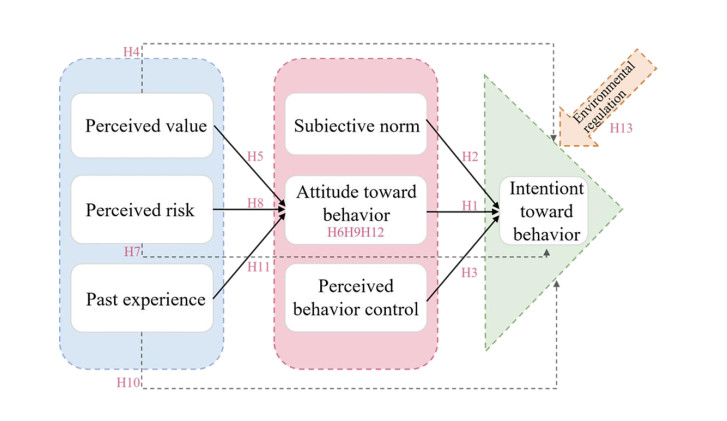
Our purpose of this study is to construct a "psychological-behavioral-environmental" analytical framework to explore the influencing mechanism of farmers' participation in waste classification.
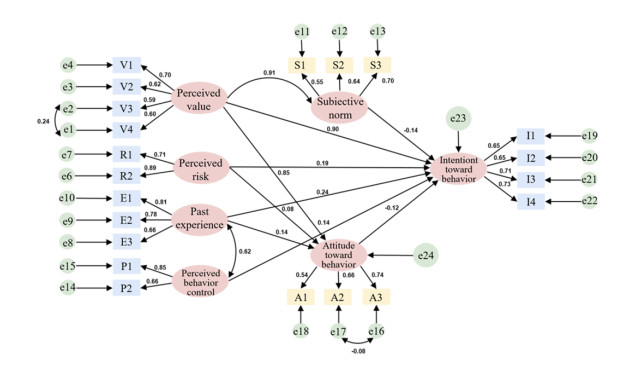
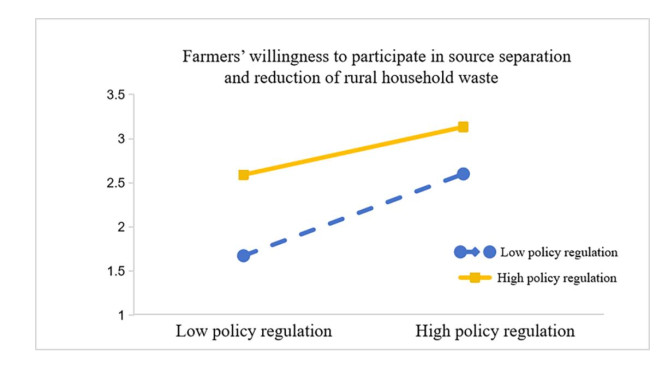
An empirical analysis was conducted through questionnaires and structural equation modeling to reveal the significant effects of behavioral attitudes, Subjective norm, and perceived values on farmers' willingness to participate. [Findings] The results showed that (1) attitude toward behavior, Subjective norm, perceived behavioral control, perceived value, perceived risk, and past experiences have a significant positive influence on farmers' willingness to participate in source separation and reduction of rural household waste. The path coefficient of perceived value was 0.78, which is an important factor influencing willingness to participate. (2) Attitude toward behavior plays a significant mediating role in the relationship between perceived value, perceived risk, past experience, and willingness to participate. (3) Environmental regulation has a negative moderating effect on the relationship between behavioral attitudes and willingness to participate, indicating that there is a formalization problem in the current policy environment and that over-reliance on administrative intervention may not be conducive to the formation of endogenous motivation of farmers. (4) The willingness to participate was stronger among farmers with higher education and higher household income levels, while the older group showed lower motivation to participate due to lack of classification knowledge and stereotyped habits. [Originality/value] Effective enhancement of farmers' participation in garbage classification requires the integration of cognitive reinforcement, behavioral motivation, conscious awareness cultivation, and institutional innovation.
Citation: Nan Zhang, Han Li, Siyu Chen, Shi Yin. Decoding the psychological, behavioral, and environmental drivers of farmers' willingness to participate in rural household waste source separation: A SEM analysis of policy influence, attitudinal changes, and perceived risks[J]. AIMS Environmental Science, 2025, 12(5): 856-886. doi: 10.3934/environsci.2025038
Our purpose of this study is to construct a "psychological-behavioral-environmental" analytical framework to explore the influencing mechanism of farmers' participation in waste classification.
An empirical analysis was conducted through questionnaires and structural equation modeling to reveal the significant effects of behavioral attitudes, Subjective norm, and perceived values on farmers' willingness to participate. [Findings] The results showed that (1) attitude toward behavior, Subjective norm, perceived behavioral control, perceived value, perceived risk, and past experiences have a significant positive influence on farmers' willingness to participate in source separation and reduction of rural household waste. The path coefficient of perceived value was 0.78, which is an important factor influencing willingness to participate. (2) Attitude toward behavior plays a significant mediating role in the relationship between perceived value, perceived risk, past experience, and willingness to participate. (3) Environmental regulation has a negative moderating effect on the relationship between behavioral attitudes and willingness to participate, indicating that there is a formalization problem in the current policy environment and that over-reliance on administrative intervention may not be conducive to the formation of endogenous motivation of farmers. (4) The willingness to participate was stronger among farmers with higher education and higher household income levels, while the older group showed lower motivation to participate due to lack of classification knowledge and stereotyped habits. [Originality/value] Effective enhancement of farmers' participation in garbage classification requires the integration of cognitive reinforcement, behavioral motivation, conscious awareness cultivation, and institutional innovation.

| [1] |
Wang Z, Huang L, Li W (2024) Approach or avoidance? The mechanisms underlying the impact of community goal orientation on residents' waste separation recycling behaviors. Behav Sci 15: 23–23. https://doi.org/10.3390/bs15010023 doi: 10.3390/bs15010023

|
| [2] |
Liao N, Lü F, Zhang H, et al. (2023) Life cycle assessment of waste management in rural areas in the transition period from mixed collection to source-separation. Waste Manage 158: 57–65. https://doi.org/10.1016/j.wasman.2023.01.008 doi: 10.1016/j.wasman.2023.01.008
|
| [3] |
Luo L, Tang J, Zhang R (2025) Effects of ecological education on college students' willingness to categorize garbage and the heterogeneity of academic levels. Arid Zone Resour Environ 39: 63–75. https://doi.org/10.13448/j.cnki.jalre.2025.025 doi: 10.13448/j.cnki.jalre.2025.025
|
| [4] |
Babé A, Cuingnet R, Scuturici M (2025) Generalization abilities of foundation models in waste classification. Waste Manage 198: 187–197. https://doi.org/10.1016/J.WASMAN.2025.02.032 doi: 10.1016/J.WASMAN.2025.02.032
|
| [5] |
Su W, Wang Y, Lv J (2025) Dynamic evolution of residents' garbage sorting behavior under policy-driven change: Evidence from multi-wave data deduction in Shanghai. Environ Technol Inno 38: 104095.https://doi.org/10.1016/j.eti.2025.104095 doi: 10.1016/j.eti.2025.104095
|
| [6] |
Wang F, Lu S, Guo J (2024) The group effect of agricultural households' household waste sorting behavior: A survey study based on the rural areas around Qinling National Park. J Northwest Agri Forestry Univ 24: 131–140. https://doi.org/10.13968/j.cnki.1009-9107.2024.06.13 doi: 10.13968/j.cnki.1009-9107.2024.06.13
|
| [7] |
Su Y, Mo S (2024) Institutional logic and realization path of rural habitat governance: Taking the pilot of rural living waste classification as an example. China Rural Observation 4: 124–143. https://doi.org/10.20074/j.cnki.11-3586/f.2024.04.007 doi: 10.20074/j.cnki.11-3586/f.2024.04.007
|
| [8] |
Gao X, Jin Y, Liu G (2023) Informational policy tools, village-level autonomy and rural residents' waste classification: Cross-level effects based on affective event theory. J Agric Forestry Econ Manage 22: 487–496. https://doi.org/10.16195/j.cnki.cn36-1328/f.2023.04.51 doi: 10.16195/j.cnki.cn36-1328/f.2023.04.51
|
| [9] |
Song C, Zhu H, Zhang L (2023) A study of rural residents' behavior and willingness to classify domestic waste: Based on the perspectives of institutional constraints and social norms. Arid Zone Resour Environ 37: 73–80. https://doi.org/10.13448/j.cnki.jalre.2023.139 doi: 10.13448/j.cnki.jalre.2023.139
|
| [10] |
Chen S, Huang S, Chen J (2023) How environmental regulation affects farmers' willingness to separate household waste: Based on 2020 CLES public data. World Agric 5: 104–115. https://doi.org/10.13856/j.cn11-1097/s.2023.05.009 doi: 10.13856/j.cn11-1097/s.2023.05.009
|
| [11] | Chen L, Liu T (2023) A study of the impact of Internet use on farmers' household waste sorting behavior—Evidence from China's land economy survey. Xinjiang Agric Reclam Econ 28–38. |
| [12] |
Zhu H, Shan H, Shen Y (2022) Study on the impact of digital literacy on the willingness and behavior of farmers to classify domestic waste. J Jiangsu Univ 24: 35–53. https://doi.org/10.13317/j.cnki.jdskxb.2022.035 doi: 10.13317/j.cnki.jdskxb.2022.035
|
| [13] |
Zhang Y, Feng M, Yi F (2023) Research on the effect and mechanism of rural digital governance on farmers' waste classification. World Agric 78–90. https://doi.org/10.13856/j.cn11-1097/s.2023.11.007 doi: 10.13856/j.cn11-1097/s.2023.11.007
|
| [14] |
Chen L (2025) Impact of rural digital governance on farmers' participation in habitat improvement - Based on 1047 farmers' research data in four provinces of the Yellow River Basin. Arid Zone Resour Environ 39: 54–66. https://doi.org/10.13448/j.cnki.jalre.2025.080 doi: 10.13448/j.cnki.jalre.2025.080
|
| [15] |
Jia Y, Zhao M (2020) The effects of domestic waste pollution perception and social capital on the level of garbage classification of farm households—Based on 1374 farm household survey data in Shaanxi. Resource Sci 42: 2370–2381. https://doi.org/10.18402/resci.2020.12.10 doi: 10.18402/resci.2020.12.10
|
| [16] |
Liu J, Jia Y, Ji S, et al. (2021) Effects of pollution perception and village emotion on farmers' willingness to separate household waste. Arid Zone Resour Environ 35: 48–52. https://doi.org/10.13448/j.cnki.jalre.2021.006 doi: 10.13448/j.cnki.jalre.2021.006
|
| [17] |
Deng Z, Zhang J, Xu Z, et al. (2013) A study on the cognitive and behavioral responses of farmers in rural living environment improvement—A case study of the main rice production area in Dongting Lake Wetland Reserve. Agric Technol Econ 72–79. https://doi.org/10.13246/j.cnki.jae.2013.02.005 doi: 10.13246/j.cnki.jae.2013.02.005
|
| [18] |
Shi Z, Yu S (2024) The influence of pro-environmental awareness on farmers' household waste sorting behavior under environmental regulation. J China Agric Univ 29: 208–220. https://doi.org/10.11841/j.issn.1007-4333.2024.01.19 doi: 10.11841/j.issn.1007-4333.2024.01.19
|
| [19] |
He Y, Huang S, Chen S, et al. (2022) How environmental policies affect farmers' willingness to separate domestic waste: A mediation effect analysis based on social norms and value perceptions. World Agric 95–107. https://doi.org/10.13856/j.cn11-1097/s.2022.05.009 doi: 10.13856/j.cn11-1097/s.2022.05.009
|
| [20] |
Chen SW, Huang SM, Chen J, et al. (2023). How environmental regulation affects farmers' willingness to separate domestic waste based on 2020CLES public data. World Agric 104–115. https://doi.org/10.13856/j.cn11-1097/s.2023.05.009 doi: 10.13856/j.cn11-1097/s.2023.05.009
|
| [21] |
Ng G, Huang Z, Guo W (2023) Impact of digital technology adoption on the participation of rural households in habitat improvement in karst areas - Based on the empirical data of 5704 households in 8 provinces. Arid Zone Resour Environ 37: 24–30. https://doi.org/10.13448/j.cnki.jalre.2023.003 doi: 10.13448/j.cnki.jalre.2023.003
|
| [22] |
Zhao J, Xie B (2022) Farmers' willingness to participate in domestic waste management: An analysis of the mediating effect based on farmers' perceptions. Product Res 87–92. https://doi.org/10.19374/j.cnki.14-1145/f.2022.06.007 doi: 10.19374/j.cnki.14-1145/f.2022.06.007
|
| [23] | Zhou L, Peng X, Du Y (2024) A study on high-quality supply of garbage classification services in rural communities with digital empowerment: a case study based on the source management of domestic garbage in Fenghuang Town, Zibo City. Environm Protect Circ Econ 44: 1–7. |
| [24] | Zeng F (2024) How to realize the effective governance of rural life--Taking the practice of points system of household waste management as an example. Gov Modernization Res 40: 78–86. |
| [25] | Wei X, Ma B (2022) Reward and punishment incentive mechanism for rural household waste classification and management based on a complex network evolutionary game model. China Environ Sci 42, 3822–3831. |
| [26] | Zhu N, Qin F (2023) A paradoxical study on the willingness and behavior of rural residents to classify household garbage—Based on the survey data of 2,420 rural households in CLES. Rural Econ 89–95. |
| [27] |
Wang S, Yan C (2023) Modernization of rural environmental governance empowered by digital technology. Modern Econ Discuss 12: 126–132. https://doi.org/10.13891/j.cnki.mer.2023.12.013 doi: 10.13891/j.cnki.mer.2023.12.013
|
| [28] |
Li Z, Zhang Y (2023) Internet use, garbage classification and rural residents' happiness: An empirical analysis based on CLDS. Stat Manag 38: 58–66. https://doi.org/10.16722/j.issn.1674-537x.2023.12.014 doi: 10.16722/j.issn.1674-537x.2023.12.014
|
| [29] | Liu J, Guo Y, Liu J (2023) Research on rural garbage classification and governance based on evolutionary game theory. Rural Sci Technol 14: 152–155. |
| [30] |
Li Y, Westlund H, Liu Y (2019) Why some rural areas decline while some others do not: An overview of rural evolution in the world. J Rural Stud 72: 1–10. https://doi.org/10.1016/j.jrurstud.2019.09.012 doi: 10.1016/j.jrurstud.2019.09.012
|
| [31] | Chen J, Hu Y, Fei F, et al. (2024) Construction and case study of the whole chain model of urban waste classification based on digital technology. Resour Sci 46: 46(4), 687–699. |
| [32] | Fan Z, Wang J (2021) Model and suggestions on classified treatment of rural domestic waste. IOP Conf Series Earth Environ Sci 831: 012034. |
| [33] |
Zhou Z, Liu J, Zeng H, et al. (2020) How does soil pollution risk perception affect farmers' pro-environmental behavior? The role of income level. J Environ Manage 275: 111210. https://doi.org/10.1016/j.jenvman.2020.110806 doi: 10.1016/j.jenvman.2020.110806
|
| [34] |
Wang S, Yan C (2023) Modernization of rural environmental governance empowered by digital technology. Modern Econ Discuss 12: 126–132. https://doi.org/10.13891/j.cnki.mer.2023.12.013 doi: 10.13891/j.cnki.mer.2023.12.013
|
| [35] | Ma J, Yin Z, Cai X (2023) How garbage classification policy effectively promotes the garbage classification behavior of farmers: A study based on the perspective of policy perception. Ecolog Econ 39: 188–194. |
| [36] |
Lin X, Li J (2023) Spatial re-engineering of rural habitat environment and its realization mechanism: Taking Z Village in Shanghai suburbs as an example. Academic Forum 46: 105–115. https://doi.org/10.16524/j.45-1002.2023.05.006 doi: 10.16524/j.45-1002.2023.05.006
|
| [37] | Chen N, Dwyer L, Firth T (2018) Residents' place attachment and word-of-mouth behaviours: A tale of two cities. J Hosp Tour Manag 37: 1–10. |
| [38] |
Jiang P, Li W (2023) The social basis of long-term mechanism construction of rural living waste classification. J Huazhong Agri Univ 5: 132–142. https://doi.org/10.13300/j.cnki.hnwkxb.2023.05.013 doi: 10.13300/j.cnki.hnwkxb.2023.05.013
|
| [39] |
Chen Y, Lai Z, Wang Z, et al. (2021) Optimizing locations of waste transfer stations in rural areas. PloS One 16: e0257199. https://doi.org/10.1371/journal.pone.0250962 doi: 10.1371/journal.pone.0250962
|
| [40] |
Li Q, Sun X, Hu X (2023) Study on the trend of carbon emissions from municipal waste treatment in China. Environ Pollut Prevention 45: 952–958. https://doi.org/10.15985/j.cnki.1001-3865.2023.07.010 doi: 10.15985/j.cnki.1001-3865.2023.07.010
|
| [41] | Yi F, Zhang Q, Li Y (2023) A path to enhance the governance system and governance capacity of low-carbon communities based on digital driving. Urban Dev Res 30: 133–140. |
| [42] | Zhu N, Qin F (2023) A paradoxical study on the willingness and behavior of rural farmers to classify household waste: Based on the survey data of 2420 farmers from CLES. Rural Econ 5: 89–95. |
| [43] |
Cao R, Cao G, Liu P (2024) The effects of public values and policy type goal congruence on garbage sorting behavior: A response surface analysis. J Northwestern Univ 54: 21–33. https://doi.org/10.16152/j.cnki.xdxbsk.2024-04-002 doi: 10.16152/j.cnki.xdxbsk.2024-04-002
|
| [44] |
Taghipour H, Amjad Z, Aslani H, et al. (2016) Characterizing and quantifying solid waste of rural communities. J Mater Cycles Waste 18: 690–697. https://doi.org/10.1007/s10163-015-0365-z doi: 10.1007/s10163-015-0365-z
|
| [45] |
Tibesigwa B, Visser M, Hodkinson B (2016) Effects of objective and subjective income comparisons on subjective wellbeing. Soc Indic Res 129: 1155–1170. https://doi.org/10.1007/s11205-015-1035-1 doi: 10.1007/s11205-015-1035-1
|
| [46] |
Zhang Y, Xu B (2020) Research on urban farmers' participation in garbage sorting based on the theory of embedded social structure. Arid Zone Resour Environ 34: 64–70. https://doi.org/10.13448/j.cnki.jalre.2020.270 doi: 10.13448/j.cnki.jalre.2020.270
|
| [47] | Zhu N, Wei T, Qin F (2023) Analysis on the willingness to pay and payment level of household waste management fee. China Agri Resour Zoning 44: 132–139. |
| [48] | Nie Z, Luo X, Tang L (2021) Social supervision, village rules and regulations, and farmers' participation behavior in centralized domestic waste treatment: Based on survey data from Hubei Province. Yangtze River Basin Resour Environ 30: 2264–2276. |
| [49] | Jia Y, Zhao M (2020) The effects of domestic waste pollution perception and social capital on the level of garbage classification of farm households: Based on 1374 farm household survey data in Shaanxi. Resour Sci 42: 2370–2381. |
| [50] |
Rogge N, De Jaeger S (2013) Measuring and explaining the cost efficiency of municipal solid waste collection and processing services. Omega 41: 653–665. https://doi.org/10.1016/j.omega.2012.09.006 doi: 10.1016/j.omega.2012.09.006
|
| [51] | Cao Y, Zhang X, He L (2020) Collective action in maintaining rural infrastructures: Cadre-farmer relationship, institutional rules and their interaction terms. Land Use Policy 99: 104869. |
| [52] |
Huang K, Wang J, Bai J, et al. (2013) Domestic solid waste discharge and its determinants in rural China. China Agr Econ Rev 5: 512–525. https://doi.org/10.1108/CAER-02-2012-0008 doi: 10.1108/CAER-02-2012-0008
|
| [53] | Zhang Y, Qie X, Zhang L (2022) A study on the impact of social capital on rural farmers' household waste classification. Res Agr Modernization 43: 1066–1077. |
| [54] |
Van Fossen JA, Ropp JW, Darcy K, et al. (2022) Comfort with and willingness to participate in COVID-19 contact tracing: The role of risk perceptions, trust, and political ideology. Soc Sci Med 306: 115174. https://doi.org/10.1016/j.socscimed.2022.115174 doi: 10.1016/j.socscimed.2022.115174
|
| [55] | Li T, Chen M, Wang X (2020) Effects of livelihood capital and environmental risk perception on farmers' willingness to pay for rural household waste management. J Agric Forestry Econ Manage 19: 643–653. |
| [56] |
Pan D, Ying R, Huang Z (2017) Determinants of residential solid waste management services provision: A village-level analysis in rural China. Sustainability 9: 1104. https://doi.org/10.3390/su9010110 doi: 10.3390/su9010110
|
| [57] |
Jia Y, Cheng S, Shi R (2021) Decision-making behavior of rural residents' domestic waste classification in Northwestern China: Analysis based on environmental responsibility and pollution perception. J Clean Prod 320: 128840. https://doi.org/10.1016/j.jclepro.2021.129374 doi: 10.1016/j.jclepro.2021.129374
|
| [58] |
Zhu N, Qin F (2023) Dilemma of source classification of rural domestic waste and countermeasures to crack it. Environ Prot 51: 49–51. https://doi.org/10.14026/j.cnki.0253-9705.2023.z1.017 doi: 10.14026/j.cnki.0253-9705.2023.z1.017
|
| [59] |
Chen Y (2017) Practice of environmentally significant behaviours in rural China: From being motivated by economic gains to being motivated by environmental considerations. Behav Sci 7: 69. https://doi.org/10.3390/bs7030059 doi: 10.3390/bs7030059
|
| [60] |
Zeng W, Wang K, Li S (2011) Planning for the decision of tourists' revisit intention: An empirical study based on coastal eco-tourism area. Manage Rev 23: 90–97. https://doi.org/10.14120/j.cnki.cn11-5057/f.2011.03.012 doi: 10.14120/j.cnki.cn11-5057/f.2011.03.012
|
| [61] |
Yang Z, Li P, Wang W (2021) Research on the influence of accident experience on miners' unsafe behavior based on social cognitive theory. J Safety Environ 21: 1607–1614. https://doi.org/10.13637/j.issn.1009-6094.2020.0049 doi: 10.13637/j.issn.1009-6094.2020.0049
|
| [62] | David VE, John Y, Hussain S (2020) Rethinking sustainability: A review of Liberia's municipal solid waste management systems, status, and challenges. J Mater Cycles Waste 22: 1299–1317. |
| [63] | Liu M, Yin J, Li L (2024) Digital technology enabling the construction of ecological civilization: An example of urban waste classification. China Soft Science 6: 66–78. |
| [64] | Su Y, Chen X, Li Y, et al. (2024) The robustness mechanism of the rural social-ecological system in response to the impact of urbanization: Evidence from irrigation commons in China. World Dev 174: 106481. |
| [65] |
Jiang P, Li W (2023). The social basis of long-term mechanism construction of rural living waste classification. J Huazhong Agr Univ 5: 132–142. https://doi.org/10.13300/j.cnki.hnwkxb.2023.05.013 doi: 10.13300/j.cnki.hnwkxb.2023.05.013
|
| [66] |
Zeng C, Niu D, Li H, et al. (2016) Public perceptions and economic values of source-separated collection of rural solid waste: A pilot study in China. Resour Cons Recy 107: 166–173. https://doi.org/10.1016/j.resconrec.2015.12.010 doi: 10.1016/j.resconrec.2015.12.010
|
| [67] | Jia Y, Zhao M, Xia X (2019) Rural domestic waste classification and treatment mode and suggestions. Resour Sci 41: 338–351. |
| [68] |
Bernardes C, Günther WMR (2014) Generation of domestic solid waste in rural areas: Case study of remote communities in the Brazilian Amazon. Hum Ecol 42: 617–629. https://doi.org/10.1007/s10745-014-9679-z doi: 10.1007/s10745-014-9679-z
|
| [69] | Jiang P, Hu R (2021) Problems, causes and countermeasures of rural living waste classification. Academic Exchange 2: 146–156. |
| [70] |
Wei X, Ma B (2022) Reward and punishment incentive mechanism for rural household waste classification and management: Based on complex network evolutionary game model. China Environ Sci 42: 3822–3831. https://doi.org/10.19674/j.cnki.issn1000-6923.20220329.006 doi: 10.19674/j.cnki.issn1000-6923.20220329.006
|
| [71] |
Lee T, Shi D (2021) A comparison of full information maximum likelihood and multiple imputation in structural equation modeling with missing data. Psychol Methods 26: 466–485. https://doi.org/10.1037/MET0000381 doi: 10.1037/MET0000381
|
| [72] |
Wen Z, Ye B (2014) Mediation effects analysis: Methods and model development. Psychol Sci Fair 22: 731–745. https://doi.org/10.3724/SP.J.1042.2014.00731 doi: 10.3724/SP.J.1042.2014.00731
|
| [73] | Chen R, Zheng Y, Liu W (2013) Mediation effect analysis: Principles, procedures, Bootstrap methods and their applications. J Market Sci 9: 120–135. |
| [74] |
Zhang Y, Xu B (2020) Research on urban residents' participation in garbage classification based on the theory of embedded social structure. Arid Zone Resour Environ 34: 64–70. https://doi.org/10.13448/j.cnki.jalre.2020.270 doi: 10.13448/j.cnki.jalre.2020.270
|
| [75] | Jiang P (2022) Transformation of rural household garbage classification method and its social logic analysis: A survey based on Lujia Village, Jinhua City, Zhejiang Province. Poyang Lake J 4: 79–87. |
| [76] |
Wang X (2024) The moral roots of household waste-sorting attitudes and intentions in China. DISU 5: 358. https://doi.org/10.1007/s43621-024-00600-z doi: 10.1007/s43621-024-00600-z
|
| [77] |
Li M, Gu Y (2025) From fiscal decentralization to high-quality economic development: Role of tax administration intensity. Financ Res Lett 77: 107047. https://doi.org/10.1016/j.frl.2025.107047 doi: 10.1016/j.frl.2025.107047
|
| [78] |
Budhijanto W, Marleni NNN, Wulaningtyas HA (2024) Techno-economic analysis on community-based municipal solid waste processing facilities: A case study in Sleman Regency Indonesia. Environ Dev 52: 101083. https://doi.org/10.1016/j.envdev.2024.101083 doi: 10.1016/j.envdev.2024.101083
|
Figures(4) / Tables(13)

Nan Zhang, Han Li, Siyu Chen, Shi Yin. Decoding the psychological, behavioral, and environmental drivers of farmers' willingness to participate in rural household waste source separation: A SEM analysis of policy influence, attitudinal changes, and perceived risks[J]. AIMS Environmental Science, 2025, 12(5): 856-886. doi: 10.3934/environsci.2025038





 DownLoad: