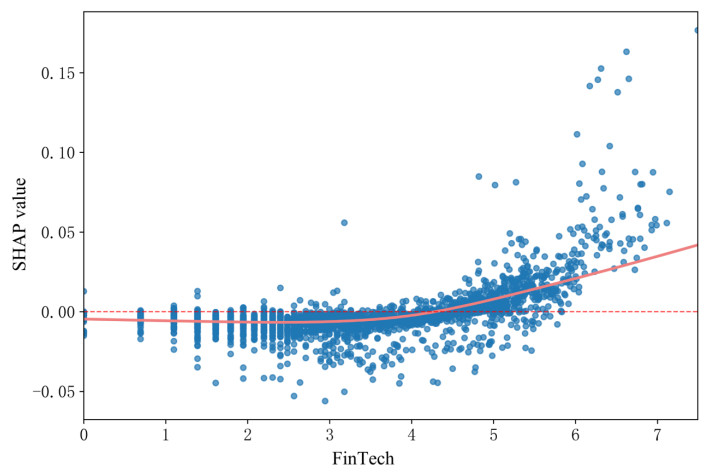
In the context of China's long-standing extensive economic growth model and increasing environmental pressures, improving total factor energy efficiency (TFEE) has become crucial for environmental protection and sustainable development. Financial technology (FinTech), as an emerging technology-driven financial innovation model, offers potential solutions; however, empirical evidence on its environmental impact remains limited. Based on balanced panel data of 268 Chinese cities from 2011 to 2021, we employed a double machine learning approach and the SHAP value algorithm to assess the impact of FinTech on TFEE as well as its nonlinear effects, with Random Forest being the primary estimation model. The major findings were as follows: (1) FinTech has a significant promoting effect on improving TFEE, which has passed multiple robustness tests. (2) In terms of mediation mechanisms, FinTech exerts its positive influence on TFEE by promoting green finance development, facilitating industrial structure optimization, and driving green technological innovation. (3) Heterogeneity analysis indicates that the role of FinTech in enhancing TFEE is more pronounced in eastern China, non-old industrial bases, and large cities. (4) According to the distribution trend of SHAP value, the impact of FinTech on TFEE exhibits a nonlinear effect, and its positive driving force can be effectively exerted only after its development level exceeds a specific threshold around 4.2. This study provides empirical evidence on the role of FinTech in advancing TFEE, offering valuable insights for policymakers seeking to harness FinTech as an effective tool to advance energy efficiency and support sustainable economic transformation.
Citation: Yaning Zhang, Yong Liu. Uncovering the role of financial technology for total factor energy efficiency in China: based on machine learning methods[J]. AIMS Environmental Science, 2025, 12(5): 887-915. doi: 10.3934/environsci.2025039
In the context of China's long-standing extensive economic growth model and increasing environmental pressures, improving total factor energy efficiency (TFEE) has become crucial for environmental protection and sustainable development. Financial technology (FinTech), as an emerging technology-driven financial innovation model, offers potential solutions; however, empirical evidence on its environmental impact remains limited. Based on balanced panel data of 268 Chinese cities from 2011 to 2021, we employed a double machine learning approach and the SHAP value algorithm to assess the impact of FinTech on TFEE as well as its nonlinear effects, with Random Forest being the primary estimation model. The major findings were as follows: (1) FinTech has a significant promoting effect on improving TFEE, which has passed multiple robustness tests. (2) In terms of mediation mechanisms, FinTech exerts its positive influence on TFEE by promoting green finance development, facilitating industrial structure optimization, and driving green technological innovation. (3) Heterogeneity analysis indicates that the role of FinTech in enhancing TFEE is more pronounced in eastern China, non-old industrial bases, and large cities. (4) According to the distribution trend of SHAP value, the impact of FinTech on TFEE exhibits a nonlinear effect, and its positive driving force can be effectively exerted only after its development level exceeds a specific threshold around 4.2. This study provides empirical evidence on the role of FinTech in advancing TFEE, offering valuable insights for policymakers seeking to harness FinTech as an effective tool to advance energy efficiency and support sustainable economic transformation.

| [1] |
Yin K, Miao Y, Huang C (2024) Environmental regulation, technological innovation, and industrial structure upgrading. Energy Environ 35: 207–227. https://doi.org/10.1177/0958305x221125645 doi: 10.1177/0958305x221125645

|
| [2] |
He Y, Zhang Y, Deng J (2024) Path to sustainable development: The effect of China's innovative industrial clusters pilot policy on prefecture-level cities' green total factor productivity. J Clean Prod 478: 143988. https://doi.org/10.1016/j.jclepro.2024.143988 doi: 10.1016/j.jclepro.2024.143988
|
| [3] |
Colmer J, Martin R, Muûls M, et al. (2025) Does pricing carbon mitigate climate change? Firm-level evidence from the european union emissions trading system. Rev Econ Stud 92: 1625–1660. https://doi.org/10.1093/restud/rdae055 doi: 10.1093/restud/rdae055
|
| [4] |
Ali Y, Khalid H (2025) Green banking policies and sustainable performance: unraveling the mediating role of GC and EP. AIMS Environ Sci 12: 744–769. https://doi.org/10.3934/environsci.2025033 doi: 10.3934/environsci.2025033
|
| [5] | Zhang Y, Xing C, Guo X (2023) The shielding effect of access to finance on small and medium-sized enterprises during the COVID-19 crisis: Comparing FinTech and traditional finance. Emerging Mark Financ Trade 59: 2383–2397. https://doi.org/10.1080/1540496x.2022.2072201 |
| [6] |
Palmié M, Wincent J, Parida V, et al. (2020) The evolution of the financial technology ecosystem: An introduction and agenda for future research on disruptive innovations in ecosystems. Technol Forecast Soc Change 151: 119779. https://doi.org/10.1016/j.techfore.2019.119779 doi: 10.1016/j.techfore.2019.119779
|
| [7] | Liu C, Li Q, Zhang S et al. (2022) How Does Financial Technology Affect Enterprise Innovation? Evidence from Chinese Listed Companies. Econ Rev 30-47. https://doi.org/10.19361/j.er.2022.01.03 |
| [8] |
Liao K, Ma C, Zhang J, et al. (2024) Does big data infrastructure development facilitate bank fintech innovation? Evidence from China. Finance Res Lett 65: 105540. https://doi.org/10.1016/j.frl.2024.105540 doi: 10.1016/j.frl.2024.105540
|
| [9] |
Baber H (2020) Financial inclusion and FinTech: A comparative study of countries following Islamic finance and conventional finance. Qual Res Financ Mark 12: 24–42. https://doi.org/10.12785/jifs/040203 doi: 10.12785/jifs/040203
|
| [10] |
Ren F, Yu X (2021) Coupling analysis of urbanization and ecological total factor energy efficiency: a case study from Hebei province in China. Sustain Cities Soc 74: 103183. https://doi.org/10.1016/j.scs.2021.103183 doi: 10.1016/j.scs.2021.103183
|
| [11] |
Gao D, Li G, Yu J (2022) Does digitization improve green total factor energy efficiency? Evidence from Chinese 213 cities. Energy 247: 123395. https://doi.org/10.1016/j.energy.2022.123395 doi: 10.1016/j.energy.2022.123395
|
| [12] |
Xu J, Li J, Liu C (2022) How does foreign trade affect green total factor energy efficiency? Evidence from China. Front Environ Sci 10: 979177. https://doi.org/10.3389/fenvs.2022.979177 doi: 10.3389/fenvs.2022.979177
|
| [13] |
Zhou C, Qi S (2022) Has the pilot carbon trading policy improved China's green total factor energy efficiency? Energy Econ 114: 106268. https://doi.org/10.1016/j.eneco.2022.106268 doi: 10.1016/j.eneco.2022.106268
|
| [14] |
Cheng Z, Zhang Q, Li X (2025) Can environmental information disclosure improve total-factor energy efficiency? J Environ Plan Manag 68: 104–131. https://doi.org/10.1080/09640568.2023.2238893 doi: 10.1080/09640568.2023.2238893
|
| [15] |
Li G, Gao D, Li Y (2023) Impacts of market-based environmental regulation on green total factor energy efficiency in China. China World Econ 31: 92–114. https://doi.org/10.1111/cwe.12485 doi: 10.1111/cwe.12485
|
| [16] |
Ranabahu N (2024) Financial technology to address the liability of poorness? A typology of FinTech organisations. Eur J Innov Manag 27: 1249–1269. https://doi.org/10.1108/ejim-07-2022-0359 doi: 10.1108/ejim-07-2022-0359
|
| [17] |
Yang RX, Liu Z (2025) FinTech and urban entrepreneurial activity. Finance Res Lett 75: 106661. https://doi.org/10.1016/j.frl.2024.106661 doi: 10.1016/j.frl.2024.106661
|
| [18] |
Udeagha MC, Muchapondwa E (2023) Green finance, FinTech, and environmental sustainability: fresh policy insights from the BRICS nations. Int J Sustain Dev World Ecol 30: 633–649. https://doi.org/10.1080/13504509.2023.2183526 doi: 10.1080/13504509.2023.2183526
|
| [19] | Wang L, Vo XV, Shahbaz M, et al. (2020) Globalization and carbon emissions: is there any role of agriculture value-added, financial development, and natural resource rent in the aftermath of COP21? J Environ Manag 268: 110712. https://doi.org/10.1016/j.jenvman.2020.110712 |
| [20] |
Yu H, Wang R, Zhang A (2024) Unraveling the impact of environmental provisions in preferential trade agreements on green total factor energy efficiency. J Environ Manag 362: 121205. https://doi.org/10.1016/j.jenvman.2024.121205 doi: 10.1016/j.jenvman.2024.121205
|
| [21] |
Zhong K, Lei Y, Zhao J, et al. (2025) How to enhance China's total-factor energy efficiency via digital-real economy integration: New evidence from dynamic QCA analysis. Energy Econ 148: 108689. https://doi.org/10.1016/j.eneco.2025.108689 doi: 10.1016/j.eneco.2025.108689
|
| [22] |
Liu C, Song Y, Zhang M, et al. (2025) Enterprise carbon emission reduction effects of the green loan interest subsidy policy: Evidence of city-level spatial spillovers. Environ Impact Assess Rev 114: 107954. https://doi.org/10.1016/j.eiar.2025.107954 doi: 10.1016/j.eiar.2025.107954
|
| [23] |
Bansal P, Quan SJ (2024) Examining temporally varying nonlinear effects of urban form on urban heat island using explainable machine learning: A case of Seoul. Build Environ 247: 110957. https://doi.org/10.1016/j.buildenv.2023.110957 doi: 10.1016/j.buildenv.2023.110957
|
| [24] |
Mol AP, Spaargaren G (2000) Ecological modernisation theory in debate: A review. Environ Polit 9: 17-49. https://doi.org/10.1080/09644010008414511 doi: 10.1080/09644010008414511
|
| [25] |
Muganyi T, Yan L, Sun HP (2021) Green finance, fintech and environmental protection: Evidence from China. Environ Sci Ecotechnol 7: 100107. https://doi.org/10.1016/j.ese.2021.100107 doi: 10.1016/j.ese.2021.100107
|
| [26] | Elkington J (1997) Cannibals with Forks: The Triple Bottom Line of 21st Century Business. Capstone Publishing. |
| [27] |
Ibrahim A, Almasria NA, Al Maqtari FA, et al (2024). The impact of green finance, fintech and digital economy on environmental sustainability: evidence from advanced panel techniques. Int J Energy Econ Policy 14: 621-627. https://doi.org/10.32479/ijeep.17180 doi: 10.32479/ijeep.17180
|
| [28] |
Wang Y, Xiuping S, Zhang Q (2021) Can FinTech improve the efficiency of commercial banks? An analysis based on big data. Res Int Bus Finance 55: 101338. https://doi.org/10.1016/j.ribaf.2020.101338 doi: 10.1016/j.ribaf.2020.101338
|
| [29] |
Wang H, Li Y, Lin W, et al. (2023) How does digital technology promote carbon emission reduction? Empirical evidence based on e-commerce pilot city policy in China. J Environ Manag 325: 116524. https://doi.org/10.1016/j.jenvman.2022.116524 doi: 10.1016/j.jenvman.2022.116524
|
| [30] |
Tan C, Wang Z, Zhou P (2023) Fintech "Enabling" and Enterprise Green Innovation: From the Perspectives of Credit Allocation and Credit Supervision. J Financ Econ 49: 34-48. https://doi.org/10.16538/j.cnki.jfe.20220519.101 doi: 10.16538/j.cnki.jfe.20220519.101
|
| [31] |
Hasan M, Hoque A, Abedin MZ, et al. (2024) FinTech and sustainable development: A systematic thematic analysis using human- and machine-generated processing. Int Rev Financ Anal 95: 103473. https://doi.org/10.1016/j.irfa.2024.103473 doi: 10.1016/j.irfa.2024.103473
|
| [32] |
Li X, Cui S, Lai X (2020) Can Digital Finance Increase the Value of Listed Companies?:Theoretical Mechanism Analysis and Empirical Test. Mod Financ Econ 40: 83-95. https://doi.org/10.19559/j.cnki.12-1387.2020.09.006 doi: 10.19559/j.cnki.12-1387.2020.09.006
|
| [33] |
Jiang C, Ma X (2019) The impact of financial development on carbon emissions: a global perspective. Sustainability 11: 5241. https://doi.org/10.3390/su11195241 doi: 10.3390/su11195241
|
| [34] |
Cai Q, Chen W, Wang M, et al. (2025) Drivers of green finance development: a nonlinear fsQCA-ANN analysis. Int J Glob Warm 36: 86–105. https://doi.org/10.1504/ijgw.2025.10069279 doi: 10.1504/ijgw.2025.10069279
|
| [35] |
He Y, Wang K, Zhang Y et al. (2024) Research on the Effect and Mechanism of Fintech on Enterprise Innovation Investment. Theory Pract Financ Econ 45: 25-32. https://doi.org/10.16339/j.cnki.hdxbcjb.2024.02.004 doi: 10.16339/j.cnki.hdxbcjb.2024.02.004
|
| [36] |
Xu J, Li T, Chen F, et al. (2025) Does Fintech Foster the Development of Green Finance? Emerg Mark Finance Trade 61: 1771–1781. https://doi.org/10.1080/1540496x.2024.2430500 doi: 10.1080/1540496x.2024.2430500
|
| [37] |
Yu CH, Wu X, Zhang D, et al. (2021) Demand for green finance: Resolving financing constraints on green innovation in China. Energy Policy 153: 112255. https://doi.org/10.1016/j.enpol.2021.112255 doi: 10.1016/j.enpol.2021.112255
|
| [38] | Wang W, Ge P (2024) The Mechanism and Development Path of Industrial Digital Finance Supporting the New Development Pattern of "Dual Circulation". World Econ Stud 93-104. https://doi.org/10.13516/j.cnki.wes.2024.02.001 |
| [39] |
Lv P, Xiong H (2022) Can FinTech improve corporate investment efficiency? Evidence from China. Res Int Bus Finance 60: 101571. https://doi.org/10.1016/j.ribaf.2021.101571 doi: 10.1016/j.ribaf.2021.101571
|
| [40] |
Li L, Yin F (2024) Digital Inclusive Finance, Financing Constraints and Investment Efficiency of Small and Medium-sized Enterprises. Sci Manag Res 42: 106-114. https://doi.org/10.19445/j.cnki.15-1103/g3.2024.01.012 doi: 10.19445/j.cnki.15-1103/g3.2024.01.012
|
| [41] |
Li F, Li J, Wang D (2024) Policy instruments and green innovation: Evidence and implications for corporate performance. J Clean Prod 471: 143443. https://doi.org/10.1016/j.jclepro.2024.143443 doi: 10.1016/j.jclepro.2024.143443
|
| [42] |
Wang D, Liang YF, Dou W (2025) How does urban industrial structure upgrading affect green productivity? The moderating role of smart city development. Struct Change Econ Dyn 72: 133–149. https://doi.org/10.1016/j.strueco.2024.09.017 doi: 10.1016/j.strueco.2024.09.017
|
| [43] |
Dangelico RM (2017) What drives green product development and how do different antecedents affect market performance? A survey of Italian companies with eco-labels. Bus Strategy Environ 26: 1144–1161. https://doi.org/10.1002/bse.1975 doi: 10.1002/bse.1975
|
| [44] | Zheng S, Liu J, Yao T (2024) Research on the Effect and Mechanism of Digital Finance Promoting Green Technology Innovation. Econ Probl 41-47. https://doi.org/10.16011/j.cnki.jjwt.2024.02.016 |
| [45] |
Zameer H, Yasmeen H (2022) Green innovation and environmental awareness driven green purchase intentions. Mark Intell Plan 40: 624–638. https://doi.org/10.1108/mip-12-2021-0457 doi: 10.1108/mip-12-2021-0457
|
| [46] |
Qin L, Aziz G, Hussan MW, et al. (2024) Empirical evidence of fintech and green environment: Using the green finance as a mediating variable. Int Rev Econ Finance 89: 33–49. https://doi.org/10.1016/j.iref.2023.07.056 doi: 10.1016/j.iref.2023.07.056
|
| [47] |
Shen N, Zhou J, Zhang G, et al. (2025) How does data factor marketization influence urban carbon emission efficiency? A new method based on double machine learning. Sustain Cities Soc 119: 106106. https://doi.org/10.1016/j.scs.2024.106106 doi: 10.1016/j.scs.2024.106106
|
| [48] |
Chernozhukov V, Chetverikov D, Demirer M, et al. (2018) Double/debiased machine learning for treatment and structural parameters. Econom J 21: C1–C68. https://doi.org/10.1111/ectj.12097 doi: 10.1111/ectj.12097
|
| [49] |
Borup D, Christensen BJ, Mühlbach NS, et al. (2023) Targeting predictors in random forest regression. Int J Forecast 39: 841–868. https://doi.org/10.1016/j.ijforecast.2022.02.010 doi: 10.1016/j.ijforecast.2022.02.010
|
| [50] |
Breiman L (2001) Random forests. Mach Learn 45: 5-32. https://doi.org/10.1023/A:1010933404324 doi: 10.1023/A:1010933404324
|
| [51] |
Athey S, Imbens GW (2019) Machine learning methods that economists should know about. Annu Rev Econ 11: 685-725. https://doi.org/10.1146/annurev-economics-080217-053433 doi: 10.1146/annurev-economics-080217-053433
|
| [52] |
Atzmueller M, Fürnkranz J, Kliegr T, et al. (2024) Explainable and interpretable machine learning and data mining. Data Min Knowl Discov 38: 2571–2595. https://doi.org/10.1007/s10618-024-01041-y doi: 10.1007/s10618-024-01041-y
|
| [53] |
Aas K, Jullum M, Løland A (2021) Explaining individual predictions when features are dependent: More accurate approximations to Shapley values. Artif Intell 298: 103502. https://doi.org/10.1016/j.artint.2021.103502 doi: 10.1016/j.artint.2021.103502
|
| [54] |
Su X, Zhou W, Nakagami KI, et al. (2012) Capital stock-labor-energy substitution and production efficiency study for China. Energy Econ 34: 1208–1213. https://doi.org/10.1016/j.eneco.2011.11.002 doi: 10.1016/j.eneco.2011.11.002
|
| [55] |
Yang L, Yang Y, Zhang X, et al. (2018) Whether China's industrial sectors make efforts to reduce CO2 emissions from production? A decomposed decoupling analysis. Energy 160: 796–809. https://doi.org/10.1016/j.energy.2018.06.186 doi: 10.1016/j.energy.2018.06.186
|
| [56] |
Ge W, Yang P, Pan X, et al. (2024) Sustainable utilization of mining resources: Exploring the impact of FinTech on green development from the perspective of mining enterprises. Resour Policy 97: 105239. https://doi.org/10.1016/j.resourpol.2024.105239 doi: 10.1016/j.resourpol.2024.105239
|
| [57] |
Fungáčová Z, Weill L, Zhou M (2017) Bank capital, liquidity creation and deposit insurance. J Financ Serv Res 51: 97-123. https://doi.org/10.1007/s10693-016-0240-7 doi: 10.1007/s10693-016-0240-7
|
| [58] |
Li J, Li J, Zhu X, et al (2020) Risk spillovers between FinTech and traditional financial institutions: Evidence from the US. Int Rev Financ Anal 71: 101544. https://doi.org/10.1016/j.irfa.2020.101544 doi: 10.1016/j.irfa.2020.101544
|
| [59] |
Gomber P, Koch JA, Siering M (2017) Digital Finance and FinTech: current research and future research directions. J Bus Econ 87: 537-580. https://doi.org/10.1007/s11573-017-0852-x doi: 10.1007/s11573-017-0852-x
|
| [60] |
Chen Z, Kahn ME, Liu Y, et al. (2018) The consequences of spatially differentiated water pollution regulation in China. J Environ Econ Manag 88: 468–485. https://doi.org/10.1016/j.jeem.2018.01.010 doi: 10.1016/j.jeem.2018.01.010
|
| [61] |
Shahbaz M, Li J, Dong X, et al. (2022) How financial inclusion affects the collaborative reduction of pollutant and carbon emissions: The case of China. Energy Econ 107: 105847. https://doi.org/10.1016/j.eneco.2022.105847 doi: 10.1016/j.eneco.2022.105847
|
| [62] |
Zhang Y, Bawuerjiang R, Lu M, et al. (2024) Green finance and environmental pollution: Evidence from China. Econ Anal Policy 84: 98–110. https://doi.org/10.1016/j.eap.2024.08.022 doi: 10.1016/j.eap.2024.08.022
|
| [63] |
Zhao J, Jiang Q, Dong X, et al. (2022) How does industrial structure adjustment reduce CO2 emissions? Spatial and mediation effects analysis for China. Energy Econ 105: 105704. https://doi.org/10.1016/j.eneco.2021.105704 doi: 10.1016/j.eneco.2021.105704
|
| [64] |
Zhai X, An Y, Shi X, et al. (2023) Emissions trading scheme and green development in China: Impact of city heterogeneity. Sustain Dev 31: 2583–2597. https://doi.org/10.1002/sd.2533 doi: 10.1002/sd.2533
|
| [65] |
Teng M, Shen M (2023) The impact of FinTech on carbon efficiency: Evidence from Chinese cities. J Clean Prod 425: 138984. https://doi.org/10.1016/j.jclepro.2023.138984 doi: 10.1016/j.jclepro.2023.138984
|
| [66] |
Qi Y, Ouyang L, Yu Y (2024) The impact of FinTech adoption on corporate investment: Evidence from China. Finance Res Lett 67: 105929. https://doi.org/10.1016/j.frl.2024.105929 doi: 10.1016/j.frl.2024.105929
|
| [67] |
Huang Z, Tan Y, Yang Z, et al. (2023) FinTech adoption and the effects of economic uncertainty on household consumption. China Econ Rev 80: 102011. https://doi.org/10.1016/j.chieco.2023.102011 doi: 10.1016/j.chieco.2023.102011
|
| [68] |
Wang X, Zhou H, Cheng L (2023) Fintech Development in China: Index Compilation, Overall Trend and Spatiotemporal Characteristics. Mod Econ Sci 45: 46-60. https://doi.org/10.20069/j.cnki.DJKX.202301004 doi: 10.20069/j.cnki.DJKX.202301004
|
| [69] |
Li L, Zhang P, Lo K, et al. (2020) The evolution of regional economic resilience in the old industrial bases in China: A case study of Liaoning Province, China. Chin Geogr Sci 30: 340–351. https://doi.org/10.1007/s11769-020-1105-4 doi: 10.1007/s11769-020-1105-4
|
| [70] |
Yu L, Wang Y, Wei X (2023) Towards low-carbon development: The role of industrial robots in decarbonization in Chinese cities. J Environ Manage 330: 117216. https://doi.org/10.1016/j.jenvman.2023.117216 doi: 10.1016/j.jenvman.2023.117216
|
| [71] |
Dong H, Zheng Y, Tang Y (2024) Impact of FinTech on the industrial structural transformation: Evidence from China's resource-based cities. Resour Policy 91: 104833. https://doi.org/10.1016/j.resourpol.2024.104833 doi: 10.1016/j.resourpol.2024.104833
|
| [72] |
Guo M, Luo D, Liu C (2024) City civilization, employment creation and talent agglomeration: Empirical evidence from "National Civilized City" policy in China. China Econ Rev 87: 102215. https://doi.org/10.1016/j.chieco.2024.102215 doi: 10.1016/j.chieco.2024.102215
|
| [73] |
Bu Y, Yu X, Li H (2023) The nonlinear impact of FinTech on the real economic growth: evidence from China. Econ Innov New Technol 32: 1138–1155. https://doi.org/10.1080/10438599.2022.2095512 doi: 10.1080/10438599.2022.2095512
|
| [74] |
Luo Y, Andresen J, Clarke H, et al. (2019) A decision support system for waste heat recovery and energy efficiency improvement in data centres. Appl Energy 250: 1217–1224. https://doi.org/10.1016/j.apenergy.2019.05.029 doi: 10.1016/j.apenergy.2019.05.029
|
| [75] |
Dunbar K, Sarkis J, Treku DN (2024) FinTech for environmental sustainability: Promises and pitfalls. One Earth 7: 23–30. https://doi.org/10.1016/j.oneear.2023.12.012 doi: 10.1016/j.oneear.2023.12.012
|
| [76] | Arner DW, Barberis J, Buckley RP (2017) FinTech and RegTech in a Nutshell, and the Future in a Sandbox. CFA Institute Research Foundation. |
| [77] |
Teng M, Shen M (2023) Fintech and energy efficiency: Evidence from OECD countries. Resour Policy 82: 103550. https://doi.org/10.1016/j.resourpol.2023.103550 doi: 10.1016/j.resourpol.2023.103550
|
| [78] |
Fowlie M, Meeks R (2021) The economics of energy efficiency in developing countries. Rev Environ Econ Policy 15: 238-260. https://doi.org/10.1086/715606 doi: 10.1086/715606
|
| [79] |
Buchak G, Matvos G, Piskorski T, et al (2018) Fintech, regulatory arbitrage, and the rise of shadow banks. J Financ Econ 130: 453-483. https://doi.org/10.1016/j.jfineco.2018.03.011 doi: 10.1016/j.jfineco.2018.03.011
|
Figures(6) / Tables(7)

Yaning Zhang, Yong Liu. Uncovering the role of financial technology for total factor energy efficiency in China: based on machine learning methods[J]. AIMS Environmental Science, 2025, 12(5): 887-915. doi: 10.3934/environsci.2025039





 DownLoad: