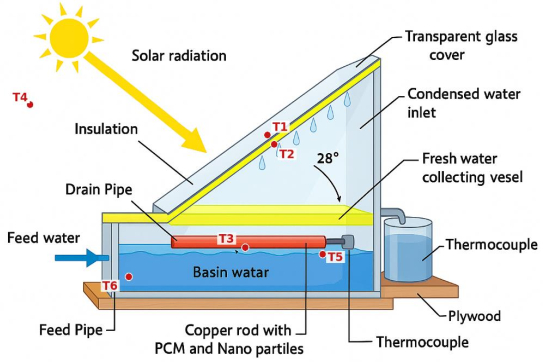
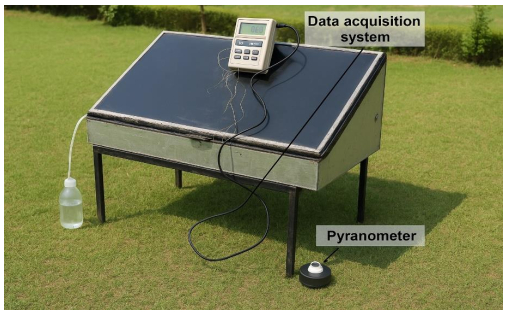
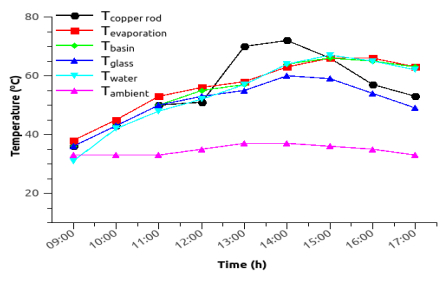
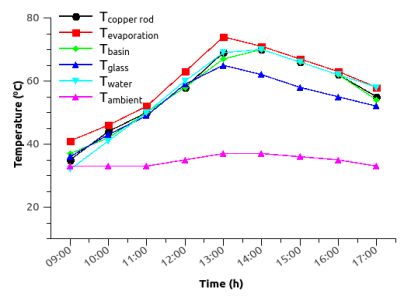
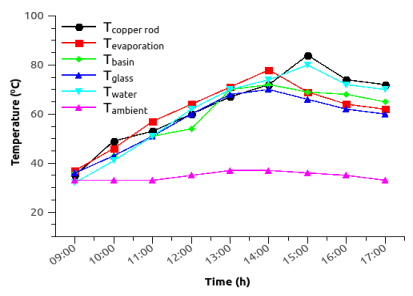
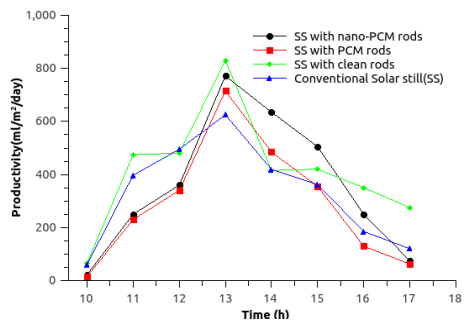
Low productivity remains a key limitation of conventional solar stills for desalination. In this study, we evaluated the performance of a solar still integrated with copper rods filled with nano-enhanced phase change material (NPCM), benchmarked against three configurations: a conventional still, a still with empty copper rods, and a still using unmodified phase change material (PCM). Four single-slope solar stills were fabricated and tested simultaneously under identical ambient conditions. Distillate yield, temperature profiles, and thermal efficiency were recorded during daytime (9:00–17:00) and nighttime operation to assess the influence of dispersed nanoparticles on heat storage and release behavior. The NPCM still achieved a distillate yield of 4.27 kg/m2·day, compared with 1.98 kg/m2·day for the conventional still. The improved thermal conductivity and heat retention of the nano-PCM matrix resulted in a 19.4% higher nocturnal yield (1.49 kg/m2·day) relative to the PCM still (1.28 kg/m2·day). Peak rod temperature reached 86 ℃ for the NPCM configuration, versus 79 ℃ (PCM) and 68 ℃ (empty rod). Thermal efficiency increased from 47.20% (conventional) to 70.15% (NPCM), representing a 65% gain in productivity and a 48.62% improvement in efficiency. These findings confirm that nanoparticle dispersion in PCM enhances heat storage capacity, thermal distribution, and freshwater yield in solar stills. The NPCM-integrated design offers a promising route toward higher-efficiency, sustainable solar desalination for arid and coastal regions.
Citation: Mohammad Saalim, Syed Mohd Yahya, Arshad Hussain Khan, Azhar Jamil, Mohd Seraj. Augmenting solar still productivity through phase-change materials and nano-enhanced PCM composites[J]. AIMS Energy, 2026, 14(5): 983-1004. doi: 10.3934/energy.2026040
Low productivity remains a key limitation of conventional solar stills for desalination. In this study, we evaluated the performance of a solar still integrated with copper rods filled with nano-enhanced phase change material (NPCM), benchmarked against three configurations: a conventional still, a still with empty copper rods, and a still using unmodified phase change material (PCM). Four single-slope solar stills were fabricated and tested simultaneously under identical ambient conditions. Distillate yield, temperature profiles, and thermal efficiency were recorded during daytime (9:00–17:00) and nighttime operation to assess the influence of dispersed nanoparticles on heat storage and release behavior. The NPCM still achieved a distillate yield of 4.27 kg/m2·day, compared with 1.98 kg/m2·day for the conventional still. The improved thermal conductivity and heat retention of the nano-PCM matrix resulted in a 19.4% higher nocturnal yield (1.49 kg/m2·day) relative to the PCM still (1.28 kg/m2·day). Peak rod temperature reached 86 ℃ for the NPCM configuration, versus 79 ℃ (PCM) and 68 ℃ (empty rod). Thermal efficiency increased from 47.20% (conventional) to 70.15% (NPCM), representing a 65% gain in productivity and a 48.62% improvement in efficiency. These findings confirm that nanoparticle dispersion in PCM enhances heat storage capacity, thermal distribution, and freshwater yield in solar stills. The NPCM-integrated design offers a promising route toward higher-efficiency, sustainable solar desalination for arid and coastal regions.

| [1] |
Chauhan VK, Shukla SK, Rathore PK (2022) A systematic review for performance augmentation of solar still with heat storage materials: A state of art. J Energy Storage 47: 103578. https://doi.org/10.1016/j.est.2021.103578 doi: 10.1016/j.est.2021.103578

|
| [2] |
Nagaraju V, Murali G, Sankeerthana M, et al. (2021) A review on recent developments of solar stills to enhance productivity using nanoparticles and nano-PCM. Int J Green Energy 19: 685–706. https://doi.org/10.1080/15435075.2021.1956935 doi: 10.1080/15435075.2021.1956935
|
| [3] |
Kateshia J, Lakhera V (2022) A comparative study of various fatty acids as phase change material to enhance the freshwater productivity of solar still. J Energy Storage 48: 103947. https://doi.org/10.1016/j.est.2021.103947 doi: 10.1016/j.est.2021.103947
|
| [4] |
Almuhanna E (2013) Evaluation of single slop solar still integrated with evaporative cooling system for brackish water desalination. J Agric Sci 6: 48–58. https://doi.org/10.5539/jas.v6n1p48 doi: 10.5539/jas.v6n1p48
|
| [5] |
Tripathi R, Tiwari GN (2005) Effect of water depth on internal heat and mass transfer for active solar distillation. Desalination 173: 187–200. https://doi.org/10.1016/j.desal.2004.08.032 doi: 10.1016/j.desal.2004.08.032
|
| [6] |
Keshtkar M, Eslami M, Jafarpur K (2020) Effect of design parameters on performance of passive basin solar stills considering instantaneous ambient conditions: A transient CFD modeling. Sol Energy 201: 884–907. https://doi.org/10.1016/j.solener.2020.03.068 doi: 10.1016/j.solener.2020.03.068
|
| [7] |
Velmurugan V, Srithar K (2011) Performance analysis of solar stills based on various factors affecting the productivity—A review. Renewable Sustainable Energy Rev 15: 1294–1304. https://doi.org/10.1016/j.rser.2010.10.012 doi: 10.1016/j.rser.2010.10.012
|
| [8] |
Panchal H, Mevada D, Sadasivuni KK, et al. (2020) Experimental and water quality analysis of solar stills with vertical and inclined fins. Groundw Sustain Dev 11: 100410. https://doi.org/10.1016/j.gsd.2020.100410 doi: 10.1016/j.gsd.2020.100410
|
| [9] |
Rahbar N, Esfahani JA, Fotouhi-Bafghi E (2015) Estimation of convective heat transfer coefficient and water-productivity in a tubular solar still—CFD simulation and theoretical analysis. Sol Energy 113: 313–323. https://doi.org/10.1016/j.solener.2014.12.032 doi: 10.1016/j.solener.2014.12.032
|
| [10] |
Ahsan A, Imteaz M, Thomas UA, et al. (2014) Parameters affecting the performance of a low cost solar still. Appl Energy 114: 924–930. https://doi.org/10.1016/j.apenergy.2013.08.066 doi: 10.1016/j.apenergy.2013.08.066
|
| [11] | Bhaskar N, Rai AK (2018) Thermal investigation of a tubular solar still. Int J Mech Eng Technol 9: 356–362. Available from: https://iaeme.com/Home/article_id/IJMET_09_01_038. |
| [12] |
Nougriaya SK, Chopra MK, Gupta B, et al. (2020) Stepped solar still: a review on designs analysis. Mater Today Proc 46: 5647–5660. https://doi.org/10.1016/j.matpr.2020.09.598 doi: 10.1016/j.matpr.2020.09.598
|
| [13] |
Asbik M, Ansari O, Bah A, et al. (2016) Exergy analysis of solar desalination still combined with heat storage system using phase change material (PCM). Desalination 381: 26–37. https://doi.org/10.1016/j.desal.2015.11.031 doi: 10.1016/j.desal.2015.11.031
|
| [14] |
Kabeel AE, Sathyamurthy R, Manokar AM, et al. (2020) Experimental study on tubular solar still using Graphene Oxide Nano particles in phase change material (NPCM's) for fresh water production. J Energy Storage 28: 101204. https://doi.org/10.1016/j.est.2020.101204 doi: 10.1016/j.est.2020.101204
|
| [15] |
Asbik M, Boushaba H, Hafs H, et al. (2021) Investigating the effect of sensible and latent heat storage materials on the performance of a single basin solar still during winter days. J Energy Storage 44: 103480. https://doi.org/10.1016/j.est.2021.103480 doi: 10.1016/j.est.2021.103480
|
| [16] |
Kabeel AE, Abdelgaied M (2016) Improving the performance of solar still by using PCM as a thermal storage medium under Egyptian conditions. Desalination 383: 22–28. https://doi.org/10.1016/j.desal.2016.01.006 doi: 10.1016/j.desal.2016.01.006
|
| [17] |
Gnanavel C, Saravanan R, Chandrasekaran M (2021) CFD analysis of solar still with PCM. Mater Today Proc 37: 694–700. https://doi.org/10.1016/j.matpr.2020.05.638 doi: 10.1016/j.matpr.2020.05.638
|
| [18] |
Vigneswaran VS, Kumaresan G, Dinakar BV, et al. (2019) Augmenting the productivity of solar still using multiple PCMs as heat energy storage. J Energy Storage 26: 101019. https://doi.org/10.1016/j.est.2019.101019 doi: 10.1016/j.est.2019.101019
|
| [19] |
Kedar SA, Bewoor AK, Murali G, et al. (2021) Effect of reflecting material on CPC to improve the performance of hybrid groundwater solar desalination system. Int J Photoenergy 6: 1–3. https://doi.org/10.1155/2021/6675236 doi: 10.1155/2021/6675236
|
| [20] |
Rufuss DDW, Arulvel S, Kumar VA, et al. (2022) Combined effects of composite thermal energy storage and magnetic field to enhance productivity in solar desalination. Renewable Energy 181: 219–234. https://doi.org/10.1016/j.renene.2021.07.124 doi: 10.1016/j.renene.2021.07.124
|
| [21] |
Manoj Kumar P, Sudarvizhi D, Prakash KB, et al. (2021) Investigating a single slope solar still with a nano-phase change material. Mater Today Proc 45: 7922–7925. https://doi.org/10.1016/j.matpr.2020.12.804 doi: 10.1016/j.matpr.2020.12.804
|
| [22] |
Sharshir SW, Peng G, Wu L, et al. (2017) The effects of flake graphite nanoparticles, phase change material, and film cooling on the solar still performance. Appl Energy 191: 358–366. https://doi.org/10.1016/j.apenergy.2017.01.067 doi: 10.1016/j.apenergy.2017.01.067
|
| [23] |
Thalib MM, Manokar AM, Essa FA, et al. (2020) Comparative study of tubular solar stills with phase change material and nano-enhanced phase change material. Energies 13: 3989. https://doi.org/10.3390/en13153989 doi: 10.3390/en13153989
|
| [24] |
Kushwah A, Kumar A, Gaur MK (2025) Techno-economic analysis of solar still with nano-phase change material and heating coil: A novel approach for sustainable development. J Therm Eng 11: 476–492. https://doi.org/10.14744/thermal.0000928 doi: 10.14744/thermal.0000928
|
| [25] | Padmanaban M, Suresh S, Kalidoss P (2023) Experimental investigation on the performance of solar stills with vent holes and hybrid nano PCM. In: Recent Advances in Thermal Sciences and Engineering, 421–435. https://doi.org/10.1007/978-981-19-7214-0_35 |
| [26] |
Saeed MMA, Hachim DM, Hameed H (2019) Numerical investigation for single slope solar still performance with optimal amount of nano-PCM. J Adv Res Fluid Mech Therm Sci 63: 302–316. https://doi.org/10.13140/RG.2.2.22254.97609 doi: 10.13140/RG.2.2.22254.97609
|
| [27] |
Alagu K, Reddy MS, Kumar MN, et al. (2020) Solar desalination using solar still enhanced by PCM and nano fluid. AIP Conference Proceedings 2311: 080008. https://doi.org/10.1063/5.0034238 doi: 10.1063/5.0034238
|
| [28] |
Murali G, Ramani P, Murugan M, et al. (2024). Improved solar still productivity using PCM and nano-PCM composites integrated energy storage. Sci Rep 14: 15609. https://doi.org/10.1038/s41598-024-65418-1 doi: 10.1038/s41598-024-65418-1
|
| [29] |
Chen W, Zou C, Li X, et al. (2019) Application of recoverable carbon nanotube nanofluids in solar desalination system: An experimental investigation. Desalination 451: 92–101. https://doi.org/10.1016/j.desal.2017.09.025 doi: 10.1016/j.desal.2017.09.025
|
| [30] |
Yadav A, Verma A, Kumar A, et al. (2021) Recent advances on enhanced thermal conduction in phase change materials using carbon nanomaterials. J Energy Storage 43: 103173. https://doi.org/10.1016/j.est.2021.103173 doi: 10.1016/j.est.2021.103173
|
| [31] |
Yousef MS, Hassan H (2019) Energetic and exergetic performance assessment of the inclusion of phase change materials (PCM) in a solar distillation system. Energy Convers Manag 179: 349–361. https://doi.org/10.1016/j.enconman.2018.10.078 doi: 10.1016/j.enconman.2018.10.078
|
| [32] |
Diabil HAN (2022) Experimental study to enhance the productivity of single-slope single-basin solar still. Open Eng 12: 157–168. https://doi.org/10.1515/eng-2022-0015 doi: 10.1515/eng-2022-0015
|
| [33] |
Jamil B, Akhtar N (2017) Effect of specific height on the performance of a single slope solar still: An experimental study. Desalination 414: 73–88. https://doi.org/10.1016/j.desal.2017.03.036 doi: 10.1016/j.desal.2017.03.036
|
| [34] |
Reda A, Monssif N, Mohamed H (2024) Numerical study of PCM-integrated solar still efficiency enhancement. Int J Low-Carbon Technol 19: 443–454. https://doi.org/10.1093/ijlct/ctae004 doi: 10.1093/ijlct/ctae004
|
| [35] |
Chaichan MT, Kazem HA (2018) Single slope solar distillator productivity improvement using phase change material and Al2O3 nanoparticle. Sol Energy 164: 370–381. https://doi.org/10.1016/j.solener.2018.02.049 doi: 10.1016/j.solener.2018.02.049
|
| [36] |
Mohammed AH, Attalla M, Shmroukh AN (2021) Performance enhancement of single-slope solar still using phase change materials. Environ Sci Pollut Res 28: 17098–17108. https://doi.org/10.1007/s11356-020-12096-x doi: 10.1007/s11356-020-12096-x
|
| [37] |
Dhindsa GS (2021) Performance enhancement of basin solar still using paraffin wax and floating wicks in the basin. Mater Today Proc 37: 3310–3316. https://doi.org/10.1016/j.matpr.2020.09.121 doi: 10.1016/j.matpr.2020.09.121
|
| [38] |
Murali G, Ramani P, Murugan M, et al. (2024) Improved solar still productivity using PCM and nano-PCM composites integerated energy storage. Sci Rep 14: 15609. https://doi.org/10.1038/s41598-024-65418-1 doi: 10.1038/s41598-024-65418-1
|
| [39] |
Bakthavatchalam B, Habib K, Saidur R, et al. (2021) Optimization of thermophysical and rheological properties of mxene ionanofluids for hybrid solar photovoltaic/thermal systems. Nanomaterials 11: 320. https://doi.org/10.3390/nano11020320 doi: 10.3390/nano11020320
|
| [40] |
Masthan Vali PSN, Murali G, Kurhade AS, et al. (2025) Synthesis and characterization of paraffin wax-based composite phase change materials with improved thermal properties for E-Vehicle BTMS. Energy Sci Eng 13: 5731–5740. https://doi.org/10.1002/ese3.70281 doi: 10.1002/ese3.70281
|
| [41] |
Vasanthakumar R, Navaneethakrishnan P, Murali G, et al. (2024) Investigation of thermal properties of SiO2 and TiO2 composite nanofluids synthesized using sol–gel method for solar thermal applications. J Therm Anal Calorim 149: 14463–14473. https://doi.org/10.1007/s10973-024-13798-x doi: 10.1007/s10973-024-13798-x
|
| [42] |
Nagaraju V, Murali G, Anand K, et al. (2022) Experimental study on performance of single slope solar still integrated with sand troughs. Sustainable Energy Technol Assess 50: 101884. https://doi.org/10.1016/j.seta.2021.101884 doi: 10.1016/j.seta.2021.101884
|
| [43] |
Wang J, Feng JC, Zhuang Y (2025) Dynamic regulation of the photothermal conversion performances of nano-enhanced phase change material composited with ceramic foam subjected to external fields. Sol Energy Mater Sol Cells 279: 113268. https://doi.org/10.1016/j.solmat.2024.113268 doi: 10.1016/j.solmat.2024.113268
|
| [44] |
Piyush R, Ashwni G, Sherwani AF (2023) A comparative numerical study about the impact of rectangular and T shaped fins on melting of PCM in a rectangular enclosure. Appl Therm Eng 228: 120461. https://doi.org/10.1016/j.applthermaleng.2023.120461 doi: 10.1016/j.applthermaleng.2023.120461
|
| [45] |
Ranjan KR, Kaushik SC (2013) Economic feasibility evaluation of solar distillation systems based on the equivalent cost of environmental degradation and high-grade energy savings. Int J Low-Carbon Technol 11: 8–15. https://doi.org/10.1093/ijlct/ctt048 doi: 10.1093/ijlct/ctt048
|
| [46] |
Mukherjee K, Tiwari GN (1986) Economic analyses of various designs of conventional solar stills. Energy Convers Manage 26: 155–157. https://doi.org/10.1016/0196-8904(86)90049-X doi: 10.1016/0196-8904(86)90049-X
|
Figures(11) / Tables(8)

Mohammad Saalim, Syed Mohd Yahya, Arshad Hussain Khan, Azhar Jamil, Mohd Seraj. Augmenting solar still productivity through phase-change materials and nano-enhanced PCM composites[J]. AIMS Energy, 2026, 14(5): 983-1004. doi: 10.3934/energy.2026040





 DownLoad: