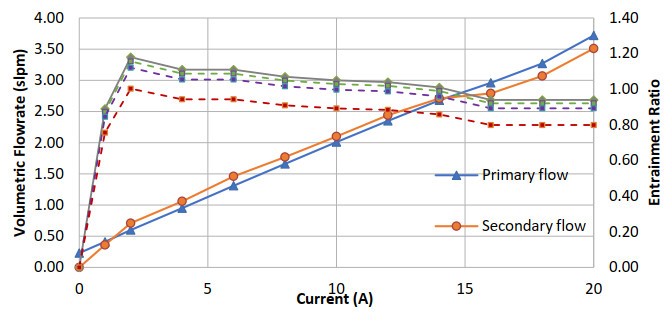
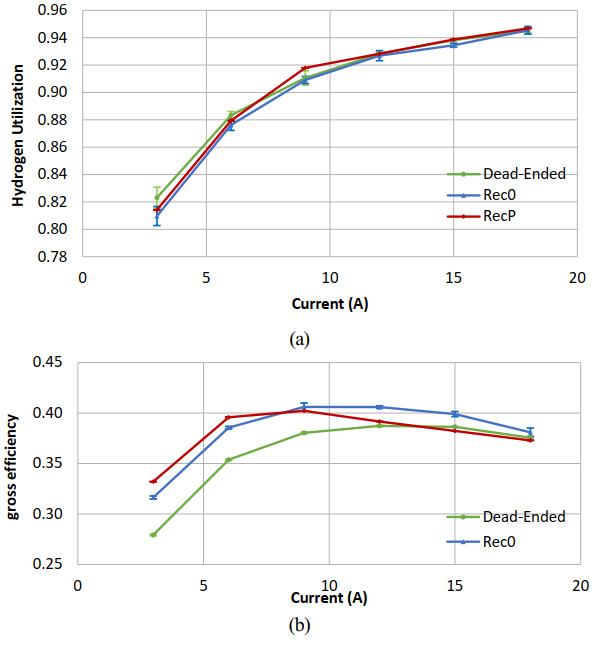
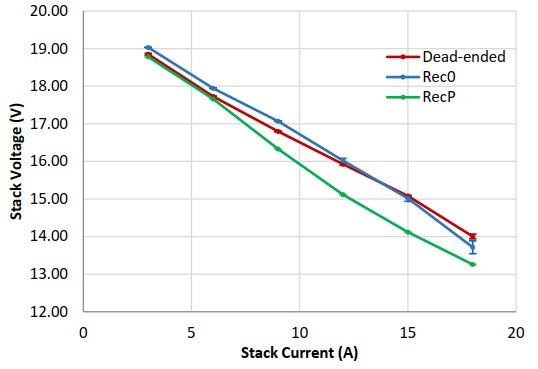
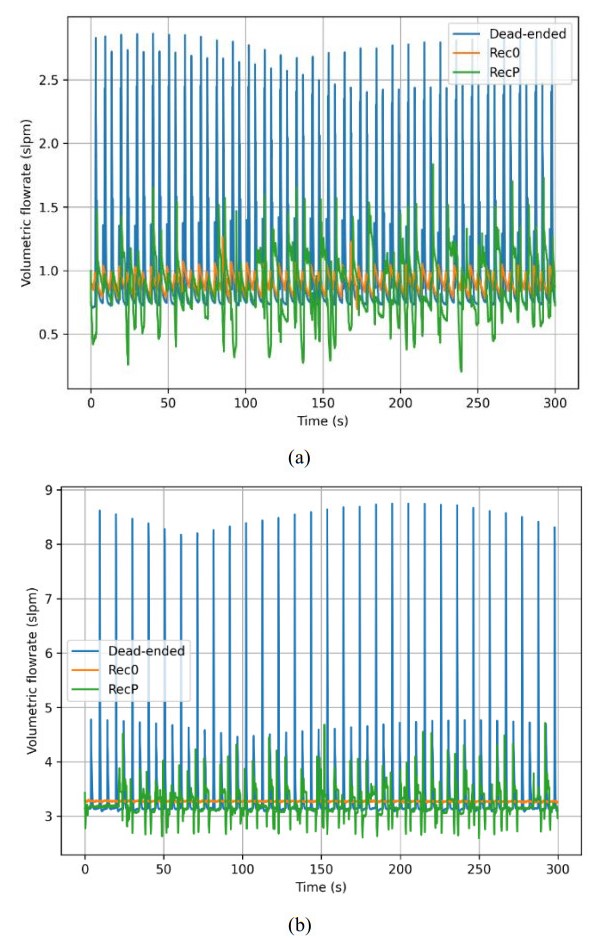
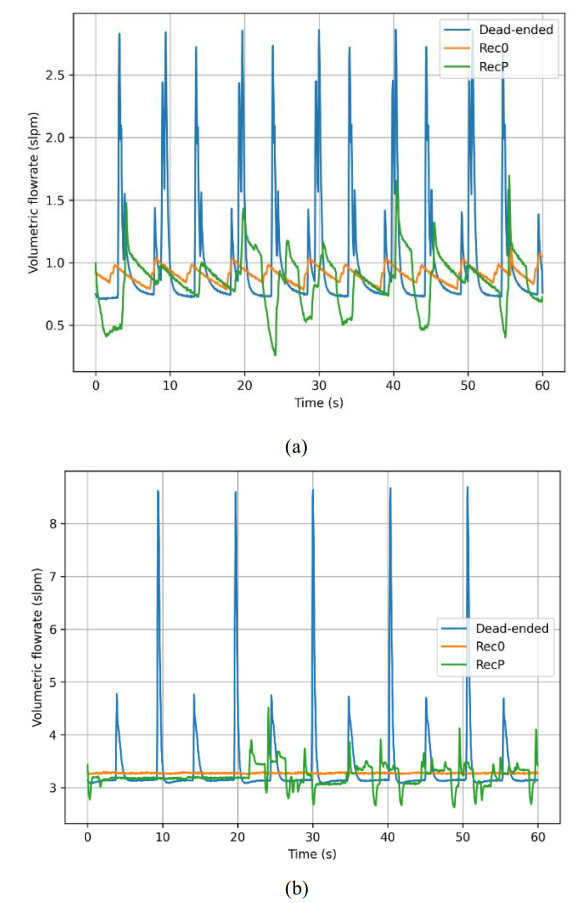
This work presents an experimental investigation of a simple ejector-based passive hydrogen recirculation system for a 0.5 kW small-scale open-cathode proton exchange membrane fuel cell (PEMFC) stack. Several ejector geometries were designed and fabricated using a 3D printer, and the final configuration employed a converging nozzle with a diameter of 0.2 mm and a mixing-chamber-to-nozzle diameter ratio of 4.5. Experiments showed that the ejector achieves entrainment ratios peaking at ~1.3 at low current and stabilizing around 0.9–1.0 at higher loads, while maintaining stable operation across the full load range. Compared with a dead-ended anode configuration, passive recirculation reduces the total hydrogen supply required by the system, with the reduction being strongly influenced by purge dynamics that are prominent in sub-kW operation. Beyond averaged hydrogen saving, purge-event transients were quantified using time-resolved supply-flow traces and introduced purge-event metrics (overshoot amplitude and purge-induced excess volume) to capture purge-dominated behavior and the buffering role of recirculation. Finally, by contrasting without and with anode inlet pressure setting operations, this paper shows that pressure regulation can improve steady utilization yet partially compromise transient suppression, motivating purge-aware pressure control as a practical operational guideline for small-scale open-cathode PEMFC systems.
Citation: Katherin Indriawati, Naufal Ikhsan Wijaya, Edy Herianto Majlan. Hydrogen feed reduction in small-scale open-cathode PEMFCs using passive ejector-based recirculation[J]. AIMS Energy, 2026, 14(5): 957-982. doi: 10.3934/energy.2026039
This work presents an experimental investigation of a simple ejector-based passive hydrogen recirculation system for a 0.5 kW small-scale open-cathode proton exchange membrane fuel cell (PEMFC) stack. Several ejector geometries were designed and fabricated using a 3D printer, and the final configuration employed a converging nozzle with a diameter of 0.2 mm and a mixing-chamber-to-nozzle diameter ratio of 4.5. Experiments showed that the ejector achieves entrainment ratios peaking at ~1.3 at low current and stabilizing around 0.9–1.0 at higher loads, while maintaining stable operation across the full load range. Compared with a dead-ended anode configuration, passive recirculation reduces the total hydrogen supply required by the system, with the reduction being strongly influenced by purge dynamics that are prominent in sub-kW operation. Beyond averaged hydrogen saving, purge-event transients were quantified using time-resolved supply-flow traces and introduced purge-event metrics (overshoot amplitude and purge-induced excess volume) to capture purge-dominated behavior and the buffering role of recirculation. Finally, by contrasting without and with anode inlet pressure setting operations, this paper shows that pressure regulation can improve steady utilization yet partially compromise transient suppression, motivating purge-aware pressure control as a practical operational guideline for small-scale open-cathode PEMFC systems.

| [1] |
Khan N, Al-Sagheer Y, Steinberger-Wilckens R (2022) PEFC system reactant gas supply management and anode purging strategy: An experimental approach. Energies 15: 288–306. https://doi.org/10.3390/en15010288 doi: 10.3390/en15010288

|
| [2] |
Wang B, Deng H, Jiao K (2018) Purge strategy optimization of proton exchange membrane fuel cell with anode recirculation. Appl Energy 225: 1–13. https://doi.org/10.1016/j.apenergy.2018.04.058 doi: 10.1016/j.apenergy.2018.04.058
|
| [3] |
Bai Q, Liu Z, Hsieh C (2023) Research on the performance of self-made open-cathode fuel cell stacks under different operating conditions. Membranes 13: 881–898. https://doi.org/10.3390/membranes13110881 doi: 10.3390/membranes13110881
|
| [4] | Mus J, Mylle S, Schotte S, et al. (2022) CFD modelling and simulation of PEMFCs in STAR-CCM+. 2022 11th International Conference on Renewable Energy Research and Application (ICRERA), Istanbul, Turkey, 260–267. https://doi.org/10.1109/ICRERA55966.2022.9922908 |
| [5] |
Zhao C, Wang F, Wu X (2024) Analysis and review on air-cooled open-cathode proton exchange membrane fuel cells: Bibliometric, environmental adaptation and prospect. Renewable Sustainable Energy Rev 197: 114408. https://doi.org/10.1016/j.rser.2024.114408 doi: 10.1016/j.rser.2024.114408
|
| [6] |
Zhang J, Wang C, Zhang A (2022) Experimental study on temperature and performance of an open-cathode PEMFC stack under thermal radiation environment. Appl Energy 311: 118646. https://doi.org/10.1016/j.apenergy.2022.118646 doi: 10.1016/j.apenergy.2022.118646
|
| [7] |
He P, Zhang Q, Mu Y, et al. (2025) Experimental investigation on the impact of ambient temperature and current load rate on the cold start behavior of a short PEMFC stack. Appl Energy 396: 126317. https://doi.org/10.1016/j.apenergy.2025.126317 doi: 10.1016/j.apenergy.2025.126317
|
| [8] |
He P, Zhang Q, Mu Y, et al. (2026) Temperature-dependent cathode starvation effects on cold start behavior of PEMFC stacks: An experimental investigation. Appl Energy 406: 127299. https://doi.org/10.1016/j.apenergy.2025.127299 doi: 10.1016/j.apenergy.2025.127299
|
| [9] |
Rabbani A, Rokni M (2013) Effect of nitrogen crossover on purging strategy in PEM fuel cell systems. Appl Energy 111: 1061–1070. https://doi.org/10.1016/j.apenergy.2013.06.057 doi: 10.1016/j.apenergy.2013.06.057
|
| [10] |
Steinberger M, Geiling J, Oechsner R, et al. (2018) Anode recirculation and purge strategies for PEM fuel cell operation with diluted hydrogen feed gas. Appl Energy 232: 572–582. https://doi.org/10.1016/j.apenergy.2018.10.004 doi: 10.1016/j.apenergy.2018.10.004
|
| [11] |
Liu Z, Chen J, Liu H, et al. (2020) Anode purge management for hydrogen utilization and stack durability improvement of PEM fuel cell systems. Appl Energy 275: 115110. https://doi.org/10.1016/j.apenergy.2020.115110 doi: 10.1016/j.apenergy.2020.115110
|
| [12] |
Hou J, Yang M, Zhang J (2020) Active and passive fuel recirculation for solid oxide and proton exchange membrane fuel cells. Renewable Energy 155: 1355–1371. https://doi.org/10.1016/j.renene.2020.04.002 doi: 10.1016/j.renene.2020.04.002
|
| [13] |
Arabbeiki M, Mansourkiaei M, Ferrero D, et al. (2024) Ejectors in hydrogen recirculation for PEMFC-based systems: A comprehensive review of design, operation, and numerical simulations. Energies 17: 4815. https://doi.org/10.3390/en17194815 doi: 10.3390/en17194815
|
| [14] |
Nikiforow K, Koski P, Karimäki H, et al. (2016) Designing a hydrogen gas ejector for 5 kW stationary PEMFC system—CFD modeling and experimental validation. Int J Hydrogen Energy 41: 14952–14970. https://doi.org/10.1016/j.ijhydene.2016.06.122 doi: 10.1016/j.ijhydene.2016.06.122
|
| [15] |
Kuo J-K, Hsieh C-Y (2021) Numerical investigation into effects of ejector geometry and operating conditions on hydrogen recirculation ratio in 80 kW PEM fuel cell system. Energy 233: 121100. https://doi.org/10.1016/j.energy.2021.121100 doi: 10.1016/j.energy.2021.121100
|
| [16] |
Pei P, Ren P, Li Y, et al. (2019) Numerical studies on wide-operating-range ejector based on anodic pressure drop characteristics in proton exchange membrane fuel cell system. Appl Energy 235: 729–738. https://doi.org/10.1016/j.apenergy.2018.11.005 doi: 10.1016/j.apenergy.2018.11.005
|
| [17] |
Han J, Feng J, Hou T, et al. (2021) Performance investigation of a multi-nozzle ejector for proton exchange membrane fuel cell system. Int J Energy Res 45: 9476–9492. https://doi.org/10.1002/er.5996 doi: 10.1002/er.5996
|
| [18] |
Ding H, Dong Y, Zhang Y, et al. (2023) Energy efficiency assessment of hydrogen recirculation ejectors for proton exchange membrane fuel cell (PEMFC) system. Appl Energy 346: 121357. https://doi.org/10.1016/j.apenergy.2023.121357 doi: 10.1016/j.apenergy.2023.121357
|
| [19] |
Feng J, Han J, Pang Z, et al. (2023) Designing hydrogen recirculation ejectors for proton exchange membrane fuel cell systems. Energies 16: 1201. https://doi.org/10.3390/en16031201 doi: 10.3390/en16031201
|
| [20] |
Singer G, Köll R, Pertl P, et al. (2023) Development of an ejector for passive hydrogen recirculation in PEM fuel cell systems by applying 2D CFD simulation. Automot Eng Technol 8: 211-226. https://doi.org/10.1007/s41104-023-00133-z doi: 10.1007/s41104-023-00133-z
|
| [21] | Maulana FR, Indriawati K, Wahyuono RA (2023) Reactant control strategies for maximizing efficiency in open cathode PEM fuel cell. 2023 8th International Conference on Instrumentation, Control, and Automation (ICA), Jakarta, Indonesia, 30–35. https://doi.org/10.1109/ICA58538.2023.10273067 |
| [22] | Indriawati K, Maulana FR, Wahyuono RA (2025) Stoichiometric ratio guided control strategies for efficiency improvement on open cathode PEM fuel cell. Eng Lett 33: 1297–1314. |
| [23] |
Li K, Wang C, Li J, et al. (2024) Experimental investigation into the performance of PEMFCs with three different hydrogen recirculation schemes. Inventions 9: 33. https://doi.org/10.3390/inventions9020033 doi: 10.3390/inventions9020033
|
| [24] |
Wang X, Lu Y, Zhang B, et al. (2022) Experimental analysis of an ejector for anode recirculation in a 10 kW polymer electrolyte membrane fuel cell system. Int J Hydrogen Energy 47: 1925–1939. https://doi.org/10.1016/j.ijhydene.2021.10.140 doi: 10.1016/j.ijhydene.2021.10.140
|
| [25] |
Ding H, Zhang P, Dong Y, et al. (2024) Optimization of hydrogen recirculation ejector for proton-exchange membrane fuel cells (PEMFC) systems considering non-equilibrium condensation. Renewable Energy 237: 121748. https://doi.org/10.1016/j.renene.2024.121748 doi: 10.1016/j.renene.2024.121748
|
| [26] | Tu Z, Liu Y, Chan SH (2022) Water management and performance enhancement in a proton exchange membrane fuel cell system using 3D-printed ejectors. SSRN Electronic Journal, Preprint. https://doi.org/10.2139/ssrn.4169694 |
| [27] |
Ahluwalia RK, Wang X (2007) Buildup of nitrogen in direct hydrogen polymer-electrolyte fuel cell stacks. J Power Sources 171: 63–71. https://doi.org/10.1016/j.jpowsour.2007.01.032 doi: 10.1016/j.jpowsour.2007.01.032
|
| [28] |
Baik KD, Kim MS (2011) Characterization of nitrogen gas crossover through the membrane in proton-exchange membrane fuel cells. Int J Hydrogen Energy 36: 732–739. https://doi.org/10.1016/j.ijhydene.2010.09.046 doi: 10.1016/j.ijhydene.2010.09.046
|
| [29] |
He Z, Jian H, Mao J, et al. (2026) Metal foam solid oxide fuel cell stack with high power density for fast and safe thermal cycling. Appl Energy 412: 127720. https://doi.org/10.1016/j.apenergy.2026.127720 doi: 10.1016/j.apenergy.2026.127720
|
Figures(8) / Tables(5)

Katherin Indriawati, Naufal Ikhsan Wijaya, Edy Herianto Majlan. Hydrogen feed reduction in small-scale open-cathode PEMFCs using passive ejector-based recirculation[J]. AIMS Energy, 2026, 14(5): 957-982. doi: 10.3934/energy.2026039





 DownLoad: