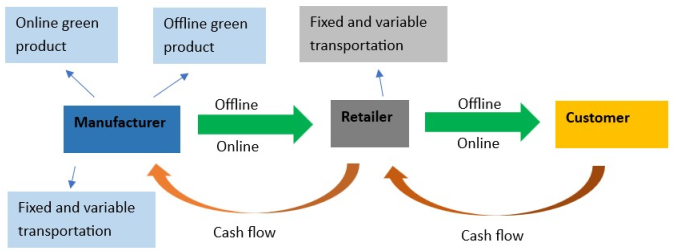
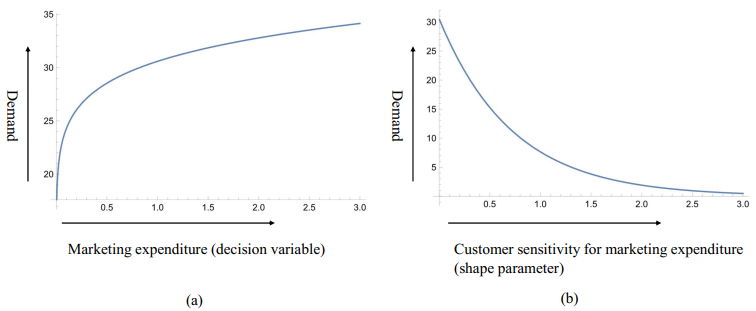
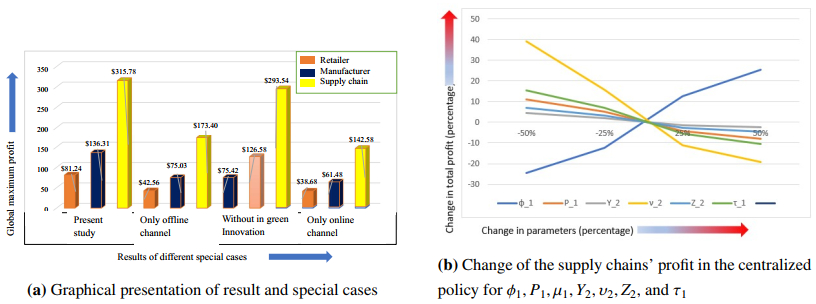
Businesses improve their operations by controlling carbon emissions and environmental impact. Emissions from a system can be controlled, which is more realistic in most industries rather than using a zero-emissions system. An eco-friendly technology helps to improve environmental impact and emissions compared with a traditional system without a green innovation technology. This research examines a carbon tax and utilization of green innovation in a dual-channel retailing with two independent channels. The dual-channel operations uses marketing to advertise products to their associated customers. The manufacturer and the retailer communicate through independent online and offline channels. The demand depends on green innovation, marketing expenditures, and the retail price of the respective channel. The model is solved for a centralized and a decentralized methods. The results demonstrate that the lack of green innovation in decentralized policy decrease the profits of the retailer and manufacturer by 7.27% and 7.16%, respectively, and under the centralized policy, it decreases by 6.98%. In the absence of the online channel, the retailer's and manufacturer's profits increase by 45.04% and 47.61%, respectively, under the decentralized policy for the offline channel.
Citation: Parthasarathi Mandal, Mitali Sarkar, Sarla Pareek, Rekha Guchhait, Biswajit Sarkar. Impact of marketing expenditure and carbon emissions on dual-channel retailing[J]. Clean Technologies and Recycling, 2026, 6(2): 252-288. doi: 10.3934/ctr.2026011
Businesses improve their operations by controlling carbon emissions and environmental impact. Emissions from a system can be controlled, which is more realistic in most industries rather than using a zero-emissions system. An eco-friendly technology helps to improve environmental impact and emissions compared with a traditional system without a green innovation technology. This research examines a carbon tax and utilization of green innovation in a dual-channel retailing with two independent channels. The dual-channel operations uses marketing to advertise products to their associated customers. The manufacturer and the retailer communicate through independent online and offline channels. The demand depends on green innovation, marketing expenditures, and the retail price of the respective channel. The model is solved for a centralized and a decentralized methods. The results demonstrate that the lack of green innovation in decentralized policy decrease the profits of the retailer and manufacturer by 7.27% and 7.16%, respectively, and under the centralized policy, it decreases by 6.98%. In the absence of the online channel, the retailer's and manufacturer's profits increase by 45.04% and 47.61%, respectively, under the decentralized policy for the offline channel.

| [1] |
Alipanah M, Saha AK, Vahidi E, et al. (2021) Value recovery from spent lithium-ion batteries: A review on technologies, environmental impacts, economics, and supply chain. Clean Technol. Recycl. 1: 152–184. https://doi.org/10.3934/ctr.2021008 doi: 10.3934/ctr.2021008

|
| [2] |
Yadav D, Singh R, Kumar A, et al. (2022) Reduction of pollution through sustainable and flexible production by controlling by-products. J. Environ. Inf. 40: 106. https://doi.org/10.3808/jei.202200476 doi: 10.3808/jei.202200476
|
| [3] |
Habib MS, Omair M, Ramzan MB, et al. (2022) A robust possibilistic flexible programming approach toward a resilient and cost-efficient biodiesel supply chain network. J. Cleaner Prod. 366: 132752. https://doi.org/10.1016/j.jclepro.2022.132752 doi: 10.1016/j.jclepro.2022.132752
|
| [4] |
Kumar S, Sigroha M, Kumar N, et al. (2025) How does the retail price maintain trade-credit management with continuous investment to support the cash flow?. J. Retail. Consum. Serv. 83: 104116. https://doi.org/10.1016/j.jretconser.2024.104116 doi: 10.1016/j.jretconser.2024.104116
|
| [5] |
Xie W, Chen Y (2025) From marketing to manpower: Impact of advertising expenditures on employment. Int. Rev. Financ. Anal. 104: 104333. https://doi.org/10.1016/j.irfa.2025.104333 doi: 10.1016/j.irfa.2025.104333
|
| [6] |
Tayyab M, Sarkar B (2021) An interactive fuzzy programming approach for a sustainable supplier selection under textile supply chain management. Comput. Indust. Eng. 155: 107164. https://doi.org/10.1016/j.cie.2021.107164 doi: 10.1016/j.cie.2021.107164
|
| [7] |
Korkosz M, Bogusz P, Prokop J, et al. (2019) Comparative analysis of fault-tolerant dual-channel BLDC and SR motors. Energies 12: 2489. https://doi.org/10.3390/en12132489 doi: 10.3390/en12132489
|
| [8] |
Hayat K, Qingyu Z (2024) The synergistic effects of green innovation strategies on sustainable innovative performance with the mediation of green innovative competitive advantage. Corp. Soc. Resp. Environ. Manage. 31: 4172–4189. https://doi.org/10.1002/csr.2770 doi: 10.1002/csr.2770
|
| [9] |
Paul A (2025) Resolving environmental, social, and governance challenges: A bibliometric review of ethical supply chain management. Clean Technol. Recycl. 5: 64–86. https://dx.doi.org/10.3934/ctr.2025004 doi: 10.3934/ctr.2025004
|
| [10] |
Supakar P, Sarkar M, Sarkar B (2026) Forecasting grocery item sales using gradient boosting models: A study of GridSearchCV, randomizedsearchcv, and optuna optimization approaches. Ain Shams Eng. J. 17: 104012. https://doi.org/10.1016/j.asej.2026.104012 doi: 10.1016/j.asej.2026.104012
|
| [11] | Kugele ASH, Oh Y, Kar S, et al. (2026) A generative artificial intelligence-driven smart factory using generative adversarial networks. Int. J. Prod. Res.. https://doi.org/10.1080/00207543.2026.2683883 |
| [12] |
Chaudhari U, Bhadoriya A, Jani MY, et al. (2023) A generalized payment policy for deteriorating items when demand depends on price, stock, and advertisement under carbon tax regulations. Math. Comput. Simul. 207: 556–574. https://doi.org/10.1016/j.matcom.2022.12.015 doi: 10.1016/j.matcom.2022.12.015
|
| [13] |
Vishnoi M, Deepi D, Singh SR, et al. (2026) Sustainable closed-loop supply chain management for a two-warehouse system with trade-credit and emissions constraints under dynamic demand. Sci. Rep. 16: 18438. https://doi.org/10.1038/s41598-026-43484-x doi: 10.1038/s41598-026-43484-x
|
| [14] |
Kugele ASH, Sarkar B (2026) Advanced risk management for a business-to-business and business-to-consumer service supply chain under information asymmetry with Stackelberg game. J. Ind. Inf. Integr. 54: 101168. https://doi.org/10.1016/j.jii.2026.101168 doi: 10.1016/j.jii.2026.101168
|
| [15] |
Msacky NJ, Ndaka FE, Mgana S (2026) Fruit and vegetable postharvest waste in Tanzania: A review of occurrence, sources, environmental impacts, and contextual utilization pathways. Clean Technol. Recycl. 6: 161–207. https://doi.org/10.3934/ctr.2026008 doi: 10.3934/ctr.2026008
|
| [16] | Dammak K, Zouari A, Sidhom L (2026) Systemic drivers of sustainability in smallholder-based agri-food supply chains: Insights from DEMATEL analysis. J. Agribus. Devel. Emerg. Econ.. https://doi.org/10.1108/JADEE-10-2025-0494 |
| [17] | Gupta SK (2026) AI-augmented sustainability management in agri-food supply chain: Rethinking decision-making in the era of algorithms. J. Agribus. Devel. Emerg. Econ.. https://doi.org/10.1108/JADEE-09-2025-0412 |
| [18] |
Gomaa AH (2026) Sustainable supply chain management in Industry 4.0: A review, research gaps, and conceptual framework. Clean Technol. Recycl. 6: 139–160. https://doi.org/10.3934/ctr.2026007 doi: 10.3934/ctr.2026007
|
| [19] |
Li C, Zhang S (2025) Do innovation policies and fintech create synergistic effects for the sustainability of urban green innovation? An empirical test based on a triple difference approach. Sustain. Futures 9: 100696. https://doi.org/10.1016/j.sftr.2025.100696 doi: 10.1016/j.sftr.2025.100696
|
| [20] |
Yuan D, Wu X, Shang D, et al. (2025) How government environmental attention influences corporate green innovation: A chain mediating model. Technol. Forecast. Soc. Change 218: 124195. https://doi.org/10.1016/j.techfore.2025.124195 doi: 10.1016/j.techfore.2025.124195
|
| [21] |
Sarkar B, Mridha B, Pareek S (2022) A sustainable smart multi-type biofuel manufacturing with the optimum energy utilization under flexible production. J. Cleaner Prod. 332: 129869. https://doi.org/10.1016/j.jclepro.2021.129869 doi: 10.1016/j.jclepro.2021.129869
|
| [22] |
Cui W (2025) Green management innovation, supply chain finance capabilities, and corporate green innovation performance. Finance Res. Lett. 85: 108157. https://doi.org/10.1016/j.frl.2025.108157 doi: 10.1016/j.frl.2025.108157
|
| [23] |
Ismail IJ (2025) The influence of green absorptive capacity on agripreneur's adoption of precision agriculture technologies: Mediating effects of green innovations. Innovation Green Dev. 4: 100248. https://doi.org/10.1016/j.igd.2025.100248 doi: 10.1016/j.igd.2025.100248
|
| [24] |
Fan X, Wang Z, Wu S, et al. (2025) Environmental investment and green innovation in polluting enterprises: Evidence from heavily polluting listed firms in China. J. Environ. Manage. 393: 127177. https://doi.org/10.1016/j.jenvman.2025.127177 doi: 10.1016/j.jenvman.2025.127177
|
| [25] |
Bhattacharya S, Sarkar M, Sarkar B, et al. (2026) An application of stochastic optimization through barter exchange. AIMS Math. 11: 21251–21292. http://dx.doi.org/10.3934/math.2026863 doi: 10.3934/math.2026863
|
| [26] |
Sarkar B, Sarkar M, Mridha B (2026) Mitigating the bullwhip effect and improved sustainable dual-channel retail management profitability. Comput. Ind. Eng. 216: 111968. https://doi.org/10.1016/j.cie.2026.111968 doi: 10.1016/j.cie.2026.111968
|
| [27] |
Kar S, Basu K, Sarkar B (2023) Advertisement policy for dual-channel within emissions-controlled flexible production system. J. Retail. Consum. Serv. 71: 103077. https://doi.org/10.1016/j.jretconser.2022.103077 doi: 10.1016/j.jretconser.2022.103077
|
| [28] |
Sana SS (2022) Sale through dual channel retailing system—a mathematical approach. Sustainability Anal. Model. 2: 100008. https://doi.org/10.1016/j.samod.2022.100008 doi: 10.1016/j.samod.2022.100008
|
| [29] |
Sarkar B, Mridha B, Pareek S, et al. (2021) A flexible biofuel and bioenergy production system with transportation disruption under a sustainable supply chain network. J. Cleaner Prod. 317: 128079. https://doi.org/10.1016/j.jclepro.2021.128079 doi: 10.1016/j.jclepro.2021.128079
|
| [30] |
Datta A, Dey BK, Bhuniya S, et al. (2025) Adaptation of e-commerce retailing to enhance customer satisfaction within a dynamical system under transfer of risk. J. Retail. Consum. Serv. 84: 104129. https://doi.org/10.1016/j.jretconser.2024.104129 doi: 10.1016/j.jretconser.2024.104129
|
| [31] |
Almonares RAL, Maneenop S, Jaroenjitrkam A (2026) The impact of carbon emissions on firm performance in the global transportation sector. Res. Trans. Econ. 117: 101761. https://doi.org/10.1016/j.retrec.2026.101761 doi: 10.1016/j.retrec.2026.101761
|
| [32] |
Tong H, Xia E, Sun C, et al. (2026) More precise accounting of marine carbon emission efficiency: Based on input-output analysis and considering marine carbon sinks. Resour. Conserv. Recycl. Adv. 30: 200332. https://doi.org/10.1016/j.rcradv.2026.200332 doi: 10.1016/j.rcradv.2026.200332
|
| [33] |
Wang N, Ling Fu L, Wang Y, et al. (2026) Life cycle carbon emissions of lithium-ion batteries considering dynamic round-trip efficiency degradation: From assessment to reduction. J. Energy Storage 163: 122148. https://doi.org/10.1016/j.est.2026.122148 doi: 10.1016/j.est.2026.122148
|
| [34] |
Jorgenson A, Goh T, Viens N, et al. (2026) Reducing inequality is not antithetical to solving the climate crisis: An analysis of disposable income shares and carbon emissions for Canada's provinces. Environ. Impact Assess. Rev. 120: 108440. https://doi.org/10.1016/j.eiar.2026.108440 doi: 10.1016/j.eiar.2026.108440
|
| [35] |
Liu X, Wang Z, Liu M, et al. (2026) Beyond emission reduction: How carbon capture reshapes operational flexibility and energy efficiency of coal-fired CHP plants. Energy 351: 140884. https://doi.org/10.1016/j.energy.2026.140884 doi: 10.1016/j.energy.2026.140884
|
| [36] |
Bar N, Sangal I, Sarkar B (2026) Impact of smart energy on a three-echelon closed-loop supply chain management with reduction of carbon emissions. Sci. Rep. 16: 2245. https://doi.org/10.1038/s41598-025-32009-7 doi: 10.1038/s41598-025-32009-7
|
| [37] |
Zhang W, Tan NN, Ma T (2025) Mechanisms for the low-carbon transition of public transport energy systems: Decoupling emissions and energy consumption in Inner Mongolia and the path to three-chain synergy. Energies 18: 4817. https://doi.org/10.3390/en18184817 doi: 10.3390/en18184817
|
| [38] |
Lee H, Ko S, Lee J, et al. (2025) Operational strategies for a sustainable eco-friendly public transportation system: A comparative evaluation using traffic and emission microsimulation models. Res. Trans. Bus. Manage. 62: 101452. https://doi.org/10.1016/j.rtbm.2025.101452 doi: 10.1016/j.rtbm.2025.101452
|
| [39] |
Ke JY, Cho W, Su H (2025) Flying through uncertainty: Air transportation's impact on supply chain resilience and inventory efficiency. Trans. Res. Part E: Log. Trans. Rev. 197: 104042. https://doi.org/10.1016/j.tre.2025.104042 doi: 10.1016/j.tre.2025.104042
|
| [40] |
Manafi B, Sayan H (2025) A bi-objective robust optimization and heuristic framework for designing resilient and responsive global supply chains with multi modal transportation. J. Ind. Inf. Integr. 100895. https://doi.org/10.1016/j.jii.2025.100895 doi: 10.1016/j.jii.2025.100895
|
| [41] |
Sarkar B, Ganguly B, Pareek S, et al. (2022) A three-echelon green supply chain management for biodegradable products with three transportation modes. Comput. Ind. Eng. 174: 108727. https://doi.org/10.1016/j.cie.2022.108727 doi: 10.1016/j.cie.2022.108727
|
| [42] |
Lucchini F, Torchio R, Bianchi N (2024) A survey on the sustainability of traditional and emerging materials for next-generation EV motors. Energies 17: 5861. https://doi.org/10.3390/en17235861 doi: 10.3390/en17235861
|
| [43] |
Credle S, Harun NF, Johnson G, et al. (2025) Blockchain research and development activities sponsored by the US department of energy and utility sector. Energies 18: 611. https://doi.org/10.3390/en18030611 doi: 10.3390/en18030611
|
| [44] |
Sarkar B, Guchhait R (2023) Ramification of information asymmetry on a green supply chain management with the cap-trade, service, and vendor-managed inventory strategies. Electron. Commer. Res. Appl. 60: 101274. https://doi.org/10.1016/j.elerap.2023.101274 doi: 10.1016/j.elerap.2023.101274
|
| [45] |
Olabode O, Kumar N, De D (2025) Food loss and waste management in the retail food supply chain: Methods and framework to achieve environmental sustainability. J. Environ. Manage. 387: 125718. https://doi.org/10.1016/j.jenvman.2025.125718 doi: 10.1016/j.jenvman.2025.125718
|
| [46] |
Sadeghi K, Ojha D, Kaur P, Mahto RV, Dhir A (2025) Metaverse technology in sustainable supply chain management: Experimental findings. Decis. Support Syst. 191: 114423. https://doi.org/10.1016/j.dss.2025.114423 doi: 10.1016/j.dss.2025.114423
|
| [47] |
Padiyar SVS, Zaidi U, Kumar A, et al. (2025) Influence of a cloudy fuzzy environment for deteriorating products with ramp-type demand under a supply chain management. Human. Soc. Sci. Commun. 12: 1371. https://doi.org/10.1057/s41599-025-05219-7 doi: 10.1057/s41599-025-05219-7
|
| [48] |
Sarkar B, Kar S, Pal, A, et al. (2026) An investigation of retailing techniques within a supply chain model under a leader–follower game strategy. Ain Shams Eng. J. 17: 103878. https://doi.org/10.1016/j.asej.2025.103878 doi: 10.1016/j.asej.2025.103878
|
| [49] |
Falcone PM, Fiorentino R (2025) Nudging towards sustainability: Exploring the role of behavioral interventions in circular bio-economy development for the fashion industry. Corp. Soc. Resp. Environ. Manage. 32: 661–678. https://doi.org/10.1002/csr.2983 doi: 10.1002/csr.2983
|
| [50] |
Giganti P, Falcone PM (2025) Unveiling latent topics in the interplay of circular economy and energy transition: A topic modelling approach. Resour. Conserv. Recycl. 219: 108318. https://doi.org/10.1016/j.resconrec.2025.108318 doi: 10.1016/j.resconrec.2025.108318
|
| [51] |
Giganti P, Borrello M, Falcone PM, et al. (2024) The impact of blockchain technology on enhancing sustainability in the agri-food sector: A scoping review. J. Cleaner Prod. 456: 142379. https://doi.org/10.1016/j.jclepro.2024.142379 doi: 10.1016/j.jclepro.2024.142379
|
| [52] | Rahman MH, Rumpa SSA, Lucky FA, et al. (2026) Urbanization, industrialization, and energy transition: An empirical analysis of life expectancy in a developing economy. Sustainable Dev.. https://doi.org/10.1002/sd.70825 |
| [53] |
Tutore I, Falcone PM, Chianese L (2026) Springing into sustainability: Assessing experiential learning outcomes for circular economy competences. J. Cleaner Prod. 552: 147964. https://doi.org/10.1016/j.jclepro.2026.147964 doi: 10.1016/j.jclepro.2026.147964
|
| [54] |
Adams P, Freitas IMB, Fontana R (2019) Strategic orientation, innovation performance and the moderating influence of marketing management. J. Bus. Res. 97: 129–140. https://doi.org/10.1016/j.jbusres.2018.12.071 doi: 10.1016/j.jbusres.2018.12.071
|
| [55] |
Volkmar G, Fischer PM, Reinecke S (2022) Artificial intelligence and machine learning: Exploring drivers, barriers, and future developments in marketing management. J. Bus. Res. 149: 599–614. https://doi.org/10.1016/j.jbusres.2022.04.007 doi: 10.1016/j.jbusres.2022.04.007
|
| [56] |
Wengler S, Kolk M (2023) Applying multi-stage marketing in industrial markets: Exploratory insights on its successful implementation, management and adaptation in dynamic markets. Ind. Market. Manage. 108: 205–222. https://doi.org/10.1016/j.indmarman.2022.11.012 doi: 10.1016/j.indmarman.2022.11.012
|
| [57] |
Mero J, Vanninen H, Keränen J (2023) B2B influencer marketing: Conceptualization and four managerial strategies. Ind. Mark. Manage. 108: 79–93. https://doi.org/10.1016/j.indmarman.2022.10.017 doi: 10.1016/j.indmarman.2022.10.017
|
| [58] |
Guenther P, Guenther M, Ringle CM, et al. (2023) Improving PLS-SEM use for business marketing research. Ind. Mark. Manage. 111: 127–142. https://doi.org/10.1016/j.indmarman.2023.03.010 doi: 10.1016/j.indmarman.2023.03.010
|
| [59] |
Cabanelas P, Cortez RM, Charterina J (2023) The buying center concept as a milestone in industrial marketing: Review and research agenda. Ind. Mark. Manage. 108: 65–78. https://doi.org/10.1016/j.indmarman.2022.10.026 doi: 10.1016/j.indmarman.2022.10.026
|
| [60] |
Keränen O, Lehtimäki T, Komulainen H, et al. (2023) Changing the market for a sustainable innovation. Ind. Mark. Manage. 108: 108–121. https://doi.org/10.1016/j.indmarman.2022.11.005 doi: 10.1016/j.indmarman.2022.11.005
|
| [61] |
Ghosh SK, Sarkar B, Goswami P, et al.(2026) Quality control with autonomation for market segmentation in a service-based smart complex production system. Ain Shams Eng. J. 17: 104229. https://doi.org/10.1016/j.asej.2026.104229 doi: 10.1016/j.asej.2026.104229
|
| [62] |
He B, Ozdemir-Akyildirim O, Yuan K (2023) Product customization schemes and value co-creation with platform-driven C2M model. Electron. Commer. Res. Appl. 62: 101339. https://doi.org/10.1016/j.elerap.2023.101339 doi: 10.1016/j.elerap.2023.101339
|
| [63] |
Singh SK, Chauhan A, Sarkar B (2023) Sustainable biodiesel supply chain model based on waste animal fat with subsidy and advertisement. J. Cleaner Prod. 382: 134806. https://doi.org/10.1016/j.jclepro.2022.134806 doi: 10.1016/j.jclepro.2022.134806
|
| [64] |
Chauhan R, Majumder A, Kumar V (2023) The impact of adopting customization policy and sustainability for improving consumer service in a dual-channel retailing. J. Retail. Consum. Serv. 75: 103504. https://doi.org/10.1016/j.jretconser.2023.103504 doi: 10.1016/j.jretconser.2023.103504
|
| [65] |
Zhao Y, Huang W, Xu E, et al. (2023) Pricing and green promotion decisions in a retailer-owned dual-channel supply chain with multiple manufacturers. Clean. Logist. Supply Chain 6: 100092. https://doi.org/10.1016/j.clscn.2023.100092 doi: 10.1016/j.clscn.2023.100092
|
| [66] |
Golovko E, Lopes-Bento C, Sofka W (2022) Marketing learning by exporting–how export-induced marketing expenditures improve firm performance. J. Bus. Res. 150: 194–207. https://doi.org/10.1016/j.jbusres.2022.06.015 doi: 10.1016/j.jbusres.2022.06.015
|
| [67] |
Guchhait R, Sarkar B (2024) A decision-making problem for product outsourcing with flexible production under a global supply chain management. Int. J. Prod. Econ. 272: 109230. https://doi.org/10.1016/j.ijpe.2024.109230 doi: 10.1016/j.ijpe.2024.109230
|
| [68] |
Singh A, Mehrotra A, Alghafes R, Mohsen J (2025) Impact of e-waste regulations on firms' R & D and marketing expenditures: Insights for a circular economy. Technol. Forecasting Soc. Change 220: 124306. https://doi.org/10.1016/j.techfore.2025.124306 doi: 10.1016/j.techfore.2025.124306
|
| [69] |
Mahapatra AS, Mahapatra MS, Sarkar B, et al. (2022) Benefit of preservation technology with promotion and time-dependent deterioration under fuzzy learning. Expert Syst. Appl. 201: 117169. https://doi.org/10.1016/j.eswa.2022.117169 doi: 10.1016/j.eswa.2022.117169
|
| [70] |
Barman A, Sana SS (2025) Decision-making in sustainable dual-channel supply chain under carbon trading, risk aversion, and government subsidy policy. Socio-Econ. Plann. Sci. 102: 102321. https://doi.org/10.1016/j.seps.2025.102321 doi: 10.1016/j.seps.2025.102321
|
| [71] |
Chauhan R, Majumder A (2025) Involvement of carbon regulation in a smart dual-channel supply chain for customized products under uncertain environment. Environ. Devel. Sustainability 27: 6997–7032. https://doi.org/10.1007/s10668-023-04178-w doi: 10.1007/s10668-023-04178-w
|
| [72] |
Zhao H, Zhang H (2025) Effect of marketing expenditures on supply chain finance: Moderating role of customer concentration. Finance Res. Lett. 75: 106792. https://doi.org/10.1016/j.frl.2025.106792 doi: 10.1016/j.frl.2025.106792
|
| [73] |
Khan MAA, Cárdenas-Barrón LE, Treviño-Garza G, et al. (2023) Installment for advance payment and pricing decisions for an inventory system under power demand pattern and all-units discount. Int. J. Prod. Econ. 265: 108951. https://doi.org/10.1016/j.ijpe.2023.108951 doi: 10.1016/j.ijpe.2023.108951
|
| [74] |
Pal B. Sana SS, Chaudhuri K (2015) Two‐echelon manufacturer–retailer supply chain strategies with price, quality, and promotional effort sensitive demand. Int. Trans. Oper. Res. 22: 1071–1095. https://doi.org/10.1111/itor.12131 doi: 10.1111/itor.12131
|
| [75] |
San-José LA, Sicilia J, Cárdenas-Barrón LE, et al. (2024) A sustainable inventory model for deteriorating items with power demand and full backlogging under a carbon emission tax. Int. J. Prod. Econ. 268: 109098. https://doi.org/10.1016/j.ijpe.2023.109098 doi: 10.1016/j.ijpe.2023.109098
|
| [76] |
Davoudi Z, Seifbarghy M, Sarkar M, et al. (2023) Effect of bargaining on pricing and retailing under a green supply chain management. J. Retail. Consum. Serv. 73: 103285. https://doi.org/10.1016/j.jretconser.2023.103285 doi: 10.1016/j.jretconser.2023.103285
|
| [77] |
Gautam P, Maheshwari S, Kausar A, et al. (2023) Sustainable retail model with preservation technology investment to moderate deterioration with environmental deliberations. J. Cleaner Prod. 390: 136128. https://doi.org/10.1016/j.jclepro.2023.136128 doi: 10.1016/j.jclepro.2023.136128
|
| [78] |
Sarkar A, Guchhait R, Sarkar B (2022) Application of the artificial neural network with multithreading within an inventory model under uncertainty and inflation. Int. J. Fuzzy Syst. 24: 2318–2332. https://doi.org/10.1007/s40815-022-01276-1 doi: 10.1007/s40815-022-01276-1
|
| [79] |
Sarkar B, Guchhait R, Sarkar M (2026) A sustainable electric vehicle smart production with work-in-process inventory of outsourced spare parts. J. Indust. Inf. Integr. 49: 100998. https://doi.org/10.1016/j.jii.2025.100998 doi: 10.1016/j.jii.2025.100998
|
| [80] |
Li B, Wan W, Zhang Y, et al. (2025) Emotional road-side advertisements and driving speed: the moderating effect of reckless and careless driving. Trans. Res. Part F Traffic Psychol. Behav. 114: 970–976. https://doi.org/10.1016/j.trf.2025.07.015 doi: 10.1016/j.trf.2025.07.015
|
| [81] |
Guchhait R, Sarkar B (2025) Economic evaluation of an outsourced fourth-party logistics (4PL) under a flexible production system. Int. J. Prod. Econ. 279: 109440. https://doi.org/10.1016/j.ijpe.2024.109440 doi: 10.1016/j.ijpe.2024.109440
|
| [82] |
Das SK, Bressanelli G, Saccani N (2026) Linking the adoption of service-based business models to circular economy performance: The moderating role of supply chain practices. J. Environ. Manage. 414: 130437. https://doi.org/10.1016/j.jenvman.2026.130437 doi: 10.1016/j.jenvman.2026.130437
|
| [83] | AlBakri AA, Marashdeh H, Mathivathanan D (2026) Building intellectual capital through circular economy and sustainable digital supply chains: Evidence from GCC manufacturing sector. J. Intell. Capital. https://doi.org/10.1108/JIC-07-2025-0286 |
Figures(5) / Tables(7)
Parthasarathi Mandal, Mitali Sarkar, Sarla Pareek, Rekha Guchhait, Biswajit Sarkar. Impact of marketing expenditure and carbon emissions on dual-channel retailing[J]. Clean Technologies and Recycling, 2026, 6(2): 252-288. doi: 10.3934/ctr.2026011





 DownLoad: