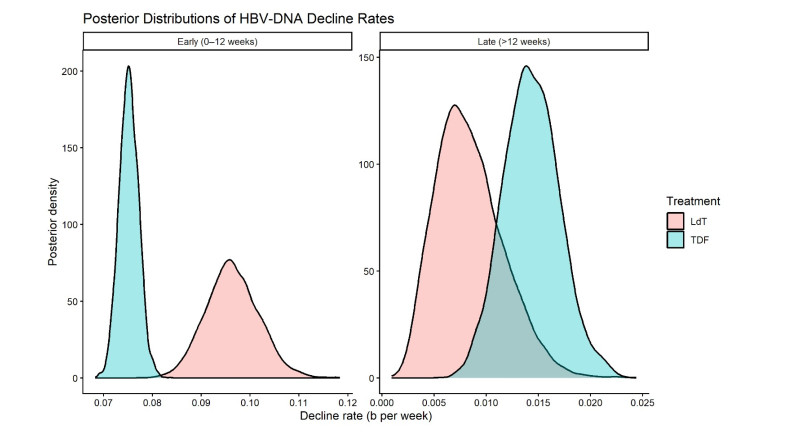
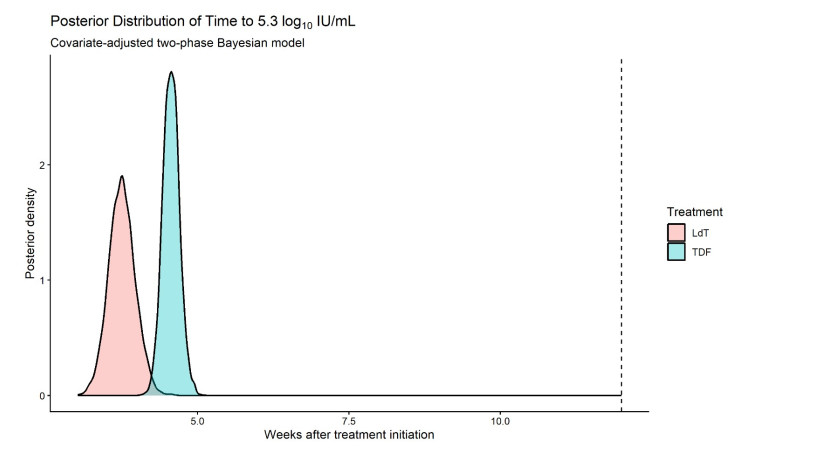
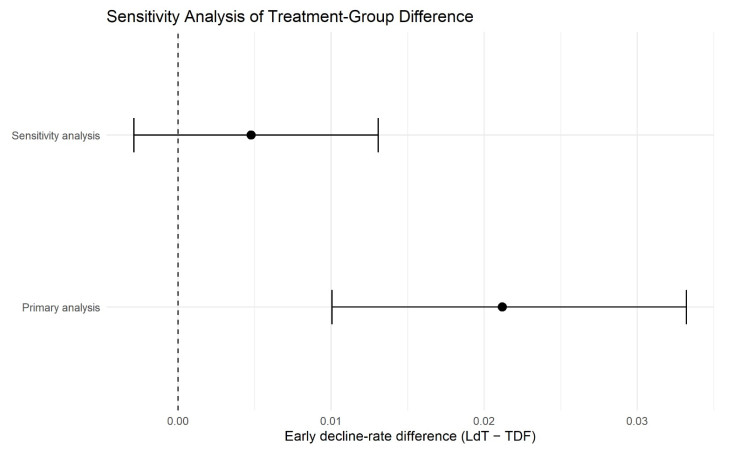
Antiviral prophylaxis during pregnancy can lower maternal hepatitis B virus (HBV) DNA and thus help reduce the risk of mother-to-child transmission. However, the decline in the viral load can differ substantially between patients and may also change as treatment continues. We analyzed longitudinal HBV DNA measurements from 328 pregnant women who received either telbivudine (LdT; $ n = 95 $) or tenofovir disoproxil fumarate (TDF; $ n = 233 $) with a hierarchical Bayesian model. The treatment comparison was observational. Because several potentially important clinical characteristics were not available for linkage to the individual trajectories, the adjusted analysis used the last HBV DNA measurement at or before treatment initiation and the treatment initiation week as patient-level covariates. We modeled the decline with a continuous two-phase exponential curve, allowing a separate rate during the first 12 weeks and after week 12. In the adjusted analysis, the posterior mean early-phase decline rates were 0.0964 week$ ^{-1} $ for LdT and 0.0752 week$ ^{-1} $ for TDF, a difference of 0.0212 week$ ^{-1} $ (95% CrI: 0.0100–0.0332). After week 12, the corresponding rates were 0.0084 and 0.0143 week$ ^{-1} $, with a difference of $ -0.0059 $ week$ ^{-1} $ (95% CrI: $ -0.0132 $–0.0021). The model-based population mean time to 5.3 log$ _{10} $ IU/mL was 3.75 weeks for LdT and 4.56 weeks for TDF. When the specified low-end observations were excluded, the early-rate difference fell to 0.0048 week$ ^{-1} $ (95% CrI: $ -0.0029 $–0.0131). Overall, both groups showed a marked early decline followed by a slower later phase. The apparent early treatment difference was sensitive to the handling of low-end measurements, and the observational design does not permit a causal treatment conclusion. Nevertheless, the Bayesian framework provides a useful way to describe patient-to-patient variations and uncertainty in these longitudinal HBV DNA trajectories.
Citation: Dayaram Nehra, Daihai He. Hierarchical Bayesian modelling of HBV DNA decay: comparison of viral decline following telbivudine and tenofovir disoproxil fumarate prophylaxis[J]. Big Data and Information Analytics, 2026, 10: 294-307. doi: 10.3934/bdia.2026015
Antiviral prophylaxis during pregnancy can lower maternal hepatitis B virus (HBV) DNA and thus help reduce the risk of mother-to-child transmission. However, the decline in the viral load can differ substantially between patients and may also change as treatment continues. We analyzed longitudinal HBV DNA measurements from 328 pregnant women who received either telbivudine (LdT; $ n = 95 $) or tenofovir disoproxil fumarate (TDF; $ n = 233 $) with a hierarchical Bayesian model. The treatment comparison was observational. Because several potentially important clinical characteristics were not available for linkage to the individual trajectories, the adjusted analysis used the last HBV DNA measurement at or before treatment initiation and the treatment initiation week as patient-level covariates. We modeled the decline with a continuous two-phase exponential curve, allowing a separate rate during the first 12 weeks and after week 12. In the adjusted analysis, the posterior mean early-phase decline rates were 0.0964 week$ ^{-1} $ for LdT and 0.0752 week$ ^{-1} $ for TDF, a difference of 0.0212 week$ ^{-1} $ (95% CrI: 0.0100–0.0332). After week 12, the corresponding rates were 0.0084 and 0.0143 week$ ^{-1} $, with a difference of $ -0.0059 $ week$ ^{-1} $ (95% CrI: $ -0.0132 $–0.0021). The model-based population mean time to 5.3 log$ _{10} $ IU/mL was 3.75 weeks for LdT and 4.56 weeks for TDF. When the specified low-end observations were excluded, the early-rate difference fell to 0.0048 week$ ^{-1} $ (95% CrI: $ -0.0029 $–0.0131). Overall, both groups showed a marked early decline followed by a slower later phase. The apparent early treatment difference was sensitive to the handling of low-end measurements, and the observational design does not permit a causal treatment conclusion. Nevertheless, the Bayesian framework provides a useful way to describe patient-to-patient variations and uncertainty in these longitudinal HBV DNA trajectories.

| [1] |
European Association for the Study of the Liver, (2017) EASL 2017 Clinical Practice Guidelines on the management of hepatitis B virus infection. J Hepatol 67: 370–398. https://doi.org/10.1016/j.jhep.2017.03.021 doi: 10.1016/j.jhep.2017.03.021
|
| [2] |
World Health Organization, (2024) Guidelines for the Prevention, Diagnosis, Care and Treatment for People with Chronic Hepatitis B Infection, World Health Organization, Geneva, 2024. |
| [3] |
Pan CQ, Duan Z, Dai E, Zhang S, Han G, Wang Y, et al. (2016) Tenofovir to prevent hepatitis B transmission in mothers with high viral load. N Engl J Med 374: 2324–2334. https://doi.org/10.1056/NEJMoa1508660 doi: 10.1056/NEJMoa1508660
|
| [4] |
Brown Jr RS, McMahon BJ, Lok ASF, Wong JB, Ahmed AT, Mouchli MA, et al. (2016) Antiviral therapy in chronic hepatitis B viral infection during pregnancy: A systematic review and meta-analysis. Hepatology 63: 319–333. https://doi.org/10.1002/hep.28302 doi: 10.1002/hep.28302
|
| [5] |
Nowak MA, Bonhoeffer S, Hill AM, Boehme R, Thomas HC, McDade H, (1996) Viral dynamics in hepatitis B virus infection. Proc Natl Acad Sci 93: 4398–4402. https://doi.org/10.1073/pnas.93.9.4398 doi: 10.1073/pnas.93.9.4398
|
| [6] |
Tsiang M, Rooney JF, Toole JJ, Gibbs CS, (1999) Biphasic clearance kinetics of hepatitis B virus from patients during adefovir dipivoxil therapy. Hepatology 29: 1863–1869. https://doi.org/10.1002/hep.510290626 doi: 10.1002/hep.510290626
|
| [7] |
Wolters LMM, Hansen BE, Niesters HGM, Zeuzem S, Schalm SW, de Man RA, (2002) Viral dynamics in chronic hepatitis B patients during lamivudine therapy. Liver 22: 121–126. https://doi.org/10.1034/j.1600-0676.2002.01579.x doi: 10.1034/j.1600-0676.2002.01579.x
|
| [8] |
Perelson, AS, Ribeiro RM (2004) Hepatitis B virus kinetics and mathematical modeling. Semin Liver Dis 24: 11–16. https://doi.org/10.1055/s-2004-828673 doi: 10.1055/s-2004-828673
|
| [9] |
Ciupe SM (2018) Modeling the dynamics of hepatitis B infection, immunity, and drug therapy. Immunol Rev 285: 38–54. https://doi.org/10.1111/imr.12686 doi: 10.1111/imr.12686
|
| [10] |
Shen M, He S, Yao N, Li R, Wang J, Zhong W, et al. (2025) Real-world clinical data-driven modelling on the initiation time of antiviral prophylaxis among pregnant women with chronic hepatitis B infection. J Hepatol 82: 816–825. https://doi.org/10.1016/j.jhep.2024.11.017 doi: 10.1016/j.jhep.2024.11.017
|
| [11] |
Gelman A, Carlin JB, Stern HS, Dunson DB, Vehtari A, Rubin DB (2013), Bayesian Data Analysis, Chapman & Hall/CRC Press. https://doi.org/10.1201/b16018 |
| [12] |
Gelman A (2006) Prior distributions for variance parameters in hierarchical models. Bayesian Anal 1: 515–534. https://doi.org/10.1214/06-BA117A doi: 10.1214/06-BA117A
|
| [13] |
Hoffman MD, Gelman A (2014) The No-U-Turn sampler: Adaptively setting path lengths in Hamiltonian Monte Carlo. J Mach Learn Res 15: 1593–1623. |
| [14] |
Betancourt M (2017) A conceptual introduction to Hamiltonian Monte Carlo, preprint, arXiv: 1701.02434. https://doi.org/10.48550/arXiv.1701.02434 |
| [15] |
Vehtari A, Gelman A, Simpson D, Carpenter B, Bürkner PC, (2021) Rank-normalization, folding, and localization: An improved $\widehat{R}$ for assessing convergence of MCMC (with Discussion). Bayesian Anal 16: 667–718. https://doi.org/10.1214/20-BA1221 doi: 10.1214/20-BA1221
|
Figures(7) / Tables(3)

Dayaram Nehra, Daihai He. Hierarchical Bayesian modelling of HBV DNA decay: comparison of viral decline following telbivudine and tenofovir disoproxil fumarate prophylaxis[J]. Big Data and Information Analytics, 2026, 10: 294-307. doi: 10.3934/bdia.2026015

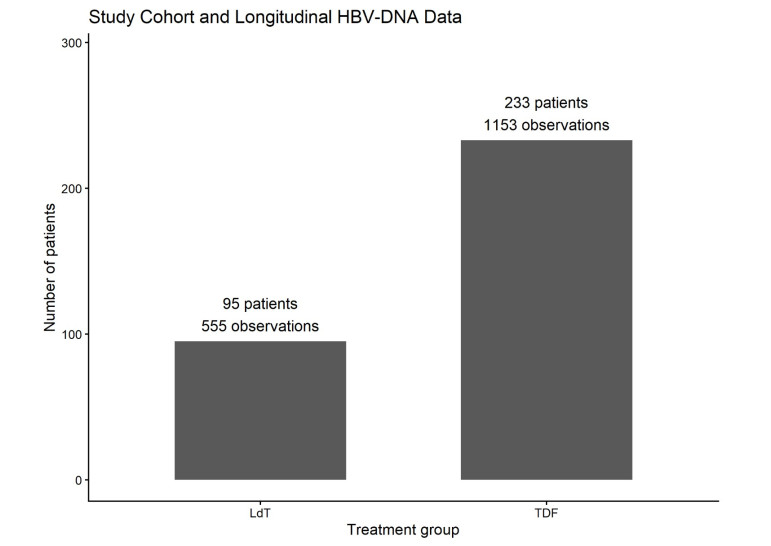
Overview of the longitudinal HBV DNA dataset and treatment groups. The analysis included 328 pregnant women, with 95 receiving LdT and 233 receiving TDF
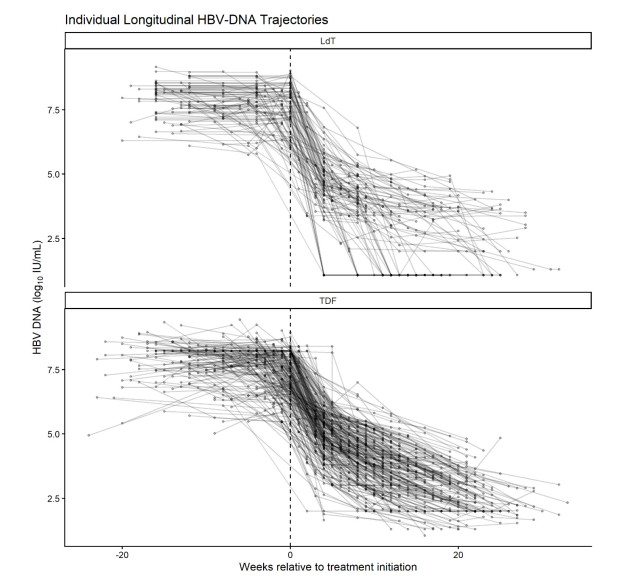
Individual longitudinal HBV DNA trajectories for women receiving LdT and TDF. Time is expressed relative to the treatment initiation, with week 0 representing the treatment-start week
Posterior distributions of the early (0–12 weeks) and late ($ > $ 12 weeks) HBV DNA decline rates for LdT and TDF. The distributions show the substantially faster early decline in both groups
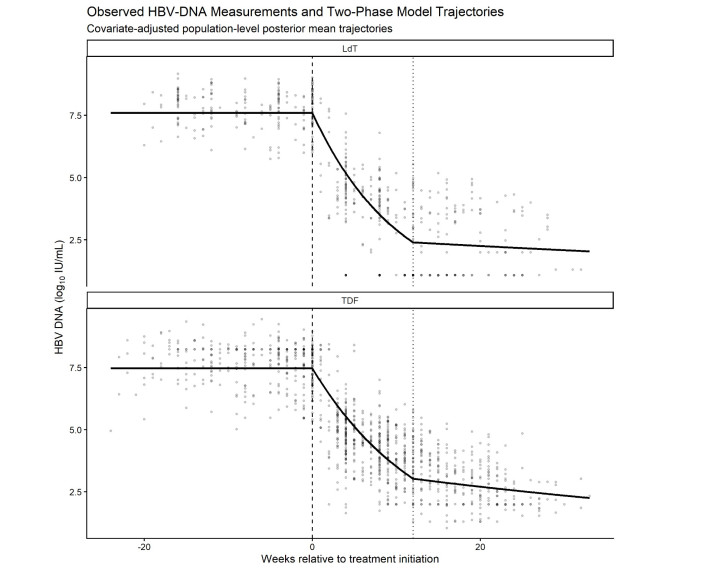
Observed HBV DNA measurements and population-level fitted trajectories from the covariate-adjusted continuous two-phase Bayesian model. The vertical reference lines indicate treatment initiation at week 0 and the week-12 transition
Posterior distributions of the estimated time to reach 5.3 log$_{10} $ IU/mL under the covariate-adjusted two-phase model
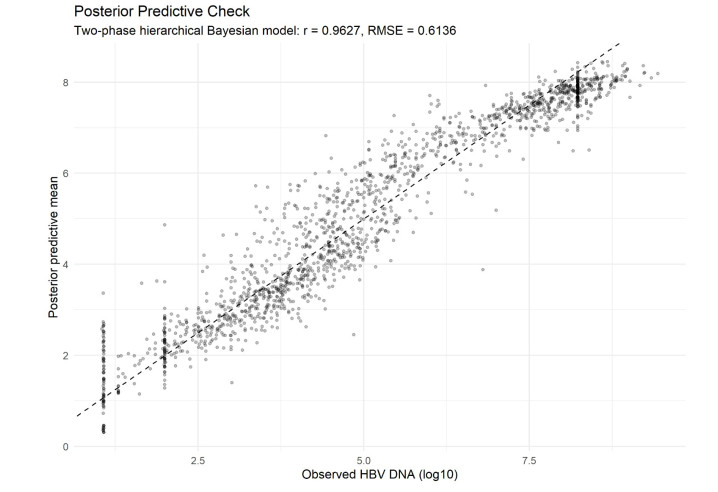
Posterior predictive check for the unadjusted two-phase hierarchical Bayesian model. Observed HBV DNA values are compared with posterior predictive means. The correlation was 0.9627 and the RMSE was 0.6136 log$ _{10} $ units
Sensitivity analysis of the early HBV DNA decline-rate difference between LdT and TDF. The primary estimate was 0.0212 week $ ^{-1} $ (95% CrI: 0.0100–0.0332), whereas the sensitivity estimate was 0.0048 week $ ^{-1} $ (95% CrI: $ -0.0029 $ –0.0131)





 DownLoad: