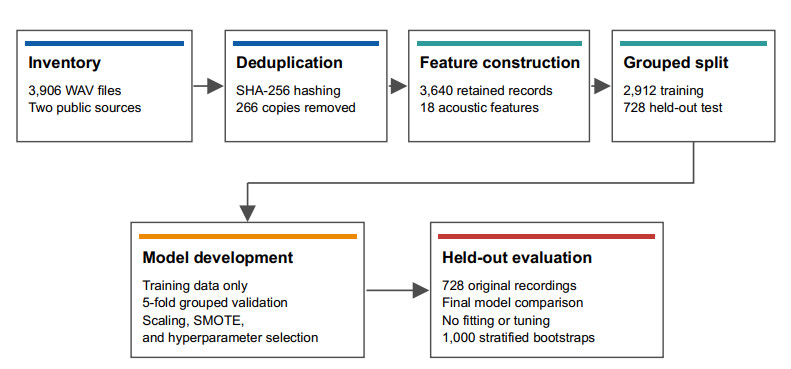
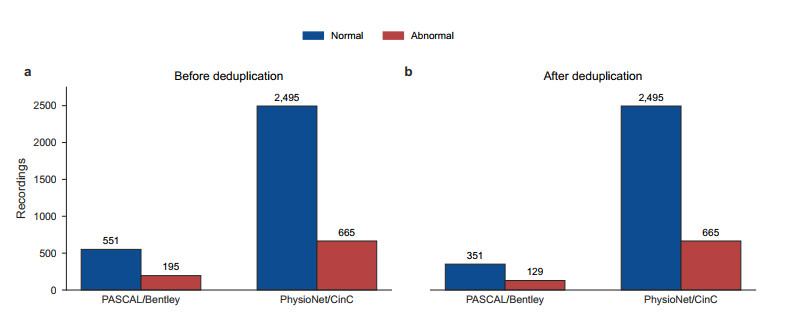
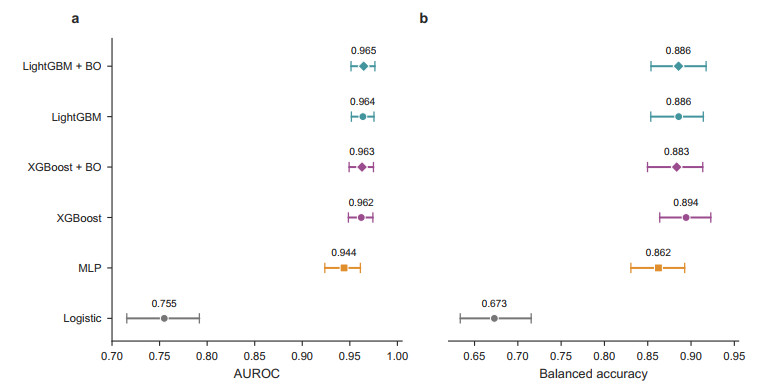
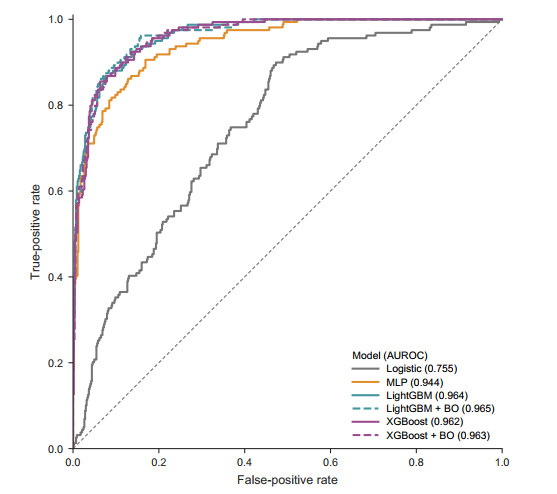
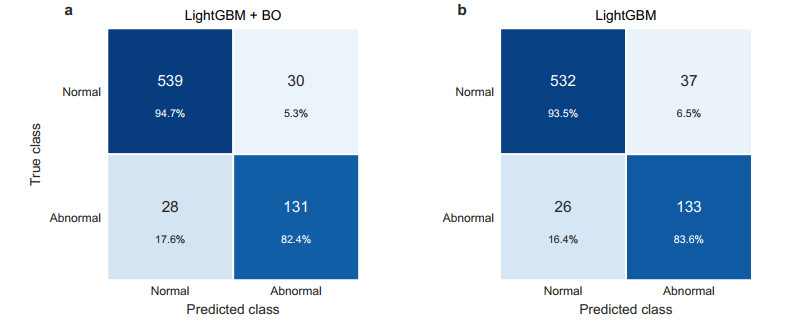
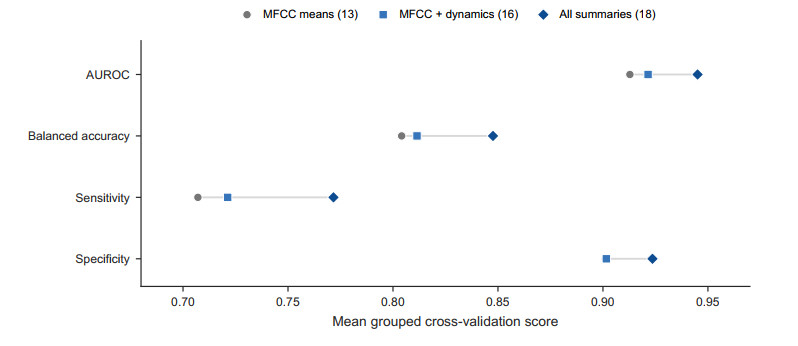
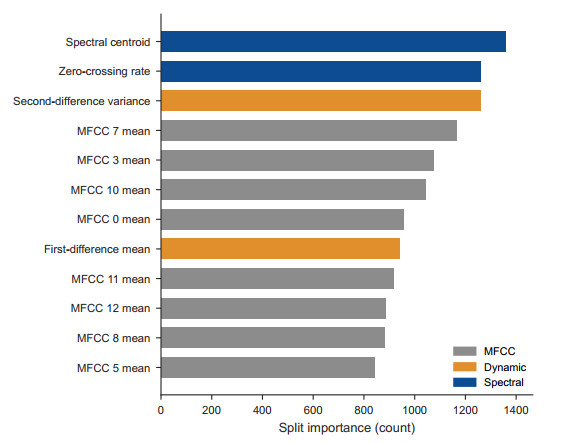
Automated heart-sound classification can be affected by duplicate recordings, class imbalance, and information leakage during data preparation. We evaluated an MFCC-based acoustic-feature pipeline for recording-level normal-abnormal heart-sound classification. The assembled dataset initially contained 3906 WAV files drawn from a subset of the PhysioNet/Computing in Cardiology Challenge 2016 and the PASCAL Classifying Heart Sounds Challenge 2011. Byte-level deduplication removed 266 copies before partitioning, leaving 3640 unique recordings. Eighteen global acoustic features were extracted from each unique recording: 13 mean mel-frequency cepstral coefficients, three MFCC dispersion or temporal-difference summaries, mean spectral centroid, and mean zero-crossing rate. Logistic regression, a multilayer perceptron, LightGBM, and XGBoost were compared, with Bayesian hyperparameter optimization conducted by five-fold grouped cross-validation within the training partition for both gradient-boosting models. On the held-out set, Bayesian-optimized LightGBM achieved an area under the receiver operating characteristic curve of 0.965 (recording-level 95% bootstrap interval 0.951–0.976), accuracy of 0.920, and balanced accuracy of 0.886. The results support the usefulness of the implemented feature set and gradient-boosting models for internal classification within the assembled two-source dataset.
Citation: Jingyu Fang, Lijun Pei. Normal-abnormal heart sound classification using MFCC-based acoustic features and gradient boosting[J]. Big Data and Information Analytics, 2026, 10: 275-293. doi: 10.3934/bdia.2026014
Automated heart-sound classification can be affected by duplicate recordings, class imbalance, and information leakage during data preparation. We evaluated an MFCC-based acoustic-feature pipeline for recording-level normal-abnormal heart-sound classification. The assembled dataset initially contained 3906 WAV files drawn from a subset of the PhysioNet/Computing in Cardiology Challenge 2016 and the PASCAL Classifying Heart Sounds Challenge 2011. Byte-level deduplication removed 266 copies before partitioning, leaving 3640 unique recordings. Eighteen global acoustic features were extracted from each unique recording: 13 mean mel-frequency cepstral coefficients, three MFCC dispersion or temporal-difference summaries, mean spectral centroid, and mean zero-crossing rate. Logistic regression, a multilayer perceptron, LightGBM, and XGBoost were compared, with Bayesian hyperparameter optimization conducted by five-fold grouped cross-validation within the training partition for both gradient-boosting models. On the held-out set, Bayesian-optimized LightGBM achieved an area under the receiver operating characteristic curve of 0.965 (recording-level 95% bootstrap interval 0.951–0.976), accuracy of 0.920, and balanced accuracy of 0.886. The results support the usefulness of the implemented feature set and gradient-boosting models for internal classification within the assembled two-source dataset.

| [1] |
Clifford GD, Liu C, Moody B, Springer D, Silva I, Li Q, et al. (2016) Classification of normal/abnormal heart sound recordings: The physioNet/computing in cardiology challenge 2016. Comput Cardiol 43: 609–612. https://doi.org/10.22489/CinC.2016.179-154 doi: 10.22489/CinC.2016.179-154

|
| [2] |
Liu C, Springer D, Li Q, Moody B, Abad Juan R, Chorro FJ, et al. (2016) An open access database for the evaluation of heart sound algorithms. Physiol Meas 37: 2181–2213. https://doi.org/10.1088/0967-3334/37/12/2181 doi: 10.1088/0967-3334/37/12/2181
|
| [3] | Bentley P, Nordehn G, Coimbra M, Mannor S (2011) The PASCAL Classifying Heart Sounds Challenge 2011 (CHSC2011) Results. Available from: https://www.peterjbentley.com/heartchallenge/. |
| [4] |
Langley P, Murray A (2017) Heart sound classification from unsegmented phonocardiograms. Physiol Meas 38: 1658–1670. https://doi.org/10.1088/1361-6579/aa724c doi: 10.1088/1361-6579/aa724c
|
| [5] | Koike T, Qian K, Schuller BW, Yamamoto Y (2021) Transferring cross-corpus knowledge: An investigation on data augmentation for heart sound classification. In: 2021 43rd Annual International Conference of the IEEE Engineering in Medicine & Biology Society (EMBC): 1976–1979. https://doi.org/10.1109/EMBC46164.2021.9629714 |
| [6] |
Roberts DR, Bahn V, Ciuti S, Boyce MS, Elith J, Guillera-Arroita G, et al. (2017) Cross-validation strategies for data with temporal, spatial, hierarchical, or phylogenetic structure. Ecography 40: 913–929. https://doi.org/10.1111/ecog.02881 doi: 10.1111/ecog.02881
|
| [7] |
Kaufman S, Rosset S, Perlich C, Stitelman O (2012) Leakage in data mining: Formulation, detection, and avoidance. ACM Trans Knowl Discov Data 6: 15. https://doi.org/10.1145/2382577.2382579 doi: 10.1145/2382577.2382579
|
| [8] |
Kapoor S, Narayanan A (2023) Leakage and the reproducibility crisis in machine-learning-based science. Patterns 4: 100804. https://doi.org/10.1016/j.patter.2023.100804 doi: 10.1016/j.patter.2023.100804
|
| [9] |
Chawla NV, Bowyer KW, Hall LO, Kegelmeyer WP (2002) SMOTE: Synthetic minority over-sampling technique. J Artif Intell Res 16: 321–357. https://doi.org/10.1613/jair.953 doi: 10.1613/jair.953
|
| [10] |
Davis S, Mermelstein P (1980) Comparison of parametric representations for monosyllabic word recognition in continuously spoken sentences. IEEE Trans Acoust Speech Signal Process 28: 357–366. https://doi.org/10.1109/TASSP.1980.1163420 doi: 10.1109/TASSP.1980.1163420
|
| [11] | Ke G, Meng Q, Finley T, Wang T, Chen W, Ma W, et al. (2017) LightGBM: A highly efficient gradient boosting decision tree. Adv Neural Inf Process Syst 30: 3146–3154. |
| [12] | Chen T, Guestrin C (2016) XGBoost: A scalable tree boosting system. In: Proceedings of the 22nd ACM Sigkdd International Conference on Knowledge Discovery and Data Mining, 785–794. https://doi.org/10.1145/2939672.2939785 |
| [13] | Snoek J, Larochelle H, Adams RP (2012) Practical Bayesian optimization of machine learning algorithms. Adv Neural Inf Process Syst 25: 2951–2959. |
| [14] |
Goldberger AL, Amaral LAN, Glass L, Hausdorff JM, Ivanov PC, Mark RG, et al. (2000) PhysioBank, PhysioToolkit, and PhysioNet: Components of a new research resource for complex physiologic signals. Circulation 101: e215–e220. https://doi.org/10.1161/01.CIR.101.23.e215 doi: 10.1161/01.CIR.101.23.e215
|
| [15] |
McFee B, Raffel C, Liang D, Ellis DPW, McVicar M, Battenberg E, et al. (2015) Librosa: Audio and music signal analysis in Python. SciPy 2015: 18–24. https://doi.org/10.25080/Majora-7b98e3ed-003 doi: 10.25080/Majora-7b98e3ed-003
|
| [16] | Lemaitre G, Nogueira F, Aridas CK (2017) Imbalanced-learn: A Python toolbox to tackle the curse of imbalanced datasets in machine learning. J Mach Learn Res 18: 1–5. |
| [17] | Pedregosa F, Varoquaux G, Gramfort A, Michel V, Thirion B, Grisel O, et al. (2011) Scikit-learn: Machine learning in Python. J Mach Learn Res 12: 2825–2830. |
| [18] |
Schmidt SE, Holst-Hansen C, Graff C, Toft E, Struijk JJ (2010) Segmentation of heart sound recordings by a duration-dependent hidden Markov model. Physiol Meas 31: 513–529. https://doi.org/10.1088/0967-3334/31/4/004 doi: 10.1088/0967-3334/31/4/004
|
| [19] |
Springer DB, Tarassenko L, Clifford GD (2016) Logistic regression-HSMM-based heart sound segmentation. IEEE Trans Biomed Eng 63: 822–832. https://doi.org/10.1109/TBME.2015.2475278 doi: 10.1109/TBME.2015.2475278
|
| [20] |
Potes C, Parvaneh S, Rahman A, Conroy B (2016) Ensemble of feature-based and deep learning-based classifiers for detection of abnormal heart sounds. Comput Cardiol 43: 621–624. https://doi.org/10.22489/CinC.2016.182-399 doi: 10.22489/CinC.2016.182-399
|
| [21] |
Rubin J, Abreu R, Ganguli A, Nelaturi S, Matei I, Sricharan K (2016) Classifying heart sound recordings using deep convolutional neural networks and mel-frequency cepstral coefficients. Comput Cardiol 43: 813–816. https://doi.org/10.22489/CinC.2016.236-175 doi: 10.22489/CinC.2016.236-175
|
| [22] |
Tschannen M, Kramer T, Marti G, Heinzmann M, Wiatowski T (2016) Heart sound classification using deep structured features. Comput Cardiol 43: 565–568. https://doi.org/10.22489/CinC.2016.162-186 doi: 10.22489/CinC.2016.162-186
|
| [23] |
Zabihi M, Rad AB, Kiranyaz S, Gabbouj M, Katsaggelos AK (2016) Heart sound anomaly and quality detection using ensemble of neural networks without segmentation. Comput Cardiol 43: 613–616. https://doi.org/10.22489/CinC.2016.180-213 doi: 10.22489/CinC.2016.180-213
|
| [24] |
Yaseen Y, Son GY, Kwon S (2018) Classification of heart sound signal using multiple features. Appl Sci 8: 2344. https://doi.org/10.3390/app8122344 doi: 10.3390/app8122344
|
| [25] |
Deng M, Meng T, Cao J, Wang S, Zhang J, Fan H (2020) Heart sound classification based on improved MFCC features and convolutional recurrent neural networks. Neural Networks 130: 22–32. https://doi.org/10.1016/j.neunet.2020.06.015 doi: 10.1016/j.neunet.2020.06.015
|
| [26] |
Mei N, Wang H, Zhang Y, Liu F, Jiang X, Wei S (2021) Classification of heart sounds based on quality assessment and wavelet scattering transform. Comput Biol Med 137: 104814. https://doi.org/10.1016/j.compbiomed.2021.104814 doi: 10.1016/j.compbiomed.2021.104814
|
| [27] |
Liu A, Zhang S, Wang Z, Tang Y, Zhang X, Wang Y (2023) A learnable front-end based efficient channel attention network for heart sound classification. Physiol Meas 44: 095003. https://doi.org/10.1088/1361-6579/acf3cf doi: 10.1088/1361-6579/acf3cf
|
| [28] |
Krishnan PT, Balasubramanian P, Umapathy S (2020) Automated heart sound classification system from unsegmented phonocardiogram (PCG) using deep neural network. Phys Eng Sci Med 43: 505–515. https://doi.org/10.1007/s13246-020-00851-w doi: 10.1007/s13246-020-00851-w
|
| [29] |
Ren Z, Chang Y, Nguyen TT, Tan Y, Qian K, Schuller BW (2024) A comprehensive survey on heart sound analysis in the deep learning era. IEEE Comput Intell Mag 19: 42–57. https://doi.org/10.1109/MCI.2024.3401309 doi: 10.1109/MCI.2024.3401309
|
| [30] |
Oliveira J, Renna F, Costa PD, Nogueira M, Oliveira C, Ferreira C, et al. (2022) The CirCor DigiScope dataset: From murmur detection to murmur classification. IEEE J Biomed Health Inform 26: 2524–2535. https://doi.org/10.1109/JBHI.2021.3137048 doi: 10.1109/JBHI.2021.3137048
|
| [31] | Reyna MA, Kiarashi Y, Elola A, Oliveira J, Renna F, Gu A, et al. (2023) Heart murmur detection from phonocardiogram recordings: The george b. moody physionet challenge 2022 PLOS Digit Health 2: e0000324. https://doi.org/10.1371/journal.pdig.0000324 |
| [32] |
Susic D, Gradisek A, Gams M (2024) PCGmix: A data-augmentation method for heart-sound classification. IEEE J Biomed Health Inform 28: 6874–6885. https://doi.org/10.1109/JBHI.2024.3458430 doi: 10.1109/JBHI.2024.3458430
|
| [33] |
Fuadah YN, Pramudito MA, Lim KM (2023) An optimal approach for heart sound classification using grid search in hyperparameter optimization of machine learning. Bioengineering 10: 45. https://doi.org/10.3390/bioengineering10010045 doi: 10.3390/bioengineering10010045
|
| [34] |
Shin JM, Park S, Shin K, Seo WY, Kim HS, Kim DK, et al. (2025) Temporal convolutional neural network-based feature extraction and asynchronous channel information fusion method for heart abnormality detection in phonocardiograms. Comput Methods Programs Biomed 269: 108871. https://doi.org/10.1016/j.cmpb.2025.108871 doi: 10.1016/j.cmpb.2025.108871
|
| [35] |
Furui S (1986) Speaker-independent isolated word recognition using dynamic features of speech spectrum. IEEE Trans Acoust Speech Signal Process 34: 52–59. https://doi.org/10.1109/TASSP.1986.1164788 doi: 10.1109/TASSP.1986.1164788
|
| [36] |
Friedman JH (2001) Greedy function approximation: A gradient boosting machine. Ann Stat 29: 1189–1232. https://doi.org/10.1214/aos/1013203451 doi: 10.1214/aos/1013203451
|
| [37] | Cawley GC, Talbot NLC (2010) On over-fitting in model selection and subsequent selection bias in performance evaluation. J Mach Learn Res 11: 2079–2107. |
| [38] |
Varma S, Simon R (2006) Bias in error estimation when using cross-validation for model selection. BMC Bioinf 7: 91. https://doi.org/10.1186/1471-2105-7-91 doi: 10.1186/1471-2105-7-91
|
| [39] |
Fawcett T (2006) An introduction to ROC analysis. Pattern Recognit Lett 27: 861–874. https://doi.org/10.1016/j.patrec.2005.10.010 doi: 10.1016/j.patrec.2005.10.010
|
| [40] |
Saito T, Rehmsmeier M (2015) The precision-recall plot is more informative than the ROC plot when evaluating binary classifiers on imbalanced datasets. PLoS ONE 10: e0118432. https://doi.org/10.1371/journal.pone.0118432 doi: 10.1371/journal.pone.0118432
|
| [41] |
Matthews BW (1975) Comparison of the predicted and observed secondary structure of T4 phage lysozyme. Biochim Biophys Acta 405: 442–451. https://doi.org/10.1016/0005-2795(75)90109-9 doi: 10.1016/0005-2795(75)90109-9
|
| [42] |
Efron B (1979) Bootstrap methods: Another look at the jackknife. Ann Stat 7: 1–26. https://doi.org/10.1214/aos/1176344552 doi: 10.1214/aos/1176344552
|
| [43] |
Kelly CJ, Karthikesalingam A, Suleyman M, Corrado G, King D (2019) Key challenges for delivering clinical impact with artificial intelligence. BMC Med 17: 195. https://doi.org/10.1186/s12916-019-1426-2 doi: 10.1186/s12916-019-1426-2
|
| [44] |
Collins GS, Moons KGM, Dhiman P, Riley RD, Beam AL, Van Calster B, et al. (2024) TRIPOD+AI statement: Updated guidance for reporting clinical prediction models that use regression or machine learning methods. BMJ 385: e078378. https://doi.org/10.1136/bmj-2023-078378 doi: 10.1136/bmj-2023-078378
|
| [45] |
Tang H, Dai Z, Jiang Y, Li T, Liu C (2018) PCG classification using multidomain features and SVM classifier. BioMed Res Int 2018: 4205027. https://doi.org/10.1155/2018/4205027 doi: 10.1155/2018/4205027
|
| [46] |
Li F, Liu M, Zhao Y, Kong L, Dong L, Liu X, et al. (2019) Feature extraction and classification of heart sound using 1D convolutional neural networks. EURASIP J Adv Signal Process 2019: 59. https://doi.org/10.1186/s13634-019-0651-3 doi: 10.1186/s13634-019-0651-3
|
| [47] |
Xiao B, Xu Y, Bi X, Zhang J, Ma X (2020) Heart sounds classification using a novel 1-D convolutional neural network with extremely low parameter consumption. Neurocomputing 392: 153–159. https://doi.org/10.1016/j.neucom.2018.09.101 doi: 10.1016/j.neucom.2018.09.101
|
| [48] |
Li F, Tang H, Shang S, Mathiak K, Cong F (2020) Classification of heart sounds using convolutional neural network. Appl Sci 10: 3956. https://doi.org/10.3390/app10113956 doi: 10.3390/app10113956
|
| [49] |
Humayun AI, Ghaffarzadegan S, Ansari MI, Feng Z, Hasan T (2020) Towards domain invariant heart sound abnormality detection using learnable filterbanks. IEEE J Biomed Health Inform 24: 2189–2198. https://doi.org/10.1109/JBHI.2020.2970252 doi: 10.1109/JBHI.2020.2970252
|
| [50] |
Varoquaux G (2018) Cross-validation failure: Small sample sizes lead to large error bars. NeuroImage 180: 68–77. https://doi.org/10.1016/j.neuroimage.2017.06.061 doi: 10.1016/j.neuroimage.2017.06.061
|
Figures(7) / Tables(8)

Jingyu Fang, Lijun Pei. Normal-abnormal heart sound classification using MFCC-based acoustic features and gradient boosting[J]. Big Data and Information Analytics, 2026, 10: 275-293. doi: 10.3934/bdia.2026014






 DownLoad: