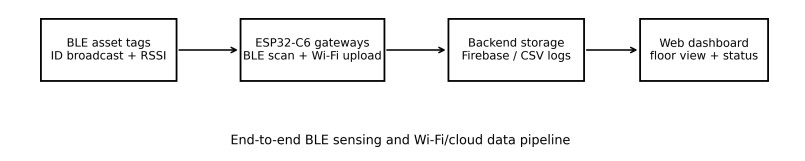
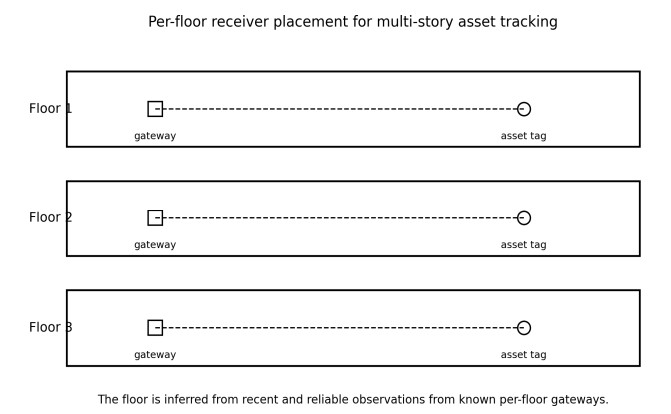
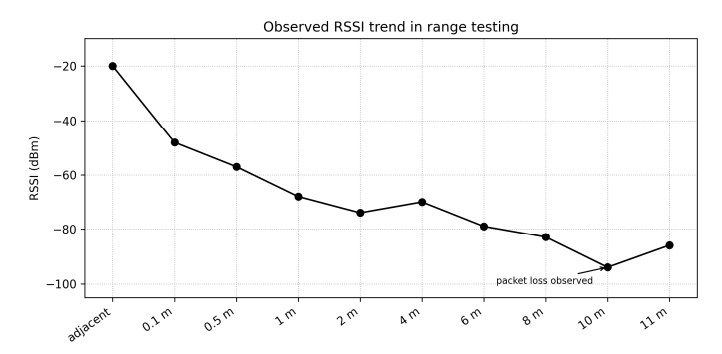
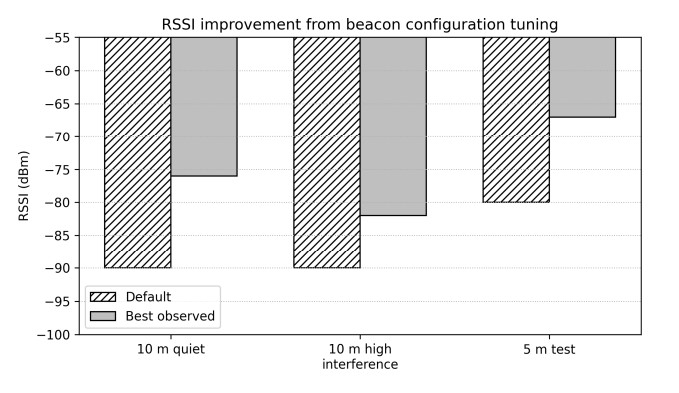
Indoor asset tracking in multi-story buildings is difficult because low-cost radio signals are affected by attenuation, multipath propagation, human blockage, dense 2.4 GHz interference, and floor-to-floor ambiguity. This paper presents the design and engineering validation of a low-cost tracking system based on Bluetooth Low Energy asset tags and ESP32-C6 wireless gateways. In the prototype, beacons attached to assets broadcast identifiers, fixed transponders scan advertisements and record received signal strength indicator (RSSI) values, and a wireless/cloud backhaul stores observations for a web dashboard and historical CSV logging. The evaluation focuses on floor-level and area-level asset awareness rather than statistically verified coordinate-level positioning. Experimental observations show strong adjacent detection (–20 dBm), a reduced signal strength at 1 m (–68 dBm), packet loss around 10 m under noisy conditions (–94 dBm), and a weak maximum observed detection at approximately 28 m under favorable line-of-sight conditions. Vertical testing showed no signal through a single floor slab at approximately 3.9 m separation and only occasional weak detection around –92 dBm at approximately 2.34 m separation. Configuration tests show differences in the observed RSSI values across the transmit power, strength code, and internal capacitor code settings, with Config 2 and Config 4 providing the strongest observed RSSI in several scenarios. These observations do not establish detection stability or isolate the physical effects of the device-specific codes. The results support a preliminary deployment strategy based on per-floor gateways, conservative receiver spacing, and site-specific beacon configuration.
Citation: Xudong Gao. Design and engineering validation of a Bluetooth low energy indoor asset tracking system with ESP32-C6 wireless gateways for multi-story buildings[J]. Big Data and Information Analytics, 2026, 10: 257-274. doi: 10.3934/bdia.2026013
Indoor asset tracking in multi-story buildings is difficult because low-cost radio signals are affected by attenuation, multipath propagation, human blockage, dense 2.4 GHz interference, and floor-to-floor ambiguity. This paper presents the design and engineering validation of a low-cost tracking system based on Bluetooth Low Energy asset tags and ESP32-C6 wireless gateways. In the prototype, beacons attached to assets broadcast identifiers, fixed transponders scan advertisements and record received signal strength indicator (RSSI) values, and a wireless/cloud backhaul stores observations for a web dashboard and historical CSV logging. The evaluation focuses on floor-level and area-level asset awareness rather than statistically verified coordinate-level positioning. Experimental observations show strong adjacent detection (–20 dBm), a reduced signal strength at 1 m (–68 dBm), packet loss around 10 m under noisy conditions (–94 dBm), and a weak maximum observed detection at approximately 28 m under favorable line-of-sight conditions. Vertical testing showed no signal through a single floor slab at approximately 3.9 m separation and only occasional weak detection around –92 dBm at approximately 2.34 m separation. Configuration tests show differences in the observed RSSI values across the transmit power, strength code, and internal capacitor code settings, with Config 2 and Config 4 providing the strongest observed RSSI in several scenarios. These observations do not establish detection stability or isolate the physical effects of the device-specific codes. The results support a preliminary deployment strategy based on per-floor gateways, conservative receiver spacing, and site-specific beacon configuration.

| [1] |
Hightower J, Borriello G (2001) Location systems for ubiquitous computing. Computer 34: 57–66.https://doi.org/10.1109/2.940014 doi: 10.1109/2.940014

|
| [2] |
Zafari F, Gkelias A, Leung KK (2019) A survey of indoor localization systems and technologies. IEEE Commun Surv Tutorials 21: 2568–2599.https://doi.org/10.1109/COMST.2019.2911558 doi: 10.1109/COMST.2019.2911558
|
| [3] | Espressif Systems (2024) ESP32-C6 Datasheet. Available from: https://www.espressif.com/sites/default/files/documentation/esp32-c6_datasheet_en.pdf. |
| [4] |
He S, Chan SHG (2016) Wi-Fi fingerprint-based indoor positioning: Recent advances and comparisons. IEEE Commun Surv Tutorials 18: 466–490.https://doi.org/10.1109/COMST.2015.2464084 doi: 10.1109/COMST.2015.2464084
|
| [5] |
Faragher R, Harle R (2015) Location fingerprinting with Bluetooth Low Energy beacons. IEEE J Sel Areas Commun 33: 2418–2428.https://doi.org/10.1109/JSAC.2015.2430281 doi: 10.1109/JSAC.2015.2430281
|
| [6] |
Azaddel MH, Nourian MA, ShahHosseini K, Junoh SA, Akbari A (2023) SPOTTER: A novel asynchronous and independent WiFi and BLE fusion method based on particle filter for indoor positioning. Internet Things 24: 100967.https://doi.org/10.1016/j.iot.2023.100967 doi: 10.1016/j.iot.2023.100967
|
| [7] |
Kanaris L, Kokkinis A, Liotta A, Stavrou S (2017) Fusing Bluetooth beacon data with Wi-Fi radiomaps for improved indoor localization. Sensors 17: 812.https://doi.org/10.3390/s17040812 doi: 10.3390/s17040812
|
| [8] |
Leitch SG, Ahmed QZ, Abbas WB, Hafeez M, Lazaridis PI, Sureephong P, et al. (2023) On indoor localization using WiFi, BLE, UWB, and IMU technologies. Sensors 23: 8598.https://doi.org/10.3390/s23208598 doi: 10.3390/s23208598
|
| [9] |
Zhang X, He F, Chen Q, Jiang X, Bao J, Ren T, et al. (2022) A differentially private indoor localization scheme with fusion of WiFi and Bluetooth fingerprints in edge computing. Neural Comput Appl 34: 4111– 4132.https://doi.org/10.1007/s00521-021-06815-9 doi: 10.1007/s00521-021-06815-9
|
| [10] | Hu Y, Qian F, Yin Z, Li Z, Ji Z, Han Y, et al. (2022) Experience: Practical indoor localization for malls. In: Proceedings of the 28th Annual International Conference on Mobile Computing and Networking, 82–93.https://doi.org/10.1145/3495243.3517021 |
| [11] |
Jin Z, Li Y, Yang Z, Y. Zhang, Z. Cheng (2023) Real-time indoor positioning based on BLE beacons and pedestrian dead reckoning for smartphones. Appl Sci 13: 4415.https://doi.org/10.3390/app13074415 doi: 10.3390/app13074415
|
| [12] |
Fetzer T, Ebner F, Deinzer F, Grzegorzek M (2023) Using barometer for floor assignation within statistical indoor localization. Sensors 23: 80.https://doi.org/10.3390/s23010080 doi: 10.3390/s23010080
|
| [13] |
Marjasz R, Grochla K, Polys K (2024) A comprehensive algorithm for vertical positioning in multi-building environments as an advancement in indoor floor-level detection. Sci Rep 14: 14034.https://doi.org/10.1038/s41598-024-64824-9 doi: 10.1038/s41598-024-64824-9
|
| [14] |
Zhou G, Xu S, Zhang S, Wang Y, Xiang C (2022) Multi-floor indoor localization based on multi-modal sensors. Sensors 22: 4162.https://doi.org/10.3390/s22114162 doi: 10.3390/s22114162
|
| [15] | Google Firebase, Firebase Realtime Database Documentation. Available from: https://firebase.google.com/docs/database. |
Figures(4) / Tables(8)

Xudong Gao. Design and engineering validation of a Bluetooth low energy indoor asset tracking system with ESP32-C6 wireless gateways for multi-story buildings[J]. Big Data and Information Analytics, 2026, 10: 257-274. doi: 10.3934/bdia.2026013






 DownLoad: