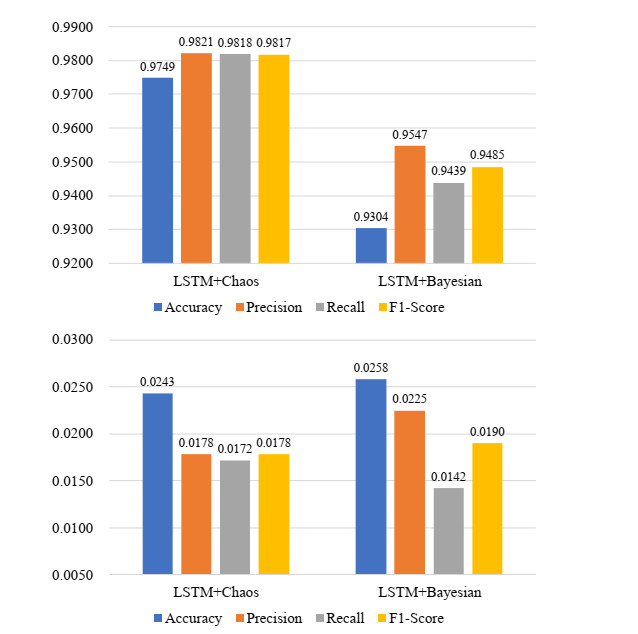
Pneumonia is a disease with a high mortality rate worldwide. Existing diagnostic methods for pneumonia inevitably cause varying degrees of trauma to the human body and are time-consuming. To address these drawbacks, this study attempts to use sound signals for pneumonia diagnoses, thereby innovatively integrating acoustic features with machine learning algorithms to establish a non-invasive pneumonia screening method. The experiment utilizes a publicly available respiratory sound dataset containing acoustic samples from pneumonia patients and healthy individuals. By combining Mel-frequency cepstral coefficients (MFCC) with time-domain energy features, a multidimensional feature set is constructed, and five machine learning models, including the backpropagation neural network (BP), the recurrent neural network (RNN), and the long short-term memory network (LSTM), are employed for binary classification modeling, training, and evaluation. To ensure a sufficient generalization ability, a strategy of ten repetitions of ten-fold cross-validation is introduced, and both chaotic optimization and Bayesian optimization are used to search for the optimal hyperparameters of the models. The results show that among the five baseline models, the LSTM performs the best on the dataset, thereby achieving an accuracy of 91.12% on the validation set. After chaotic optimization, the classification performance of the LSTM is significantly improved, with various metrics enhanced to different extents: for example, the accuracy reaches 97.49% and the F1-score increases to 98.17%, significantly outperforming the results achieved through Bayesian optimization. This method successfully overcomes the drawbacks of traditional pneumonia diagnosis approaches, enables non-invasive screening for asymptomatic or early-stage pneumonia, and offers the diagnostic advantages of high efficiency and low cost, thus providing a new solution for the clinical diagnosis of pneumonia.
Citation: Zhou Yang, Lijun Pei. Audio signal-driven non-invasive pneumonia diagnosis: an LSTM model with chaos optimization[J]. Big Data and Information Analytics, 2026, 10: 230-256. doi: 10.3934/bdia.2026012
Pneumonia is a disease with a high mortality rate worldwide. Existing diagnostic methods for pneumonia inevitably cause varying degrees of trauma to the human body and are time-consuming. To address these drawbacks, this study attempts to use sound signals for pneumonia diagnoses, thereby innovatively integrating acoustic features with machine learning algorithms to establish a non-invasive pneumonia screening method. The experiment utilizes a publicly available respiratory sound dataset containing acoustic samples from pneumonia patients and healthy individuals. By combining Mel-frequency cepstral coefficients (MFCC) with time-domain energy features, a multidimensional feature set is constructed, and five machine learning models, including the backpropagation neural network (BP), the recurrent neural network (RNN), and the long short-term memory network (LSTM), are employed for binary classification modeling, training, and evaluation. To ensure a sufficient generalization ability, a strategy of ten repetitions of ten-fold cross-validation is introduced, and both chaotic optimization and Bayesian optimization are used to search for the optimal hyperparameters of the models. The results show that among the five baseline models, the LSTM performs the best on the dataset, thereby achieving an accuracy of 91.12% on the validation set. After chaotic optimization, the classification performance of the LSTM is significantly improved, with various metrics enhanced to different extents: for example, the accuracy reaches 97.49% and the F1-score increases to 98.17%, significantly outperforming the results achieved through Bayesian optimization. This method successfully overcomes the drawbacks of traditional pneumonia diagnosis approaches, enables non-invasive screening for asymptomatic or early-stage pneumonia, and offers the diagnostic advantages of high efficiency and low cost, thus providing a new solution for the clinical diagnosis of pneumonia.

| [1] | Asif MAAR, Nishat MM, Faisal F, Dip RR, Udoy MH, Shikder MF, et al. (2021) Performance evaluation and comparative analysis of different machine learning algorithms in predicting cardiovascular disease. Eng Lett 29: 731. |
| [2] | Gomathy CK, Naidu MAR, (2021) The prediction of disease using machine learning. Int J Sci Res Eng Manage 5: 1–7. |
| [3] |
Parthiban G, Srivatsa SK, (2012) Applying machine learning methods in diagnosing heart disease for diabetic patients. Int J Appl Inf Syst 3: 25–30. https://doi.org/10.5120/ijais12-450593 doi: 10.5120/ijais12-450593

|
| [4] | Patel J, Tejal Upadhyay D, Patel S, (2015) Heart disease prediction using machine learning and data mining technique. Heart Dis 7: 129–137. |
| [5] |
Shahbaz M, Ali S, Guergachi A, Niazi A, Umer A, (2019) Classification of Alzheimer's disease using machine learning techniques. Data 2019: 296–303. https://doi.org/10.5220/0007949902960303 doi: 10.5220/0007949902960303
|
| [6] |
Nishat MM, Faisal F, Dip RR, Nasrullah SM, Ahsan R, Shikder F, et al. (2021) A comprehensive analysis on detecting chronic kidney disease by employing machine learning algorithms. EAI Endorsed Trans Pervasive Heal Technol 7: e1. https://doi.org/10.4108/eai.13-8-2021.170671 doi: 10.4108/eai.13-8-2021.170671
|
| [7] |
Shukur BS, Mijwil MM, (2023) Involving machine learning techniques in heart disease diagnosis: A performance analysis. Int J Electr Comput Eng 13: 2177. https://doi.org/10.11591/ijece.v13i2.pp2177-2185 doi: 10.11591/ijece.v13i2.pp2177-2185
|
| [8] | Pingale K, Surwase S, Kulkarni V, Sarage S, Karve A, (2019) Disease prediction using machine learning. Int Res J Eng Technol 6: 831–833. |
| [9] | Tawfik M, Al-Zidi N M, Fathail I, Nimbhore S, (2022) Asthma detection system: Machine and deep learning-based techniques. In: Artificial Intelligence and Sustainable Computing: Proceedings of ICSISCET 2021, 207–218. https://doi.org/10.1007/978-981-19-1653-3_16 |
| [10] |
Mafazy MM, Faisal MR, Kartini D, Indriani F, Saragih TH, (2023) Classification of covid-19 cough sounds using mel frequency cepstral coefficient (MFCC) feature extraction and support vector machine. Telematika 16: 60–68. http://dx.doi.org/10.35671/telematika.v16i2.2569 doi: 10.35671/telematika.v16i2.2569
|
| [11] |
Suliman A, Zhang Y, (2015) A review on back-propagation neural networks in the application of remote sensing image classification. J Earth Sci Eng 5: 52–65. https://doi.org/10.17265/2159-581X/2015.01.004 doi: 10.17265/2159-581X/2015.01.004
|
| [12] | Sibi P, Jones SA, Siddarth P, (2013) Analysis of different activation functions using backpropagation neural networks. J Theor Appl Inf Technol 47: 1264–1268. |
| [13] |
Zhang XR, Sun X, Sun W, Xu T, Wang PP, Jha SK, (2022) Deformation expression of soft tissue based on BP neural network. Intell Autom Soft Comput 32: 1041–1053. https://doi.org/10.32604/iasc.2022.016543 doi: 10.32604/iasc.2022.016543
|
| [14] |
Xi WD, Huang L, Wang CD, Zheng YY, Lai J, (2019) BPAM: Recommendation based on BP neural network with attention mechanism. IJCAI 2019: 3905–3911. https://doi.org/10.24963/ijcai.2019/542 doi: 10.24963/ijcai.2019/542
|
| [15] |
Zhou H, Chen Y, Zhang S, (2019) Ship trajectory prediction based on BP neural network. J Artif Intell 1: 29. https://doi.org/10.32604/jai.2019.05939 doi: 10.32604/jai.2019.05939
|
| [16] | Gunarto DM, Sa'adah S, Utama DQ, (2023) Predicting cryptocurrency price using RNN and LSTM method. Sisfokom 12: 1–8. |
| [17] |
Smailov N, Dosbayev Z, Omarov N, Sadykova B, Zhekambayeva M, Zhamangarin D, et al. (2023) A novel deep CNN-RNN approach for real-time impulsive sound detection to detect dangerous events. Int J Adv Comput Sci Appl 2023: 14. https://doi.org/10.14569/IJACSA.2023.0140431 doi: 10.14569/IJACSA.2023.0140431
|
| [18] |
Krak I, Zalutska O, Molchanova M, Mazurets O, Bahrii R, Sobko O, et al. (2024) Abusive speech detection method for Ukrainian language used recurrent neural network. COLINS 2024: 16–28. https://doi.org/10.31110/COLINS/2024-3/002 doi: 10.31110/COLINS/2024-3/002
|
| [19] |
Mahdi M G, Sleem A, Elhenawy I, Safwat S, (2024) Advancing Arabic handwriting recognition with convolutional and recurrent neural network ensembles. Inf Sci Appl 3: 43–63. https://doi.org/10.61356/j.iswa.2024.3294 doi: 10.61356/j.iswa.2024.3294
|
| [20] |
Adegbenle A, Awodele O, Ogbonna C, Adigun T, (2024) A secured keystroke-based model for preventing social engineering attacks using recurrent neural network. Int J Comput Sci 13: 1–11. https://doi.org/10.47760/ijcsmc.2024.v13i10.001 doi: 10.47760/ijcsmc.2024.v13i10.001
|
| [21] |
Al-Selwi SM, Hassan MF, Abdulkadir SJ, Muneer A, (2023) LSTM inefficiency in long-term dependencies regression problems. J Adv Res Appl Sci Eng Technol 30: 16–31. https://doi.org/10.37934/araset.30.3.1631 doi: 10.37934/araset.30.3.1631
|
| [22] |
Albeladi K, Zafar B, Mueen A, (2023) Time series forecasting using LSTM and ARIMA. Int J Adv Comput Sci Appl 14: 313–320. https://doi.org/10.14569/IJACSA.2023.0140133 doi: 10.14569/IJACSA.2023.0140133
|
| [23] |
Issa ASA, Albayrak Z, (2023) DDoS attack intrusion detection system based on hybridization of CNN and LSTM. Acta Polytech Hung 20: 105–123. https://doi.org/10.12700/APH.20.2.2023.2.6 doi: 10.12700/APH.20.2.2023.2.6
|
| [24] | Klosowski G, Rymarczyk T, Niderla K, Kulisz M, Skowron Ł, Soleimani M, (2023) Using an LSTM network to monitor industrial reactors using electrical capacitance and impedance tomography-a hybrid approach. Eksploat Niezawodn 25. http://doi.org/10.17531/ein.2023.1.11 |
| [25] |
Lasri I, Riadhsolh A, Elbelkacemi M, (2023) Self-attention-based Bi-LSTM model for sentiment analysis on tweets about distance learning in higher education. Int J Emerg Technol Learn 18: 119–141. https://doi.org/10.3991/ijet.v18i12.38071 doi: 10.3991/ijet.v18i12.38071
|
| [26] |
Adam AZR, Setiawan EB, (2023) Social media sentiment analysis using convolutional neural network (CNN) dan gated recurrent unit (GRU). JITEKI 9: 119–131. https://doi.org/10.26555/jiteki.v9i1.25813 doi: 10.26555/jiteki.v9i1.25813
|
| [27] |
Darmawan H, Yuliana M, Hadi M, (2023) GRU and XGBoost performance with hyperparameter tuning using GridSearchCV and Bayesian optimization on an IoT-based weather prediction system. Int J Adv Sci Eng Inf Technol 13: 848–859. https://doi.org/10.18517/ijaseit.13.3.18377 doi: 10.18517/ijaseit.13.3.18377
|
| [28] |
Dey A, Biswas S, (2024) Workout action recognition in video streams using an attention driven residual DC-GRU network. Comput Mater Continua, 79: 3067–3087. https://doi.org/10.32604/cmc.2024.049512 doi: 10.32604/cmc.2024.049512
|
| [29] |
Kervanci IS, Akay MF, Özceylan E, (2024) Bitcoin price prediction using LSTM, GRU and hybrid LSTM-GRU with bayesian optimization, random search, and grid search for the next days. J Ind Manage Optim, 20: 570–588. https://doi.org/10.3934/jimo.2023091 doi: 10.3934/jimo.2023091
|
| [30] |
Kamil G, Setiawan EB, (2023) Aspect-level sentiment analysis on social media using gated recurrent unit (GRU). Build Inf Technol Sci 4: 1837–1844. https://doi.org/10.47065/bits.v4i4.3105 doi: 10.47065/bits.v4i4.3105
|
| [31] |
Sun G, Lin J, Yang C, Yin X, Li Z, Guo P, et al. (2021) Stock price forecasting: An echo state network approach. Comput Syst Sci Eng 36: 509–520. https://doi.org/10.32604/csse.2021.014189 doi: 10.32604/csse.2021.014189
|
| [32] | Lukoševicius M, (2007) Echo state networks with trained feedbacks. Networks 2007: 4. |
| [33] | Hart AG, Olding KR, Cox AMG, Isupova O, Dawes JHP, (2021) Echo state networks for reinforcement learning, preprin, arXiv: 2102.06258. |
| [34] | Illies I, Jaeger H, Kosuchinas O, M Rincon, V Sakenas, N Vaskevicius, Stepping Forward through Echoes of the Past: Forecasting with Echo State Networks. Short Report on the Winning Entry to the NN3 Financial Forecasting Competition, 2007. Available from: https://www.ai.rug.nl/minds/uploads/2213_Jaegeretal07b.pdf. |
| [35] | Saadat J, Moallem P, Koofigar H, (2017) Training echo state neural network using Harmony search algorithm. Int J Artif Intell 15: 163–179. |
| [36] |
Zhang H, Ren G, (2024) Intelligent leaf disease diagnosis: Image algorithms using Swin Transformer and federated learning. Visual Comput, 41: 4815–1838. https://doi.org/10.1007/s00371-024-03692-w doi: 10.1007/s00371-024-03692-w
|

Figures(17) / Tables(2)

Zhou Yang, Lijun Pei. Audio signal-driven non-invasive pneumonia diagnosis: an LSTM model with chaos optimization[J]. Big Data and Information Analytics, 2026, 10: 230-256. doi: 10.3934/bdia.2026012






 DownLoad: