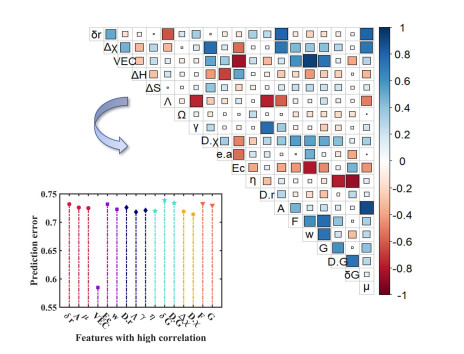
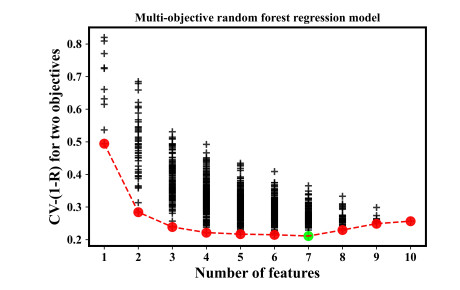
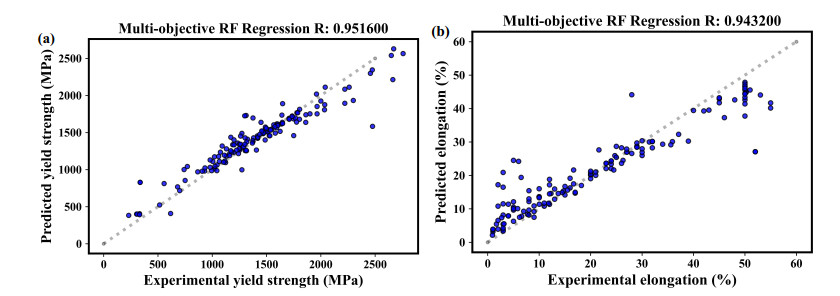
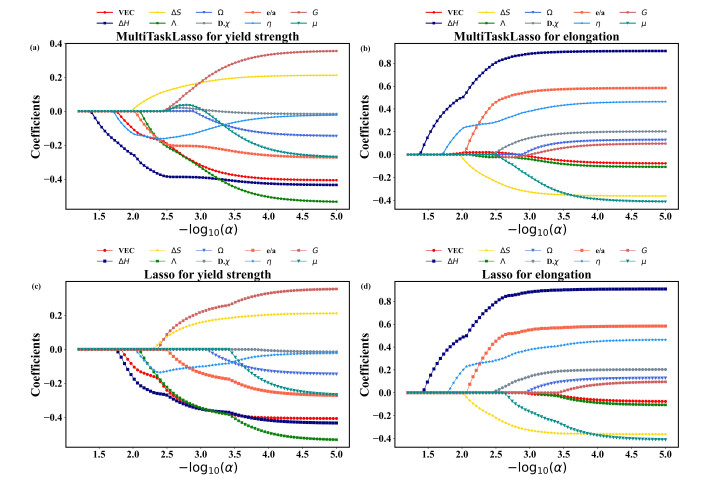
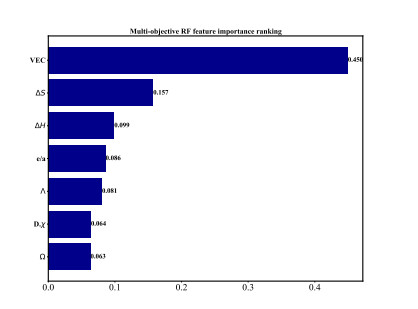
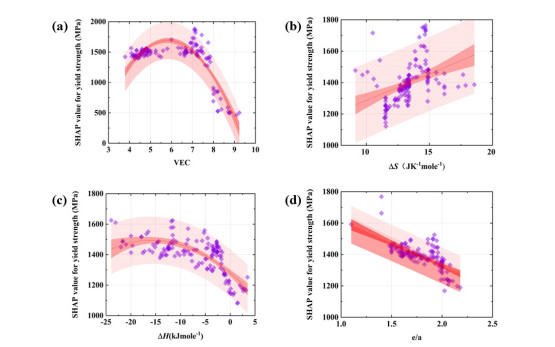
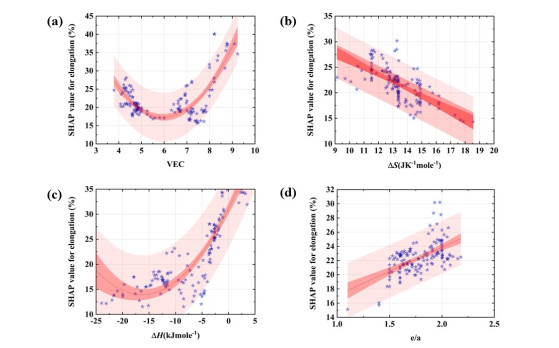
The strength-ductility trade-off has limited the potential of many structural materials, especially in high-entropy alloys (HEAs). Here, we study the yield strength and ductility of HEAs with an experimental dataset consisting of 144 samples using multi-objective machine learning. First, we construct a feature pool including 20 features from the phase and mechanical properties of these HEAs, and utilize feature engineering to screen and rank the features. Then, the multi-objective random forest and MultiTaskLasso algorithms are chosen to train and predict the yield strength and ductility. The differences between multi-task Lasso and Lasso are compared. Moreover, through the interpretable feature analysis method—shapley additive explanation, the influence of the feature value on the mechanical properties of HEAs is analyzed.
Citation: Guanying Wei, Jesper Byggmästar, Junzhi Cui, Jingli Ren. Evading the strength-ductility trade-off dilemma in high-entropy alloys by multi-objective machine learning[J]. Big Data and Information Analytics, 2025, 9: 92-105. doi: 10.3934/bdia.2025005
The strength-ductility trade-off has limited the potential of many structural materials, especially in high-entropy alloys (HEAs). Here, we study the yield strength and ductility of HEAs with an experimental dataset consisting of 144 samples using multi-objective machine learning. First, we construct a feature pool including 20 features from the phase and mechanical properties of these HEAs, and utilize feature engineering to screen and rank the features. Then, the multi-objective random forest and MultiTaskLasso algorithms are chosen to train and predict the yield strength and ductility. The differences between multi-task Lasso and Lasso are compared. Moreover, through the interpretable feature analysis method—shapley additive explanation, the influence of the feature value on the mechanical properties of HEAs is analyzed.

| [1] |
Ritchie RO, (2011) The conflicts between strength and toughness. Nat Mater 10: 817–822. https://doi.org/10.1038/nmat3115 doi: 10.1038/nmat3115

|
| [2] |
Wei Y, Li Y, Zhu L, Liu Y, Lei X, et al. (2014) Evading the strength-ductility trade-off dilemma in steel through gradient hierarchical nanotwins. Nat Commun 5: 3580. https://doi.org/10.1038/ncomms4580 doi: 10.1038/ncomms4580
|
| [3] | Poletti MG, Fiore G, Gili F, Mangherini D, Battezzati L, Development of a new high entropy alloy for wear resistance: FeCoCrNiW$_{0.3}$ and FeCoCrNiW$_{0.3}$ + 5at.% of C. Mater Des 115: 247–254. https://doi.org/10.1016/j.matdes.2016.11.027 |
| [4] | Ding J, Inoue A, Han Y, Kong FL, Zhu SL, Wang Z, et al. High entropy effect on structure and properties of (Fe, Co, Ni, Cr)-B amorphous alloys. J Alloys Compd 696: 345–352. https://doi.org/10.1016/j.jallcom.2016.11.223 |
| [5] |
Wu YD, Cai YH, Wang T, Si JJ, Zhu J, Wang YD, et al. (2014) A refractory Hf$_25$Nb$_25$Ti$_25$Zr$_25$ high-entropy alloy with excellent structural stability and tensile properties. Mater Lett 9: 130–277. https://doi.org/10.1016/j.matlet.2014.05.134 doi: 10.1016/j.matlet.2014.05.134
|
| [6] |
Guo X, Xie X, Ren J, Laktionova M, Tabachnikova E, Yu L, et al. (2017) Plastic dynamics of the Al$_{0.5}$CoCrCuFeNi high entropy alloy at cryogenic temperatures: Jerky flow, stair-like fluctuation, scaling behavior, and non-chaotic state. Appl Phys Lett 111: 251905. https://doi.org/10.1063/1.5004241 doi: 10.1063/1.5004241
|
| [7] |
Sharma V, Wang C, Lorenzini R, Ma R, Zhu Q, Sinkovits D, et al. (2014) Rational design of all organic polymer dielectrics. Nat Commun 5: 4845. https://doi.org/10.1038/ncomms5845 doi: 10.1038/ncomms5845
|
| [8] |
Yuan R, Xue D, Zhou Y, Ding X, Sun J, Lookman T, (2019) The search for BaTiO$_{3}$-based piezoelectrics with large piezoelectric coefficient using machine learning. IEEE Trans Ultrason Ferroelectr Freq Control 66: 394–401. https://doi.org/10.1109/TUFFC.2018.2888800 doi: 10.1109/TUFFC.2018.2888800
|
| [9] |
Ding QQ, Zhang Y, Chen X, Fu XQ, Chen DK, Chen SJ, et al. (2019) Tuning element distribution, structure and properties by composition in high-entropy alloys. Nature 574: 223–227. https://doi.org/10.1038/s41586-019-1617-1 doi: 10.1038/s41586-019-1617-1
|
| [10] |
Xie TB, Xiong ZP, Liu Z, Deng GY, Cheng XW, (2021) Excellent combination of compressive strength and ductility of (CoCrFeNi)$_{x}$(Co$_{0.26}$Cr$_{0.07}$Fe$_{0.16}$Ni$_{0.31}$Hf$_{0.4)}$ high-entropy alloys. Mater Des 202: 109569. https://doi.org/10.1016/j.matdes.2021.109569 doi: 10.1016/j.matdes.2021.109569
|
| [11] |
Pan QS, Zhang LX, Feng R, Lu QH, An K, Chuang AC, et al. (2021) Gradient cell-structured high-entropy alloy with exceptional strength and ductility. Science 374: 984–989. https://doi.org/10.1126/science.abj8114 doi: 10.1126/science.abj8114
|
| [12] |
Zhou ZQ, Zhou YJ, He QF, Ding ZY, Li FC, Yang Y, (2019) Machine learning guided appraisal and exploration of phase design for high entropy alloys. npj Comput Mater 5: 128. https://doi.org/10.1038/s41524-019-0265-1 doi: 10.1038/s41524-019-0265-1
|
| [13] |
Wei GY, Cui JZ, Wang W, Guo XX, Ren JL, Wang WH, (2022) Short-to-medium range structure and glass-forming ability in metallic glasses. Phys Rev Mater 6: 055601. https://doi.org/10.1103/PhysRevMaterials.6.055601 doi: 10.1103/PhysRevMaterials.6.055601
|
| [14] |
Lookman T, Balachandran P, Xue DZ, Yuan RH, (2019) Active learning in materials science with emphasis on adaptive sampling using uncertainties for targeted design. npj Comput Mater 5: 21. https://doi.org/10.1038/s41524-019-0153-8 doi: 10.1038/s41524-019-0153-8
|
| [15] |
Chang HN, Tao YW, Liaw PK, Ren JL, (2022) Phase prediction and effect of intrinsic residual strain on phase stability in high-entropy alloys with machine learning. J Alloys Compd 921: 166149. https://doi.org/10.1016/j.jallcom.2022.166149 doi: 10.1016/j.jallcom.2022.166149
|
| [16] |
Xiong J, Shi SQ, Zhang TY, (2021) Machine learning of phases and mechanical properties in complex concentrated alloys. J Mater Sci Technol 87: 133–142. https://doi.org/10.1016/j.jmst.2021.01.054 doi: 10.1016/j.jmst.2021.01.054
|
| [17] |
Wen C, Zhang Y, Wang CX, Xue DZ, Bai Y, Antonov S, et al. (2019) Machine learning assisted design of high entropy alloys with desired property. Acta Mater 170: 109–117. https://doi.org/10.1016/j.actamat.2019.03.010 doi: 10.1016/j.actamat.2019.03.010
|
| [18] |
Wu LL, Wei GY, Wang G, Wang HY, Ren JL, (2022) Creating win-wins from strength-ductility trade-off in multi-principal element alloys by machine learning. Mater Today Commun 32: 104010. https://doi.org/10.1016/j.mtcomm.2022.104010 doi: 10.1016/j.mtcomm.2022.104010
|
| [19] |
Gorsse S, Nguyen M, Senkov O, Miracle D, (2018) Database on the mechanical properties of high entropy alloys and complex concentrated alloys. Data Brief 21: 63–69. https://doi.org/10.1016/j.dib.2018.11.111 doi: 10.1016/j.dib.2018.11.111
|
| [20] |
Lu S, Zhou Q, Ouyang Y, Guo Y, Li Q, Wang J, (2018) Accelerated discovery of stable lead-free hybrid organic-inorganic perovskites via machine learning. Nat Commun 9: 3405. https://doi.org/10.1038/s41467-018-05761-w doi: 10.1038/s41467-018-05761-w
|
| [21] |
Guo S, (2015) Phase selection rules for cast high entropy alloys: An overview. Mater Sci Technol 31: 1223–1230. https://doi.org/10.1179/1743284715Y.0000000018 doi: 10.1179/1743284715Y.0000000018
|
| [22] |
Toda-Caraballo I, Rivera-Díaz-del-Castillo PEJ, (2015) Modelling solid solution hardening in high entropy alloys. Acta Mater 85: 14–23. https://doi.org/10.1016/j.actamat.2014.11.014 doi: 10.1016/j.actamat.2014.11.014
|
| [23] |
Varvenne C, Luque A, Curtin WA, (2016) Theory of strengthening in fcc high entropy alloys. Acta Mater 118: 164–176. https://doi.org/10.1016/j.actamat.2016.07.040 doi: 10.1016/j.actamat.2016.07.040
|
| [24] | Hu GX, Cai X, Rong YH, (2010) Material Science Foundation, 3 Eds., Shanghai Jiao Tong University Press. |
| [25] |
Wang WY, Shang SL, Wang Y, Han FB, Darling KA, Wu YD, et al. (2017) Atomic and electronic basis for the serrations of refractory high-entropy alloys. npj Comput Mater 3: 2–10. https://doi.org/10.1038/s41524-017-0024-0 doi: 10.1038/s41524-017-0024-0
|
| [26] |
Wang Z, Fang Q, Li J, Liu Y, (2018) Effect of lattice distortion on solid solution strengthening of BCC high-entropy alloys. J Mater Sci Technol 34: 349–354. https://doi.org/10.1016/j.jmst.2017.07.013 doi: 10.1016/j.jmst.2017.07.013
|
| [27] | Kluyver T, Ragan-Kelley B, Perez F, Granger B, Bussonnier M, Frederic J, et al. (2016) Jupyter notebooks—a publishing format for reproducible computational workflows, In: Positioning and Power in Academic Publishing: Players, Agents and Agendas, IOS Press, 87–90. https://doi.org/10.3233/978-1-61499-649-1-87 |
| [28] | Zhou Y, Jin R, Hoi SC, (2010) Exclusive lasso for multi-task feature selection, In: Proceedings of the Thirteenth International Conference on Artificial Intelligence and Statistics, 9: 988–995. |
| [29] |
Breiman L, (2001) Random forest. Mach Learn 45: 5–32. https://doi.org/10.1023/A:1010933404324 doi: 10.1023/A:1010933404324
|
| [30] | Swami A, Jain R, (2013) Scikit-learn: Machine learning in Python. J Mach Learn Res 12: 2825–2830. |
| [31] |
Geman S, Bienenstock E, Doursat R, (1992) Neural networks and the bias/variance dilemma. Neural Comput 4: 1–58. https://doi.org/10.1162/neco.1992.4.1.1 doi: 10.1162/neco.1992.4.1.1
|
| [32] |
Wei QH, Xiong J, Sun S, Zhang TY, (2021) Multi-objective machine learning of four mechanical properties of steels. Sci Sin. Tech 51: 722–736. https://doi.org/10.1360/SST-2020-0475 doi: 10.1360/SST-2020-0475
|
| [33] |
Chen R, Qin G, Zheng H, Wang L, Su Y, Chiu Y, et al. (2018) Composition design of high entropy alloys using the valence electron concentration to balance strength and ductility. Acta Mater 144: 129–137. https://doi.org/10.1016/j.actamat.2017.10.058 doi: 10.1016/j.actamat.2017.10.058
|
| [34] | Lundberg SM, Lee SI, (2017) A unified approach to interpreting model predictions. Adv Neural Inf Process Syst 30: 4765–4774. |
Figures(7) / Tables(3)

Guanying Wei, Jesper Byggmästar, Junzhi Cui, Jingli Ren. Evading the strength-ductility trade-off dilemma in high-entropy alloys by multi-objective machine learning[J]. Big Data and Information Analytics, 2025, 9: 92-105. doi: 10.3934/bdia.2025005






 DownLoad: