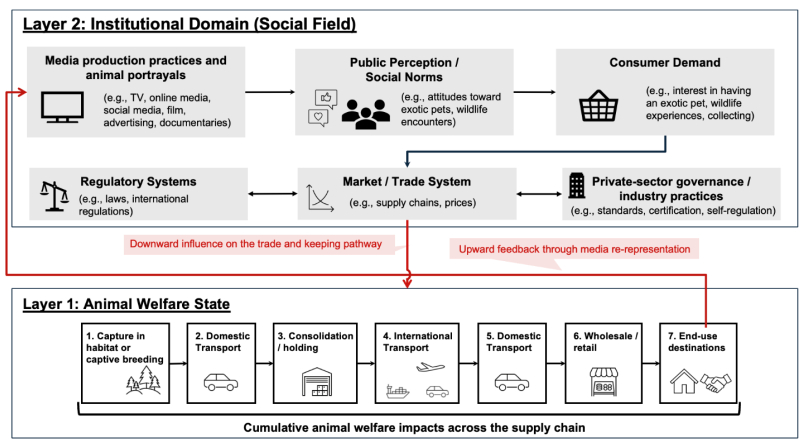
Animal welfare must be examined through two interconnected layers: (1) the scientific layer, which evaluates an individual's welfare state; and (2) the social implementation layer, in which scientific understanding is integrated into institutions, norms, and practical applications. This study focuses on wildlife trade and media portrayals in Japan as a domain in which these two layers are simultaneously compromised. Specifically, we compared (1) the explicit inclusion of animal welfare in broadcasting standards and production guidelines; (2) illustrative wildlife portrayals in Japanese television programs, examined for the presence of welfare-relevant contextual information; and (3) welfare-oriented information practices in two selected zoo cases. Our findings indicate that, within the Japanese broadcasting frameworks reviewed, explicit mechanisms for integrating production-stage animal welfare and demand-related considerations into media production remain limited. The selected zoo cases illustrate how contextual information, relevant professional expertise, and attention to visitor behavior can be incorporated into public communication. These comparative results suggest that animal welfare can be embedded in media production in ways compatible with freedom of expression when welfare-relevant considerations are integrated into production and editorial decisions. Potential implementation conditions include welfare-informed planning, relevant expert involvement, and contextual information that reduces misinterpretation and demand-related risks.
Citation: Kanako Ake, Misako Namiki, Ayako Nagakura, Rio Sugiyama. Wildlife portrayals, media production structures, and animal welfare: A report on institutional gaps and comparative practices in Japan[J]. AIMS Animal Science, 2026, 2(2): 84-104. doi: 10.3934/aas.2026007
Animal welfare must be examined through two interconnected layers: (1) the scientific layer, which evaluates an individual's welfare state; and (2) the social implementation layer, in which scientific understanding is integrated into institutions, norms, and practical applications. This study focuses on wildlife trade and media portrayals in Japan as a domain in which these two layers are simultaneously compromised. Specifically, we compared (1) the explicit inclusion of animal welfare in broadcasting standards and production guidelines; (2) illustrative wildlife portrayals in Japanese television programs, examined for the presence of welfare-relevant contextual information; and (3) welfare-oriented information practices in two selected zoo cases. Our findings indicate that, within the Japanese broadcasting frameworks reviewed, explicit mechanisms for integrating production-stage animal welfare and demand-related considerations into media production remain limited. The selected zoo cases illustrate how contextual information, relevant professional expertise, and attention to visitor behavior can be incorporated into public communication. These comparative results suggest that animal welfare can be embedded in media production in ways compatible with freedom of expression when welfare-relevant considerations are integrated into production and editorial decisions. Potential implementation conditions include welfare-informed planning, relevant expert involvement, and contextual information that reduces misinterpretation and demand-related risks.

| [1] |
Birch J (2022) Should animal welfare be defined in terms of consciousness? Philos Sci 89: 1114–1123. https://doi.org/10.1017/psa.2022.59 doi: 10.1017/psa.2022.59

|
| [2] |
Vigors B, Sandøe P, Lawrence AB (2021) Positive welfare in science and society: Differences, similarities and synergies. Front Anim Sci 2: 738193. https://doi.org/10.3389/fanim.2021.738193 doi: 10.3389/fanim.2021.738193
|
| [3] | World Organisation for Animal Health (2018) Terrestrial animal health code: Section 7. Anim Welf. Available from: https://www.woah.org/fileadmin/Home/eng/Health_standards/tahc/2018/en_titre_1.7.htm |
| [4] |
Mellor DJ (2017) Operational details of the Five Domains Model and its key applications to the assessment and management of animal welfare. Animals 7: 60. https://doi.org/10.3390/ani7080060 doi: 10.3390/ani7080060
|
| [5] |
Broom DM (1983) Stereotypies as animal welfare indicators. In: Smidt D, Indicators relevant to farm animal welfare, Current Topics in Veterinary Medicine and Animal Science, vol 23, Netherlands: Springer, 81–87. https://doi.org/10.1007/978-94-009-6738-0_11 doi: 10.1007/978-94-009-6738-0_11
|
| [6] | Duncan IJ (1993) The science of animal well-being. Anim Welf Inf Cent News 4: 4–7. Available from: https://www.researchgate.net//publication/266521630_The_Science_of_Animal_Well-being |
| [7] |
Dawkins MS (2021) Does smart farming improve or damage animal welfare? Technology and what animals want. Front Anim Sci 2: 736536. https://doi.org/10.3389/fanim.2021.736536 doi: 10.3389/fanim.2021.736536
|
| [8] |
Weary DM, Robbins JA (2019) Understanding the multiple conceptions of animal welfare. Anim Welf 28: 33–40. https://doi.org/10.7120/09627286.28.1.033 doi: 10.7120/09627286.28.1.033
|
| [9] |
van der Staay FJ, Goerlich VC, Meijboom FLB, et al. (2025) Animal welfare definitions, frameworks, and assessment tools: Advancing the measurement and laying the foundation for improved animal welfare through a three-step approach. Anim Welf 34: e30. https://doi.org/10.1017/awf.2025.23 doi: 10.1017/awf.2025.23
|
| [10] |
Thomas-Walters L, McNulty C, Veríssimo D (2020) A scoping review into the impact of animal imagery on pro-environmental outcomes. Ambio 49: 1135–1145. https://doi.org/10.1007/s13280-019-01271-1 doi: 10.1007/s13280-019-01271-1
|
| [11] |
Nekaris KAI, Campbell N, Coggins TG, et al. (2013) Tickled to death: Analysing public perceptions of "cute" videos of threatened species (slow lorises—Nycticebus spp.) on Web 2.0 sites. PLOS One 8: e69215. https://doi.org/10.1371/journal.pone.0069215 doi: 10.1371/journal.pone.0069215
|
| [12] |
Moloney GK, Tuke J, Dal Grande E, et al. (2021) Is YouTube promoting the exotic pet trade? Analysis of the global public perception of popular YouTube videos featuring threatened exotic animals. PLOS One 16: e0235451. https://doi.org/10.1371/journal.pone.0235451 doi: 10.1371/journal.pone.0235451
|
| [13] |
Bergman JN, Buxton RT, Lin HY, et al. (2022) Evaluating the benefits and risks of social media for wildlife conservation. Facets 7: 360–397. https://doi.org/10.1139/facets-2021-0112 doi: 10.1139/facets-2021-0112
|
| [14] |
Baker SE, Cain R, Van Kesteren F, et al. (2013) Rough trade: animal welfare in the global wildlife trade. BioScience 63: 928–938. https://doi.org/10.1525/bio.2013.63.12.6 doi: 10.1525/bio.2013.63.12.6
|
| [15] |
Liew JH, Kho ZY, Lim RBH, et al. (2021) International socioeconomic inequality drives trade patterns in the global wildlife market. Sci Adv 7: eabf7679. https://doi.org/10.1126/sciadv.abf7679 doi: 10.1126/sciadv.abf7679
|
| [16] | CITES Secretariat (2022) World wildlife trade report 2022 (CoP19 Inf. 24). Geneva: CITES Secretariat. Available from: https://cites.org/sites/default/files/documents/E-CoP19-Inf-24.pdf |
| [17] |
Lambert H, Elwin A, Assou D, et al. (2025) Chains of commerce: A comprehensive review of animal welfare impacts in the international wildlife trade. Animals (Basel) 15: 971. https://doi.org/10.3390/ani15070971 doi: 10.3390/ani15070971
|
| [18] | World Organisation for Animal Health (2021) A rapid review of evidence on managing the risk of disease emergence in the wildlife trade. Paris: World Organisation for Animal Health. Available from: https://www.woah.org/app/uploads/2022/08/a-oie-review-wildlife-trade-march2021.pdf |
| [19] | Japan (1973) Act on Welfare and Management of Animals (Act No. 105 of 1973). Available from: https://www.japaneselawtranslation.go.jp/ja/laws/view/3798 |
| [20] | Ministry of the Environment, Japan (2021) Ordinance Establishing Standards for the Methods of Management of Animals Handled by Type 1 and Type 2 Animal Handling Businesses. [in Japanese]. Available from: https://laws.e-gov.go.jp/law/503M60001000007 |
| [21] | Ministry of the Environment, Japan (2002) Standards Relating to the Keeping and Care of Household Animals [in Japanese]. Available from: https://www.env.go.jp/nature/dobutsu/aigo/2_data/laws/nt_r02_21_1.pdf |
| [22] | Ministry of the Environment, Japan (2004) Standards Relating to the Keeping and Care of Exhibition Animals [in Japanese]. Available from: https://www.env.go.jp/nature/dobutsu/aigo/2_data/laws/nt_r02_21_2.pdf |
| [23] | Ministry of the Environment, Japan (2026) Public Comments on the Draft Amendment to the Ordinance Establishing Standards for the Methods of Management of Animals Handled by Type 1 and Type 2 Animal Handling Businesses [in Japanese]. Available from: https://www.env.go.jp/press/press_02741.html |
| [24] |
Sigaud M, Kitade T, Sarabian C (2023) Exotic animal cafes in Japan: A new fashion with potential implications for biodiversity, global health, and animal welfare. Conserv Sci Pract 5: e12867. https://doi.org/10.1111/csp2.12867 doi: 10.1111/csp2.12867
|
| [25] |
Tanaka A, Erzinçioğlu TS, Ward SJ, et al. (2025) Unveiling welfare concerns in Japanese exotic animal cafes. J Vet Med Sci 87: 1499–1508. https://doi.org/10.1292/jvms.24-0257 doi: 10.1292/jvms.24-0257
|
| [26] | Wild Welfare & JCAW (2025) Statement on the necessity of regulating the keeping of primates and the ethical concerns regarding exotic animal cafes in Japan [in Japanese]. Available from: https://www.dokyoren.com/250426/ |
| [27] | Musing L, Suzuki K, Nekaris KAI (2015) Crossing international borders: The trade of slow lorises Nycticebus spp. as pets in Japan. Asian Primates J 5: 12–23. Available from: https://static1.1.sqspcdn.com/static/f/1200343/27164384/1469417361063/2016Jul25_ARTICLE_ALLV_51.pdf?token=GQANYznah1fS65pY09fOgh%2B2PYs%3D |
| [28] |
Sand PH (2018) Japan's ivory trade in the face of the endangered species convention. J Int Wildlife Law Policy 21: 221–238. https://doi.org/10.1080/13880292.2018.1554872 doi: 10.1080/13880292.2018.1554872
|
| [29] | Sato S (2016) Applied animal behaviour science in Japan and the culture of "aigo". In: Brown JA, Seddon Y, Appleby M, Animals and Us: 50 Years and More of Applied Ethology, Wageningen: Wageningen Academic Publishers, 227–240. https://doi.org/10.3920/978-90-8686-828-5_11 |
| [30] | Rosin P (1976) Federal regulation of zoos. Environ Aff 5: 381. Available from: https://scispace.com/pdf/federal-regulation-of-zoos-2ss1gjos7f.pdf |
| [31] |
Cohn JP (1988) Captive breeding for conservation. BioScience 38: 312-316. https://doi.org/10.2307/1310732 doi: 10.2307/1310732
|
| [32] | World Zoo Organization (1993) The world zoo conservation strategy: The role of the zoos and aquaria of the world in global conservation. Available from: https://portals.iucn.org/library/node/6691 |
| [33] | World Association of Zoos and Aquariums (2003) WAZA code of ethics and animal welfare. Available from: https://pdf4pro.com/view/waza-code-of-ethics-and-animal-welfare-242bb3.html |
| [34] | World Association of Zoos and Aquariums (2005) Building a Future for Wildlife: The World Zoo and Aquarium Conservation Strategy. Available from: https://www.waza.org/wp-content/uploads/2019/03/wzacs-en.pdf |
| [35] | World Association of Zoos and Aquariums (2015) Committing to conservation: The world zoo and aquarium conservation strategy. Available from: https://www.waza.org/wp-content/uploads/2019/03/WAZA-Conservation-Strategy-2015_Portrait.pdf |
| [36] | World Association of Zoos and Aquariums (2015) Caring for wildlife: The world zoo and aquarium animal welfare strategy. Available from: https://www.waza.org/wp-content/uploads/2019/03/WAZA-Animal-Welfare-Strategy-2015_Landscape.pdf |
| [37] | World Association of Zoos and Aquariums (2023) WAZA assessment tool—For confirmation of the Associations' animal welfare evaluation processes. Available from: https://wazaglobal.sharepoint.com/:w:/s/WAZAExecutiveOffice/EVEM7wujhBhAiukWCbjFmTYBeVmgcfKlVqMSwGEO0cMHvA |
| [38] |
Rose PE, Lewton J (2025) Key concepts for enhancing zoo animal welfare: Coping, comfort, choice, control, challenge, and compassion. J Appl Anim Welf Sci 28: 497–514. https://doi.org/10.1080/10888705.2024.2440891 doi: 10.1080/10888705.2024.2440891
|
| [39] | World Association of Zoos and Aquariums (2023) WAZA code of ethics. Available from: https://www.waza.org/wp-content/uploads/2025/02/WAZA-Code-of-Ethics-Concerns-Process-2025.pdf |
| [40] | World Association of Zoos and Aquariums (2025) Advancing animal welfare: The world zoo and aquarium animal welfare strategy. Available from: https://www.waza.org/wp-content/uploads/2025/10/WAZA-AWS_WEB-300DPI.pdf |
| [41] |
Cronin KA (2021) Working to supply the demand: Recent advances in the science of zoo animal welfare. J Zool Bot Gard, 2: 349–350. https://doi.org/10.3390/jzbg2030024 doi: 10.3390/jzbg2030024
|
| [42] |
Yamanashi Y, Ikkatai Y, Honjo M, et al. (2025) A comparison of attitudes towards animal welfare between British and Japanese zoo visitors: Where and when do cultural differences diverge? PLOS One 20: e0320241. https://doi.org/10.1371/journal.pone.0320241 doi: 10.1371/journal.pone.0320241
|
| [43] | Japanese Association of Zoos and Aquariums (2021) Animal welfare guideline [in Japanese]. Available from: https://www.jaza.jp/assets/document/about-jaza/document/2021/doubutsu-hukushi-kitei.pdf |
| [44] | World Association of Zoos and Aquariums (2020) Guidelines for animal–visitor interactions. Available from: https://www.waza.org/wp-content/uploads/2020/05/ENG_WAZA-Guidelines-for-AVI_FINAL_-April-2020.pdf |
| [45] | Patton MQ (2015) Qualitative research & evaluation methods: Integrating theory and practice. 4th ed. Thousand Oaks, CA: Sage Publications. Available from: https://study.sagepub.com/patton4e |
| [46] | Japan Commercial Broadcasters Association (2023) Broadcasting standards. Tokyo: Japan Commercial Broadcasters Association [in Japanese]. Available from: https://j-ba.or.jp/category/broadcasting/jba101032 |
| [47] | Nippon Hoso Kyokai (2025) NHK broadcasting guidelines. Nippon Hoso Kyokai [in Japanese]. Available from: https://www.nhk.or.jp/info/pr/bc-guideline/assets/pdf/guideline2025.pdf |
| [48] | British Broadcasting Corporation (2025) BBC editorial guidelines 2025. London: British Broadcasting Corporation. Available from: https://www.bbc.co.uk/editorialguidelines/documents/bbc-editorial-guidelines-2025.pdf |
| [49] | British Broadcasting Corporation (2025) Guidance: Recording the natural world. Available from: https://www.bbc.co.uk/editorialguidelines/guidance/natural-world |
| [50] | Netflix (2024) Production health & safety guidance: Working with animals. Los Gatos, CA: Netflix. Available from: https://sites.google.com/netflix.com/netflixemeaprodhealthandsafety/hazard-guidance/animals?authuser=0 |
| [51] | National Geographic Society (2023) Sustainability guidelines. Washington, DC: National Geographic Society. Available from: https://www.nationalgeographic.org/society/sustainability-guidelines/ |
| [52] | Ofcom (2021) Freedom of information request: Right to know request regarding animal welfare complaints. Available from: https://www.ofcom.org.uk/siteassets/resources/documents/about-ofcom/foi/2021/september/animal-welfare-complaints-2020-2021.pdf?v=326920 |
| [53] |
Nunes VF, Lopes PFM, Ferreira RG (2023) #capuchinmonkeys on social media: A threat for species conservation. Anthrozoos 36: 665–683. https://doi.org/10.1080/08927936.2023.2210440 doi: 10.1080/08927936.2023.2210440
|
| [54] | Aldrich BC, Feddema K, Fourage A, et al. (2023) Primate portrayals: Narratives and perceptions of primates in entertainment. In primates in anthropogenic landscapes: Exploring primate behavioural flexibility across human contexts, Springer Cham: Springer International Publishing. 307–326. Available from: https://link.springer.com/chapter/10.1007/978-3-031-11736-7_17 |
| [55] | Kitade T, Naruse Y (2018) Otter alert: A rapid assessment of illegal trade and booming demand in Japan. Traffic Japan office. Available from: https://www.traffic.org/site/assets/files/11196/otter-alert-vfinal-web-100.pdf |
| [56] |
Harrington LA, Macdonald DW, D'Cruze N (2019) Popularity of pet otters on YouTube: Evidence of an emerging trade threat. Nat Conserv 36: 17–45. https://doi.org/10.3897/natureconservation.36.33842 doi: 10.3897/natureconservation.36.33842
|
| [57] | ROOTs (2025) Guidelines for Animal-Related Media Content. Tokyo: ROOTs. Available from: https://www.roots-wildlife.org/ |
| [58] | Broadcasting Ethics & Program Improvement Organization (2020) Opinion on TBS TV "Crazy Journey – Reptile Hunter" (Decision No. 37) Tokyo; BPO [in Japanese]. Available from: https://www.bpo.gr.jp/?p=10462 |
| [59] | TBS Innovation Land (2024 March 7). Behind the Scenes of BS-TBS programme production. Tokyo: TBS Innovation Land [in Japanese]. Available from: https://innovation.tbs.co.jp/neo_interview/674/ |
| [60] | Baum G (2013) Animals were harmed. The Hollywood Reporter, November 25, 2013. Available from: https://www.hollywoodreporter.com/news/general-news/animals-were-harmed-hollywood-reporter-investigation-on-set-injury-death-cover-ups-659556/ |
Figures(4) / Tables(1)
Kanako Ake, Misako Namiki, Ayako Nagakura, Rio Sugiyama. Wildlife portrayals, media production structures, and animal welfare: A report on institutional gaps and comparative practices in Japan[J]. AIMS Animal Science, 2026, 2(2): 84-104. doi: 10.3934/aas.2026007





 DownLoad: